Marc Guldimann

514 posts

Marc Guldimann banner
Marc Guldimann

Marc Guldimann

@guldi

Founder/CEO at @adelaidemetrics - helping brands invest in media more efficiently using attention data. @spongecell and @enliken previously


Los Angeles Katılım Şubat 2007
842 Takip Edilen614 Takipçiler
Marc Guldimann
Marc Guldimann@guldi·
@joe_zappa @aripap @bokelley Lol.. normally people who throw around pejorative "derangement syndrome"s don't chicken out on debates. Keep it up, keyboard warrior! 👊
English
0
0
2
45
Ari Paparo
Ari Paparo@aripap·
BOK @bokelley is talking agentic ads at #prebidsummit2025 but I think the most interesting thing he said was that the future of SSPs is enabling publishers to sell outcomes, even if in non-auction contexts.
English
5
1
31
2.3K
Gareth Hates AdTech
Gareth Hates AdTech@HatesAdtech·
Has anyone ever run an anti advertising campaign to see if brand safety actually matters? Use audience targeting, buy exclusively horrible shit, send surveys. What if all this money being spent on brand safety is a waste for some brands? Do I need to start an agency that exclusively does this?
English
7
0
26
2.1K
Cable
Cable@MrCable0x·
I’ve always loved marketing and consumer insight — but this brilliant clip from @rorysutherland captures exactly why I walked away from it professionally… and into the world of investing/crypto full-time. youtube.com/clip/UgkxvIFsr…
English
3
0
5
302
Rob Leathern
Rob Leathern@robleathern·
More simply put: ads on the open web have failed because there is no management of ad load (each publisher chooses ad placements; so it's a tragedy of the commons) or value. Ad load on Meta and Google O&O properties otoh, are very well understood, controlled and revenues managed. An understanding of user time/attention and advertiser value leads to massive $$$. The web is too free and open, and hence its monetization is broken cc @eric_seufert
Stratechery@stratechery

2025.21: The Upheaval Coming for the Internet Economy The best Stratechery content from the week of May 19, 2025, including AI and the future of the web, slam dunks and moonshots at Google, and OpenAI entering the hardware business. stratechery.com/2025/the-uphea…


English
9
1
37
7.2K
Marc Guldimann
Marc Guldimann@guldi·
@101Programmatic It's coming soon, hopefully by the end of the quarter - DM me if you want access to the beta.
English
1
0
8
162
Vlad Chubakov (@Programmatic 101)
Vlad Chubakov (@Programmatic 101)@101Programmatic·
DV360 + Adelaide AU for attention bidding sounds great (can't find it in UI yet). More than tech availability, education is crucial: why viewability isn't enough & how attention optimization drives real advertiser outcomes. Shifting industry practice is the bigger challenge 👇
English
3
0
20
2.9K
Marc Guldimann
Marc Guldimann@guldi·
@Scrilla100 @elevin11 @mikeosullivan 4/ compliance with the standard is easily verifiable. Otherwise markets tend to settle on “ratings” published by a trusted third party as currencies after using them for arbitrage.
English
0
0
3
28
Marc Guldimann
Marc Guldimann@guldi·
@Scrilla100 @elevin11 @mikeosullivan 3/ who typically don’t have an interest in arb except when currencies are fucked, just take the new metric to sellers and ask for their guarantees to be made this way. And you have a new market-driven currency. Fiat metrics are typically a bad idea unless
English
1
0
1
31
Marc Guldimann
Marc Guldimann@guldi·
@elevin11 @mikeosullivan @Scrilla100 Best way to create a shared understanding of quality is to prove lift to buyers and help them arb.. then as the alpha gets squeezed help the sell-side trade w/ it. Limited incentive for sell-side to get involved until buy-side is on board.
English
1
0
1
40
Marc Guldimann
Marc Guldimann@guldi·
@elevin11 @hypersoren @joe_zappa @reidjjackson "just buy outcomes" is such a weird take.. ignores incentives, attribution gaming, tension around funnel control, etc.. paying a vendor to eat conversion risk is long term bad. Smart brands are shifting spend from lower funnel to brand.. the outcome for that? quality reach
English
0
0
1
40
Reid Jackson
Reid Jackson@reidjjackson·
How long until The Trade Desk rolls out their own Performance Max+ offering?
English
4
0
23
2K
Marc Guldimann
Marc Guldimann@guldi·
@airgups23 What’s the metric/result you are paying on? Reducing reach on premium pubs? There is no measurable benefit to brand safety..
English
0
0
2
78
Shiv 💡
Shiv 💡@airgups23·
If I'm a marketer, I demand my brand safety vendor charge me for results, not for tech. Otherwise, incentives are way too out of whack.
English
9
2
25
2.6K
Michael Bishop
Michael Bishop@BishPlsOk·
@AdtechGod Topic idea: "Will the one true definition of 'attention' please stand up?" x.com/BishPlsOk/stat…
Michael Bishop@BishPlsOk

“Attention” (adtech usage) has meant something different every few years. Here’s my prediction for the next iteration: The platonic ideal of an ad *minimizes the magnitude of drift* between a user’s pre-existing mental state or context, and the requisite context to consider an ad placement valuable content that a user is pleased by, rather than aggrieved by. In other words: the role of a “good ad” is to minimize the friction of shifting attention between ad and content. Attention, here, is not a performance metric but a pointer toward the traditionally-ignored holistic state of a user’s navigation intent and desired interaction with a platform. To expand on the idea — a user’s interaction with a platform exists within a certain mental context; the simpler it is to shift one’s attention from their pre-existing context, to the context presented by a given ad? The more useful, and effective, that ad placement is. Attention is the subject whose disruption should be minimized, and in an ideal world, the financial model behind an ad seamlessly enforces this as a positive-sum interaction. Can think of the concept as a measure of “necessary activation energy” to switch from whatever the user was considering / focused on previously, to a new (ideally adjacent / compatible) context presented by the ad. Lower activation energy is good! The ideal activation energy for a context switch is not NECESSARILY zero, if the underlying platform is already solving an immediately-apparent problem; in that case the ideal ad context is compatible with, but not duplicative of, the content presented by the platform itself. Impact on attention should approach zero in the limit. This form of “attention” is fundamentally not measurable except by imprecise proxy, as it’s a subjective and personal experience…but I think it makes for a useful north-star conceptualization of “the underlying philosophy that should guide algorithmic targeting results in a manner benefiting users, and guide the metrics we DO measure and optimize against.”

English
2
1
6
1.1K
AdTechGod ®️🍪
AdTechGod ®️🍪@AdtechGod·
I’d love to see more debates in AdTech, similar to political debates. Picture two people on stage, facing off while being grilled with questions from a panel of 2-3 people, who gather input from the audience. The winner gets a pack of Oreos, but more importantly, we all walk away either hearing the truth or seeing someone get called out for dodging it.
English
20
2
42
5.1K
Marc Guldimann
Marc Guldimann@guldi·
@AdtechGod Missed opp for a great headline “Business Insider uncovers digital media scam costing advertisers over $1B per year”
English
0
0
1
92
AdTechGod ®️🍪
AdTechGod ®️🍪@AdtechGod·
ARE VERIFICATION COMPANIES BEING CHALLANGED? 1. DoubleVerify and IAS faced industry challenges and shifting perceptions in 2024. 2. Verification firms help avoid problematic ads, with DoubleVerify earning $572.5M and IAS $474.4M in 2023. 3. Both companies' share prices halved due to unmet expectations and criticism. 4. Publishers criticized keyword blocking for reducing ad revenue, citing cases like Taylor Swift's Time feature. 5. Advertisers scrutinized verification firms after ad misplacement scandals and "made for advertising" sites. 📖Article by @BusinessInsider : businessinsider.com/doubleverify-i… 🌎To learn more about verification and keeping ad dollars safe join the AdTechGod Slack Community : adtechgod.com/adtechgod-slac… ✉️Sign up for the @marketecturetv newsletter: marketecture.tv
English
6
2
21
4.6K
Marc Guldimann
Marc Guldimann@guldi·
@joe_zappa The bear case is cost-based incentives, which unfortunately a lot of the industry is subject to. Luckily price and quality very dislocated at points in the digital media market, creating an opportunity for arbitrage while still lowering CPM.
English
0
0
1
51
Joe Zappa
Joe Zappa@joe_zappa·
I'm pretty bullish on attention. I just don't see why advertisers wouldn't want to improve on viewability with metrics that indicate whether an ad is actually seen. What do you think? What's the bear case?
English
24
1
34
8.8K
Marc Guldimann
Marc Guldimann@guldi·
@warrenzenna @joe_zappa Yes and no.. technically there are plenty of impressions that don't cross the 50% for 1 second threshold but capture meaningful attention. I think Meta put out some research on this.
English
0
0
2
153
Warren Zenna
Warren Zenna@warrenzenna·
@joe_zappa In order to actually measure that something legitimately captured someone’s attention it must be viewable. I’d be interested in @guldi perspective on this.
English
1
0
1
68
Marc Guldimann
Marc Guldimann@guldi·
@joe_zappa Three main schools of thought: 1 Viewability+: how long was the impression viewable for, plus engagement 2 Duration-based: measuring or predicting how long people are paying attention 3 Probability: probability of attention to any ad in a placement
Marc Guldimann tweet media
English
0
0
2
66
Joe Zappa
Joe Zappa@joe_zappa·
Attention metrics are gaining attention/popularity as 1 replacement for third-party cookies. New signal. But what we mean by attention isn't clear. Is it how long people are actually viewing ads? Or is it a probabilistic evaluation of media quality?
English
7
1
14
2K
Marc Guldimann
Marc Guldimann@guldi·
@BishPlsOk @pesach_lattin @marketecturetv Valid point, we could talk more about "Media Quality" than "attention", we do license a ton of eyetracking data that forms the basis of our algos. Separately, it's pretty hard for currencies to be transparent without being goodharted (ha!) when the substrate is super malleable
English
1
0
1
54
Michael Bishop
Michael Bishop@BishPlsOk·
Deep-diving some actual examples, to follow up the pithy marketing tagline: "Attention". Besides being all we purportedly need, and perennially aspirational as a "better currency"...at worst we have standardized, goodharted metrics (more on that in a sec), and at best black-boxed proprietary determinations that are more connected to performance, but not quite transparent yet. (Shoutout to @AdelaideMetrics here for doing their best to build something better!) We're not there yet, and I think efforts to standardize any kind of currency out of attention are likely something of a dead end, but "build things that are less subject to being goodharted into irrelevance" is good--and important--work to continue doing. "Viewability". I touch on this in the podcast, but it's a wonderful toy example -- this is one where we HAVE both a standardized definition (50% of ad pixels visible for >= 1000ms, or 30% of pixels for large ads) and a best-practices integration guide...and that's still wildly insufficient, because DSP-level and SSP-level viewability measurement are meaningfully distinct in terms of measurement timing and methodology, which is a huge part of the "haha yeah ~25%+ discrepancy rates are normal, this is fine 🔥" pattern. This is too technical a nuance to get into in broad marketing, but it's something that is easily resolvable at both a technical level and a data consistency level largely by *better naming* and distinction of different measurement points as concrete events across the complete timeline of an ad impression's existence. (Privacy Sandbox kills the technical possibility tho 🙃) "Brand Safety". I point this out in the podcast as well, but even the Brand Safety Institute's glossary (brandsafetyinstitute.com/resources/glos……)...doesn't actually define brand safety! Part of this is because the term has evolved over time to encompass new use cases (and I think it will very much continue to do so, in the spirit of living languages), but there's significantly more noise than signal when it comes to actually discussing performance-driven outcomes of brand safety tech, best practices, and strategy. Part of our job here is to understand when and how these linguistic evolutions are necessary, and (as hopefully-competent marketers!) explain that to various parties with vested interests riding on what the words we say actually *mean*. "Fraud". This is one I would've liked to dig into in more detail, but fundamentally, "ad fraud" and "MFA" are deeply intertwined: both are essentially emergent examples of "I didn't get what I paid for," but delineated by whether there's a violation of the letter of the law, or the spirit. Outright fraud is (usually) more clear-cut: paying for something never delivered to a user, or paying twice for something seen once? Clear violation of the letter of the law. Paying for a "viewable ad impression" on AI-generated SEO-bait garbage content alongside fifty-seven other ads loaded on the same page? Well, you got exactly what you paid for, as a consequence of the underlying system (and the underlying success metrics) being designed in a way that allows such exploitation. We can agree on "GIVT" and "SIVT" distinctions, but when the boundaries get fuzzy is in the gut feeling of advertisers feeling "cheated" -- which is a symptom of the underlying problem of insufficient clarity on "what was being paid for and how" in the first place. "Privacy". To users, this feels pretty clear: "stop being creepy / exploitative / following me around in ways that feel gross and I wasn't aware I ever truly consented to." To tech vendors, it's a much more clinical, technical, and LEGAL definition, where complete compliance still by and large flies in the face of USERS' opinions on whether their privacy feels violated. The word flat-out does not mean the same thing to vendors and users, and this disconnect is, to me, one of the great sins of modern adtech, and (alongside a hilariously inadequate accounting of expected second-order effects) a succinct philosophical indictment of GDPR as adequate legislation.
English
1
1
2
249
Michael Bishop
Michael Bishop@BishPlsOk·
Between @pesach_lattin's podcast roundtable on fraud/compliance/MFA (look forward to that Wednesday!) and the latest @marketecturetv It feels timely to re-emphasize both the importance and difficulty of Naming Things Well. (Both in and out of tech!) twitter.com/BishPlsOk/stat…
Michael Bishop@BishPlsOk

The practice (art) of naming things properly is a subtly critical aspect of computer science, and yet I've never heard a term codified for it. Onomastics / onomology is the study of 'proper' names; onomancy is name-based divination. Onoturgy, "the practice of naming things"?

English
2
2
8
1.1K
Marc Guldimann
Marc Guldimann@guldi·
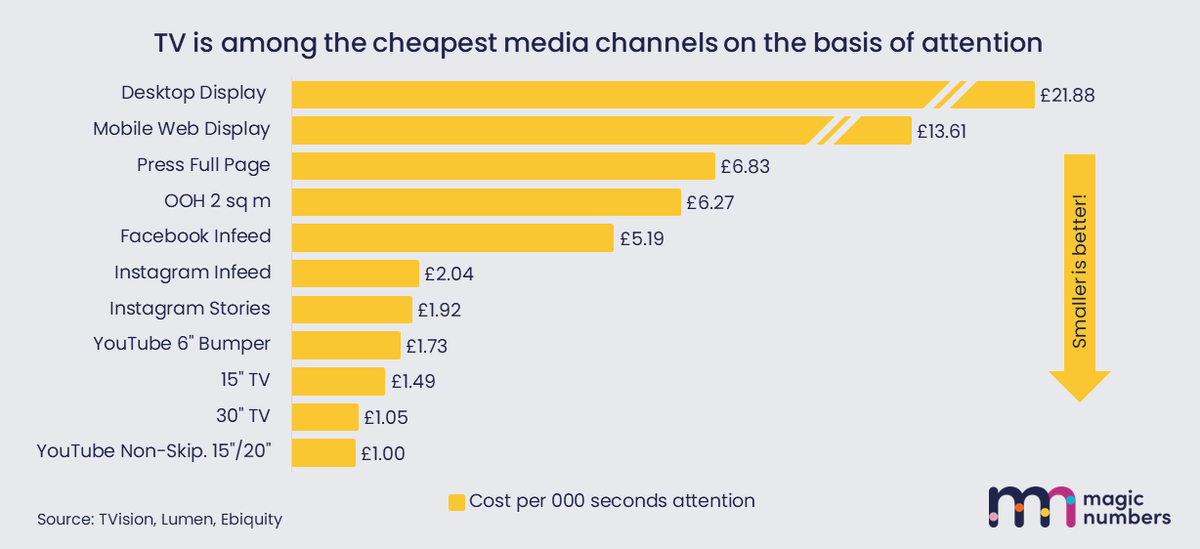
@Grace_Kite Grace - we’d love to help / share data showing the connection between attention metrics and outcomes. The chart above uses duration as a measure of attention.. this is a very bad idea with plenty of unintended consequences: dropbox.com/scl/fi/s7tj52d…
English
0
0
0
43
Dr Grace Kite 🪁
Dr Grace Kite 🪁@Grace_Kite·
📢If you want actual people to actually watch your ads, you can’t beat video with default sound on. 🧵
Dr Grace Kite 🪁 tweet media
English
4
10
65
12.9K