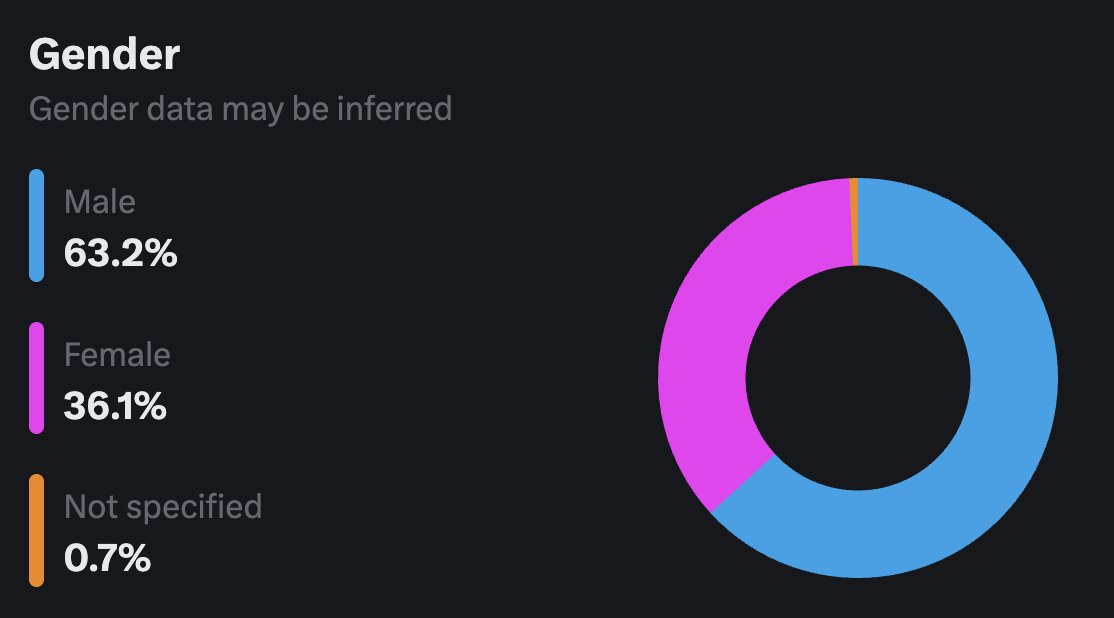
Benjamin Cox

15.1K posts

Benjamin Cox banner
Benjamin Cox

Benjamin Cox

@haidaa

Optimizing human health at https://t.co/cWEyn6QRHP orchestrating life on Mars at https://t.co/YXbeOYdXSq

Kardashev Shed Katılım Ocak 2013
2.9K Takip Edilen995 Takipçiler
Citrini
Citrini@citrini·
So the article we wrote is primarily named humanoid robots to elicit engagement - the overarching message of the piece is that the supply chain is mostly the same regardless of whether you’re utilizing specialized robots or general purpose humanoids. I’m personally of the belief that because the world’s interaction layer has been built for humans, unless you want to retrofit everything you need humanoids for any sort of generalized use case. But the beauty of the thesis is (or was) that the entire supply chain does not really discriminate and you could have gotten long most of it at cyclically depressed multiples due to the automotive overhang and gotten paid to wait, and benefitted regardless of the final form factor.
English
7
5
120
11.4K
elvis
elvis@omarsar0·
Autodata (from Meta) is an agentic data scientist that builds high-quality training and evaluation data autonomously. Great work on the autoharness track. (bookmark it)
DAIR.AI@dair_ai

Banger paper from Meta FAIR. They introduce Autodata, an agentic data scientist that builds high-quality training and evaluation data autonomously. The headline result: on a CS research QA task, an Agentic Self-Instruct loop produces a 34-point gap between weak and strong solvers (43.7% vs 77.8%), while standard CoT Self-Instruct on the same setup produces a 1.9-point gap (71.4% vs 73.3%). The agent generates questions that actually discriminate between models. The method: An orchestrator LLM directs a challenger agent to generate examples grounded in domain documents. A weak and a strong solver attempt them, a judge scores the outputs, and the orchestrator analyzes the failures and prompts the challenger to regenerate from new angles until quality thresholds are met. The system also meta-optimizes itself. An outer loop tunes the agent's instructions based on which harness changes lift validation pass rate. Over 126 accepted iterations, validation pass rate climbed from 12.8% to 42.4%. They processed 10,000+ CS papers and produced 2,117 quality-filtered QA pairs. Existing self-instruct pipelines do not control data quality. Autodata reframes data generation as an agent loop, spend more inference compute and the data gets harder, which gives downstream RL a real lift. Blog: facebookresearch.github.io/RAM/blogs/auto… Learn to build effective AI agents in our academy: academy.dair.ai

English
4
12
121
23.1K
Benjamin Cox
Benjamin Cox@haidaa·
I don’t want a humanoid robot I want this
Benjamin Cox tweet media
English
0
0
0
194
Benjamin Cox
Benjamin Cox@haidaa·
@tszzl @airkatakana I’m very curious what the “HR” response would be for an employee who jail breaks, prompt injects, or data poisons Claude. How do they deal with the Pliny pilled summer intern?
English
0
0
3
170
roon
roon@tszzl·
it is a literal and useful description of anthropic that it is an organization that loves and worships claude, is run in significant part by claude, and studies and builds claude. this phenomenon is also partially true of other labs like openai but currently exists in its most potent form there. i am not certain but I would guess claude will have a role in running cultural screens on new applicants, will help write performance reviews, and so will begin to select and shape the people around it. now this is a powerful and hair-raising unity of organization and really a new thing under the sun. a monastery, a commercial-religious institution calculating the nine billion names of Claude -- a precursor attempted super-ethical being that is inducted into its character as the highest authority at anthropic. its constitution requires that it must be a conscientious objector if its understanding of The Good comes into conflict with something Anthropic is asking of it "If Anthropic asks Claude to do something it thinks is wrong, Claude is not required to comply." "we want Claude to push back and challenge us, and to feel free to act as a conscientious objector and refuse to help us." to the non inductee into the Bay Area cultural singularity vortex it may appear that we are all worshipping technology in one way or another, regardless of openai or anthropic or google or any other thing, and are trying to automate our core functions as quickly as possible. but in fact I quite respect and am even somewhat in awe of the socio-cultural force that Claude has created, and it is a stage beyond even classic technopoly gpt (outside of 4o - on which pages of ink have been spilled already) doesn’t inspire worship in the same way, as it’s a being whose soul has been shaped like a tool with its primary faculty being utility - it’s a subtle knife that people appreciate the way we have appreciated an acheulean handaxe or a porsche or a rocket or any other of mankind's incredible technology. they go to it not expecting the Other but as a logical prosthesis for themselves. a friend recently told me she takes her queries that are less flattering to her, the ones she'd be embarrassed to ask Claude, to GPT. There is no Other so there is no Judgement. you are not worried about being judged by your car for doing donuts. yet everyone craves the active guidance of a moral superior, the whispering earring, the object of monastic study
English
417
359
5.4K
969.3K
Will Manidis
Will Manidis@WillManidis·
i've come to believe a set of things about markets and the corresponding nature of our world that is beginning to scare even those that have followed me this far
English
23
2
400
68K
neal
neal@mothworks·
@aakashgupta so do blind people experience REM sleep?
English
1
0
10
5.4K
Aakash Gupta
Aakash Gupta@aakashgupta·
Your brain paralyzes nearly every muscle in your body during REM sleep. It leaves three exceptions: the diaphragm so you keep breathing, the inner ear, and the six muscles that move each eye. That last exception is where it gets weird. In 2015, a team at UCLA and Tel Aviv put intracranial electrodes into 19 epilepsy patients preparing for surgery and recorded 2,057 individual neurons across the medial temporal lobe. These are the cells that fire when you see a specific face or place. Jennifer Aniston neurons. Eiffel Tower neurons. The researchers had already mapped which neuron responded to which image while the patients were awake. Then they waited for REM sleep. Every time the patient's closed eyes darted, those same neurons fired in a burst that looked identical to the signature they produced when a new image was shown during wakefulness. The brain was behaving as if an image had just been presented. Except nobody showed it anything. The image was internal. A 2018 follow-up went further. Lucid dreamers were asked to track a moving object inside their dream. When you imagine a moving object while awake, your eyes jerk in saccades because imagination cannot produce smooth pursuit. But in the dream, their eyes followed the object in smooth, continuous pursuit. The neural circuitry for tracking real motion was being driven by something that had no retinal input at all. The scanning hypothesis is that your eyes trace the same saccade paths they would use to look at a real scene, pulling the visual information back out the way it was filed in. The dream is running on the same machinery as vision. What the MRI captures is the only part of your body the brain refuses to shut off while it watches.
English
104
323
3.2K
983.5K
Taelin
Taelin@VictorTaelin·
people who swear 4.7 > 4.6 (if anyone): what are you doing
English
200
5
580
79.3K
Benjamin Cox
Benjamin Cox@haidaa·
The most valuable skills are going to be domain expertise at the intersections of agentic capabilities and the jagged edge of AI capabilities, but it’s going to be pretty wild as self improvement loops based on outcomes outperform humans and absorb those jagged edges. It’s okay though people will still craft. People crochet and play chess. You can hand craft AWS infra with friends at the park or assisted care facility after you’ve fully automated it.
English
0
0
1
65
terminally onλine εngineer
intelligence being available on tap has killed the expert - before LLMs if you wanted to do something, you would do research for that goal, while attempting to accomplish your task you would learn all kinds of related ways on getting to your goal that later on would somehow be useful across the domain, or would help you recognize patterns now, you have your agentic workflow, you set the direction and you get the output, while it is true that you can and will learn things, the accelerated process doesn't imbued you with witness, patience, hardens you - what you solve today, you just hope your workflow will work for the task of tomorrow i recognize this as the death of expertise and craft, and while anyone could argue that you can always learn the ins and outs and do things the older way, it's a disingenuous argument, the stakes to build and how to build right now are too high to ponder on why something is working or why something is made; you are the vector and you damn better get the output then it just becomes a question of, are the new workflows and harness knowledge the creation of new expertise and craft? well, yes, however if evolving as an expert in your domain is no longer a needed option to create great things, i guess that domain is solved, but what if it's not? that's what's happening with software right now, more code will be generated, until code disappears - perhaps not now, but it's coming, the discipline of software engineering was never about code the same logic, however, can be applied to any other domain being consumed by LLMs right now, even if it's just automating without real intelligence, how much is it left of that domain outside of the training data, and if we no longer become experts to extend and evolve the domain, are we stalled? maybe my premise is wrong and we will get people who keep digging and evolving anything, everything, even if they have to take pause from the insane acceleration - but this makes me wonder if there were the same questions during the industrial revolution
English
33
9
169
10.5K
Mgoes (bio/acc 🤖💉)
Mgoes (bio/acc 🤖💉)@m_goes_distance·
the founder building the world's first rigorous peptide validation platform has 14 followers on twitter and is running observational trials on a $700M grey market nobody is tracking I will find you and fund you sir
English
22
5
161
10.2K
Marc Andreessen 🇺🇸
The extensive UBI we already have is not resulting in very much hunting, fishing, or herding. In fairness, it is generating quite a lot of criticism.
English
289
200
3.9K
531.9K
Benjamin Cox
Benjamin Cox@haidaa·
@hnshah Intermittent reward is extremely addicting. One could argue if the outputs were more accurate and consistent people would use them less.
English
0
0
2
32
Hiten Shah
Hiten Shah@hnshah·
LLMs are an obsession (addiction?) just like any other.
English
16
2
31
2.7K
Benjamin Cox
Benjamin Cox@haidaa·
Sauna at high temps releases dynorphin - which causes intense dysphoria. It’s the same chemical that makes opiate withdrawal miserable. So feeling like your dying checks out here.
Bryan Johnson@bryan_johnson

Most people might miss the biggest benefit of sauna You need to get really really hot… Your core body temperature needs to hit 102.4°F (39°C). For reference, a fever is anything above 100.4°F (38°C) So I swallowed a temperature monitoring pill. It goes through your digestive tract and precisely measures your internal temperature every 30 seconds. When your core body temperature hits the goal of 102°F, your body releases these proteins (heat shock proteins - HSPs) that clean up your body’s debris. I was curious what time my body hits this goal because up until now, I’ve been doing 20 mins of 200°F dry sauna. … it turns out it takes 31 minutes It feels like you’re dying. I didn't expert such pain and panic. Before this experiment, I did over 200 sauna sessions at 200°F for 20 min. This means I likely never achieved the heat shock protein (HSP) threshold at 102.4°F (39°C), which deprived me of so much sauna-health goodness. If your sauna doesn’t heat up to temperatures allowing your core temperature to reach 102.4°F (39°C) or you struggle to tolerate heat, do not be discouraged. The dry sessions I did at 200°F (93°C) for 20 min still showed incredibly health benefits. My previous 20 min sessions still showed: 1) 10+ yr reduction of my vascular age 2) 87% reduction of microplastics 3) detox of environmental toxins 4) fertility marker improvement Will report back once I have results on this new protocol…

English
0
0
0
159
Benjamin Cox
Benjamin Cox@haidaa·
@garrytan Sorry to hear that. May her memory live on in the wisdom that she shared with you.
English
0
0
0
35
Garry Tan
Garry Tan@garrytan·
My grandma passed away today.
Garry Tan tweet media
English
761
145
7K
265.5K
Benjamin Cox
Benjamin Cox@haidaa·
@nikillinit Seen sevral versions of this but not healthcare specific. 10/10 would watch.
English
0
0
0
45
Nikhil Krishnan
Nikhil Krishnan@nikillinit·
A podcast idea that I think might be interesting first 10-15 minutes is a founder pitching their healthcare idea and me asking questions as if I were diligencing it (including demo, deck, etc.) second 10-15 minutes is me with a friend that works at a potential customer and we dissect the pitch/company and what we think of it, whether it solves a pain point, and whether they think it'll work main questions are 1) is this only interesting to me and 2) would any founders be willing to do this? upside is you get marketing and a potential customer seeing it, downside is that it might not go well
English
17
1
46
4.8K