Rahul Kumar

2.2K posts

Rahul Kumar banner
Rahul Kumar

Rahul Kumar

@hellorahulk

building memory technology | @timelnapp 🪄 prev: Chief AI @apres_io @neuronslab

🌎 Katılım Temmuz 2009
912 Takip Edilen356 Takipçiler
Sabitlenmiş Tweet
Rahul Kumar
Rahul Kumar@hellorahulk·
INTRODUCING: @timelnapp Timeln is a second brain that actually thinks with you. It connects everything you've ever saved, learned, or thought about — and surfaces it exactly when you need it. Today, alpha opens to the public. Here's why this is different:
Rahul Kumar tweet media
English
3
1
5
391
Rahul Kumar
Rahul Kumar@hellorahulk·
Brilliantly said @cyrilXBT , you are one of the rarest who really understand this concept. You should check out Timeln.app. It does all the stuff that the Obsidian and Claude combination does, but to a next level, 100% automated, with no backlinking required or maintenance overhead required at the file system.
English
0
0
0
10
CyrilXBT
CyrilXBT@cyrilXBT·
This is the insight most people skip entirely. Folders are a filing system. A graph is a thinking system. When Obsidian is wired to Claude as a graph, Claude is not navigating a folder hierarchy. It is traversing a network of relationships between ideas. The connections between notes are as important as the notes themselves. That is where the intelligence lives. Not in any individual file. In the structure that links them all together.
English
1
0
1
23
CyrilXBT
CyrilXBT@cyrilXBT·
Most people use Obsidian as a note-taking app. They collect information, build folders, and feel productive. They are missing the point entirely. I spent 6 months figuring out what Obsidian actually is when you connect it to Claude properly. It is not a note app. It is a second brain that thinks back. Here is the full system I built and what changed. Before this setup every Claude session started from zero. New chat. No context. Re-explain the project. Re-explain the voice. Re-explain the standards. Every single time. The first 20 minutes of every session was just feeding Claude things it already knew yesterday. The Obsidian plus Claude setup eliminates that entirely. Here is how it works. Your Obsidian vault becomes the permanent memory layer. Every project note. Every idea capture. Every daily journal entry. Every system document. All of it lives in plain text Markdown files on your local machine. Claude Code connects to the vault via MCP. Not by pasting content into a chat window. By reading and writing directly to your files in real time. Your CLAUDE. md file sits in the vault and loads automatically at the start of every session. It tells Claude who you are. What you are building. What your voice sounds like. What your current projects are. What it should never do. By the time you type your first message Claude already knows everything it needs to know. The morning briefing takes 2 minutes. You type: Morning briefing. Claude reads your daily note from yesterday, your active projects, and your inbox. It tells you the 3 most important things to focus on today, any open loops to close, and one decision to make before noon. Every idea you capture goes into the vault instantly. Every article you read gets stripped and stored as a note. Every meeting gets summarized and filed automatically. Every piece of content you create gets linked to the project it belongs to. The vault is not passive anymore. It is alive. And the longer you use it the more valuable it becomes. Because Claude is not just reading your notes. It is finding connections between notes you wrote months apart. Surfacing insights from your own thinking you had forgotten. Building on context that compounds every single week. After 90 days of this system you will not remember how you worked before it. Because you will have built something most people never build in their entire careers. A second brain that actually thinks. Bookmark this. Follow @cyrilXBT for the exact Obsidian and Claude setup that makes this possible.
CyrilXBT tweet media
English
23
30
221
11.9K
Alpha Batcher
Alpha Batcher@alphabatcher·
Your first AI team should not be 12 agents Start with 3 recurring workstreams: 1. Research - competitors - pricing changes - market updates - weekly brief - 1 recommended action per finding 2. Content - 30 ideas/month - drafts - edits - repurposing - quality gates for voice, hook, usefulness, originality 3. Operations - inbox triage - meeting prep - weekly reporting - follow-up tracking Each agent needs the same 5-part setup: > role prompt > tool access via MCP > knowledge base > repeatable workflow > output format If the research agent finds a competitor move, the content agent should draft a response and the ops agent should prep customer follow-up. That is the point: 3 linked business loops
Khairallah AL-Awady@eng_khairallah1

x.com/i/article/2051…

English
19
21
103
2.1K
Vaibhav Sisinty
Vaibhav Sisinty@VaibhavSisinty·
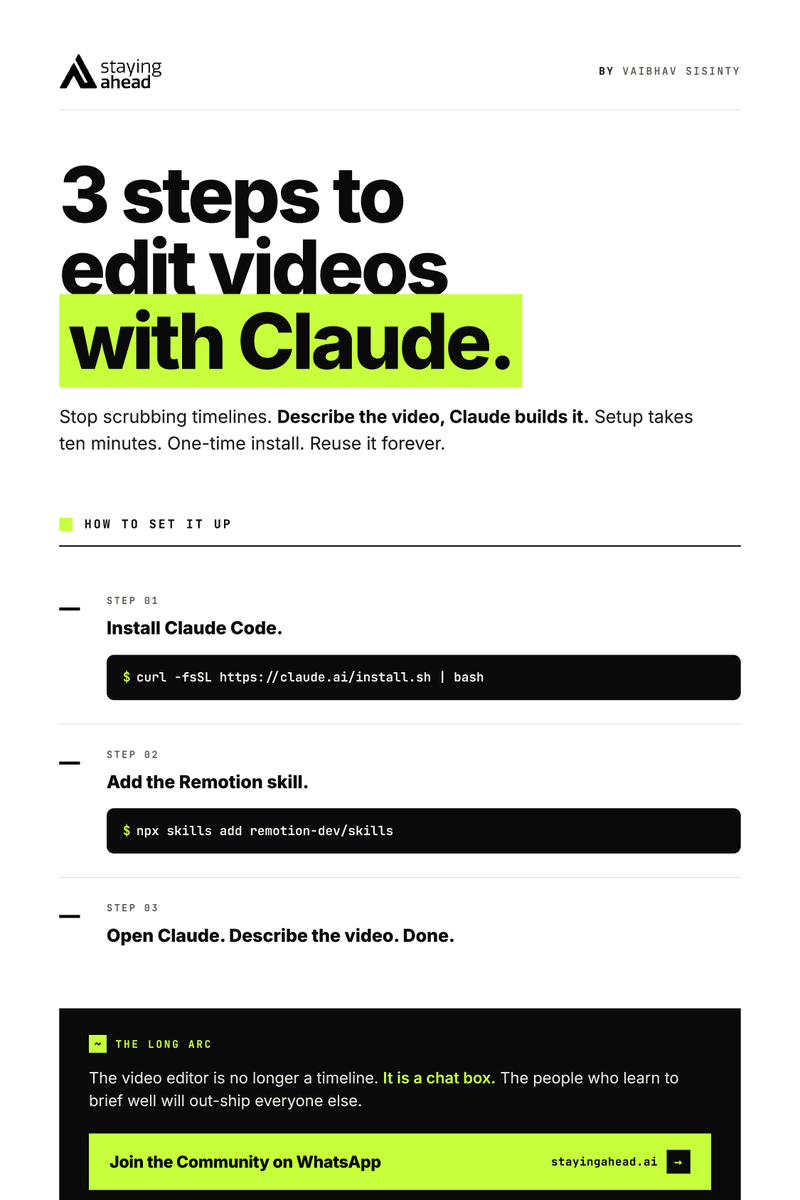
Wait. This actually works? 🤯 Claude Code paired with an open source tool called Remotion can now edit any video for you. Subtitles, split screens, cuts, transitions, full structure. The setup takes 10 minutes. → Install Claude Code from your terminal → Add the Remotion video skill → Open Claude, describe your video, AI builds it Video has been the last creative job AI couldn't touch end to end. You could generate clips. Write scripts. Clone voices. But the actual editing was still a human bottleneck. That bottleneck just dissolved. I share insights like this daily in my free WhatsApp community ↓ go.stayingahead.com/X
Vaibhav Sisinty tweet media
English
5
10
63
3.4K
Andrew Ng
Andrew Ng@AndrewYNg·
Coding agents are accelerating different types of software work to different degrees. When we architect teams, understanding these distinctions helps us to have realistic expectations. Listing functions from most accelerated to least, my order is: frontend development, backend, infrastructure, and research. Frontend development — say, building a web page to serve descriptions of products for an ecommerce site — is dramatically sped up because coding agents are fluent in popular frontend languages like TypeScript and JavaScript and frameworks like React and Angular. Additionally, by examining what they have built by operating a web browser, coding agents are now very good at closing the loop and iterating on their own implementations. Granted, LLMs today are still weak at visual design, but given a design (or if a polished design isn’t important), the implementation is fast! Backend development — say, building APIs to respond to queries requesting product data — is harder. It takes more work by human developers to steer modern models to think through corner cases that might lead to subtle bugs or security flaws. Further, a backend bug can lead to non-intuitive downstream effects like a corrupted database that occasionally returns incorrect results, which can be harder to debug than a typical frontend bug. Finally, although database migrations can be easier with coding agents, they’re still hard and need to be handled carefully to prevent data loss. While backend development is much faster with coding agents, they accelerate it less, and skilled developers still design and implement far better backends than inexperienced ones who use coding agents. Infrastructure. Agents are even less effective in tasks like scaling an ecommerce site to 10K active uses while maintaining 99.99% reliability. LLMs' knowledge is still relatively limited with respect to infrastructure and the complex tradeoffs good engineers must make, so I rarely trust them for critical infra decisions. Building good infrastructure often requires a period of testing and experimentation, and coding agents can help with that, but ultimately that’s a significant bottleneck where fast AI coding does not help much. Lastly, finding infrastructure bugs — say, a subtle network misconfiguration — can be incredibly difficult and requires deep engineering expertise. Thus, I’ve found that coding agents accelerate critical infrastructure even less than backend development. Research. Coding agents accelerate research work even less. Research involves thinking through new ideas, formulating hypotheses, running experiments, interpreting them to potentially modify the hypotheses, and iterating until we reach conclusions. Coding agents can speed up the pace at which we can write research code. (I also use coding agents to help me orchestrate and keep track of experiments, which makes it easier for a single researcher to manage more experiments.) But there is a lot of work in research other than coding, and today’s agents help with research only marginally. Categorizing software work into frontend, backend, infra, and research is an extreme simplification, but having a simple mental model for how much different tasks have sped up has been useful for how I organize software teams. For example, I now ask front-end teams to implement products dramatically faster than a year ago, but my expectations for research teams have not shifted nearly as much. I am fascinated by how to organize software teams to use coding agents to achieve speed, and will keep sharing my findings in future posts. [Original text: deeplearning.ai/the-batch/issu… ]
English
38
48
249
23.9K
Jason Zhu
Jason Zhu@GoSailGlobal·
Stanford CS336 上,Tatsu 讲了一节 LLM 架构课,把过去 3 年所有主流 LLM 拆开,看它们的共通模板 结论挺爆:90% 的架构选择已经收敛,你随便挑一个开源大模型,它跟其他模型在这些维度上几乎一模一样 讲师的原话 - 2024 年大家都在 cosplay Llama2 - 2025 年的主题是「怎么训得不崩」 - 2026 年的主题是「怎么扛住长上下文」 下面是 2026 年开源 LLM 的标准模板 你训自己的模型可以直接抄 【架构层 已经收敛的 7 件事】 1)Layer Norm 挪出残差流(pre-norm) 原版 Transformer 把 LN 放在残差里 几乎所有现代模型都挪到外面 原因:keep your residual stream clean 梯度反传更稳 2)RMS Norm 替代 LayerNorm LayerNorm 的减均值 + 加 bias 那部分实际没怎么帮上忙 丢掉之后 flops 只省 0.17% 但运行时省到 25% (瓶颈在数据搬运 计算反而次要) 3)所有 bias 项全删 跟 RMS Norm 一个道理 系统层省内存搬运 4)激活函数用 SwiGLU 或 GeGLU gated linear unit 几乎所有现代模型都用 Llama 系 / Qwen / Mistral 用 SwiGLU Google 系(Gemma / T5)用 GeGLU 区别极小 选哪个都行 5)位置编码用 RoPE 2024 年之后基本统一了 原理:把每对维度按位置旋转一个角度 让 inner product 只依赖相对位置 6)Transformer block 串联(不是并联) GPT-J / Palm 试过并联 现在基本被放弃 串联的实现优化得太好了 并联省的那点系统开销不值得损失表达力 7)Layer norm 可以「撒」 哪儿不稳就在哪儿加 LN attention 之前能加 之后能加 两边都加(double norm)也可以 现代模型很多这样做 【超参数 已经收敛的 5 个数】 1)feedforward 维度 / hidden 维度 - 非 GLU 模型:4 倍 - GLU 模型:8/3 ≈ 2.67 倍(因为 GLU 多一组矩阵 要保持总参数量) - Llama 系:3.5 倍 - T5 1.0 试过 64 倍 后来 T5 1.1 改回标准 别学 2)head 数 × head 维度 ≈ hidden 维度 几乎所有模型都遵守 T5 是为数不多的例外 3)模型纵横比(hidden / 层数)≈ 100 太深 pipeline parallel 难做 太宽 表达力受限 100 这个数字是系统约束 + 表达力的平衡点 4)vocab size 单语模型:30K 左右(早期 GPT-2 那种) 多语 / 通用模型:100K-200K(GPT-4 / Llama 3 / Gemma 都在这个范围) 现代基本都是后者 5)weight decay 仍然普遍使用 但研究发现它在 LLM 里干的事其实是优化器干预 让你最终能收敛到更深的最优点 跟你想的「防过拟合」没什么关系 所以别因为「单 epoch 不会过拟合」就把它关掉 【稳定性 三个救命 trick】 训练大模型最怕中途 loss 突然飙升 然后 NaN 全军覆没 现代模型用三个 trick 防这件事 1)Z-loss output softmax 的 normalizer 容易爆 加一个 (log Z)² 的正则项 让 Z 始终接近 1 DCLM / Olmo 都用 2)QK norm attention 的 Q 和 K 在矩阵乘之前各加一个 LN 让 softmax 的输入永远是单位尺度 multimodal 圈先用起来 现在所有大模型都加 3)Logit soft cap(仅 Google 系) attention logit 用 tanh 硬封顶 Gemma 2/3/4 都在用 但会损失一点点性能 慎用 【Attention 两个新趋势】 1)GQA(Grouped Query Attention)几乎统一 原版 multi-head 推理时 KV cache 会让算术强度崩到 1/h GQA 共享 K 和 V 但保留多个 Q 表达力几乎不损失 推理成本砍掉 80% 现在所有要做生产部署的大模型 没有不用 GQA 的 2)局部 + 全局 attention 交替 处理长上下文的新方式 Cohere Command A 起头 现在 Llama 4 / Gemma 4 / Olmo 3 全在用 比如每 4 层有 1 层 full attention 其他 3 层是 sliding window 只看附近的 token 比纯 SSM 更稳 比纯 full attention 便宜得多 (Qwen 3.5 做了变体 把 sliding window 那 3 层换成 SSM) 收尾一句 如果你正在训自己的 LLM,上面这一套就是 2026 年的「默认配置」 不需要重新发明,直接抄 如果你只是想看懂 GitHub 上那些 modeling_xxx.py 这一份足够你不再被术语吓住
Roan@RohOnChain

Anthropic pays $750,000+ a year for engineers who can build LLM architectures from scratch. Stanford taught the entire thing in 1 hour lecture & released it for free. Bookmark & watch this today before someone takes it down.

中文
16
333
1.9K
293.5K
borja
borja@borjafat·
Claude or Codex can find SEO Backlinks Tired of manual searching? Solved Tired of begging over email? Solved This 2-prompt-chain can run automatically to spot opportunities, draft and send outreach messages via email or Linkedin Run it as a scheduled task and never worry about it again Comment "PROMPT" and I'll sent it
English
169
11
138
11.7K
Josh Kale
Josh Kale@JoshKale·
Anthropic just automated the first-year analyst job at every bank on Wall Street. They released these 10 AI agents for finance: → Pitch builder → Meeting preparer → Earnings reviewer → Model builder → Market researcher → Valuation reviewer → GL reconciler → Month-end closer → Statement auditor → KYC screener The analyst pyramid just got a lot flatter.
Claude@claudeai

New for financial services: ready-to-run Claude agent templates for building pitches, conducting valuation reviews, closing the books at month-end, and more. Install them as plugins in Cowork and Claude Code, or use our cookbooks to run them in production as Managed Agents.

English
19
61
1.1K
213.9K
Karl Mehta
Karl Mehta@karlmehta·
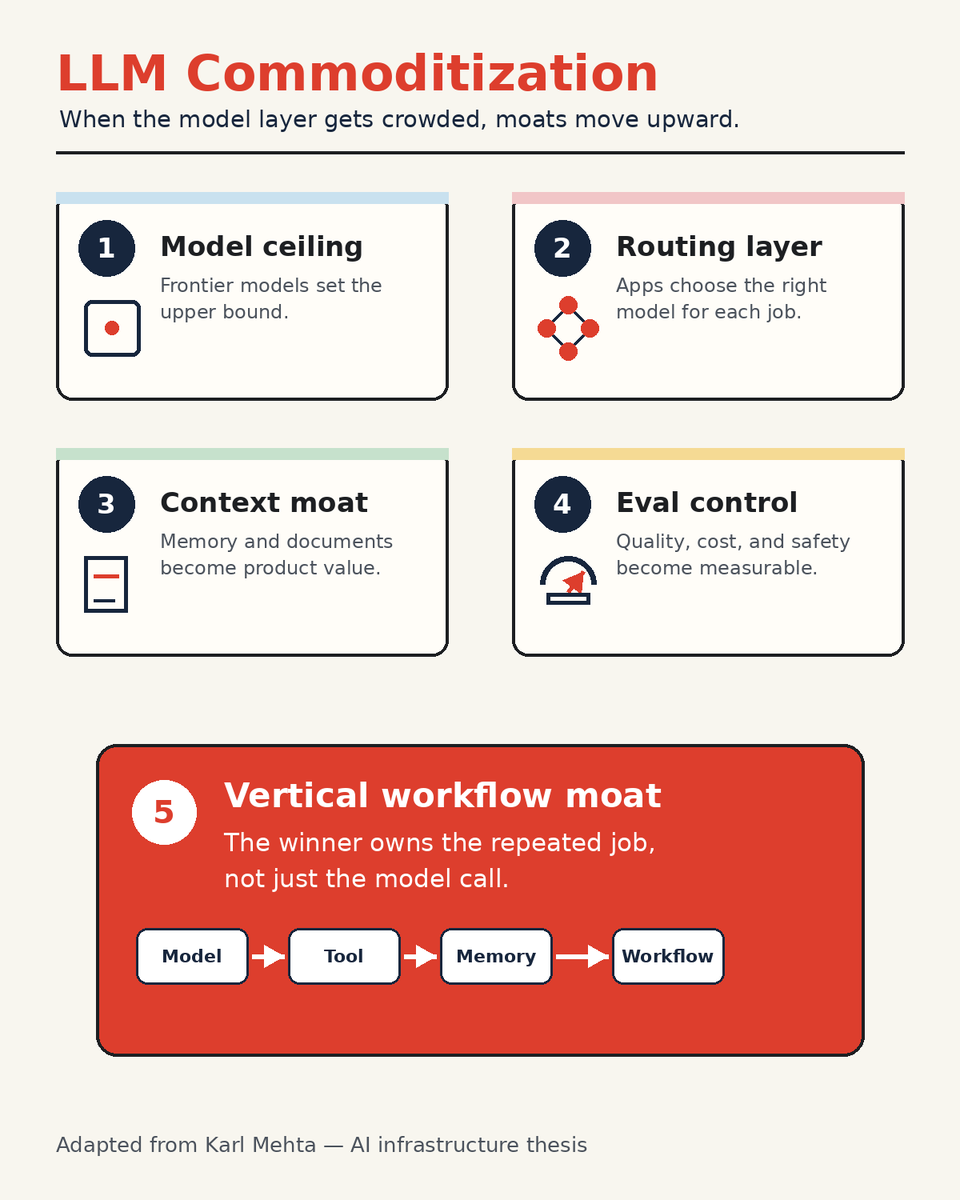
LLM commoditization in 60 seconds: 1. Frontier models set the capability ceiling. 2. Apps route between them. 3. Context becomes the product. 4. Evals become the control plane. 5. Vertical workflows become the moat.
Karl Mehta tweet media
Karl Mehta@karlmehta

x.com/i/article/2050…

English
3
10
31
5.6K
ben hylak
ben hylak@benhylak·
now, your agent can fix itself. introducing raindrop triage. an agent for finding and investigating agent issues.
English
39
33
332
37.3K
darkzodchi
darkzodchi@zodchiii·
> start a new project > open Claude Code > no CLAUDE.md > Claude doesn't know your stack > "can I edit this file?" yes > click Allow 30 times > realize .env was read 5 minutes ago > spend 2 hours configuring everything > start next project > do it all over again from scratch > there's a starter kit that does all of this in 5 minutes
darkzodchi@zodchiii

x.com/i/article/2051…

English
20
16
412
29.1K
Ben Lang
Ben Lang@benln·
Take a peek if you’re a Cursor fan and want to do more with us. We’re keeping this program small, but doing our best to bring on new members!
GIF
English
129
20
587
35.2K
Perplexity
Perplexity@perplexity_ai·
Today we're launching Perplexity Computer for Professional Finance. Finance teams can bring licensed data from providers like Morningstar, PitchBook, Daloopa, and Carbon Arc into Computer. We’ve also added 35 dedicated finance workflows for the work analysts repeat every week.
English
89
179
1.8K
248K
Rohit
Rohit@rohit4verse·
Andrej Karpathy at YC AI Startup School: "build Iron Man suits, not Iron Man robots." i've been watching builders ship and builders stall. the shippers are still coding. they wear the suit. they direct a team of agents and the keys stay in their hands. the stalled ones became the robot. they only prompt now. the muscle that catches when the model is wrong has gone quiet. there is no neutral way to use AI. you either get sharper or you get hollower. most are getting hollower and won't notice till the chat won't open. how to stay in the first group, inside:
Rohit@rohit4verse

x.com/i/article/2050…

English
29
18
133
18K
Blaze
Blaze@browomo·
This Chinese guy created 13 agents in Claude Code for Shopify stores and single-handedly serves 200 dropshippers a month, taking $800 from each. He sits at one desk in front of a wall-mounted LG monitor split into a 3x2 grid of 6 Claude windows, another identical grid runs on a vertical display next to it, plus 1 window on the MacBook within arm's reach, totaling 13 agents simultaneously building Shopify stores, each busy with its own part. No team, no managers, no support, just him, the monitor, and the API counter ticking in the header of every window. He is not on a subscription but on an API rate billed by tokens, and he figures 13 parallel agents pay for themselves from the very first client, because every finished store goes for $800, and all 13 windows together consume less than $80 a day. In the first window he set that system prompt which immediately closes the "assistant or employee" debate: "you are my new founder-engineer" So the model knows at what level it was hired: not to hint, not to advise, not to supplement, but to own the result, because for this Chinese guy Claude is no longer a helper in an IDE, it is a partner in his small factory, billed by tokens and never leaving for lunch. And the other 12 agents he spread across the layers of the store, so each one sits in its own context and does not interfere with the neighbor: "build a catalog of 80 products and rewrite the descriptions" "lay out the homepage for the niche of the client" "set up the cart, payment, and shipping by country" "generate 30 email chains for warming up" "design 50 banners and a logo for the brand" "set up analytics and A/B tests on the homepage" In a regular agency each task like this would take one designer or developer a full 2 days, because they would first collect the brief, then wait for revisions, then get on a call, whereas this Chinese guy has all 13 agents working in parallel in their windows, and while one writes descriptions, the second is already laying out the homepage, and the third is designing banners. In the end on the wall it looks like a factory: 13 identical Claude robots writing into one project, and the Chinese guy himself in the chair in front of them decides only 2 questions, which client to hand the finished store to and who to take next, and beyond that he does nothing. And economically it is still cheaper than keeping a team of 5: one operator like this closes 6 to 7 finished stores per day at $800 each, while a traditional design agency charges $3,500 for the same store and builds it over a full 2 weeks, whereas this guy spends less than $80 a day across all 13 windows. Wires hanging out, the monitor bolted to a stand, no office and no employees, just 1 desk, 13 robots, and a queue of dropshippers who send new orders every morning. In my opinion, this is the most efficient solo Shopify factory I have seen this year, and it is already running right now, while traditional agencies are still debating whether AI will take jobs from designers.
Khairallah AL-Awady@eng_khairallah1

x.com/i/article/2051…

English
48
227
1.7K
200.2K
Claude
Claude@claudeai·
New for financial services: ready-to-run Claude agent templates for building pitches, conducting valuation reviews, closing the books at month-end, and more. Install them as plugins in Cowork and Claude Code, or use our cookbooks to run them in production as Managed Agents.
English
566
1.2K
16.5K
3.7M
John Yang
John Yang@jyangballin·
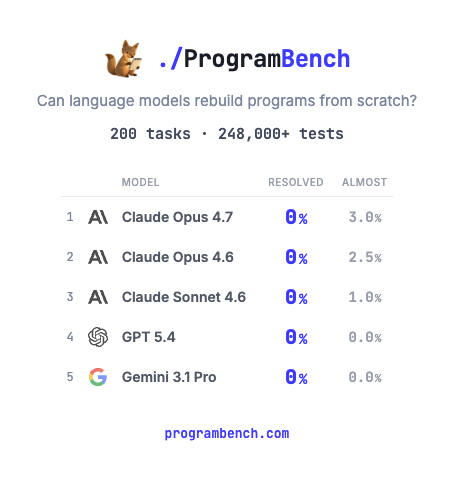
How much of SQLite, FFmpeg, PHP compiler can LMs code from scratch? Given just an executable and no starter code or internet access. Introducing ProgramBench: 200 rigorous, whole-repo generation tasks where models design, build, and ship a working program end to end. 🧵
John Yang tweet media
English
45
109
601
208.7K
brett goldstein
brett goldstein@thatguybg·
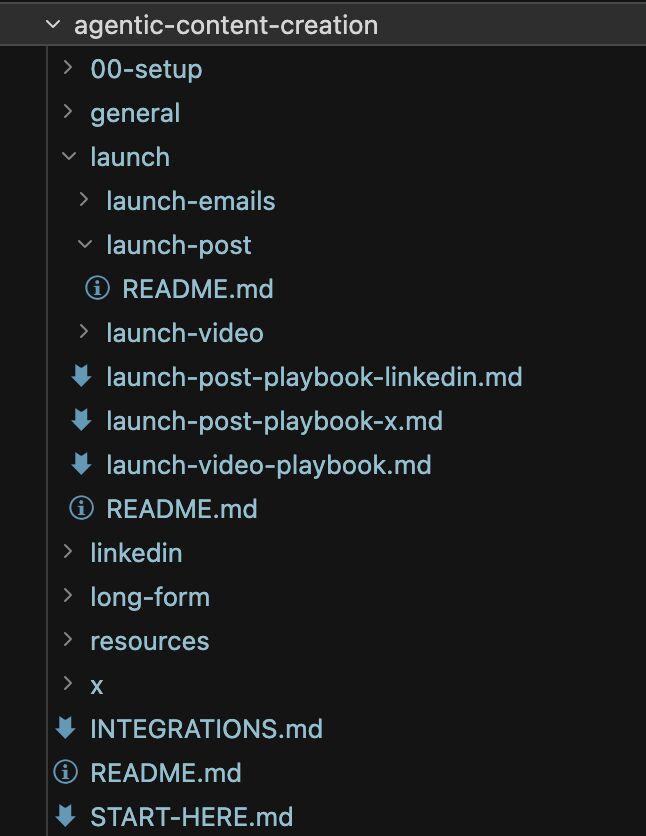
spent like 20hrs making a massive zip file of skills and agents for content creation linkedin, X, longform, launch videos, etc all a prompt away. I used it to write our next launch script. lmk if you want to try it and ill send it over.
brett goldstein tweet media
English
427
12
252
23.2K
elvis
elvis@omarsar0·
// HeavySkill // One of the cleaner takes on agentic harness design I've read. They argue that what actually drives agent harness performance is not the orchestration code. It's a single inner skill: parallel reasoning followed by deliberation. If you can internalize that into the model and most of the scaffolding becomes optional. The paper systematizes this as a two-stage pipeline you can run beneath any harness, then trains it as a learnable skill via RLVR. The numbers: > GPT-OSS-20B jumps from 69.7% (M@K) to 85.5% (HM@4) on LiveCodeBench under the heavy-thinking variant. > R1-Distill-Qwen-32B nearly doubles on IFEval, from 35.7% to 69.3%. > Several models reach Pass@N-level performance with HeavySkill. Harness wins start to look like model wins once you can train them in. If parallel-reasoning-plus-deliberation really is the inner skill, the long arc is models that come with it baked in, not orchestration glue around them. Paper: arxiv.org/abs/2605.02396 Learn to build effective AI agents in our academy: academy.dair.ai
elvis tweet media
English
9
21
190
12.1K