Here&There

20.4K posts

Here&There

Here&There

@here_there

Trying to help. Am often wrong, sometimes right! Stocks & Markets. Please DYOR. My views. Onion peeler at heart

Here&There Katılım Ocak 2015
406 Takip Edilen2.6K Takipçiler
Sabitlenmiş Tweet
Here&There
Here&There@here_there·
Market is rerating stuff that makes stuff nearly as fast as it derates stuff that could be disintermediated by AI….. RELX from 24 to 14 IMI from 14 to 20 Small caps as ever lag ….for now Maybe worth thinking Carclo over IMI REA over MP Evans Multiples of small caps that make stuff in a different postcode to their larger brethren
English
2
0
3
1.5K
n
n@nigelpm_uk·
@Trader__007 @here_there Sorry - none of this is relevant to the recent spike which we all know is related to US/Israeli action in Iran.
English
1
0
0
20
Here&There
Here&There@here_there·
You heard Rayner’s pitch The Green Party pitch And closing the North Sea makes us look dafter and dafter When you rely on others to fund you you are always vulnerable to change in sentiment Miliband’s policy is incoherent and people who we borrow from are rapidly losing patience Sentiment
English
0
0
0
10
n
n@nigelpm_uk·
@here_there @Trader__007 That's all known stuff and has nothing to do with the recent surge.
English
1
0
0
12
n
n@nigelpm_uk·
@Trader__007 @here_there Surely this is because of the huge rise in energy prices as a result of US/Israel action in Iran??
English
1
0
0
32
Here&There
Here&There@here_there·
@otemple79 I just do not trust Andrew at all. I get that’s part of the opportunity but but
English
0
0
0
25
Templeton Peck
Templeton Peck@otemple79·
Added some more #SAVE Savannah Energy as it feels mispriced - market hates it.. Even a mid-case arbitration win could be multiples of today's valuation Market still discounting Nigeria cash flows + outcome risk Paris ruling is the key catalyst, due anytime in next 14 weeks
English
1
0
0
119
Object Zero
Object Zero@Object_Zero_·
Energy Policy Outlook Renewables don’t really compete with oil, but they do compete with gas. Gas is not priced internationally, it’s priced locally. Transporting it far destroys a large fraction of it, so it’s only shipped when large arbitrage exists. Oil is priced internationally and is easy to transport huge volumes in a stable manner. Energy is a complex space, which is why there are so many conspiracies and poor understanding of the basics. Lots of complexity and nuance for strong hyperlocalised opinions to form and stick. Many countries have laypeople with strong political opinions on the matter, and in democratic countries that introduces policies that are usually counterproductive to the economy and the environment. The best energy policy is to have some sort of social cost enforced to represent the environmental cost to wider society, where environmental burdens exist, and then to have a free and open market on top of that. Pretty standard regulated market stuff. The challenge is that it has so far been too difficult for the international community to reach any sort of mutually enforced environmental cost structure, consensus is necessary as the environmental sink for this industry is not local but is the shared atmosphere of Earth. Anyone adopting such a cost structure locally/unilaterally quickly destroys their own competitiveness and fades their economy toward irrelevance. It’s a prisoner’s dilemma. Humanity is very unlikely to reach a collaborative outcome, so the optimal strategy for any sovereign entity is to outcompete everyone else in a race condition. This is what is happening in the world. Lots of countries who can’t do strategy are doing random, bad, self defeating unilateral things, and a few strategic sovereigns are racing away. Pretty obvious who is who. What the world needs isn’t a political or market solution, those have already failed. China escaped. What we need is a technology solution, and that’s going to be a residential fabric of PV + BESS and high density industrial node of deep nuclear concentration. Oil and gas will only get more expensive as they deplete, the solution is to race the 21st century technologies to the cross over point as fast as possible, so that the switch is economic (competitive) and not political (collaborative). This is the system strategy approach that is going to unfold. But it’s not what is currently underway.
Object Zero tweet media
English
8
7
47
2.3K
Here&There
Here&There@here_there·
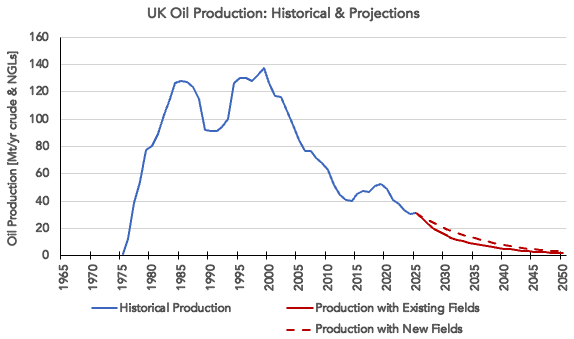
@ECIU_UK That curve is production Not reserves FFS We have 30 years of reserves before new exploration
English
0
0
1
12
ECIU
ECIU@ECIU_UK·
9️⃣3️⃣% of North Sea oil and gas likely to ever be produced has 𝗮𝗹𝗿𝗲𝗮𝗱𝘆 been extracted - new analysis Over next 25 years, of the remaining 7% of the culmulative total just 1-2% of gas (381 TWh) and oil (74M tonnes) would come from new drilling. eciu.net/media/press-re…
ECIU tweet media
English
5
8
9
473
Here&There
Here&There@here_there·
Does anyone have a view on living in South Africa? The UK is rapidly turning itself into SA - without the weather and the wine
English
1
0
3
251
Here&There
Here&There@here_there·
@Frencheconomics And having the most incoherent energy policy in the world. It’s not just balance of payments that suffers it’s credibility with a perception that ideology and zealotry trump economic and physics
English
0
0
1
212
Simon French
Simon French@Frencheconomics·
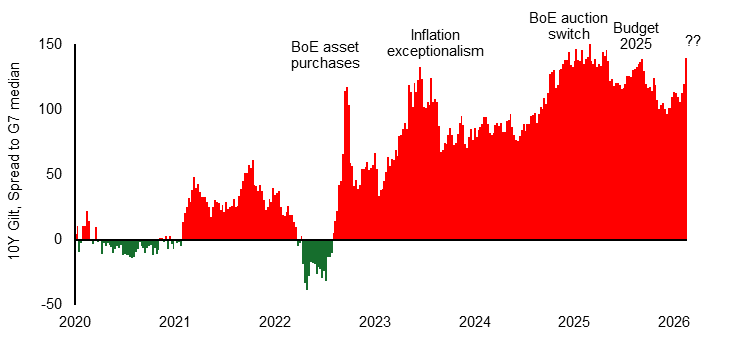
Moron Premium update. 139bp spread this morning between 10Y Gilts and G7 benchmark is consistent with previous BoE interventions in the Gilt market. Who would have thought that lumping on speculation around fiscal rules/ energy bailouts/ and soft public finance data would be received badly in fixed-income markets?
Simon French tweet media
Simon French@Frencheconomics

The big move in the short end of the Gilt curve (+90bp since Iran War began) has a lot of influencing factors right now, and there is a degree of selective interpretation depending on priors. But I would suggest a top five: 1. The UK is by DM standards a high inflation economy (because it rations energy, land and capital). Inflation has averaged 3%/year since 2010. An energy shock hits UK hardest, so inflation premia on short dated Gilts quickly emerges 2. UK rate cuts and an inflation slowdown were a consensus trade for Q2 so unwinding that positioning by allocators risks overshooting - particularly with a scarcity of institutional Gilt buyers (one of the legacies of the ongoing DB-DC pensions transition) and ongoing QT 3. An expensive bailout of household and business energy bills would likely result in an unexpected increase in short-dated Gilt issuance - so higher interest rates will be required to clear the market. I am surprised GBP has held up so well FWIW. 4. Rayner manoeuvres of recent days brings UK political change (with more issuance, more spending, more friction, institutional uncertainty) back on the table. Pricing that impact (comments about the OBR are classic bogeyman tactics) remains tricky, but qualitatively it certainly has been noticed. 5. BoE appears worried around inflation expectations - that remain elevated, at least in survey-based measures. A hawkish reaction that asserts low tolerance for any “look through” reprices the UK rate path. That kicked off yesterday’s move - but the qualitative MPC comments couldn’t justify, in isolation, the degree of repricing. Some of these factors unwind v quickly on anything that looks like a ceasefire - the benefits of being a high beta sovereign. Some are longer-lasting (political/structural) and should signal to Labour MPs demanding “rewritten fiscal rules” that the starting appetite for more issuance is already thin.


English
6
23
73
9.2K
Here&There
Here&There@here_there·
This 👇
Liam Halligan@LiamHalligan

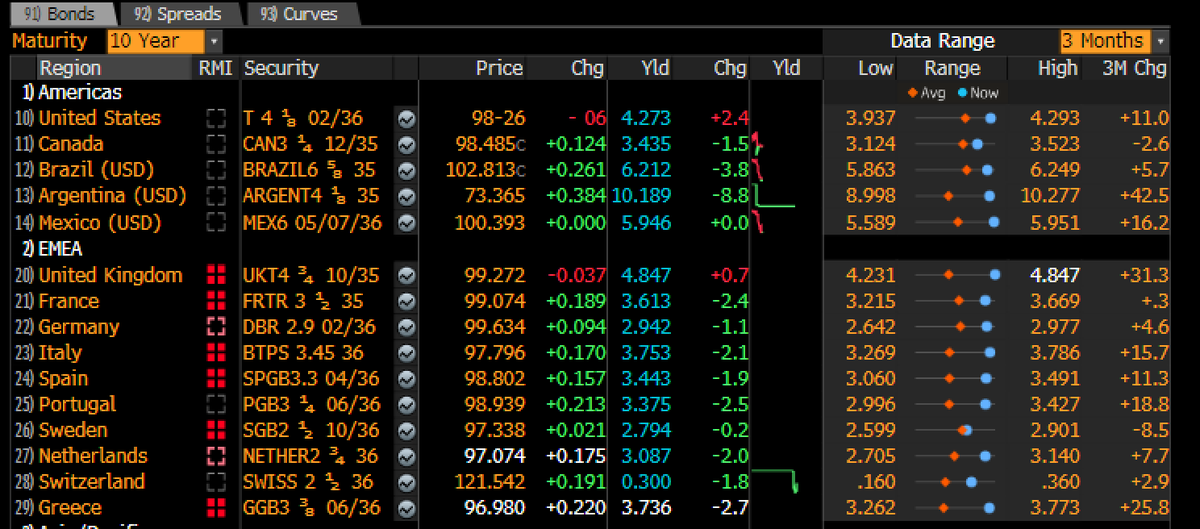
Check out the ten-year gilt yield this morning - after the UK's likely next Prime Minister tried to lecture international investors about the intricacies of fiscal policy and the UK's national accounts. A subject about which she clearly knows absolutely nothing. Nice one @AngelaRayner !!! Markets now demanding 4.9% per annum to lend money to the British government. In Morocco, it's 3.4%. And get this. In February 2026, the UK government a massive £14.3 billion - according to figures released this morning. No less than £13 billion of that money borrowed last month went on interest payments on existing debt. Think about that for one second - it's utterly insane. The UK's national accounts are now akin to a Ponzi scheme. And yet still, lunatic MPs and potential Prime Ministers call for ever more borrowing and spending - "because it's the right thing to do" Labour's chronic economic illiteracy and internal party-political posturing is driving the UK economy off a cliff ... ⬇️⬇️⬇️⬇️

English
0
0
0
262
Here&There
Here&There@here_there·
@KallumPickering Problem is Starmer does subsidies not economics He does ideology (Milliband) not Treasury
English
0
0
0
274
Kallum Pickering
Kallum Pickering@KallumPickering·
On a day when European bond markets are up (partly reversing yesterday's losses), the UK market is off again... The government should see this as a warning ahead of getting any ideas over energy subsidies - the gilt market may not wear it #ukeconomy #ukmacro
Kallum Pickering tweet media
English
3
12
65
7K
Here&There
Here&There@here_there·
@thorpesi They do not do economics They do redistribution
English
1
0
1
16
Simon Thorpe
Simon Thorpe@thorpesi·
It would help if all our politicians read this
Simon French@Frencheconomics

The big move in the short end of the Gilt curve (+90bp since Iran War began) has a lot of influencing factors right now, and there is a degree of selective interpretation depending on priors. But I would suggest a top five: 1. The UK is by DM standards a high inflation economy (because it rations energy, land and capital). Inflation has averaged 3%/year since 2010. An energy shock hits UK hardest, so inflation premia on short dated Gilts quickly emerges 2. UK rate cuts and an inflation slowdown were a consensus trade for Q2 so unwinding that positioning by allocators risks overshooting - particularly with a scarcity of institutional Gilt buyers (one of the legacies of the ongoing DB-DC pensions transition) and ongoing QT 3. An expensive bailout of household and business energy bills would likely result in an unexpected increase in short-dated Gilt issuance - so higher interest rates will be required to clear the market. I am surprised GBP has held up so well FWIW. 4. Rayner manoeuvres of recent days brings UK political change (with more issuance, more spending, more friction, institutional uncertainty) back on the table. Pricing that impact (comments about the OBR are classic bogeyman tactics) remains tricky, but qualitatively it certainly has been noticed. 5. BoE appears worried around inflation expectations - that remain elevated, at least in survey-based measures. A hawkish reaction that asserts low tolerance for any “look through” reprices the UK rate path. That kicked off yesterday’s move - but the qualitative MPC comments couldn’t justify, in isolation, the degree of repricing. Some of these factors unwind v quickly on anything that looks like a ceasefire - the benefits of being a high beta sovereign. Some are longer-lasting (political/structural) and should signal to Labour MPs demanding “rewritten fiscal rules” that the starting appetite for more issuance is already thin.

English
1
0
1
109
Here&There
Here&There@here_there·
@mwt2008 @bbcquestiontime Known reserves are 30 years They have more as they have drilled a lot more exploration wells so there reserves have growth We have now Miliband says we need hydrocarbons until 2030 so
English
0
0
0
92
Mark W Tebbutt
Mark W Tebbutt@mwt2008·
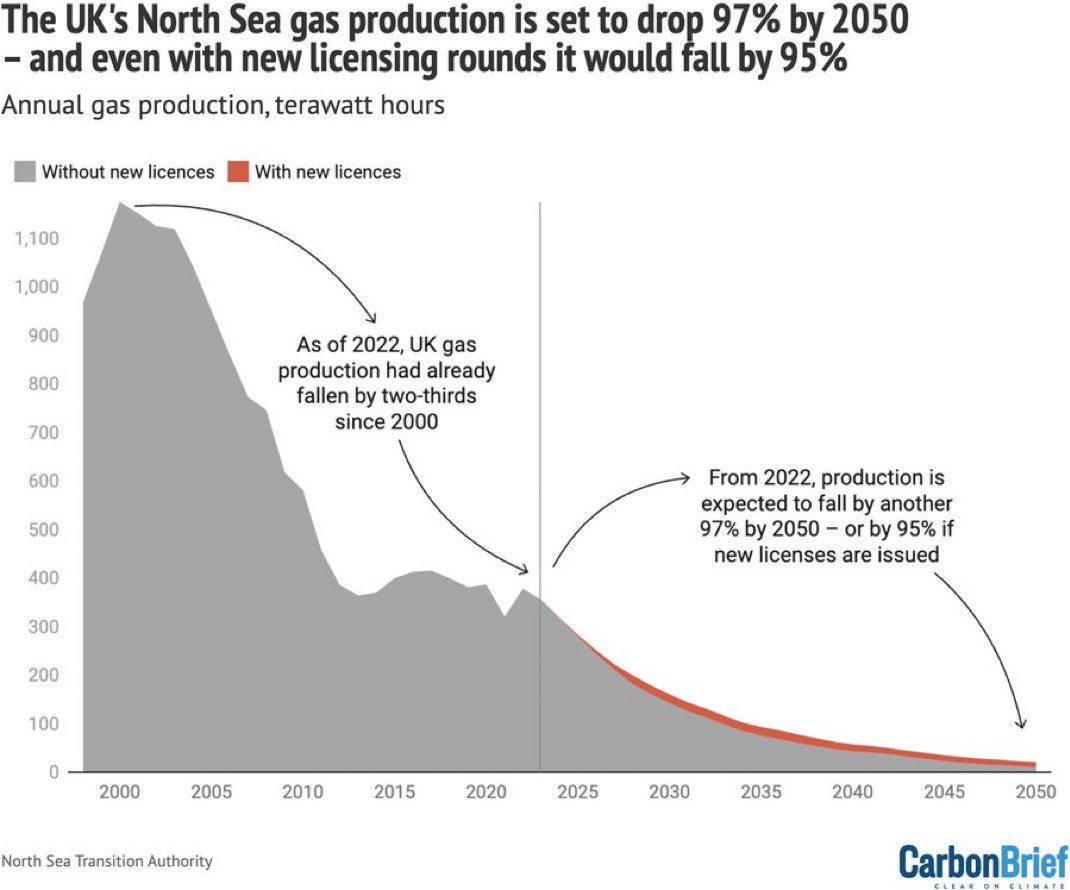
.@bbcquestiontime The UK has far less oil & gas than Norway for a simple reason: we used it faster. UK North Sea production peaked around 2000 and has already fallen by ~⅔. From here it drops ~95–97% by 2050, even with new licences. Why? • Smaller, more fragmented fields • Faster early extraction • Lower recovery rates historically • Mature basin now in decline Norway is different: • Bigger fields • Higher recovery (50–60%+) • Slower, long-term extraction So they still have more left. This isn’t politics. It’s geology and timing. #bbcqt
Mark W Tebbutt tweet mediaMark W Tebbutt tweet mediaMark W Tebbutt tweet mediaMark W Tebbutt tweet media
English
14
19
53
2.7K
Tim Jones
Tim Jones@Timothy37619215·
How many times do all the advocates for more extraction of North Sea oil and gas have to be told it won’t make one iota of difference to 🇬🇧 supply and prices . WE DONT QWN IT!!! The multinationals do . It was all sold off by Thatcher ffs !!!
English
276
241
1.1K
39.4K
Here&There
Here&There@here_there·
@Frencheconomics 6) Net Zero is inflationary and non sensical. If we had a more measured policy of intermittent spend, carbon tax and a coherent policy around importing hydrocarbons whilst closing the North Sea would the moron premium not narrow?
English
1
0
10
565
Simon French
Simon French@Frencheconomics·
The big move in the short end of the Gilt curve (+90bp since Iran War began) has a lot of influencing factors right now, and there is a degree of selective interpretation depending on priors. But I would suggest a top five: 1. The UK is by DM standards a high inflation economy (because it rations energy, land and capital). Inflation has averaged 3%/year since 2010. An energy shock hits UK hardest, so inflation premia on short dated Gilts quickly emerges 2. UK rate cuts and an inflation slowdown were a consensus trade for Q2 so unwinding that positioning by allocators risks overshooting - particularly with a scarcity of institutional Gilt buyers (one of the legacies of the ongoing DB-DC pensions transition) and ongoing QT 3. An expensive bailout of household and business energy bills would likely result in an unexpected increase in short-dated Gilt issuance - so higher interest rates will be required to clear the market. I am surprised GBP has held up so well FWIW. 4. Rayner manoeuvres of recent days brings UK political change (with more issuance, more spending, more friction, institutional uncertainty) back on the table. Pricing that impact (comments about the OBR are classic bogeyman tactics) remains tricky, but qualitatively it certainly has been noticed. 5. BoE appears worried around inflation expectations - that remain elevated, at least in survey-based measures. A hawkish reaction that asserts low tolerance for any “look through” reprices the UK rate path. That kicked off yesterday’s move - but the qualitative MPC comments couldn’t justify, in isolation, the degree of repricing. Some of these factors unwind v quickly on anything that looks like a ceasefire - the benefits of being a high beta sovereign. Some are longer-lasting (political/structural) and should signal to Labour MPs demanding “rewritten fiscal rules” that the starting appetite for more issuance is already thin.

English
15
45
152
28.9K
Here&There
Here&There@here_there·
Why do block replies @GreenRupertRead ? Your reply is just bollocks 1) economic. If we had more production the govt would have more tax revenues. Make tax revenues would mean lower gilts and more flexibility for the Chancellor. You could cut fuel duty 2) climate. Miliband’s own plans have the UK using hydrocarbons for decades. If you care about the climate so much why import dirtier hydrocarbon than domestic. It’s the politics of the playground and rank hypocrisy 3) gas is a local market. We would have lower gas prices with more domestic gas production. 4) more production more security 5) more jobs
Rupert Read 🌍 🔥@GreenRupertRead

Unbelievable shite from Reform’s James Orr on #bbcQT: utterly ridiculous to pretend that decarbonisation is responsible for our lack of energy sovereignty now, when the truth is that it is our ongoing dependence on fossil that makes us so vulnerable now. By contrast, Caroline Lucas on it. Renewables, insulation etc is where it’s at. Not stupid pointless efforts to get a bit more out of the North Sea, which won’t even reduce our bills.

English
1
0
3
453
Here&There
Here&There@here_there·
It’s not really answering my question. In the real world wholesale gas 2 weeks ago was at lows and my electricity bill was at highs. That’s a fact. Yow saw the Commons Select meeting where Head of Octopus said wholesale gas could do to zero and bills would still rise P.S re your reply your adding carbon tax to gas and ignoring all subsidies for intermittent so not like for like Either way can we agree that we need gas for the next 30 years and it would seem mad to be importing dirtier hydrocarbons than what can be produced in the UK and it’s nonsense to be booking emissions on the producer not the consumer
English
0
0
0
12
Mark W Tebbutt
Mark W Tebbutt@mwt2008·
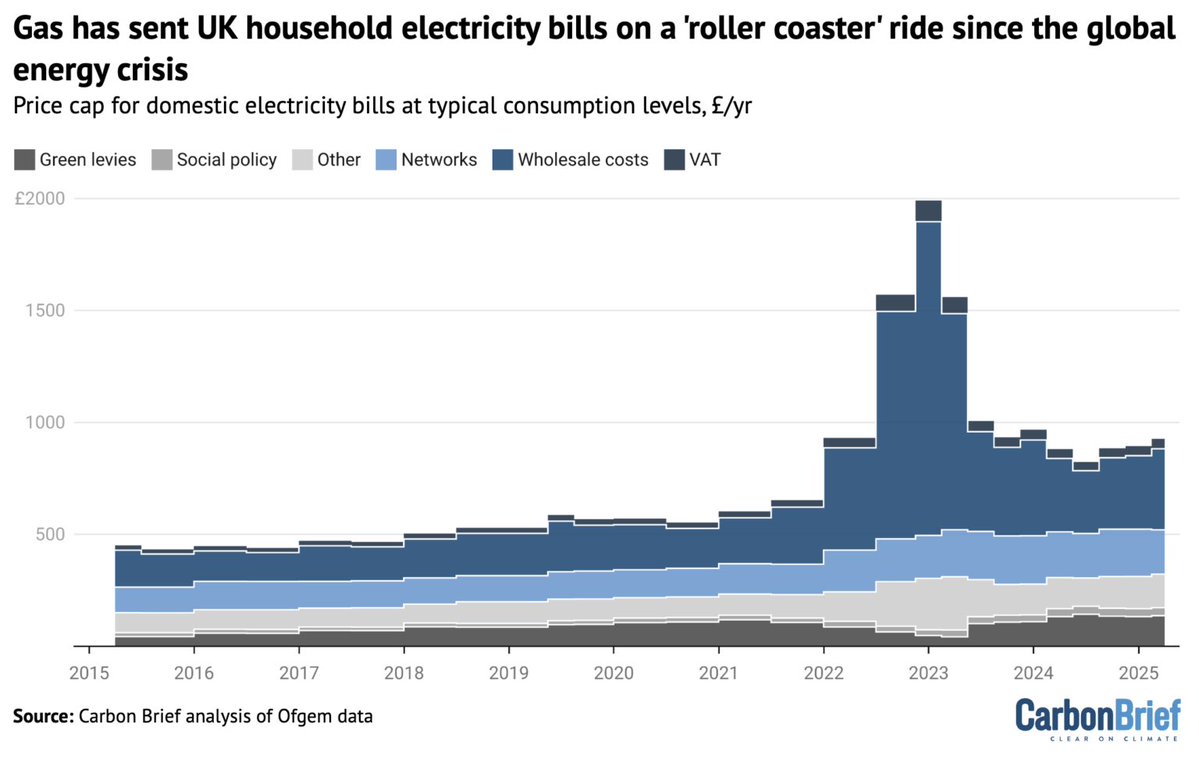
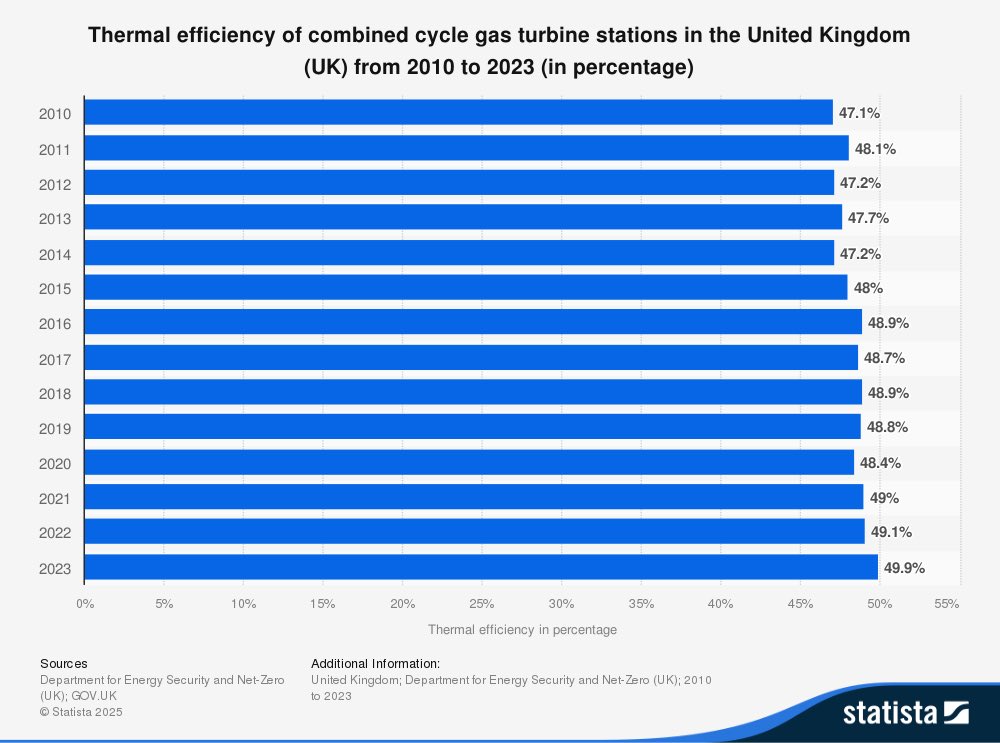
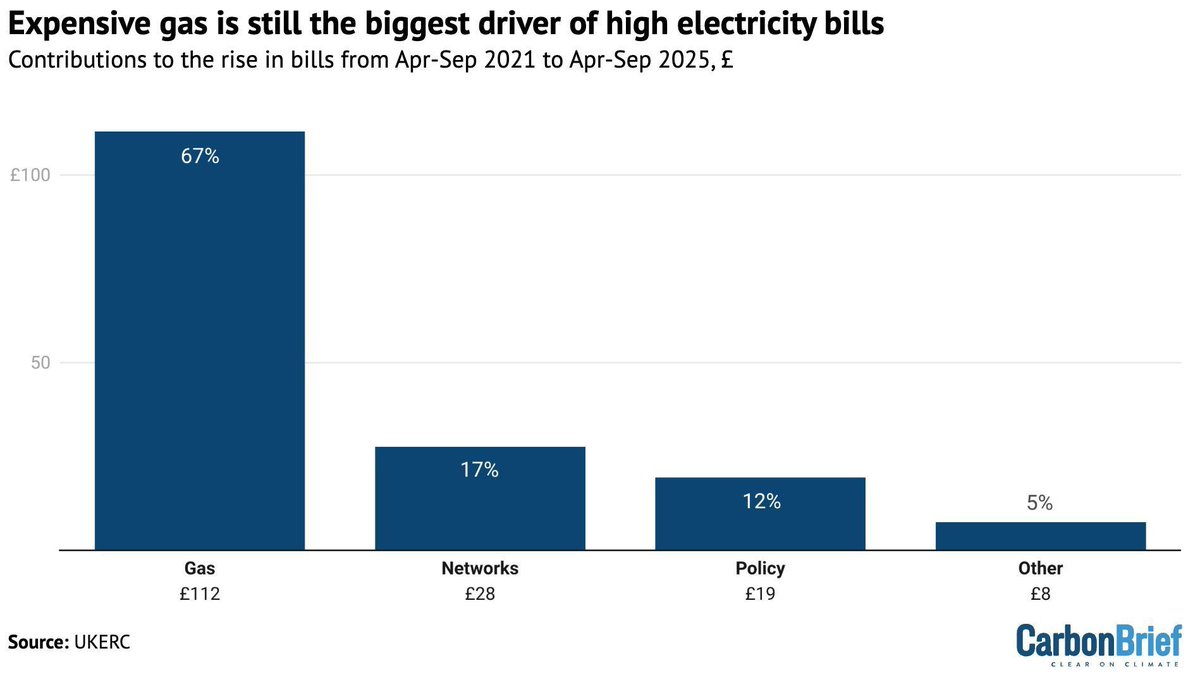
1.Gas sets the price The UK uses marginal pricing. The last unit needed to meet demand sets the price and that’s usually gas. It doesn’t need to be the majority, just the marginal plant. 2.Gas price ≠ electricity cost CCGT is ~47–50% efficient. So: • £50/MWh gas → ~£100/MWh electricity (fuel only) • Add carbon + costs → often £120–£180/MWh+ That’s why gas drives high power prices. 3.The real-world data is clear ~67% of the rise in UK electricity bills came from gas. Bills spike when gas spikes. 4.Your “2 weeks ago” point fails Bills lag wholesale prices due to hedging and the price cap. Short-term gas dips don’t immediately show up in bills. ⸻ Bottom line: Gas doesn’t need to dominate generation to dominate price. It just needs to be the last unit switched on and it’s an inefficient, expensive one. ⬇️
Mark W Tebbutt tweet mediaMark W Tebbutt tweet mediaMark W Tebbutt tweet media
English
1
0
0
19
Bjorn Lomborg
Bjorn Lomborg@BjornLomborg·
The cheap green lie You are told that solar and wind are cheap But you need near-100% backup when no sun or wind, paying for two systems Data for 2024 shows that cramming in more solar and wind makes electricity overall more and more costly iea.org/data-and-stati… Threads&refs: x.com/BjornLomborg/s…
Bjorn Lomborg tweet media
English
67
292
765
38K