Henrik TT

2.3K posts

Henrik TT

Henrik TT

@hes_tt

Katılım Kasım 2013
345 Takip Edilen206 Takipçiler
Hogan Deep
Hogan Deep@DeepHoge·
@hes_tt @FoodForFika @BuschEbba @vonderleyen_epp Du känner dig pressad märker jag. Det första var en artikel om att de ämnar bygga 20 GW. Det andra var info om att ett konkret beslut tagits för 11 GW. Om det blir 20 vet ingen, men det lär det bli. Oavsett, svara nu på hur de skall täcka effektbristen i grafen utan fossilt
Hogan Deep tweet media
Svenska
1
0
0
19
Ebba Busch
Ebba Busch@BuschEbba·
In the largest disruption to global energy supplies in modern history, Sweden stands stronger than most. 🇸🇪 🇪🇺 When Ursula von der Leyen points to Sweden, Europe should listen.
English
76
76
593
27.6K
Pablo The Ukrainian
Pablo The Ukrainian@Pablo_EscobarUA·
@hes_tt @OurWorldInData Exactly. As example, starting 2025 you literally can't buy an ICE car in Norway. So surprise surprise - all new cars in Norway are EV. By choice? No, by law. We can argue if the law is supported or no. It goes to how good you make propaganda.
English
1
0
1
18
Henrik TT retweetledi
Our World in Data
Our World in Data@OurWorldInData·
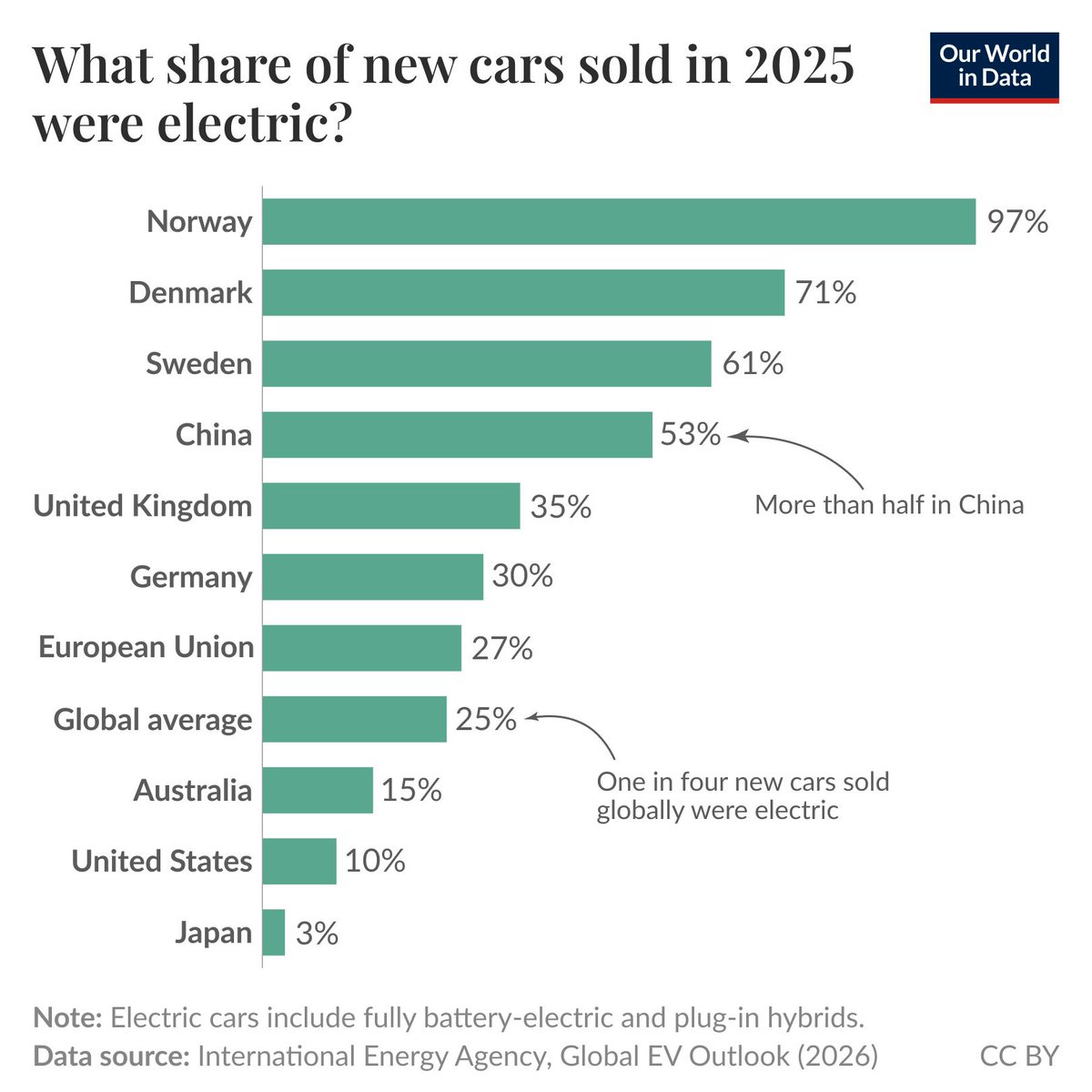
One in four cars sold in 2025 was electric. The International Energy Agency (IEA) just published its latest annual Global EV Outlook. It provides estimates for electric vehicle sales in 2025. One in four (25%) cars sold in 2025 were electric, more than double the share from just four years earlier. But there are large differences in adoption rates across the world. This chart shows new sales shares by country. In Norway, almost every new car is an electric one. In China, more than half are, while in the United States, it’s just 10%. These figures include fully electric vehicles and plug-in hybrids. You can find this data broken down by vehicle type in this chart. (This Data Insight was written by @_HannahRitchie.)
Our World in Data tweet media
English
28
174
470
61.8K
Henrik TT retweetledi
Chris Meder
Chris Meder@EVCurveFuturist·
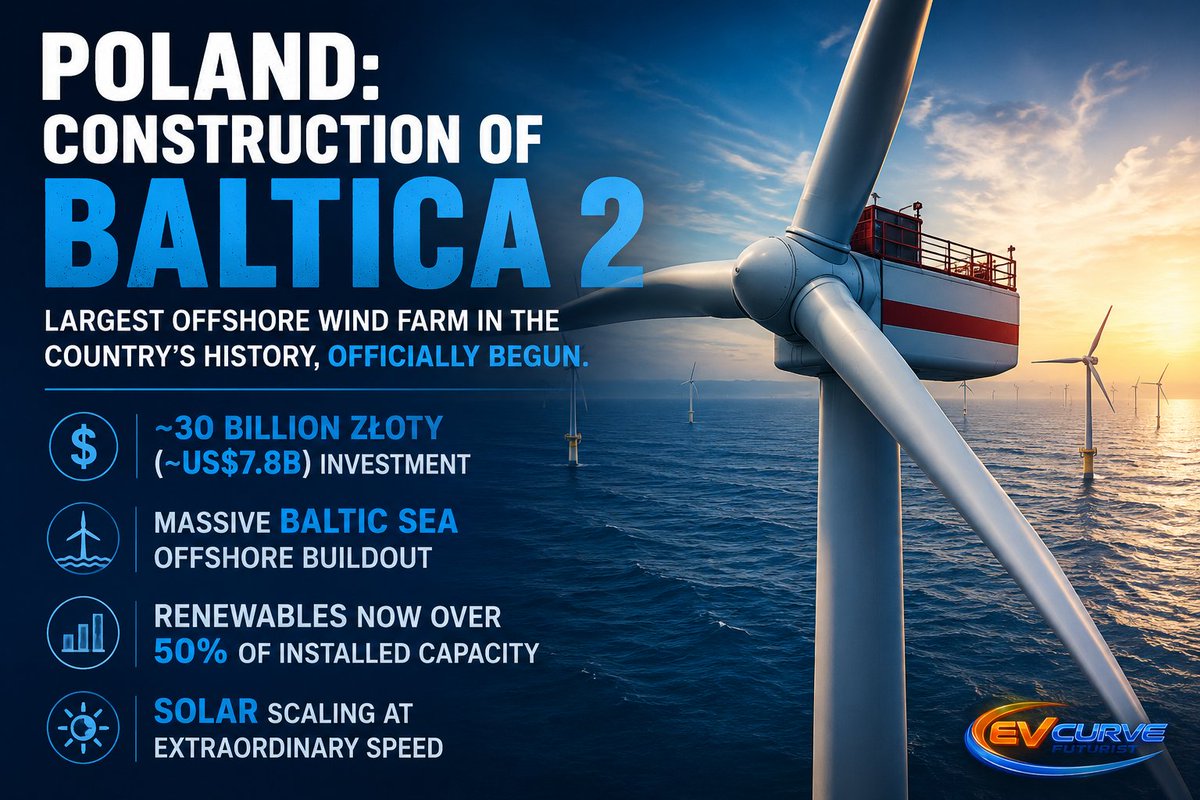
Poland: Construction of Baltica 2, the largest offshore wind farm in the country, officially begun. ~30 billion złoty (~US$7.8B) investment 1.5 GW offshore wind capacity Electricity for ~2.5 million households Renewables now >50% of installed capacity. Coal keeps losing ground!
Chris Meder tweet media
Kancelaria Premiera@PremierRP

🌊 Ruszyła budowa Baltica 2 - największej morskiej farmy wiatrowej w Polsce 🇵🇱 💰 Inwestycja o wartości ok. 30 mld zł wzmocni bezpieczeństwo energetyczne kraju i dostarczy czystą energię dla milionów gospodarstw domowych. 🚢 To kolejny wielki krok w budowie nowoczesnej energetyki na Bałtyku i rozwoju polskiego offshore. #InwestujemyWPolskę

English
3
17
47
1.9K
Henrik TT retweetledi
Chris Meder
Chris Meder@EVCurveFuturist·
With the final April 2026 #EV sales figures now in, it seems the Vikings understood electrification long before the rest of us. They literally made the god of thunder their favourite deity. For years we were told EVs wouldn't work in cold climates. Too much snow. Too dark. Too remote. Batteries would struggle. Consumers wouldn't adapt. Yet the Nordic countries continue to post some of the highest EV adoption rates on Earth. The standout for me is Denmark. A few years ago Denmark wasn't considered an EV leader. Today, more than 4 out of every 5 new cars sold are fully electric. Few analysts, automakers or policymakers would have considered that trajectory plausible back in 2020. Denmark's trajectory alone makes me want to revisit my global EV penetration model. If a mature European market can move from 7% to 81.9% BEV share in just six years, how many 2030 forecasts are still underestimating the pace of disruption? The other fascinating signal is what happens to PHEVs. Again and again they appear to act as a bridge technology rather than a destination. Once BEV penetration pushes beyond roughly 50%, PHEV growth often stalls and then starts losing share as consumers increasingly skip the compromise and go straight to full electrification. Norway showed us what a completed transition looks like. Denmark may now be showing us what the steepest part of the S-curve looks like. cleantechnica.com/2026/05/15/new…
Chris Meder tweet media
English
8
38
106
5.8K
Pablo The Ukrainian
Pablo The Ukrainian@Pablo_EscobarUA·
@OurWorldInData Now break this statistics down to each of these countries laws and policies how they force people to buy EVs instead of other cars.
English
1
0
0
87
GalorAtom
GalorAtom@AtomGalor·
@OurWorldInData The question the IEA skips: where does the electricity come from? French EVs run on nuclear. German EVs run on lignite. Same car, different planet.
English
3
0
3
296
Hogan Deep
Hogan Deep@DeepHoge·
@hes_tt @FoodForFika @BuschEbba @vonderleyen_epp Du kunde alltså inte förklara varför de behöver bygga ny gaskraft motsvarande 11 kärnreaktorer. Visste väl det. Ett tips är att de behöver fylla glappet i bifogad realtidskurva, som visar behov samt produktion (sol/vind), i realtid. Vissa tror att mer sol/vind löser det.
Hogan Deep tweet media
Svenska
1
0
0
18
Henrik TT retweetledi
Assaad Razzouk
Assaad Razzouk@AssaadRazzouk·
New: EVs set to capture an impressive 28% of global car sales in 2026 says @IEA. Petrol cars will, very soon, be for museums only Wild how off the mark the IEA has been: In 2019, they thought we'd barely hit a 5% share by now
Assaad Razzouk tweet media
English
36
134
449
51.4K
Henrik TT
Henrik TT@hes_tt·
@DeepHoge @FoodForFika @BuschEbba @vonderleyen_epp Vad hände med de 20 GW gas du nämnde längre upp? Javisstja, de behövdes ej så nu har skissen redan halverats 😄 Och allt dyrare och långsam gasutbyggnad ska ju konkurrera med allt billigare förnybart - t ex batterier i liknande skala. Så håll tummarna 😏 x.com/ember_energy/s…
Ember@ember_energy

Germany had 2.5 GW of operational grid-scale batteries in 2025, the largest fleet in the EU 🔋 Another 10 GW is in the pipeline. Had that capacity been online in 2025, Germany could have avoided €830 million in gas purchases and solar redispatch costs. ember-energy.org/latest-insight…


Svenska
1
0
0
19
Hogan Deep
Hogan Deep@DeepHoge·
@hes_tt @FoodForFika @BuschEbba @vonderleyen_epp Kolla om du också kan hitta lite info om varför man behöver bygga 11 GW gaskraft, som då motsvarar ungefär 11 nedlagda kärnreaktorer. Kolla även om du hittar info hur man blir fossilfri när man bygger ny gaskraft. Du kan även kolla på importbehovet.
Svenska
1
0
0
17
andre seiler 🇨🇭🇬🇧
@Faktencheck2030 Allerdings ist Spanien gerade daran sich bezüglich dem Bau von neuen Atomkraftwerken neu zu orientieren -das Blackoput welches nachweislich auf die Überlastung des Netzes durch nicht kontrollierbaren Sonnenstrom hat seine Spuren hinterlassen...
Deutsch
2
0
5
130
Faktencheck_jetzt
Faktencheck_jetzt@Faktencheck2030·
Atomkraft: 🌞Solarstrom verdrängt französische AKW⚛️Durch günstigen Strom aus Photovoltaik, insbesondere aus Spanien, lohnt sich bald die Leistung der unflexiblen subventionierten Kernkraft nicht mehr. #Erneuerbare golem.de/news/atomkraft…
Deutsch
340
246
671
16.5K
Hogan Deep
Hogan Deep@DeepHoge·
@hes_tt @FoodForFika @BuschEbba @vonderleyen_epp Fattar inte vad du pratar om. Tror du att man kan bygga ett elsystem i norra Europa med enbart sol och vind, så får du gärna fortsätta att leva i den villfarelsen. En villfarelse Tyskland hade för drygt 15 år sedan, men som nu med all önskvärd tydlighet visar sig vara helt fel.
Svenska
1
0
0
22
Per Everhill
Per Everhill@PEverhill·
Det här. Tysk energipolitik är så episkt misslyckad på alla plan. Klimat, försörjningstrygghet och prisnivå på europeisk bottennivå. Och på mindre än 20 år. politico.eu/article/german…
Svenska
29
79
411
9.3K
Henrik TT
Henrik TT@hes_tt·
@ChristinaSpjut @PEverhill @Sworks35378198S Fel. Tyskland har inte beställt någonting. Det enda de gjort är att avisera bidrag för ny gaskraft. Återstår att se om några energibolag som gillar att leva på bidrag anmäler sig...
Svenska
0
0
0
9
Christina Spjut
Christina Spjut@ChristinaSpjut·
@PEverhill @hes_tt @Sworks35378198S Med ett mkt stort antal gasturbiner minskar Tysklands behov av kol för elproduktion. Däremot ökar behovet av gas mkt kraftigt. Blir det att åter köpa från Ryssland?
Svenska
1
0
0
21
Christina Spjut
Christina Spjut@ChristinaSpjut·
@hes_tt @PEverhill @Sworks35378198S Så koleldningen "kommer att upphöra inom några år". Tyskland har flera ggr drabbats av s.k dunkelfläute och energikrävande industri har flyttat, övrig industri dragit ner. IG Metall har kontaktat energiministern pga oro för Tysklands avindustrialisering.
Svenska
1
0
0
29
Henrik TT
Henrik TT@hes_tt·
@PEverhill @ChristinaSpjut @Sworks35378198S Fel. Kolet har fortsatt minska för varje månad den senaste tiden. T ex i mars var minskningen marginell, men kolla vad som händer med förnybart: x.com/energy_charts_…
Leonhard Gandhi@energy_charts_d

@lahs2301 @thinkBTO Im Vergleich zum März 2025 ist im März 2026 die erneuerbare Stromerzeugung um 3,7 TWh gestiegen. Erdgas ist leicht gefallen und Braun- und Steinkohle waren in Summe konstant. Die erneuerbaren Energien haben dafür gesorgt, dass der Strompreis konstant blieb energy-charts.info/charts/energy/…

Svenska
1
0
0
23
Christina Spjut
Christina Spjut@ChristinaSpjut·
@hes_tt @PEverhill @Sworks35378198S Detta fenomen kan förstås allvarligt försvåra Tysklands planerade utfasning av koleldningen. x.com/peterdclack/st…
Peter Clack@PeterDClack

Many of the onshore wind farms along the coasts of the UK and Denmark are falling apart after only 10 years. A study reveals that energy contributions from wind farms begin to fall sharply after only 10 to 15 years, leaving the skeletons of steel and plastic blowing in the wind. The economic analysis reveals the lifespan of an onshore turbine is not 20 to 25 years, as stated by the wind industry itself, supported by the UK Government. This peer reviewed British study reveals that the energy production of onshore wind farms falls substantially as they get older, due to wear and tear. Energy and environmental economist, Professor Gordon Hughes (University of Edinburgh), carried out the statistical analysis of wind farm performance data in the UK and Denmark. He concluded that load factors, like electricity generated as a percentage of capacity, declined a lot faster than expected, suggesting a baseline 10 to 15 year lifespan. This is when the technical life of most turbines crunch to halt, and become unprofitable to continue. Rising maintenance costs makes them uneconomical. The study found the average UK wind farm's ability to meet electricity demand had fallen by a third after around 10 years, leading to a conclusion that many are fully uneconomic to run after only 12 years. While the wind industry generally forecasts a 25-year lifespan, the data reveals a different reality about the viability of keeping them spinning so long. Many companies now 'repower' (replace old turbines with new ones) long before the 25-year target to maximise subsidies and output. This often ends the lifespan of the original hardware much sooner. The wind farm study is published by the 'Renewable Energy Foundation on the Performance of Wind Farms in the United Kingdom and Denmark, 2012'.

Svenska
1
0
0
23