Stefi

407 posts

Stefi banner
Stefi

Stefi

@hey_stefi_

Data Scientist interested in Impact evaluation of onchain funding distribution | ex - @gitcoin, @0xHolonym | @FundingCommons 2023/2025 resident

Katılım Ekim 2022
349 Takip Edilen194 Takipçiler
Sabitlenmiş Tweet
Stefi
Stefi@hey_stefi_·
For the past months I’ve been deep in research on how to measure the real ROI of onchain public goods funding. I’ve done it all independently, without sponsorship, because I truly believe we can build a more sustainable funding system in web3, and that allocating resources well can genuinely change the world. Now I’m looking for support to keep building this. I’ve submitted my research (Onchain ROI Lab) to the @FundingCommons Frontier Fund on Artizen. This weekend, contributions are matched 4x, so any support can go much further. Project: artizen.fund/index/p/onchai… Fund: artizen.fund/index/mf/fundi… If you care about making public goods funding more measurable and sustainable, I’d really appreciate the support, it can be money , it can be votes 🙏
Stefi@hey_stefi_

I’ve just wrapped up the first phase of my research on applying causal analysis to evaluate the impact of funding for onchain projects. I had already shared the main research post, now I’m publishing a follow-up with: • Gaps in infra & best practices that are holding back more robust grant impact evaluation • Key learnings from interviews + the research process • Practical tips for data folks applying causal methods in this context • All queries used to access the data + the full analysis notebook If you’re working with grants, public goods funding, or onchain data, would love your thoughts. github.com/stefi-says/onc…

English
6
5
29
537
Stefi
Stefi@hey_stefi_·
@devanshmehta @Artizen Cool product review, but have you looked into the tokenomics? I’ve been diving into it since I’m participating in one of the funds. Glorious Definitely worth checking out. Do you have a project in any of the funds too?
English
0
0
1
14
Devansh Mehta
Devansh Mehta@devanshmehta·
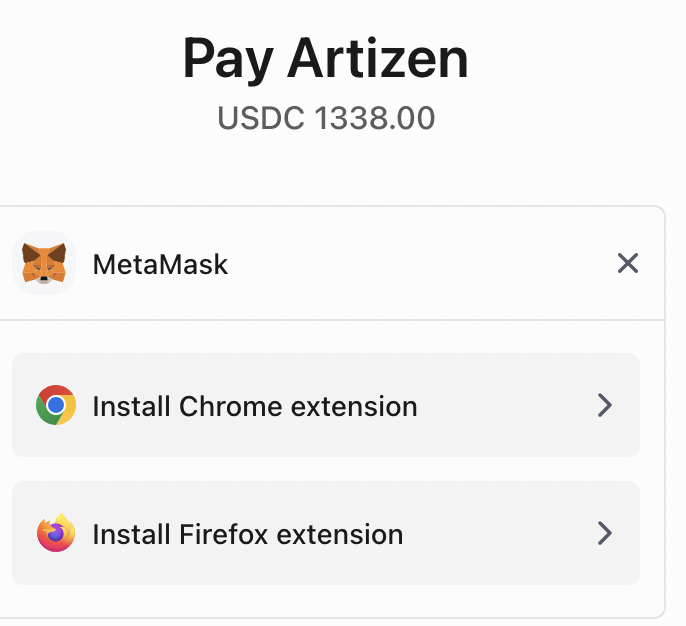
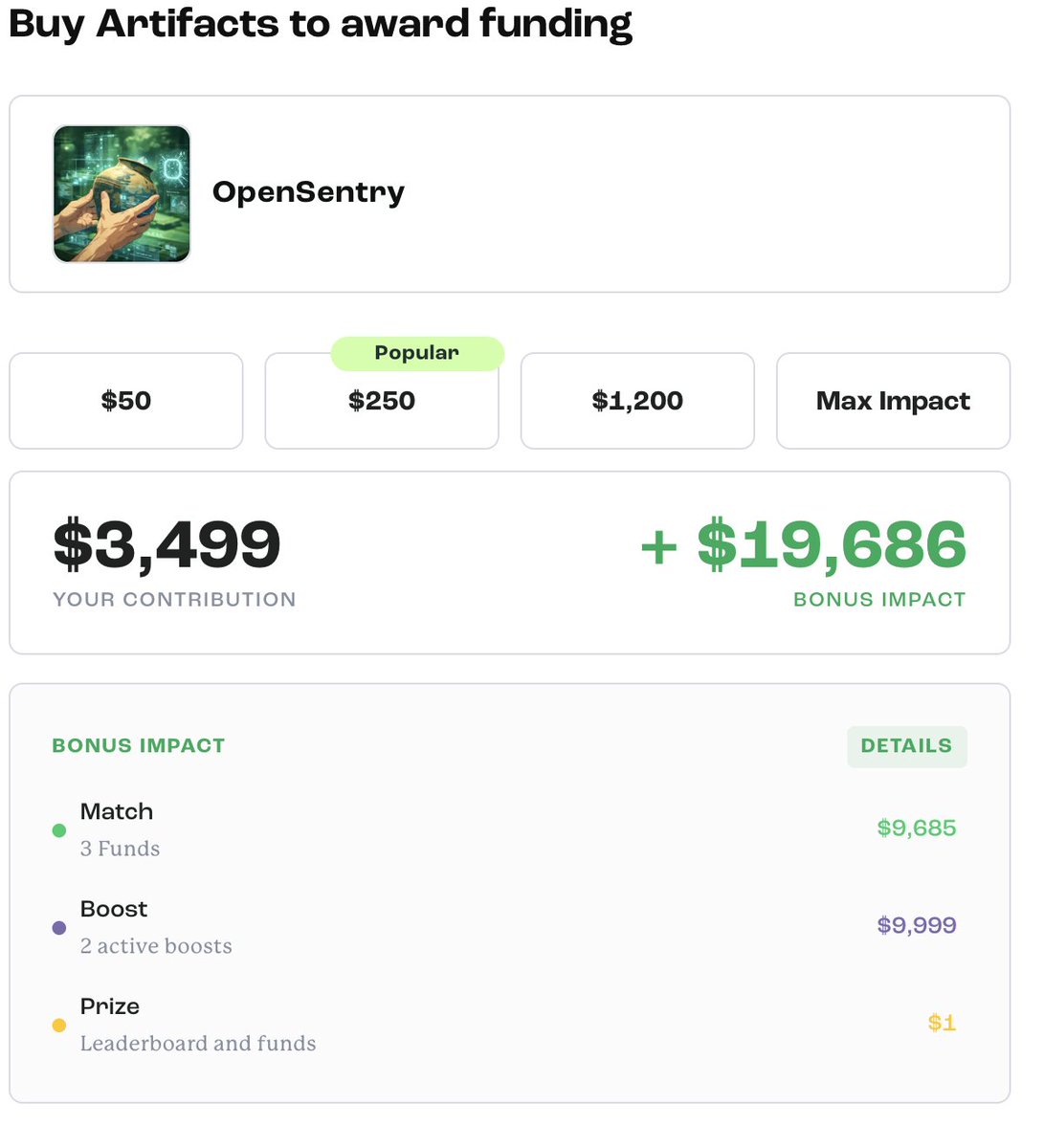
product review: @Artizen its been such a drought for new public goods funding mechanisms that im glad Artizen has emerged as a new torchbearer for the space, with over $5 million in their endowment to be distributed algorithmically to creatives i used their product today to support the amazing @LironAchdut first, a word on UX; im shocked at how enshittified @privy_io has become after its acquisition by @stripe 1. the force login with email was super annoying and unnecessary when i just want to connect my wallet and pay 2. after i go through the whole rigmarole, i see a very pleasant screen showing how far we have come: the option of choosing bank , card or crypto 3. i choose crypto, and immediately encounter a flow breaking bug for artizen in firefox it cant detect that i have already installed metamask. no matter, i see an option to pay by QR which gives me a public key to send the money to. thanks for saving us from your own janky tech, stripe 4. i see stripe taking an obscene $50 fee for a transfer that costs only $0.46 on ethereum 🤮 Now, onto the actual product 1. i like how they've implemented a feature ive long requested @gitcoin : rather than announce a matching pool, the amount coming out from their pot depends on participation if donation is made during a "boost" window in this example, my $3500 could give a match of $20k to the project! instead of having matching funds in a QF round as a fixed variable ($200k b/w all projects!), they make the amount disbursed vary according to how much the community contributes: more participation, more matching funds 2. since they dont do sybil, their main flaw is that projects can simply borrow money, support themselves with it in the round, and then get free matching 3. they also haven't seriously tackled the eligibility question seriously, beyond it being up to campaign curators. if only good projects take part in a round, it doesnt matter if your exact allocation isn't perfect overall definitely worth checking out and getting your project to apply for a relevant category!
Devansh Mehta tweet mediaDevansh Mehta tweet mediaDevansh Mehta tweet mediaDevansh Mehta tweet media
English
12
4
38
2.5K
Srishti
Srishti@srishticodes·
Harvard just made degrees worth $200k obsolete by open-sourcing its Senior AI Engineer roadmap Stop paying for bootcamps. Prof. Vijay Janapa Reddi just put the entire ML Systems (CS249r) curriculum on GitHub. If you master these 6 pillars, you're ahead of 99% of the field: > Architecture > Data Pipelines > Production > MLOps > Edge AI > Privacy This is the "Black Box" of Big Tech infrastructure, open-sourced. Read. Learn. Bookmark. Book - mlsysbook.ai/book/ GitHub Repo -github.com/harvard-edge/c…
Srishti tweet media
English
37
613
4.3K
277.3K
Stefi
Stefi@hey_stefi_·
For the past months I’ve been deep in research on how to measure the real ROI of onchain public goods funding. I’ve done it all independently, without sponsorship, because I truly believe we can build a more sustainable funding system in web3, and that allocating resources well can genuinely change the world. Now I’m looking for support to keep building this. I’ve submitted my research (Onchain ROI Lab) to the @FundingCommons Frontier Fund on Artizen. This weekend, contributions are matched 4x, so any support can go much further. Project: artizen.fund/index/p/onchai… Fund: artizen.fund/index/mf/fundi… If you care about making public goods funding more measurable and sustainable, I’d really appreciate the support, it can be money , it can be votes 🙏
Stefi@hey_stefi_

I’ve just wrapped up the first phase of my research on applying causal analysis to evaluate the impact of funding for onchain projects. I had already shared the main research post, now I’m publishing a follow-up with: • Gaps in infra & best practices that are holding back more robust grant impact evaluation • Key learnings from interviews + the research process • Practical tips for data folks applying causal methods in this context • All queries used to access the data + the full analysis notebook If you’re working with grants, public goods funding, or onchain data, would love your thoughts. github.com/stefi-says/onc…

English
6
5
29
537
Stefi
Stefi@hey_stefi_·
Here’s the revised version with that added, keeping it natural and clear: --- Hey @sejal_rekhan, not sure if you have someone directly focused on measuring ROI of grant distribution, but if so, there’s a “data nerd” section in this piece with tips and best practices for applying causal analysis to onchain transaction data. Also, the first section that is on missing infrastructure and best practices, is useful for grant managers thinking about how to evaluate impact more robustly.
English
0
0
2
64
Stefi
Stefi@hey_stefi_·
I’ve just wrapped up the first phase of my research on applying causal analysis to evaluate the impact of funding for onchain projects. I had already shared the main research post, now I’m publishing a follow-up with: • Gaps in infra & best practices that are holding back more robust grant impact evaluation • Key learnings from interviews + the research process • Practical tips for data folks applying causal methods in this context • All queries used to access the data + the full analysis notebook If you’re working with grants, public goods funding, or onchain data, would love your thoughts. github.com/stefi-says/onc…
English

2
0
5
603
Funding the Commons
Funding the Commons@FundingCommons·
Interested in learning from those shaping public goods infrastructure? 🌍🧱 Here’s a snapshot from our Open Conversations library: builders and leaders working across protocols, privacy, identity, AI, and climate. - @AyaMiyagotchi, @ethereum - @ilblackdragon, @NEARProtocol - @rjdrost, @eigenfoundation - @anke_g_liu, @StellarOrg - @hebbianloop, @humntech - @NanakNihal, @humntech - @JarrodBarnes, @NEARFoundation - @frankie, @nounsdao - @WillWheeler, @nounsdao - @RealInterchain, @LayerOnEth - @JakeHartnell, @LayerOnEth - @dsaezgil, @PachamaInc - @gonzaotc, @OpenZeppelin - @dwddao, @GainForestNow - @RRansil, Devonian - @asoltani, @AmazonHeadwater - @aza, @HumaneTech_ & @earthspecies - Chris Szymczak, @UNICEF - @lunarbyt, @Canarysafe Open Conversations is our short interview series on public goods infrastructure. Full library in the comments 👇
Funding the Commons tweet mediaFunding the Commons tweet mediaFunding the Commons tweet mediaFunding the Commons tweet media
English
2
4
30
765
Stefi retweetledi
Relay Funder
Relay Funder@RelayFunder·
🚨 We're live. Relay Funder just launched—the only crowdfunding platform built exclusively for refugee communities. ✅ 24 campaigns (Kenya & Uganda) ✅ $10K match pool ✅ Every $ flows on-chain to leaders Launch round: Open through Feb 26 app.relayfunder.com Thread 👇
English
15
25
72
9.3K
Stefi
Stefi@hey_stefi_·
@Bookof_Eth @VitalikButerin Kind of agree. But it looks like a matter of prioritization, no one or the other. What would this characteristic be mutually exclusive? Why dont we aim for both, but one then the other? We need to onboard people, making it hard does not look like a successful path
English
0
0
0
9
The Book of Ethereum 📘
The Book of Ethereum 📘@Bookof_Eth·
Ethereum was never meant to be comfortable. It was meant to be enduring. Not faster clicks. Not marginal yield. But a system that still works when power is unpopular, when platforms disappear, when permission is denied. Resilience over efficiency. Sovereignty over convenience. Verification over trust. This is why we build. This is why we endure the friction. This is why Ethereum matters. 📘 The Book remembers.
English
19
20
83
2.5K
vitalik.eth
vitalik.eth@VitalikButerin·
“Ethereum was not created to make finance efficient or apps convenient. It was created to set people free” This was an important - and controversial - line from the Trustless Manifesto ( trustlessness.eth.limo ), and it is worth revisiting it and better understanding what it means. “efficient” and “convenient” have the connotation of improving the average case, in situations where it’s already pretty good. Efficiency is about telling the world's best engineers to put their souls into reducing latency from 473 ms to 368ms, or increasing yields from 4.5% APY to 5.3% APY. Convenience is about people making one click instead of three, and reducing signup times from 1 min to 20 sec. These things can be good to do. But we must do them under the understanding that we will never be as good at this game as the Silicon Valley corporate players. And so the primary underlying game that Ethereum plays must be a different game. What is the game? Resilience. Resilience is the game where it’s not about 4.5% APY vs 5.3% APY - rather, it’s about minimizing the chance that you get -100% APY. Resilience is the game where if you become politically unpopular and get deplatformed, or if a the developers of your application go bankrupt or disappear, or if Cloudflare goes down, or if an internet cyberwar breaks out, your 2000ms latency continues to be 2000ms. Resilience is the game where anyone, anywhere in the world will be able to access the network and be a first-class participant. Resilience is sovereignty. Not sovereignty in the sense of lobbying to become a UN member state and shaking hands at Davos in two weeks, but sovereignty in the sense that people talk about "digital sovereignty" or "food sovereignty" - aggressively reducing your vulnerabilities to external dependencies that can be taken away from you on a whim. This is the sense in which the world computer can be sovereign, and in doing so make its users also sovereign. This baseline is what enables interdependence as equals, and not as vassals of corporate overlords thousands of kilometers away. This is the game that Ethereum is suited to win, and it delivers a type of value that, in our increasingly unstable world, a lot of people are going to need. The fundamental DNA of web2 consumer tech is not suited to resilience. The fundamental DNA of _finance_ often spends considerable effort on resilience, but it is a very partial form of resilience, good at solving for some types of risks but not others. Blockspace is abundant. Decentralized, permissionless and resilient blockspace is not. Ethereum must first and foremost be decentralized, permissionless and resilient block space - and then make that abundant.
English
1.2K
1.2K
7.1K
1.1M
bitpulse
bitpulse@0xBitpulse·
Gm to the ones who GM back!🌅
bitpulse tweet media
English
12
1
19
234
Stefi
Stefi@hey_stefi_·
@IoachimViju @sodofi_ I was wondering the same but I just wash my face and put on sunscreen. I will have to be a hell of concise while trying to tell a story... lol
English
1
0
1
12
ioachim viju
ioachim viju@IoachimViju·
@sodofi_ chat should i start doing vids while i do my makeup?
English
2
0
0
72
sophia
sophia@sodofi_·
grwm as i share why internet-native careers are on the rise
English
13
0
81
3K
Stefi
Stefi@hey_stefi_·
I cant emphasize enough how great is to participate in an residency. The learnings are uncountable. Every residency is a pivot on how I see the world and what I envision for the future. @FundingCommons did a great job on curation and vibes In Buenos Aires. Excited to see what will come out of the next ones. If you have the chance, join the next one. Don’t hesitate.
Funding the Commons@FundingCommons

At builder residencies, different pieces move and recombine, and suddenly the puzzle comes together. As we start planning our next one, we’re looking back at Buenos Aires and what comes up when top talent, ideas, and shared conviction collide. 🌱

English
0
0
2
74
Stefi retweetledi
Funding the Commons
Funding the Commons@FundingCommons·
Grateful to be selected for Octant Epoch 10. Proud to stand alongside projects we deeply respect—supporting public goods, privacy, and Ethereum’s long-term success. 💙
Octant@OctantApp

The Epoch 10 allocation window is officially open. 24 teams building the future of Ethereum's infrastructure, security, and community are waiting for your support. It's time to decide who gets funded. A thread on the cohort 🧵👇

English
0
6
28
1.2K
Shuhei Tanaka
Shuhei Tanaka@shutanaka_jp·
@hey_stefi_ Thanks, Stefi! logic model maps the flow: activities → outputs → outcomes → impact. The tricky part is pinpointing those causal relationships and finding the right evidence for them. That's why we're building AI agents to help generate the model based on user intent
English
1
0
0
33