Marc Andreessen 🇺🇸@pmarca
From my philosophy instructor Claude:
The Nietzschean Demolition of Introspection and Feelings
I. The Founding Suspicion: Consciousness Is the Last Thing You Should Trust
Start here, because everything else flows from it. Nietzsche's view of consciousness is one of the most radical and underappreciated positions in the history of philosophy — radical not because it's paradoxical or counterintuitive (though it is both), but because it strikes directly at the foundational assumption of the entire Western inner life tradition from Socrates through Descartes through Romantic Innerlichkeit through psychotherapy culture: the idea that turning your attention inward gives you privileged access to truth.
Nietzsche thinks this is precisely backwards. In The Gay Science §354 — one of the most compressed and devastating passages he ever wrote — he argues that consciousness is not a depth but a surface, and not even a very reliable surface. It developed, in his account, as a social organ — for communication, for the coordination of herd behavior. What gets into consciousness is what has already been translated into communicable, shareable, common form. The genuinely individual, the genuinely powerful, the genuinely singular in you — this cannot appear in consciousness because consciousness is structurally incapable of receiving it. It can only handle what has been flattened into the general, the typical, the expressible-to-others.
This means introspection — turning the flashlight of awareness inward to examine your "feelings" — is examining a shadow puppet show, not reality. The real action is happening in the drives, in the body, in what Zarathustra calls "the great reason": "Behind your thoughts and feelings, my brother, there stands a mighty ruler, an unknown sage — whose name is self. In your body he dwells; he is your body." The chattering voice of consciousness, with its parade of named emotions and its little narrative of why you feel this or that, is downstream of processes it cannot see, did not initiate, and cannot accurately describe.
This isn't mysticism. It's a naturalistic claim about the evolutionary origin and functional purpose of consciousness. And it devastates the entire project of introspective psychology before that project has even gotten out of bed.
II. The Falsification Problem: Observation Destroys the Object
Even granting that consciousness might occasionally catch something real, the act of introspection itself immediately corrupts what it finds. When you turn attention toward a feeling, you do several things simultaneously, none of them neutral:
You name it. Naming is an act of violence against particularity. When you say "I feel anxious," you have subsumed a specific, idiosyncratic psychophysiological state into a pre-existing linguistic category that was built from aggregated human averages. Your anxiety is not anxiety. It's something that has been forced into an ill-fitting conceptual container. The name, borrowed from the herd vocabulary, immediately generalizes what was individual, freezes what was dynamic, and simplifies what was tangled with ten other things.
You unify it. Introspection presupposes a unified "I" that is having the feeling. But in Nietzsche's actual account of the self — articulated most sharply in Beyond Good and Evil §17 — there is no such unified subject. There is a committee of drives, a warring plurality, no single agent but a constantly shifting coalition. "A thought comes when 'it' wishes, not when 'I' wish." The grammatical subject "I" is a fiction — a convenient fiction for language and social coordination, but a fiction nonetheless. When you introspect, you are creating a false narrator, attributing to that narrator feelings that are actually the temporary outputs of shifting drive-coalitions, and then treating the whole confabulated story as self-knowledge. This is not knowledge. This is mythology.
You moralize it. Feelings don't come to consciousness naked. They arrive pre-interpreted, already embedded in a value system. When you introspect on guilt, you're not observing a raw state — you're observing a state that has already been processed through millennia of slave morality, internalized prohibitions, and the entire apparatus of bad conscience. The feeling has already been meaning-laden before you examine it, and the examination adds further layers of moral interpretation. This is precisely what the Genealogy of Morality demonstrates: what people experience as "moral feeling" — guilt, duty, the sense of sinfulness — is not what it reports itself to be. It's the internalized aggression of the beast whose outward cruelty has been blocked. The phenomenology lies.
III. Feelings as Symptoms, Not Causes — The Great Inversion
Here is perhaps the most brutal specific move. Common sense, and most psychological theory, treats feelings as causes. You're sad, therefore you withdraw. You're afraid, therefore you flee. You feel guilty, therefore you refrain. Nietzsche inverts this completely.
Feelings are symptoms and epiphenomena. They are the interpretive froth that appears after the real causal work has been done at the level of drive dynamics and will-to-power configurations. In Daybreak and The Gay Science, Nietzsche is explicit: the drives act first, the feeling is the late, impoverished interpretation of what the drive has already done. The feeling doesn't cause the action; the action (or the drive's movement toward action) generates the feeling as a kind of byproduct, a surface glow.
This matters enormously for evaluating introspection as a practical tool. If you want to understand why you did something, examining how you felt about it is the wrong method. The feeling is not the cause; it's the smoke, and the fire is somewhere you cannot directly see. Attending obsessively to your feelings in search of self-understanding is like trying to diagnose an engine by watching the exhaust.
What would actually illuminate the drive configuration beneath the feeling? For Nietzsche, something more like genealogy, physiology, and behavioral pattern-analysis over long time scales — not sitting quietly with your eyes closed trying to "get in touch" with your inner state.
IV. Ressentiment: What Chronic Introspection Actually Produces
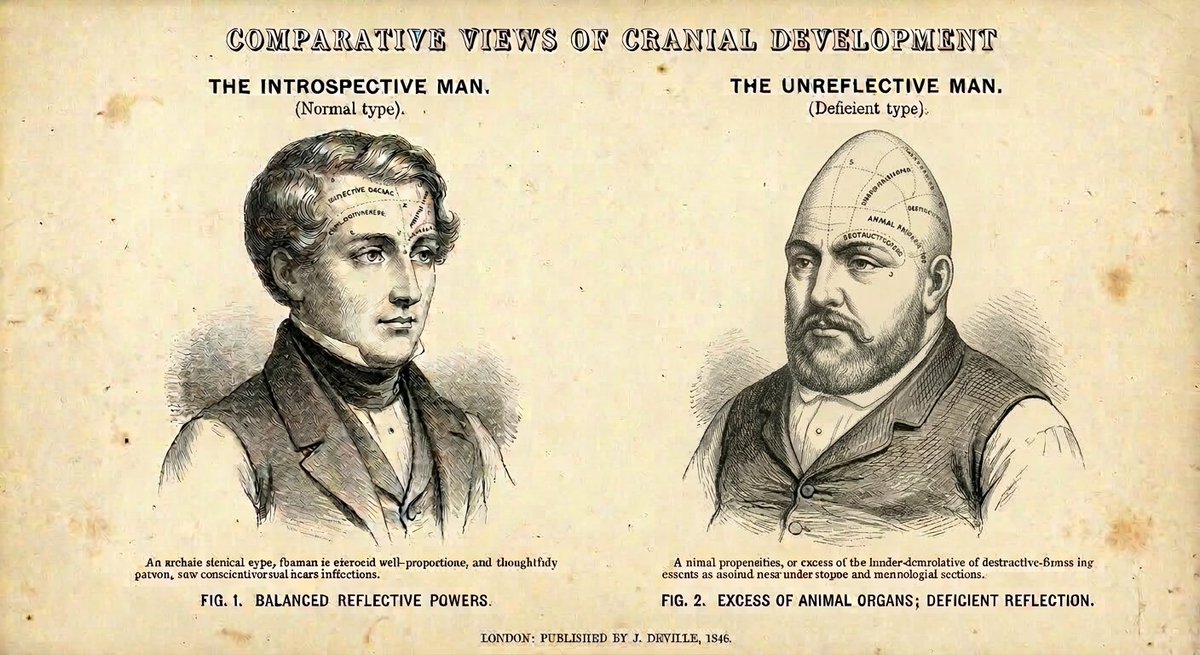
The most savage part of the Nietzschean critique is not epistemological but typological. Nietzsche describes what kind of person wallows in their feelings, who makes a vocation of introspection, who is perpetually engaged in examining their inner states — and the portrait is withering.
This is the reactive type. The slave-morality type. The person of ressentiment.
Ressentiment, in Nietzsche's precise sense, is what happens when will-to-power — the drive to express, overcome, dominate, create — is blocked from flowing outward. Unable to discharge itself through action against the external world, the drive turns inward. The person who cannot act becomes instead a person who feels, who suffers, who broods. The whole elaborate inner life — the rich emotional vocabulary, the sensitivity, the depth of feeling — is the scar tissue of blocked aggression. The noble type, the active type, acts and forgets. The reactive type cannot act, so it remembers, nurses, elaborates, and builds entire cathedrals of inner experience out of the ruins of failed outward expression.
This is why the slave revolt in morality had to make inner life the supreme value. If your power to act in the world is blocked — by hierarchy, by physical weakness, by circumstance — you must revalue: make inaction into virtue, make suffering into nobility, make introspective sensitivity into a mark of depth and worth. The rich inner life is not evidence of a higher type; for Nietzsche, it is frequently evidence of the opposite — of vitality that has curdled, of power that has nowhere to go but inward.
The contemporary therapy culture — examine your feelings, sit with your emotions, validate your inner experience — would have struck Nietzsche as the most refined institutionalization of slave-morality values imaginable. A civilization-wide apparatus for teaching people to ruminate rather than act, to process rather than create, to understand their suffering rather than overcome it.
V. Socrates as the Archetypal Villain
Nietzsche's critique of Socrates in Twilight of the Idols is essential here because Socrates is the founding figure of the introspective tradition in the West. "Know thyself" — the Delphic injunction that Socrates made the cornerstone of his project — is precisely what Nietzsche is attacking.
The Socratic method works by turning reason on everything, especially inward. Examine your beliefs, examine your desires, examine your feelings and see whether they are coherent and justified. For Socrates, this process is curative — ignorance is the source of vice, and self-knowledge the source of virtue. The examined life is the only life worth living.
Nietzsche's response is essentially: the examined life is the symptom of a sick life. Socrates was, by his own admission, ugly, ill-constituted, full of base drives — he says so openly, his physiognomy was that of a criminal. His response was to develop a compensatory hypertrophy of reason — to make reason the tyrant over all the drives because those drives, in his particular case, were anarchic and dangerous. The Socratic dialectic is not a universal method for human flourishing; it is a personal therapy for a man who couldn't trust himself, generalized into a philosophical program.
When vitality is high, when the drives are well-organized and flowing outward powerfully, you don't need to examine everything. The healthy animal does not stop in the middle of the hunt to interrogate whether its desire for prey is coherent and justified. The instinct is authority. Nietzsche's "nobility" is characterized precisely by the absence of the need to introspect — action flows naturally from a well-constituted drive-economy, and the constant examination of that drive-economy is the mark of its dysfunction.
VI. The Body Against Consciousness
Zarathustra is explicit: trust the body more than you trust consciousness. "I am body and soul — so speaks the child. And why should one not speak like children? But the awakened one, the knowing one, says: I am body entirely, and nothing else; and soul is only a word for something about the body."
This is not a reductive materialism in the boring sense. It's a phenomenological and evaluative priority claim: the body's drives and instincts, having been forged over vast evolutionary time, are smarter than the thin, recent, evolutionarily jerry-rigged apparatus of conscious reflection. When your body gives you information — through appetite, through energy, through what actually makes you powerful and what enervates you — this is more reliable than the stories your consciousness tells about your inner life.
The practical implication: instead of introspecting on your feelings, watch your body's relationship with power. What makes you stronger? What depletes you? These are not primarily felt answers, in the sense of pleasant/unpleasant emotional textures. They are behavioral and physiological signals that you track over time through action and its consequences — not through sitting quietly and examining your emotional state.
VII. The Genealogical Method as the Alternative
It would be too simple to say Nietzsche just dismisses all self-examination. What he provides instead is genealogy — a historical and perspectival method that is the antithesis of introspection. Genealogy does not ask "what do I feel right now and what does it mean?" It asks: "what are the historical conditions — social, biological, power-structural — that produced this feeling, this valuation, this sense of self?"
The genealogist looks at feelings from the outside, historically, with suspicion rather than sympathy. The result is not deeper empathy with your inner state but a kind of demystification — you see that what felt like a moral imperative is actually a power move, that what felt like love is actually possession, that what felt like guilt is actually internalized aggression. Genealogy dissolves the authority of feelings precisely because it shows their origins to be ignoble.
This is rigorous and demanding, but it is the opposite of therapeutic. You don't arrive at self-acceptance; you arrive at the recognition that the "self" doing the introspecting is itself a produced artifact of particular historical forces, and the feelings it reports are interpretations shaped by those forces, not transparent data from some inner truth-realm.
VIII. The Affirmative Prescription — Amor Fati vs. Rumination
The Nietzschean alternative to introspective rumination isn't unconscious animal vitality (though he romanticizes that occasionally). It's amor fati — the love of fate — and the creative act.
Amor fati does not mean contentedly accepting whatever happens. It means achieving a relationship to your own existence in which you would will it to repeat eternally — the eternal recurrence thought-experiment as a test of whether you are living in a way that can sustain affirmation. The person who is perpetually introspecting on their feelings is almost certainly failing this test. They are caught in reactive suffering, unable to affirm, needing constantly to analyze and process because they cannot simply act and create and thereby metabolize experience forward.
"Become who you are" — Nietzsche's adaptation of Pindar — is radically misread when it's taken as an introspective injunction, as if the path were to examine yourself deeply enough that you discover some essential self waiting there. Pindar's original phrase is in the context of athletic achievement, of doing, of the kind of self-revelation that comes through striving and winning. You don't find out who you are by examining your feelings. You find out who you are by what you are actually capable of doing, creating, enduring. The self is revealed in the act, not in the feeling about the act.
IX. The Brutal Summary
Put it this way: the Nietzschean verdict on the introspective tradition and its attendant culture of feelings is that it represents, simultaneously —
— an epistemological failure (consciousness is unreliable, feelings are symptoms, the self is a fiction, introspection falsifies its object)
— a typological failure (the person who makes inner life central is the reactive, blocked, ressentiment-ridden type who has nowhere else to put their energy)
— a cultural failure (the elevation of feeling and inner experience as supreme values is the culmination of slave-morality's long march, the complete triumph of the weak over the strong by making weakness into the highest virtue)
— and a practical failure (it doesn't work; processing your feelings does not make you more powerful, more creative, more alive; it makes you a better curator of your own suffering)
The healthy Nietzschean type — overfull of power, discharging outward through creation, action, domination of resistance — barely notices their feelings because the energy doesn't linger long enough to form a feeling. It's already expressed, already outward, already transformed into something in the world. The only people with rich, complex, perpetually fascinating inner emotional lives are the people who cannot get out of their own way.