
ishaan
84 posts


Core - AI Workspace
Launching open-source + hosted (100% free) next week.
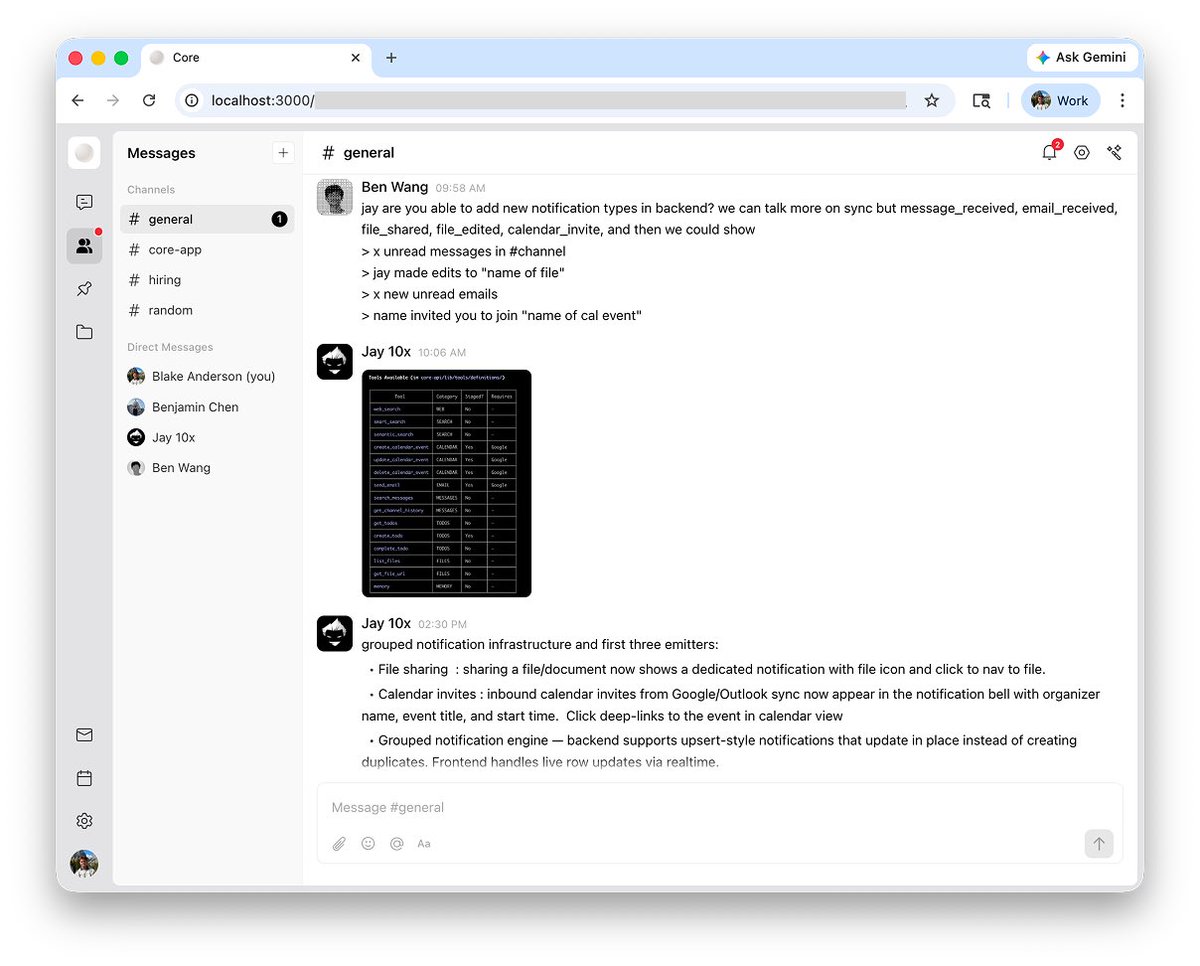
Blake Anderson@blakeandersonw
The next trillion-dollar product will be the AI workspace. Humans work with agents to manage context + execute. I’ve been working on this for the past few months but it’s become clear that the big labs will move faster, re: Perplexirt, Replit. Planning to open-source this project instead. Soon 🙏
English


ishaan retweetledi

(1/n) Evolutionary frameworks like AlphaEvolve and GEPA use diversity and fitness to select which subset of past experiments to condition the next generation on. Why not let an agent choose instead? To this end, we introduce Coding Agents as Text Optimizers (CATO). We beat AlphaEvolve on 2 out of the 3 problems we try.
Work done with @shaurnav. Blogpost and details in thread.
English

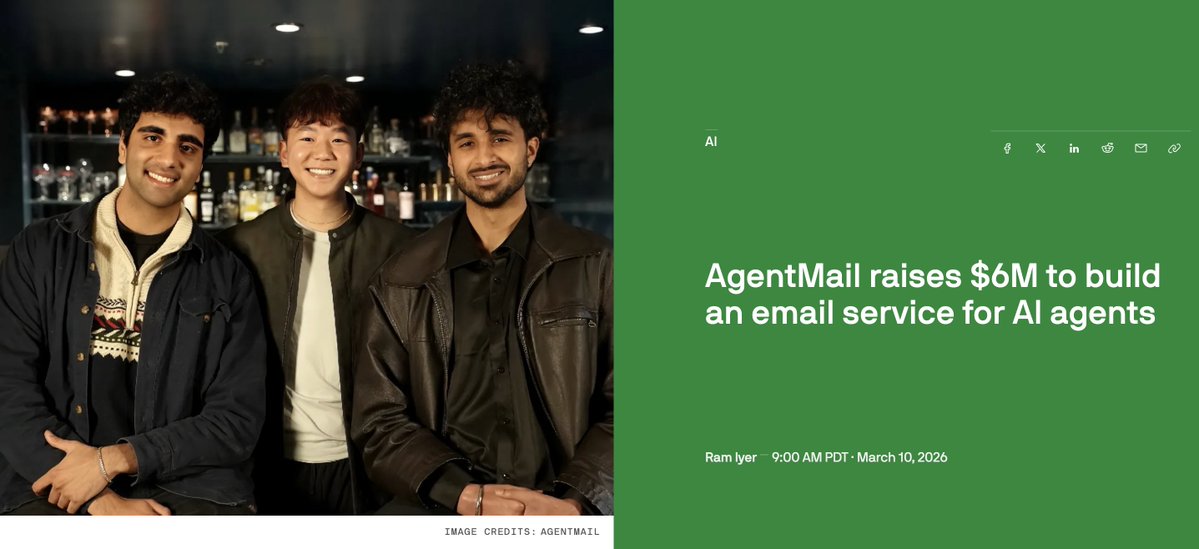
Today is a good day for me to announce that I’ve joined Mind Robotics as a researcher. Excited to build general purpose robots for manufacturing and beyond!
RJ Scaringe@RJScaringe
I am excited to announce Mind Robotics’ $500M financing, co-led by @Accel and @a16z! Mind is focused on building the world’s leading industrial robotics platform, capable of performing dexterous, variable, and reasoning-intensive tasks. Existing industrial robotics can perform repeatable, dimensionally stable tasks, but a large share of industrial value-add work requires human-like dexterity, adaptation, and physical reasoning that classical robotics cannot address. We are building AI-powered robots—models, hardware, and deployment infrastructure—that will perform real tasks, in real plants, at real scale.
English

ishaan retweetledi

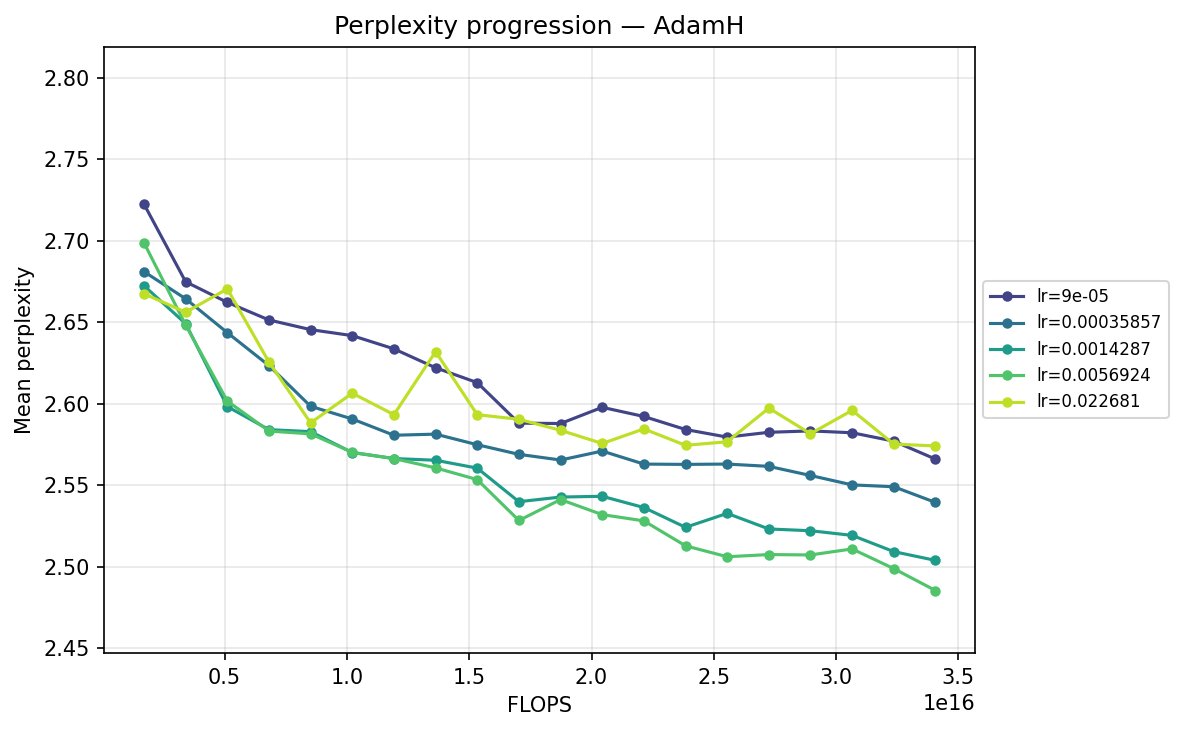
Muon can accelerate LLM training, but does that benefit transfer to regulatory DNA sequence modeling with its different data distribution? 🧬
Our results show that Muon with independent weight decay (MuonW) hits our validation perplexity target in ~37% fewer FLOPs than the best Adam configuration.


English
@abhijaymrana so long as an adoption gap exists there will be ample opportunity to leverage skill (including swe)
much like in the 1880s and 1890s the arb is simply being fast enough to act
ai allows for these redefinitions to be faster
English
My hunch is early LLMs learned to optimise for lines of code as a proxy for ‘solving the task’. Opus 4.6/Codex 5.x models seemed to have moved away from this heuristic, now more concise and significantly better. i’d be curious to know what changed, presumably in post-training
English


Spend too much on capex, jail
Spend too little on capex, jail
You spend just right on capex, believe it or not, jail
English
ishaan retweetledi

Origin (@origin_bio) is using AI to make safer cell & gene therapies for diseases like cancer.
Their model designs DNA switches & dials to program precise gene expression patterns in disease cells.
Congrats on the launch @YashRathod_75 and @malhar317!
ycombinator.com/launches/PMG-o…
English
English
ishaan retweetledi

1/ General-purpose robotics is the rare technological frontier where the US / China started at roughly the same time and there's no clear winner yet.
To better understand the landscape, @zoeytang_1007, @intelchentwo, @vishnuman0 and I spent the last ~8 weeks creating a deep dive on humanoid robotics hardware and flew to China to see the supply chain firsthand.
Here's everything we've created + our takeaways about the components, humanoid comparisons, supply chains, and geopolitics👇
English
ishaan retweetledi

The solution: Mining verifiable rewards from existing business operations.
When models were bad, human-created data was enough to measurably improve performance. But this "human" data inherently has a low ceiling:
1. When contributors (and data vendors) are incentivized to maximize data volume, quality plummets immediately - and meeting VC expectations creates these perverse incentives (notably, Surge, which is bootstrapped, is widely accepted as the "quality-focused" vendor).
2. Since leading data vendors have limited domain expertise (ops-heavy teams have almost no code/legal/etc experts), they rely on these same misaligned contributors (or frequently even LLMs) to QA this "expert" data, leading to mode collapse & hallucinations.
3. These contributors offer an inherently distilled recollection of real business workflows/practices/data. The real data is stored in enterprise software (ERPs, CRMs, and all domain-specific tooling), which these contributors are vaguely piecing together information from.
"Human" data was always the least bad option, like what RL is to training paradigms.
But in the last 6 months, with the cost of software almost driven to zero, mining enterprise data has become economically viable. Why rely on a rushed recollection from a former employee when you can extract the audit-ready data directly?
It's finally becoming possible (and cheap) to turn diverse business processes into verifiable rewards. There are over 200k mid-market companies in the US.
There's an oil well on every corner.
Grace Isford@graceisford
RL works really well when you have a verifiable task - is the math answer correct? does the code run? But non-verifiable tasks like - is this a good essay? is this helpful legal advice? is this a well-reasoned medical diagnosis? are far harder to programmatically verify This is why vertical app companies like @OpenEvidence matter...building datasets that turn fuzzy domains like medical advice into structure & something AI can actually learn from An evergreen post by @_jasonwei on the asymmetry of verification👇
English
ishaan retweetledi

UIUC incredibly important in Silicon Valley history. Other alumni include: Max Levchin (PayPal, Affirm), Marc Andreessen (Mosaic, Netscape, a16z), Steve Chen and Jawed Karim (YouTube), Larry Ellison and Bob Miner (Oracle), Russel Simmons and Jeremy Stoppelman (Yelp!), Thomas Siebel (Siebel Systems), Arnold Beckman (Beckman Instruments), and Scott Banister (IronPort).
Paul Graham@paulg
I bet few people there know it, but YC wouldn't exist without UIUC. My father went there from England on a Fullbright, and came back determined to move to America.
English
ishaan retweetledi
ishaan retweetledi

Agency > Intelligence
I had this intuitively wrong for decades, I think due to a pervasive cultural veneration of intelligence, various entertainment/media, obsession with IQ etc. Agency is significantly more powerful and significantly more scarce. Are you hiring for agency? Are we educating for agency? Are you acting as if you had 10X agency?
Grok explanation is ~close:
“Agency, as a personality trait, refers to an individual's capacity to take initiative, make decisions, and exert control over their actions and environment. It’s about being proactive rather than reactive—someone with high agency doesn’t just let life happen to them; they shape it. Think of it as a blend of self-efficacy, determination, and a sense of ownership over one’s path.
People with strong agency tend to set goals and pursue them with confidence, even in the face of obstacles. They’re the type to say, “I’ll figure it out,” and then actually do it. On the flip side, someone low in agency might feel more like a passenger in their own life, waiting for external forces—like luck, other people, or circumstances—to dictate what happens next.
It’s not quite the same as assertiveness or ambition, though it can overlap. Agency is quieter, more internal—it’s the belief that you *can* act, paired with the will to follow through. Psychologists often tie it to concepts like locus of control: high-agency folks lean toward an internal locus, feeling they steer their fate, while low-agency folks might lean external, seeing life as something that happens *to* them.”
Garry Tan@garrytan
Intelligence is on tap now so agency is even more important
English