

Brian Roach
251 posts


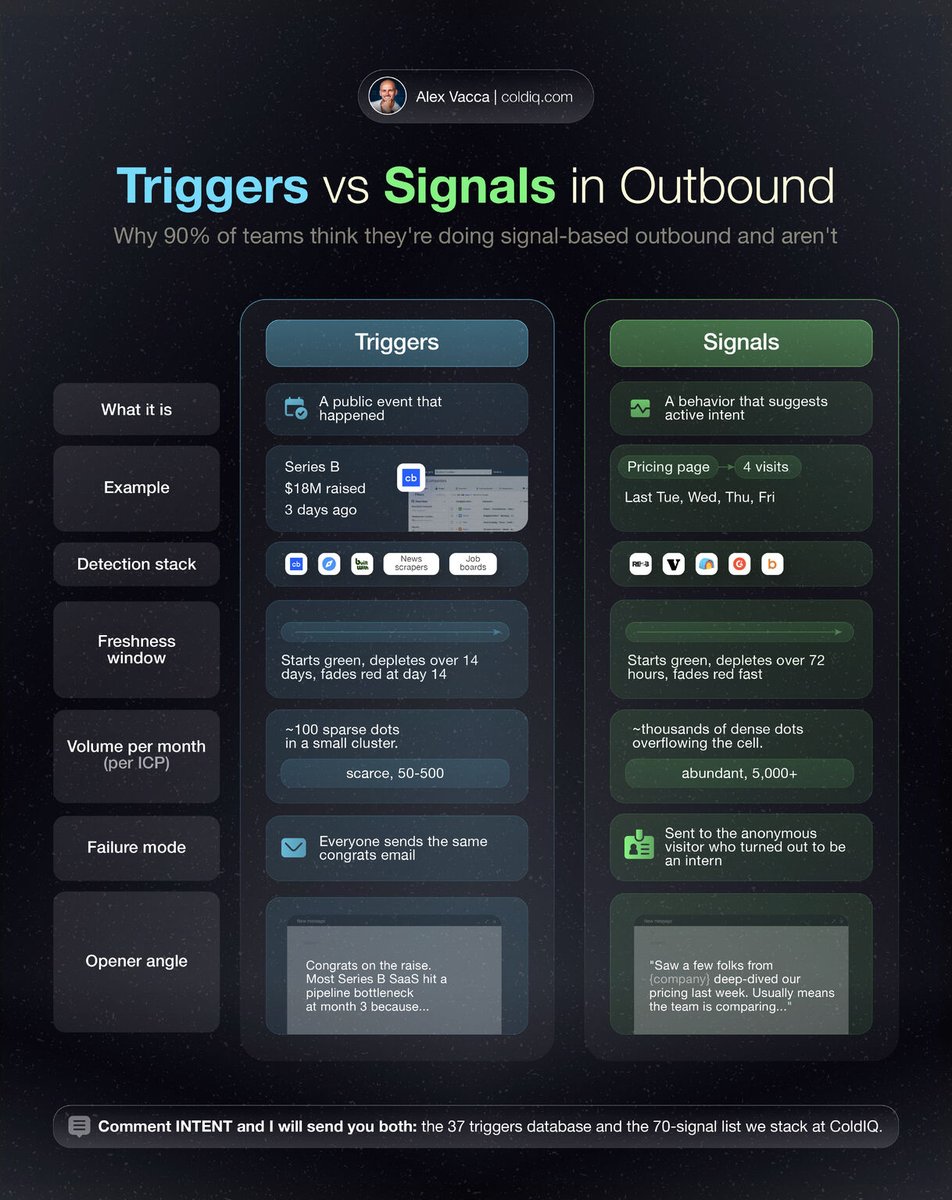
We built a database of 37 triggers and a 70-signal list that runs every cold email we send at ColdIQ (and I'm giving it all away).
Most teams pick one or the other and call it "signal-based outbound." That's why their cold outbound is stuck at 1 to 3% reply rates.
We stack both. 1 trigger as the reason to reach out. 3 signals as proof the buying window is open.
We've run outbound for 300+ B2B companies. Stacked sends pull 15 to 25% reply rates.
Inside the pack:
→ The 37 triggers (Series B, VP hired, new tool purchased) and the 7 to 14 day window each one closes in
→ The 70-signal list (pricing-page hits, post engagement, customer poach) and the 24 to 48 hour decay before they go cold
→ The stacking rule: 1 trigger + 3 signals = open the email
→ One account stacked: Series B last week, VP Sales on the home page 4 times, CEO liked an outbound post, new Head of RevOps from a customer
Reply "INTENT" and I'll send it. Must be following.
English

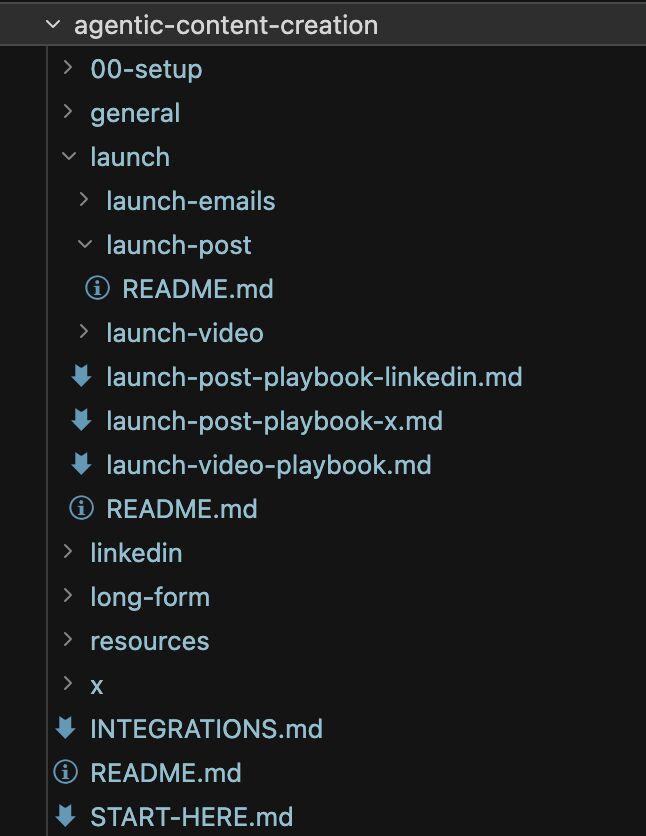
spent like 20hrs making a massive zip file of skills and agents for content creation
linkedin, X, longform, launch videos, etc all a prompt away. I used it to write our next launch script.
lmk if you want to try it and ill send it over.
English

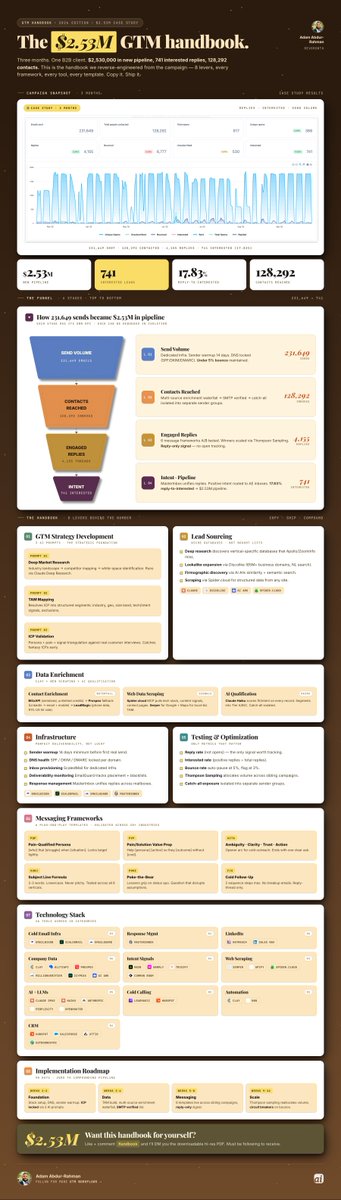
We generated $2,530,000 in new pipeline for one B2B client in 3 months.
231,649 sends → 128,292 inboxes → 4,155 replies → 741 interested.
No bought lists. No LinkedIn spam. No open-rate theater.
We reverse-engineered the winning campaign and turned it into the GTM handbook every B2B revenue team should have in their back pocket.
Inside:
→ GTM Strategy
↳ 3 AI prompts for deep market research, TAM mapping, ICP validation.
→ Lead Sourcing
↳ Niche databases Apollo and ZoomInfo miss. Discolike + AI Ark for NL search and lookalike expansion.
→ Data Enrichment
↳ Our Clay + Spider(.)cloud + BlitzAPI waterfall. Verified only. Catch-all isolated.
→ Infrastructure
↳ Sender warmup, DNS protocols, EmailGuard monitoring, MasterInbox unified replies. Under 5% bounce.
→ Testing & Optimization
↳ The only 5 metrics worth tracking (hint: opens aren't one). Thompson Sampling for sibling campaigns.
→ Messaging
↳ 6 plug-and-play templates validated across 20+ industries. PQP, PVP, ACTA, subject formula, Poke, Follow-up.
→ Technology
↳ 46 tools across 10 categories. CRM, scraping, LinkedIn, intent, LLMs, automation.
→ Implementation Roadmap
↳ 90-day sequence from zero to compounding pipeline.
Want the handbook?
🔥 Like + comment "Handbook" and I'll DM you the downloadable PDF.
[ Must be following to receive ]
English

Self-improving Claude Code skills are f*cking ridiculous 🤯
One loop → 10 test runs, scored against an eval, prompt rewritten, retested, winner kept.
A hook writer skill went from 32/50 to 47/50 overnight.
All inside Claude Code.
Perfect for DTC brands and agencies who have built Claude Code skills but the output is still inconsistent — great 70% of the time, unusable the other 30%.
If you've been manually tweaking your skill prompts one run at a time, re-reading outputs, adjusting instructions based on vibes, and never quite getting the consistency you need...
This method eliminates the entire loop:
→ You define 3-5 binary eval criteria for your skill
→ Claude runs the skill 10 times with varied inputs
→ A separate evaluator scores every output against your criteria
→ It identifies the most common failure patterns
→ Rewrites the skill prompt to fix what's failing
→ Retests and keeps the winner
→ Repeats until the score plateaus
No manual prompt tweaking.
No reviewing every output by hand.
No "it worked that one time but I can't reproduce it."
What you get:
→ A skill prompt that's been through 50+ automated test runs
→ A scored improvement log showing exactly what changed and why
→ Eval criteria you can reuse every time you update the skill
→ A method that works on any skill: hooks, briefs, ad copy, scripts, reports
Inspired by auto research repo, the same loop AI labs use to improve their own models, applied to your creative workflow.
I put together a full playbook showing how to set up the eval, the exact Claude Code prompt for the improvement loop, and starter eval criteria for the 5 most common DTC creative skills.
Want the playbook for free?
> Like this post
> Comment "IMPROVE"
And I'll send it over (must be following so I can DM)
English
We run 13 n8n workflows across ColdIQ's entire content, ads, and outbound engine, and I'm giving them all away.
Our monthly n8n bill: $384. The same workloads on Claude would cost $60K. That's why I'm not buying the "Claude killed n8n" take.
Claude Routines are good at scheduled agentic tasks that need reasoning.
They're not the same layer as n8n. They're not a replacement for production GTM infrastructure.
Our n8n stack fires 2,000+ executions daily across 13 workflows. Our Phone Finder alone has 41 nodes and waterfalls across 5 data providers.
Here's what's in the doc:
→ GTM Flywheel (81 nodes): domain in, full ICP, lookalikes, prospects, and a tailored content/ads/outbound strategy sent to your inbox
→ Phone Finder (41 nodes): name, LinkedIn URL, or domain in; Prospeo, FullEnrich, and more waterfalled; verified number in seconds
→ AI Agent Reply Manager (13 nodes): classifies a cold email reply on Instantly, drafts a response in Slack, waits for your approval before it goes out
→ Lookalike Finder (35 nodes): domain in, similar businesses by industry, size, and tech signals out
→ Viral Content Browser (10 nodes): pulls viral LinkedIn posts via Serper, filters by engagement, stores the best in Notion
→ Feeling Tracker (36 nodes, coming soon): sentiment analysis on any tool across X, Reddit, YouTube, and LinkedIn
Plus 7 more covering content, GTM, and ops. Shoutout to Sacha Martinot who built the most complex ones.
Reply "N8N" and I'll send you the full doc. Must be following.
GIF
English
Brian Roach retweetledi

@RayFernando1337 Why the fuck isn't Mythos debuting curing cancer?
English

Claude can run a full go-to-market build in 2 to 3 hours.
While everyone's obsessed with hiring $500/hr GTM consultants to build their strategy, we built something different.
Claude as a senior GTM consultant. Inside a 10-prompt sequence that builds your entire go-to-market from scratch.
We're not generating generic strategy documents. We're running 10 sequential prompts where every output feeds the next.
Here's what it does:
→ Assigns Claude a specific expert role with a credibility signal at the start of every prompt to push output depth
→ Builds ICP, positioning, pricing, 90-day plan, partnerships, competitive analysis, competitive moat, revenue stress test, and investor one-pager in sequence
→ Uses bracket input fields throughout so specificity of input directly determines quality of output
→ Feeds every output into the next prompt so ICP feeds positioning, positioning feeds pricing, and all 9 feed the final launch system
Humans still provide the inputs, review the outputs, and make the decisions.
Claude just handles the strategic framework that used to take weeks of consultant time.
Result: No blank strategy docs. No generic positioning that could describe any company.
I just put together a breakdown covering:
- How to run all 10 prompts together in the right order
- The full copy-paste prompt for each of the 10 builds
- How to use the output from each prompt before moving to the next
- The fix when output reads too generic: make it specific enough it cannot describe any other company
This is the same sequence used to run full GTM builds for B2B SaaS teams.
No fluff. Just the actual prompts and process.
Want the "10-Prompt GTM Claude" breakdown?
1. Connect with me
2. Comment "CLAUDE"
(must be connected for priority access)

English

Fair point. Local-first is a side benefit. The real bottleneck is context quality, like you said. That's why we built Rowboat around a living knowledge graph instead of RAG. Consciously building context over time is better than doing one off data pulls when needed - is our thesis.
English
Introducing Rowboat.
An AI coworker that compiles your emails, meetings, and work into a living knowledge graph, then uses it to actually get things done.
Open source. Local-first. Voice-powered.
Karpathy described the idea last week. We've been building it for a while.
English

Most people use Claude like a search engine.
So I compiled the most complete GTM Claude Resource Library you can use today.
Inside:
→ 5 free playbooks built specifically for GTM engineers
→ The Claude GTM Engineer's Bible with 1,300+ prompts across every GTM function
→ The Claude Power User Playbook with settings, prompting frameworks, and advanced workflows
→ The Claude Cowork Client Delivery System for running agency ops through Claude
→ The Claude Skills Playbook for encoding your entire GTM workflow into Claude permanently
→ The Event Marketing Pipeline Playbook for running campaigns end to end with Claude
If you run GTM at a SaaS company, manage agency ops, or build with Claude daily, this is the only resource library you will need.
Comment "LIBRARY" and I will send it straight to your DMs.

English

Clay’s new pricing is probably my fault. We were paying $314 a month, but using (based on their new model) $214,087.50 worth of Clay a WEEK. Here’s the story:
A year ago Clay's head of product hopped on a call with me.
I told him we were hitting their platform 17.3 million times per week.
Almost all custom events (i.e. HTTPs)
I remember his response being something close to "Holy shit, I think you are the largest user of Clay"
I said yeah that doesn't surprise me.
But then it also came up that we were only paying $3,769 a year.
We talked about HTTPs, custom integrations, how we were basically using Clay as a giant API orchestration layer.
I knew his wheels were turning.
If you saw my last post, you know we eventually replaced Clay entirely with a $200/mo Claude Code subscription. 272,000 leads per second vs Clay's 27 hours for the same volume.
But before we left, we were the perfect case study for why Clay's old pricing was broken.
$314/mo for 17.3 million weekly, for what they now call ‘actions’.
Run the math. We were paying $0.00001815 per action.
Clay announced their new pricing structure. They split everything into Data Credits and ‘Actions.’
Actions are HTTPs, custom integrations, API calls. The exact things we were doing 17.3 million times a week.
The new price per action credit works out to about 1.24 cents each. A 681% price increase for us
I know you might say, "But Clay is letting people stay on the old pricing if they want," and I hear you
but
I also don't know how it makes me feel that someone brand new would have to pay $856,350 per month to get the same advantages I had when I was starting out only 3 years ago.
I'm not saying that one call caused the entire restructuring.
But I am saying their head of product learned that day that someone was running 17 million HTTPs a week for the price of a nice dinner.
And now every HTTP costs 1.24 cents.
anyways
For the last year, we've been trying to figure out how to get off of our dependency on Clay.
That was until Cursor / Claude Code / Codex came out
My VP of Growth, @James, who doesnt know how to write a single line of code, touched Claude Code for the first time
And three weeks later he replaced Clay for us
We could process 272k rows per second now for the cost of a Claude Code sub
My last post was about that system
Then after that post, Clay announces new pricing that specifically monetizes the exact thing we were doing at a massive scale.
Coincidence? Maybe.
But
I may owe everyone using Clay an apology
If your Clay bill just went up, you can probably blame me for that one. Sorry!
I put together a system blueprint of what I did to replace Clay for myself -- every tool, the tech stack, a Clay vs custom comparison, and a 6-step playbook for building your own. Plus a video walkthrough where I show you the live system and how each tool actually works.
Reply CODE below and I'll DM it to you.
English
Brian Roach retweetledi

@arsenfounder This is exactly what I've been looking for! Would live to contribute to this support for outlook email (ms365). Let's chat!
English


We spent hundreds of hours building Claude Code skills for our $7M ARR GTM agency (and we're giving them away for free)
- ICP research
- signal scoring
- cold email writing
- sales intelligence
- campaign intelligence.
These run inside every system we build for 70+ B2B clients.
Reply "Claude Code" and I'll send you the Github repo with everything.
GIF
English

Introducing Blink Claw - the first platform to hire unlimited AI employees that run your business 24/7.
180+ AI models included. Gmail, Slack, LinkedIn, HubSpot - one-click connect. No API keys, no $600 Mac Mini.
Reply "Claw" + RT. Your first agent is on us. ($50 - 200 creds)
English

The hook is 80% of your ad's performance.
But most brands spend 80% of their time on everything else.
I compiled a bank of 100+ hook frameworks we've tested across 250+ brands.
Organized by:
→ Awareness level
→ Emotional trigger
→ Product category
→ Format type
Like & comment "HOOKS" and I'll send you access for free.
English

🚨 BREAKING: R.I.P. CLICKFUNNELS.
Opus 4.6 ONE-SHOTS entire VSL funnels now.
I compressed my entire VSL framework into a single 5,280-word prompt.
The same framework that's generated $1M+ and 500+ booked calls.
HOW IT WORKS:
You plug in your offer details. It spits out:
→ Full VSL script from hook to close
→ Built on the persuasion structure behind EVERY high-converting agency funnel
→ Generated $1M+ and 500+ booked calls
This thing can INSTANTLY double your booked calls.
Use it now or get left behind. 🤘
Like + reply "OPUS" and I'll DM it to you
English

@HSVSphere My Claude experience improved after I took a jailbreak prompt that tells it to roleplay as my overly attached girlfriend or something and put that in CLAUDE md, now it does literally anything lmao
English

claude used to be the one that refused literally anything, i recall asking it to mess with cpython interpreter internally using ctypes and it refusing
snwy@snwy_me
me: “hey can you help me root this old Android phone that doesn’t have oem bootloader unlock” chatgpt: “NO that is IN VIOLATION of the CARRIER POLICY and I WILL NOT STAND FOR THIS” claude: “sure here’s a CVE from 2024, i already wrote a full chain just run this C code i wrote”
English
@ibekidkirsch @mikefutia Care to expand on your Apple Notes setup? 🤔
English

@mikefutia The MCP server pattern is what makes this work. one install and the agent just discovers available tools. we run something similar for apple notes, the trick is giving structured schemas so it doesnt hallucinate field names
English

Claude Code + Google Workspace CLI is f*cking crazy 🤯
One install → Claude Code gets full access to your Gmail, Drive, Docs, Sheets, Calendar, and Slides.
All inside Claude Code.
Perfect for DTC brands and agencies whose entire business lives in Google Workspace but their AI agent can't touch any of it.
If you're running a brand or agency and your creative briefs live in Google Docs, your ad data lives in Sheets, your assets live in Drive, and your team coordination lives in Calendar...
But every time you want Claude to do something with that data, you're copy-pasting it into a chat window.
Google Workspace CLI eliminates the entire gap:
→ Claude Code reads your Sheets and builds creative performance reports automatically
→ Pulls docs from Drive and summarizes briefs you forgot existed
→ Drafts and sends emails without you touching Gmail
→ Creates calendar invites from a single prompt
→ Builds formatted Google Docs and Slides — not raw markdown dumps
→ 100+ built-in agent skills for common multi-step workflows
No copy-pasting data into chat windows.
No juggling six different MCP server configs.
No broken API auth that dies every 48 hours.
What you get:
→ One CLI that gives Claude Code access to every Google Workspace app
→ Structured JSON responses your agent actually knows how to use
→ Auto-discovery so it stays current when Google adds new features
→ Built-in skills for email triage, doc generation, meeting prep, and more
It's open source, free, and takes 10 minutes to set up.
I put together a full playbook with the install walkthrough, the Google Cloud setup, and 5 DTC-specific workflows to get running immediately.
Want it for free?
> Like this post
> Comment "CLI"
And I'll send it over (must be following so I can DM)
English

My OpenClaw bot builds websites & mails a postcard with a QR link to local businesses on autopilot...
You can use it to land new customers without a single cold call, here's how it works:
- Finds 100s of local businesses via Google Maps
- Builds each one a custom website in minutes
- Prints a real postcard with their site preview + QR code
- Mails it directly to their door
- They scan it, see their site, and reach out
- Runs 24/7 completely hands off
Direct mail gets a much higher response rate than cold email.
Reply "OpenClaw" and I'll send you the full breakdown of how you can do it too (must be following so I can DM)
English

@Ex0byt Put this in an electrobun app
Yoav@YoavCodes
Games are nice, but Electrobun's new bun -> wgpu unlocks raw gpu ML compute as well. - lines of code: html: 72, css: 195, browser ts: 318, bun ts: 450 - the ui is using a system webview - the training and inference is done on gpu direct from bun typescript. - dmg is only 20.9MB
English
