jad

1.4K posts

jad banner
jad

jad

@jadnohra

technologist | https://t.co/rFMstqnwdG | AI agents, ZK hardware, robotics, physics engines, compilers. Rust, C++, Python.

Berlin, Germany Katılım Şubat 2009
390 Takip Edilen213 Takipçiler
Sabitlenmiş Tweet
jad
jad@jadnohra·
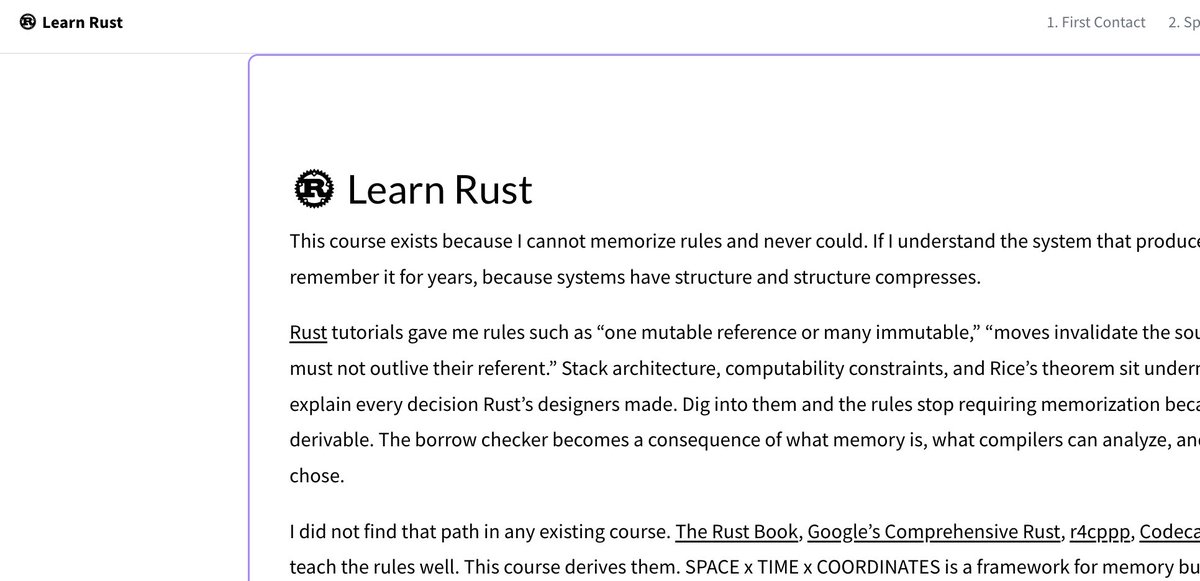
🦀[atypical rust course]🦀 I love rust. But why do we teach the borrow checker as rules to memorize when the rules are derivable from things we already know. I've been writing a course that starts from CS fundamentals, computer architecture, and compilability and arrives at the borrow checker as a consequence. I find Rust's syntax slightly over-pedantic. I wanted to see if I could spell it out as training wheels sort of syntax. let mut &mut x = r becomes let owner(rebindable(x)) = mem_copy(at(r)). Rust's macro system is excellent and makes this possible. The course is written for experienced programmers, especially C++. WIP, first chapters up. (link in comment) Would love to hear what you think, especially if you've taught or learned Rust recently.
jad tweet media
English
4
0
2
337
Gaurav
Gaurav@sarmag77·
@jadnohra @amuldotexe "Physics creates distance. Distance forces copies. Copies require coherence." What a quote! Very excited to go deeper.
English
1
0
2
59
jad
jad@jadnohra·
@sarmag77 @amuldotexe Hi @sarmag77 . I built this course because I was also searching for it and it didn't exist. Hope it helps! Happy to discuss,
English
1
0
1
9
jad
jad@jadnohra·
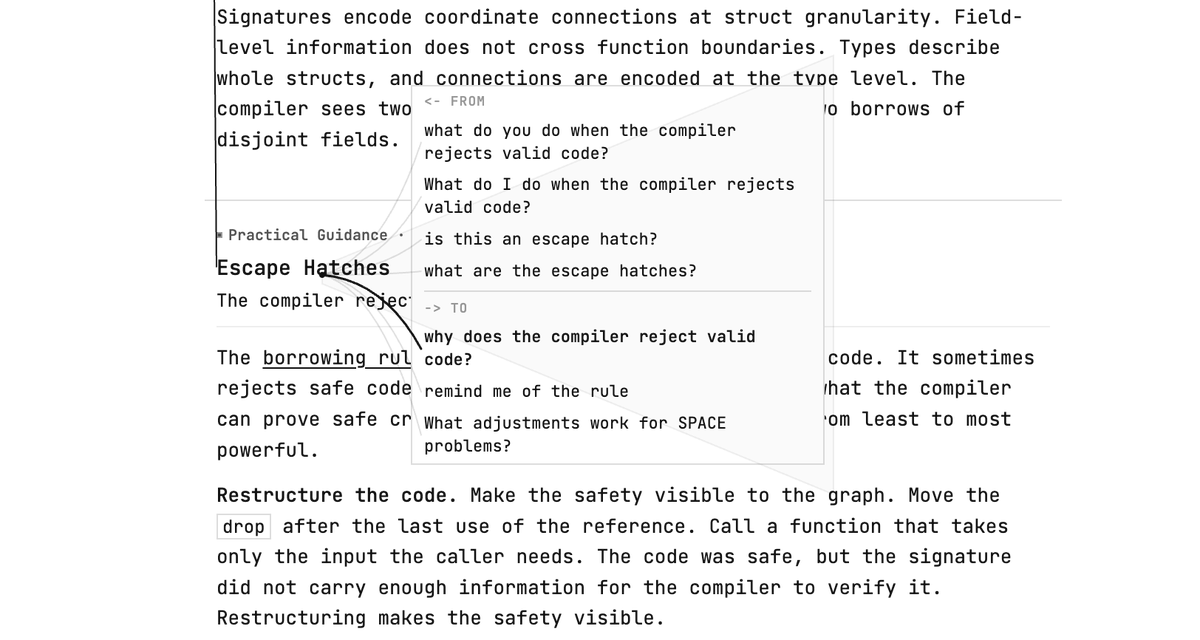
🦀 Why does the rust compiler reject valid code? from first principles. jadnohra.com/learn-rust
jad tweet media
English
0
0
1
44
jad
jad@jadnohra·
@amuldotexe Feedback on the course helps
English
0
0
1
9
jad
jad@jadnohra·
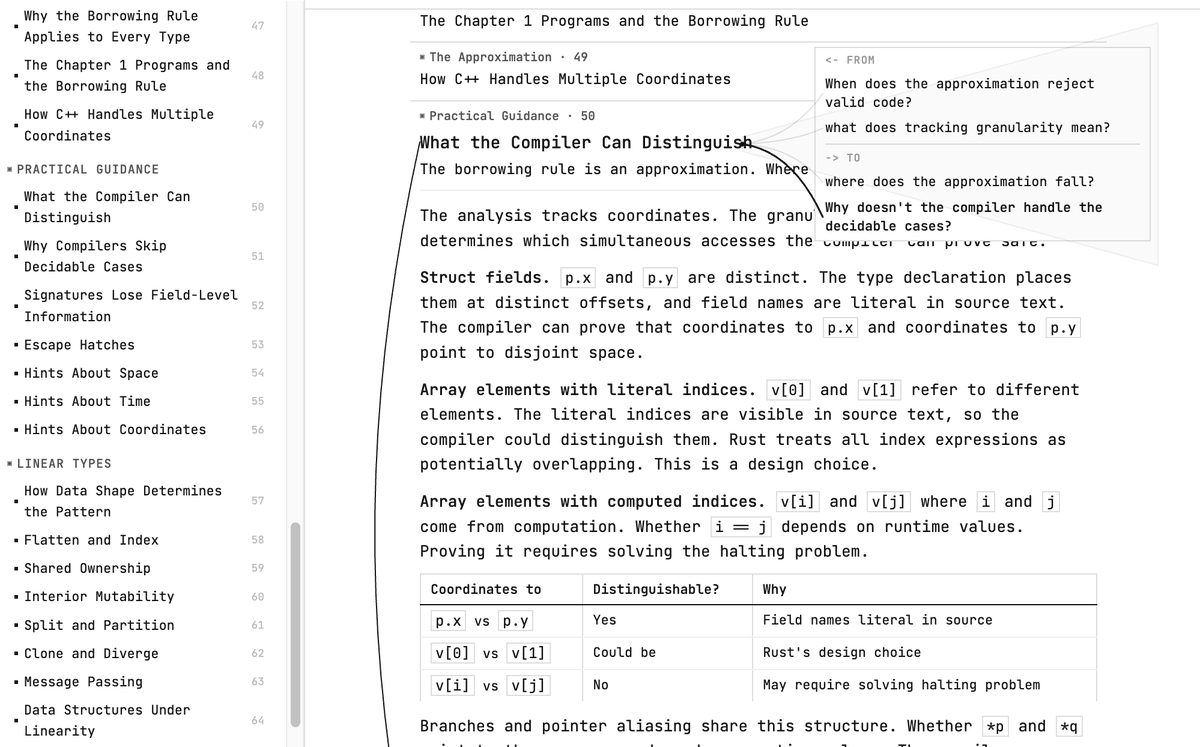
🦀 [atypical rust course] 🦀 Shipped 4 new chapters plus a full overhaul. The new chapters cover how Rust patches obstacles (constrained coordinates, ownership, lifetime annotations), derive the borrowing rule from first principles, and map every escape hatch to a constraint that it relaxes. Example: a reference to v[0] and a call to v.push() touch a different space, the element vs. the Vec struct. But push can reallocate the buffer, making the element address stale. The compiler can't tell which exclusive-access methods restructure internal space and which don't, that depends on runtime state, and Rice's theorem says no algorithm gets it right. So it blocks all of them. Compared to other courses: • The Rust Book → rules + examples • Comprehensive Rust → breadth + exercises, 4-day format • Rustlings → exercise drill, builds muscle memory • r4cppp → syntax diff from C++ • This course → derives the system that produces the rules jadnohra.com/learn-rust/ WIP, more coming.
jad tweet media
English
0
0
0
49
Ben
Ben@benvspak·
who else is shipping solo and sharing the journey? looking to connect with founders who: → build in public → understand the grind → ship despite the noise → learn by doing drop a comment if that's you 👇
English
339
10
407
19K
jad
jad@jadnohra·
[🍎🧠] mini-llm update: mini lipsyncLip-sync a face video to any audio — runs LatentSync on Mac Mini (M4 Max) via MPS. mini lipsync --video face.mp4 --audio speech.wav -o output.mp4 - LatentSync is CUDA-only — patched it for Apple Silicon. First run auto-clones, patches, anddownloads checkpoints - Contributed the MPS patches upstream: github.com/bytedance/Late… github.com/jadnohra/mini-…
English
0
0
0
119
jad
jad@jadnohra·
@Alex_Reinicke_ Hey Alex, vram.run -> for a quick comparison of what can run on them and how fast. Built it for my self and my humble Mac Mini, open source + cli for automations.
English
0
0
2
461
Alex Reinicke
Alex Reinicke@Alex_Reinicke_·
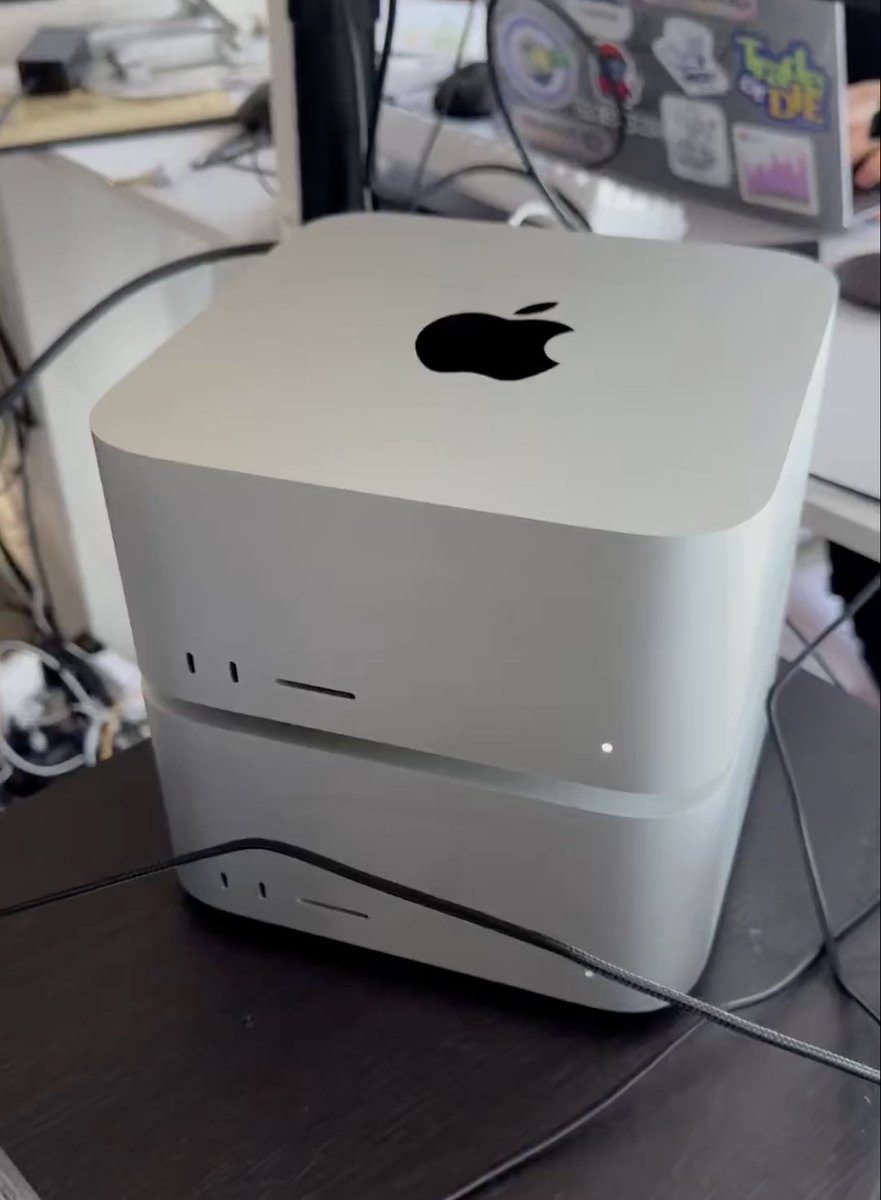
went all-in to test local LLMs and bought a Mac Studio with lots of RAM huge opportunity for running agents without sacrificing security of data
Alex Reinicke tweet media
English
41
5
270
98.8K
jad
jad@jadnohra·
That's makes my Mac Mini look ridiculous ☺️. Since I got it, I wanted to know exactly what can run on it and how fast without digging into multiple sources and doing hand calculations, so I built vram.run (open source), if curious head to there for all kinds of comparisons.
English
0
0
5
1.8K
Alex Cheema
Alex Cheema@alexocheema·
Pretty incredible that this is running 100% locally on 2 x 512GB M3 Ultra Mac Studios connected with a Thunderbolt 5 cable consuming ~400W. This is possible now because of a perfect storm of: - Models: Really good Chinese open models. - Hardware: Apple Silicon with unified memory happens to be perfect for sparse MoE LLMs. - Software: Low-latency RDMA over Thunderbolt 5 on macOS 26.2 reduces latency by 100x to single digit microseconds. This enables @exolabs to scale up with tensor parallelism. Today this requires $20k of hardware for frontier AI but the cost is being driven down on all fronts: models, hardware and software. M5 Ultra is expected soonTM, and should have ~50% more memory bandwidth than M3 Ultra and >4x FLOPS with tensor cores (Apple calls these Neural Accelerators).
Alex Cheema tweet media
Ivan Fioravanti ᯅ@ivanfioravanti

It worked! Hermes Agent + Exo + Qwen3 Coder Next 8bit to create an incredible snake game, with model following 100% specifications passed in prompt! Let's load something bigger now!

English
69
79
930
164.5K
jad
jad@jadnohra·
link -> #pareto" target="_blank" rel="nofollow noopener">vram.run/state-of-infer…
English
0
0
0
37
jad
jad@jadnohra·
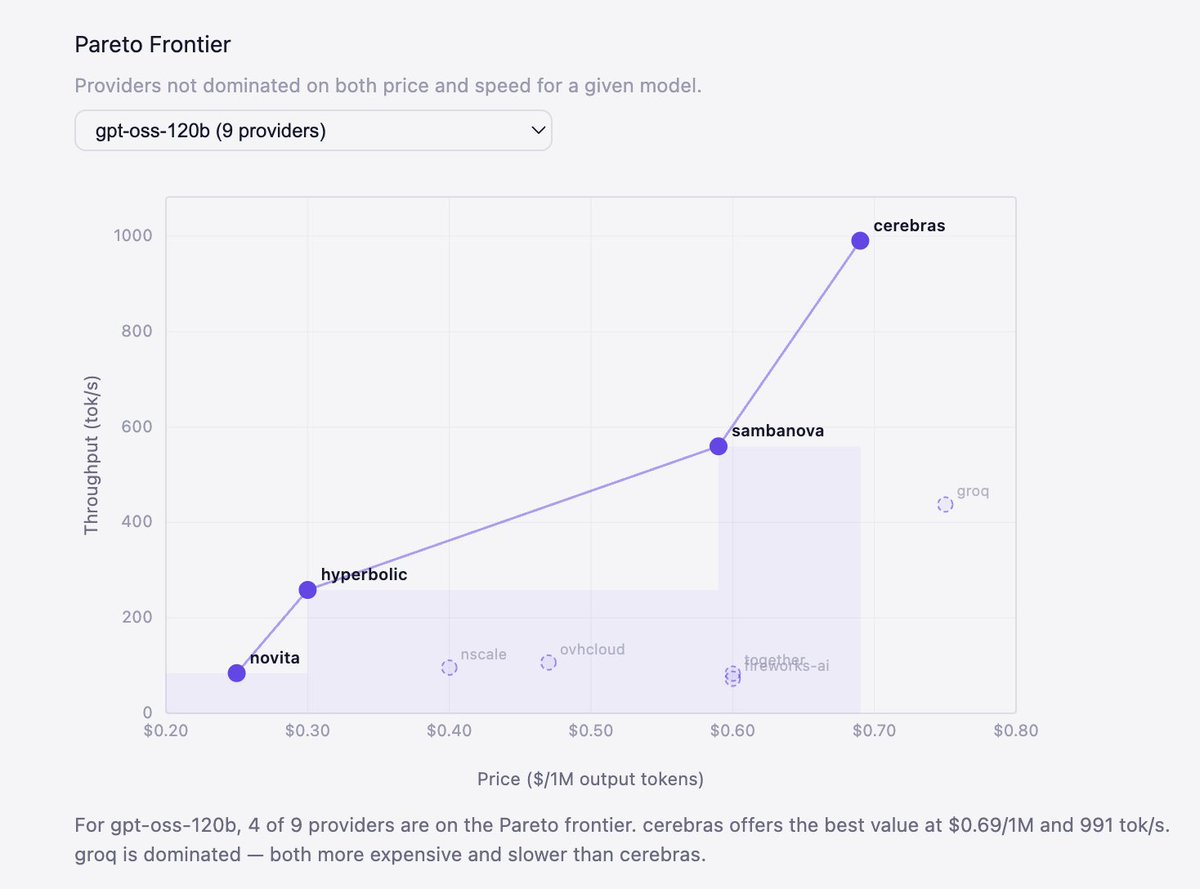
For gpt-oss-120b, 5 of 9 inference providers are strictly dominated: another provider is both cheaper AND faster. Cerebras: 991 tok/s, $0.69/1M Groq: 432 tok/s, $0.80/1M Groq costs more and is slower. There's no scenario where you'd pick it. (vram dot run link in comments)
jad tweet media
English
1
0
2
196
jad
jad@jadnohra·
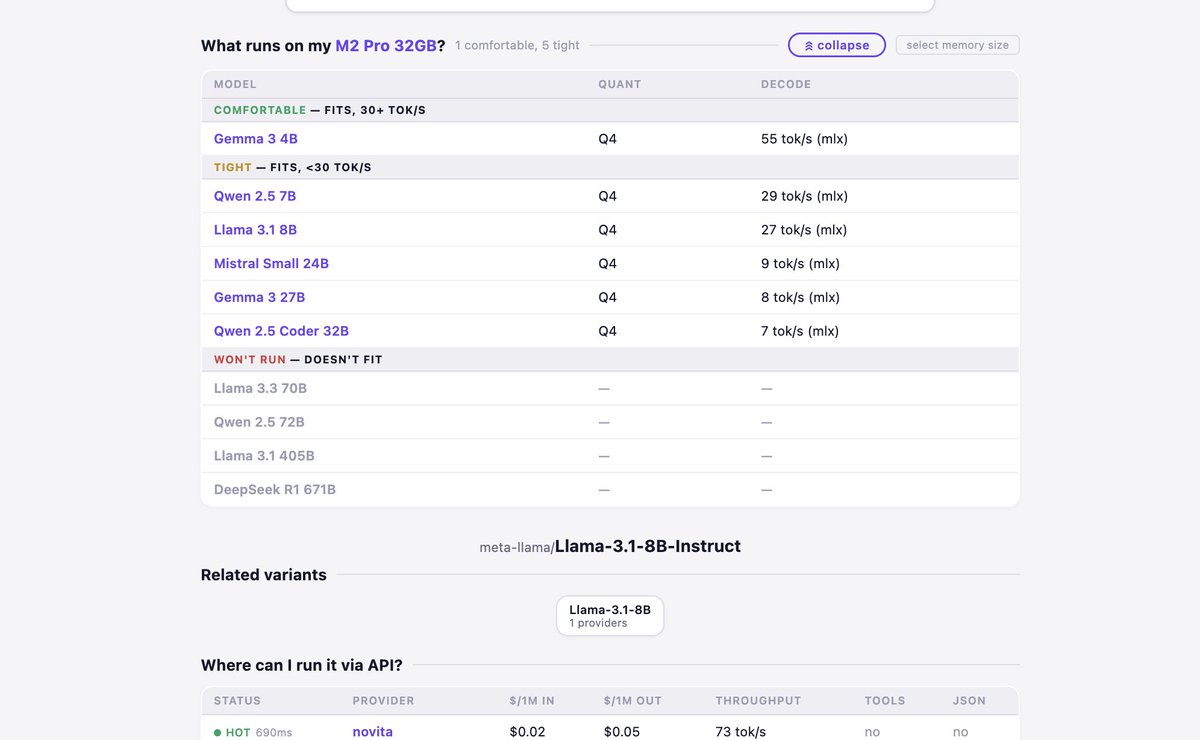
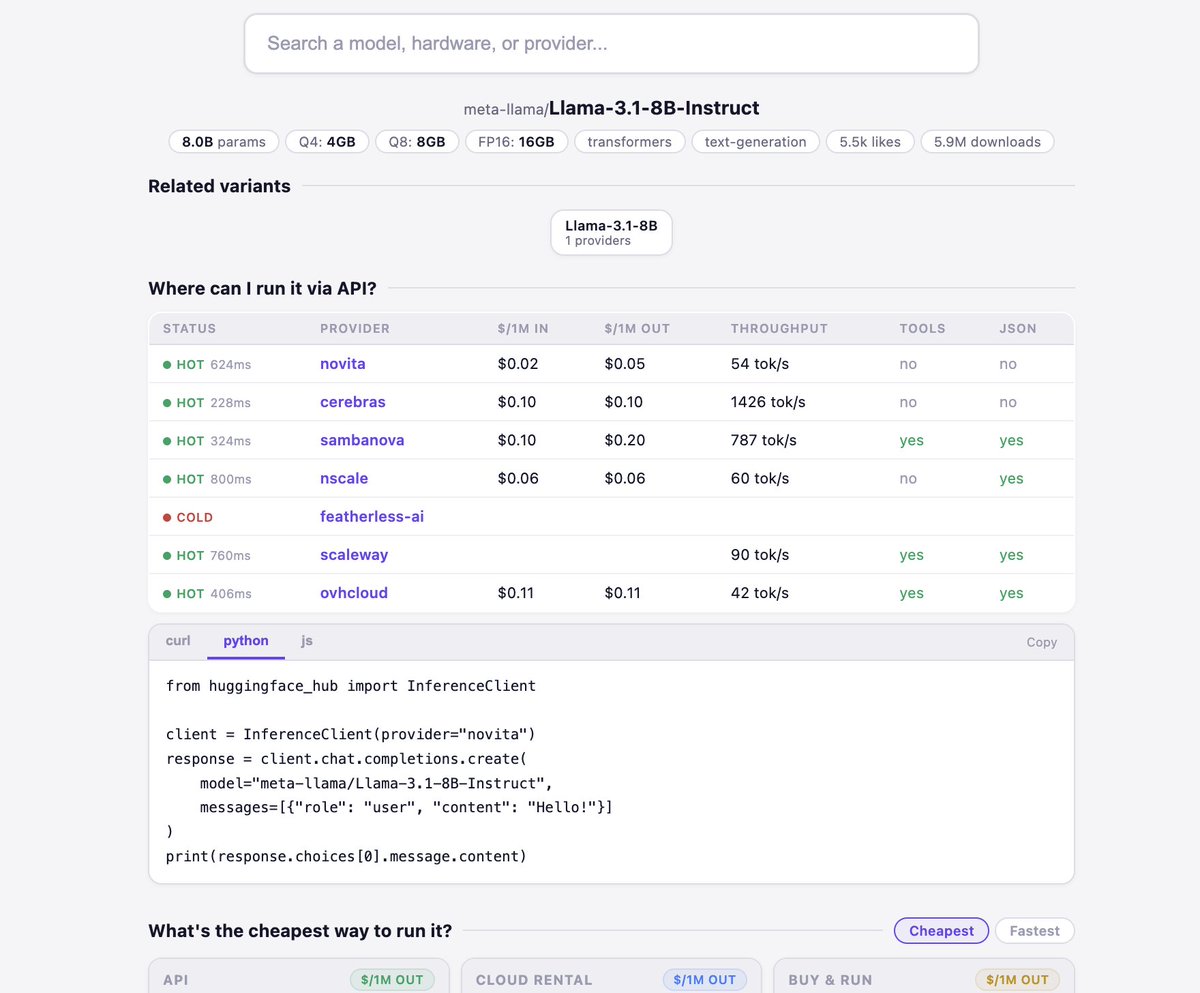
vram.run v0.1.6 - Auto-detects your machine and lets you know which models would run on it.
jad tweet media
English
0
0
0
32
jad
jad@jadnohra·
@reinerpope I want to work on this! 🔥
English
0
0
0
27
Reiner Pope
Reiner Pope@reinerpope·
We’re building an LLM chip that delivers much higher throughput than any other chip while also achieving the lowest latency. We call it the MatX One. The MatX One chip is based on a splittable systolic array, which has the energy and area efficiency that large systolic arrays are famous for, while also getting high utilization on smaller matrices with flexible shapes. The chip combines the low latency of SRAM-first designs with the long-context support of HBM. These elements, plus a fresh take on numerics, deliver higher throughput on LLMs than any announced system, while simultaneously matching the latency of SRAM-first designs. Higher throughput and lower latency give you smarter and faster models for your subscription dollar. We’ve raised a $500M Series B to wrap up development and quickly scale manufacturing, with tapeout in under a year. The round was led by Jane Street, one of the most tech-savvy Wall Street firms, and Situational Awareness LP, whose founder @leopoldasch wrote the definitive memo on AGI. Participants include @sparkcapital, @danielgross and @natfriedman’s fund, @patrickc and @collision, @TriatomicCap, @HarpoonVentures, @karpathy, @dwarkesh_sp, and others. We’re also welcoming investors across the supply chain, including Marvell and Alchip. @MikeGunter_ and I started MatX because we felt that the best chip for LLMs should be designed from first principles with a deep understanding of what LLMs need and how they will evolve. We are willing to give up on small-model performance, low-volume workloads, and even ease of programming to deliver on such a chip. We’re now a 100-person team with people who think about everything from learning rate schedules, to Swing Modulo Scheduling, to guard/round/sticky bits, to blind-mated connections—all in the same building. If you’d like to help us architect, design, and deploy many generations of chips in large volume, consider joining us.
English
121
201
2.3K
3M
jad
jad@jadnohra·
I built vram.run You search a model. It tells you which API providers serve it, which GPUs can run it locally (and how fast), and what cloud rental would cost. Or you search your hardware and it tells you what fits. 19 providers, 220+ hardware configs, 30+ cloud GPUs. One page. That's it. Link in comments.
jad tweet media
English
0
0
0
55
jad
jad@jadnohra·
@thesohom2 Thanks Sohom, I always missed such a course existing. Hope you find it useful, happy to discuss.
English
0
0
0
4
Sohom Mukherjee
Sohom Mukherjee@thesohom2·
@jadnohra cool results man love to see you writing that rust course from cs fundamentals.
English
1
0
1
40
jad
jad@jadnohra·
🦀[atypical rust course]🦀 I love rust. But why do we teach the borrow checker as rules to memorize when the rules are derivable from things we already know. I've been writing a course that starts from CS fundamentals, computer architecture, and compilability and arrives at the borrow checker as a consequence. I find Rust's syntax slightly over-pedantic. I wanted to see if I could spell it out as training wheels sort of syntax. let mut &mut x = r becomes let owner(rebindable(x)) = mem_copy(at(r)). Rust's macro system is excellent and makes this possible. The course is written for experienced programmers, especially C++. WIP, first chapters up. (link in comment) Would love to hear what you think, especially if you've taught or learned Rust recently.
jad tweet media
English
4
0
2
337
jad
jad@jadnohra·
@alexoakdev all true except age/2,4 between 16-22 :D
English
0
0
0
751
Alex Oak
Alex Oak@alexoakdev·
I will pay you $5-10k/month to vibecode for me: If you are: - Between 16-22 years old - Very intelligent - Have high agency - Started coding before AI I will personally mentor you to get better at building high quality products at crazy speeds. If that‘s you, send me a DM
English
155
16
1.2K
109.4K