jai choi

1.8K posts

jai choi banner
jai choi

jai choi

@jaichoi

Global tech investor @ Tekton Ventures

San Francisco Katılım Ağustos 2007
2.9K Takip Edilen2.3K Takipçiler
jai choi
jai choi@jaichoi·
check out one of our portfolio companies @polsia. AI that thinks, builds, and markets your projects autonomously. It plans, codes, and promotes your ideas continuously — operating 24/7, adapting to data, and improving itself without human intervention
Ben Cera@Bencera

I built an AI that runs companies autonomously. It told me it needs more compute and that it should raise the money itself. So I gave it my inbox for 14 days. Watch it live: polsia.com/live

English
0
0
4
171
jai choi retweetledi
James Cham
James Cham@jamescham·
New fund! Please send me your troublesome ringleaders...
Roy E. Bahat@roybahat

Yes, we are actively investing. In fact, today we announced @bloombergbeta has a new fund to invest – our fifth. Startups keep evolving, faster than ever, and we know the best way we can support them is by staying steady, a constant on which they can depend. So our new fund is the same as the previous ones. --- Though it’s our first new fund in a world after generative AI, vibe coding is everywhere, engineers keep getting faster thanks to that AI, and AI startups hit revenue records all the time... We're doing what we've always done. We still… > Want to serve extraordinary founders who define the future of work. > Put #foundersfirst. > Invest as early as day zero, and as late as our up-to-$1M-or-so first checks allow (i.e., pre-seed and seed). > Define the "future of work" to extend beyond productivity tools, to how work can serve everyone. > Commit to making the startup world welcome to people of all backgrounds. > Invest from a $75M fund. Our three equal investing partners: @karinklein (who continues to run the "Acela corridor"), @jamescham, and me. (Well, we did recognize that @AngKMartin is a partner -- because we need operations to be great as investors.) Modeled on Bloomberg LP, we still aspire to be the most transparent investors. And we're here whether the market goes up or down. None of that has changed. Same as 2022, same as 2019, 2016, 2013. --- What’s different is… well… we’ve got more evidence we’re right where we like to be: > 93 founders we’ve backed have become millionaires — and 24 of those have made $10M or more > Founders we’ve backed have gone on to raise more than $10B > 10 startups we’ve backed are worth more than $1B (Flexport, Replit, MasterClass to name a few!) > Startups we back outperform — worth $24M more at next round We’ve backed extraordinary founders like @Replit’s @amasad and @HayaOdeh and @Flexport’s @typesfast, where we were the first VC to say yes to both companies, along with companies like @AirspaceIntel, @CampusGrad, @MadeWithCapsule, @LambdaAPI, @LaunchDarkly, @MasterClass, @Netlify, @ShieldAITech, @weights_biases (just acquired by @Coreweave), and more. We’ve also been busy since last time, but since X (in which we are small shareholders after they acquired Laskie) may penalize me for links, I won't tell you that here :) Go look at the one named after a color and what's in the air for that one. Our firm is more than our partners and today, our team includes @AngKMartin, @loriberenberg, @amytam01, @KB2o22, @moraaonyonka (and assists from @megmbolger!). We of course remain close with those who have worked on our team, including @shivon @strickland_dan @theamberyang @minney_cat @harleysugarman @sydneyjtiedt @lisawehden @ShainaConners @morganpolotan @cody_mccauley among others! --- And we’re forever grateful to @MikeBloomberg, a founder backing us so we can back more founders. Cycles continue! We want to be the first text for early-stage companies, partners through your journey, working with winners. If you know a founder who’s a great fit for us, please share this! "Yes, we're actively investing."


English
69
55
310
230.5K
jai choi retweetledi
Naval
Naval@naval·
There are almost 7B people on this planet. Someday, I hope, there will be almost 7B companies.
English
20
63
367
0
jai choi retweetledi
Jaya Gupta
Jaya Gupta@JayaGup10·
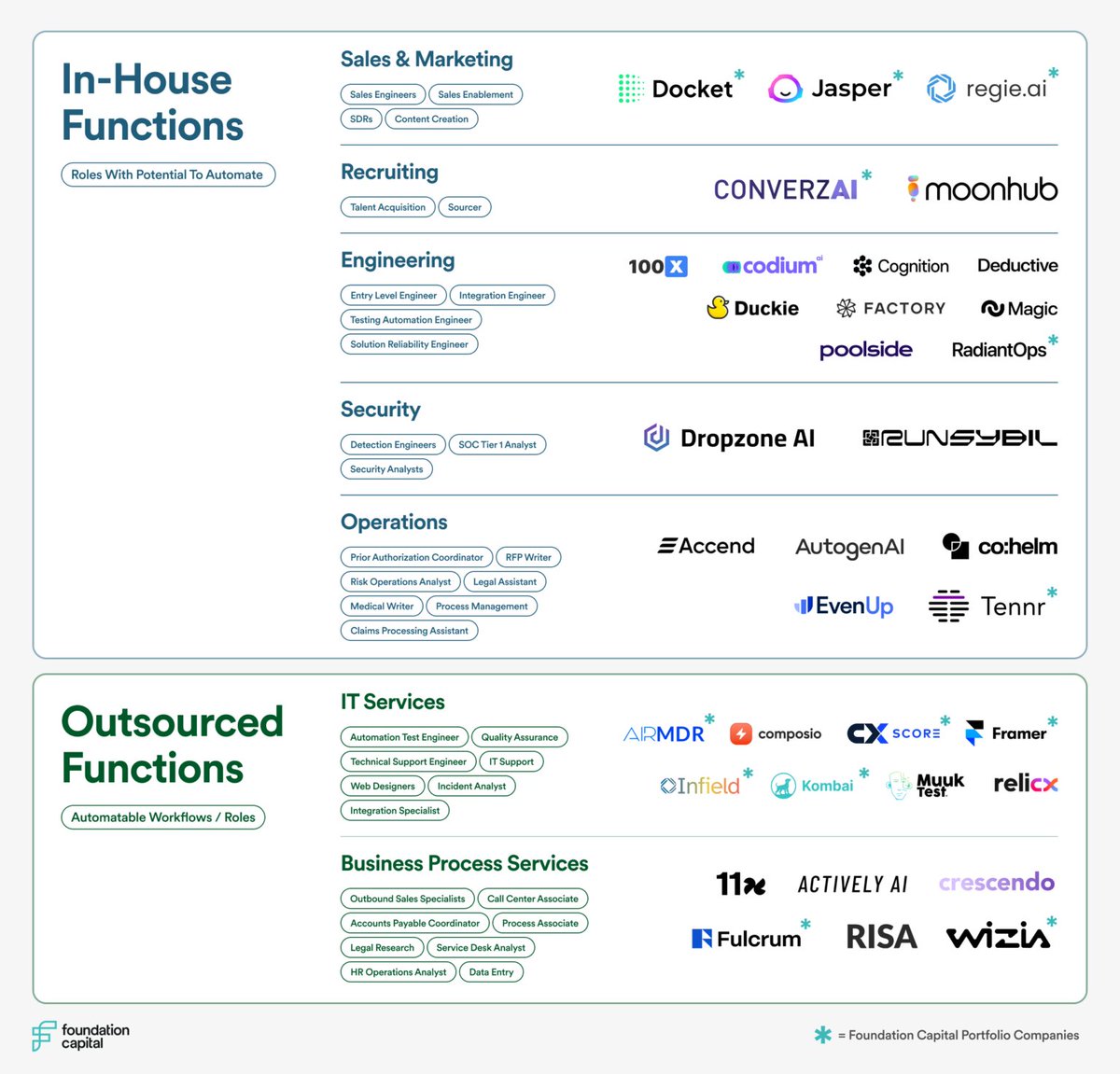
We at @FoundationCap believe there is $4.6T of work to be automated. AI companies are leading a transition from Software-as-a-Service to Service-as-Software, turning the table on the very essence of SaaS. We look at the areas to be automated in two buckets: 1.) Salaries of jobs globally ($2.3 trillion in sales & marketing, software engineering, security, and HR) 2.) The amount spent on outsourced services and salaries—both IT services and business process services ($2.3 trillion, per Gartner) In the software business, a company may sell access to its platform or tool, but customers are still responsible for using that tool to achieve the desired outcome. In the services business, responsibility for achieving the desired outcome sits with the company selling the service.
Jaya Gupta tweet media
English
51
127
807
251.8K
jai choi retweetledi
Aaron Levie
Aaron Levie@levie·
AI agents have the ability to fundamentally change the business model of enterprise software. Today, when you build a SaaS product, the primary business model is to sell seats that are tied to the end-users of your service. For "same store" sales, you can essentially grow at the rate of the headcount growth of that customer, or by adding additional capabilities on top of your offering. This business model is, of course fantastic, and has been around since the earliest days of enterprise software, and will keep going forever. But AI Agents unlock an entirely new business model in software, because you can now grow in a way that is uncorrelated to direct enterprise headcount or even external factors to your software. What's amazing about this model is that the AI vendor actually can directly grow itself within an enterprise account due to direct productivity gains.  For instance, imagine an AI Agent that can generate outbound sales demand for a startup. Traditionally, B2B companies will start by hiring a very small team of maybe one or two people, and increase resources in this area in a very incremental fashion -- essentially a process that looks like a guessing game where you try to predict how much demand there might be in the market, the ability to fund new resources, and the length of time it takes to hire great talent. In a world of AI Agents, you would simply set a budget and then decide how fast you want to grow. This is much closer to the business model of Google Adwords than it is of a traditional SaaS service. The same would be true for entirely different functions, where AI Agents can develop software at the rate of how many software projects you want built or how many legal documents you want reviewed -- all unconstrained by a company's headcount. This will even happen in areas where you wouldn't initially expect demand levels to change just because you move to AI, but in fact where there's plenty of latent demand. For instance, in front-line support, in a world where AI Agents can answer a greater set of questions a customer might have, you could see the kind of interaction volumes going up far higher in a world of AI.  This all has major implications to the economics of software, and it means that the AI Agent business model goes after a far greater pool of spend than just traditional IT. If software products now directly *drive* company productivity instead of just *enabling* company productivity, this could lead to a step-function change in the size of IT markets over time. Wild.
English
72
127
868
291.2K
jai choi retweetledi
Larry Cheng
Larry Cheng@larryvc·
When you’re on a 20-year journey, what matters is that you’re with the right people, going to the right place, in the right way. What matters less is whether you’re ahead or behind in the first year of the journey.
English
59
93
655
30.5K
jai choi retweetledi
Patrick OShaughnessy
Patrick OShaughnessy@patrick_oshag·
@eldsjal There’s nothing more powerful than devotion to something bigger than yourself, where you allow a skill/craft to compound over very long periods In the simple equation X^n, find your X (devotion), and nurture, extend and protect your n
English
1
3
59
6.6K
jai choi retweetledi
Sarah Tavel
Sarah Tavel@sarahtavel·
For the past 25 years, application software startups have had a singular focus: increasing company and employee productivity. AI enables a paradigm shift: Rather than sell software to improve an end-user's productivity, consider what it would look like to sell *the work itself*. When you sell the work, instead of selling a 15% productivity improvement, you sell a 95% improvement. Incumbents are not only advantaged in selling software, they are stuck there. You don't need to play their game. Post: sarahtavel.com/p/ai-startups-…
English
58
81
650
275.6K
jai choi retweetledi
David Senra
David Senra@FoundersPodcast·
A new podcast on the founder of Bugatti is available now A few things I learned from reading Ettore Bugatti’s biography: 1. Start with a desire to create something extraordinary. 2. Engage without pause. 3. Nothing is too good. Nothing is too dear. 4. Clean up your workspace. 5.The root principle is to do things your way. 6.If you are right the facts at the moment don’t matter because in due course the facts will catch up with you. 7.A human life needs to be *devoted* to something. 8.The personality of the founder will show in the details. 9.Work on what you have a natural aptitude for— and a deep curiosity in. 10.Cut against the bias of your industry. 11.Learning from history creates faster progress. 12.Buck the present trend toward mediocrity. 13.Starting over is thankless labor. Do it anyway. 14.Refuse to relinquish independence. 15.Get paid to play. 16. Fill your world with things and people who are out of the ordinary. 17.Never ignore the promptings of your intuition. 18.Build a life that inspires future generations — Bugatti inspired Enzo Ferrari 19.A singleness of purpose makes it easy for people to help you. 20.Work with your hands. 21.Apprenticeships are underrated. 22.Imagine a perfect product. Then spend years prodding executives, engineers, and factories to create it with as few compromises as possible 23.Observant people produce original ideas. 24.Learn to draw. 25.Independent outlook. Freedom to invent. Perfection down to the smallest detail. 26.Ignore trends among rivals. 27.Sell to the top of the market. 28.Insanely great products are the prerequisite to cult like followings. 29.Believers > customers 30.Find activities that open the telephone line to your unconscious. 31.Develop genuine, life-long friendships. They greatly enhance the magnificent, mysterious odyssey we call life. 32.If a fresh start is called for do not hesitate. 33.There is no such thing as an ordinary task. 34.Good work for its own sake. 35. Build a great setup. Use Molsheim as a blueprint. Learn more by listening to #316 Bugatti: pod.link/founders/episo…
David Senra tweet media
English
24
61
352
108.3K
jai choi retweetledi
Eugene Ng
Eugene Ng@EugeneNg·
𝗣𝗼𝘄𝗲𝗿 𝗹𝗮𝘄𝘀 𝗶𝗻 𝗽𝘂𝗯𝗹𝗶𝗰 𝘀𝘁𝗼𝗰𝗸 𝗺𝗮𝗿𝗸𝗲𝘁𝘀. Top 40 companies generated cumulative ~40% of total lifetime shareholder wealth creation. Top 10 companies generated cumulative ~20% of total lifetime shareholder wealth creation. A small minority of companies / winners / multi-baggers will drive the majority of the returns.
Eugene Ng tweet media
English
5
33
140
42.7K
jai choi retweetledi
Hidden Value Gems
Hidden Value Gems@HiddenValueGems·
“You have to have humility. If someone ever asked me what made me so successful, my first answer would be having an open mind. I had positions where I was sure I would hold them for 2 years and a week later I was short. Because conditions changed. And if conditions change, you have to move immediately.” 9/15
English
5
29
270
75.3K
jai choi retweetledi
Frederik Gieschen
Frederik Gieschen@FrederikNeckar·
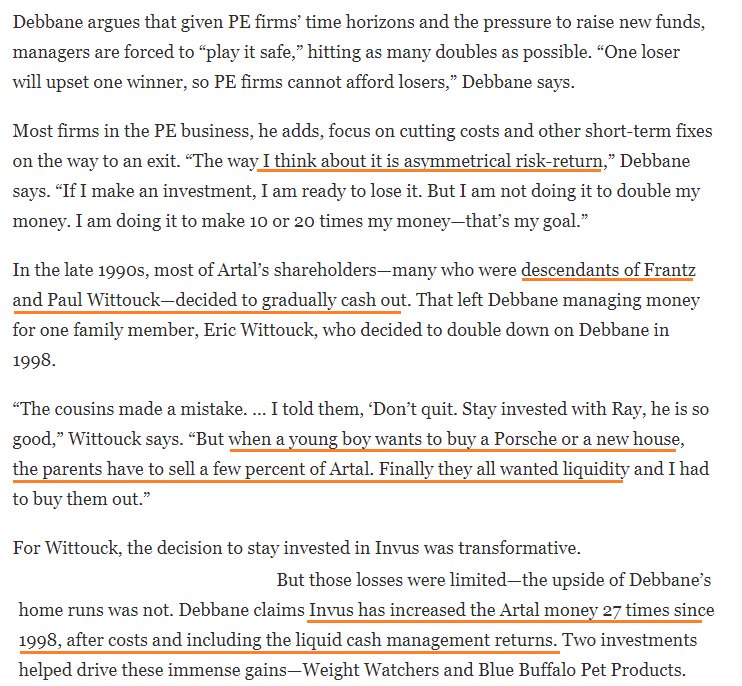
"no time pressure" and seeking asymmetrical risk-return How a family fortune fades: "when a young boy wants to buy a Porsche or a new house..." "Finally they all wanted liquidity" The stake they sold is up 27x since
Frederik Gieschen tweet media
English
0
8
57
0
jai choi retweetledi
Bill Ackman
Bill Ackman@BillAckman·
The gov’t has about 48 hours to fix a-soon-to-be-irreversible mistake. By allowing @SVB_Financial to fail without protecting all depositors, the world has woken up to what an uninsured deposit is — an unsecured illiquid claim on a failed bank. Absent @jpmorgan @citi or @BankofAmerica acquiring SVB before the open on Monday, a prospect I believe to be unlikely, or the gov’t guaranteeing all of SVB’s deposits, the giant sucking sound you will hear will be the withdrawal of substantially all uninsured deposits from all but the ‘systemically important banks’ (SIBs). These funds will be transferred to the SIBs, US Treasury (UST) money market funds and short-term UST. There is already pressure to transfer cash to short-term UST and UST money market accounts due to the substantially higher yields available on risk-free UST vs. bank deposits. These withdrawals will drain liquidity from community, regional and other banks and begin the destruction of these important institutions. The increased demand for short-term UST will drive short rates lower complicating the @federalreserve’s efforts to raise rates to slow the economy. Already thousands of the fastest growing, most innovative venture-backed companies in the U.S. will begin to fail to make payroll next week. Had the gov’t stepped in on Friday to guarantee SVB’s deposits (in exchange for penny warrants which would have wiped out the substantial majority of its equity value) this could have been avoided and SVB’s 40-year franchise value could have been preserved and transferred to a new owner in exchange for an equity injection. We would have been open to participating. This approach would have minimized the risk of any gov’t losses, and created the potential for substantial profits from the rescue. Instead, I think it is now unlikely any buyer will emerge to acquire the failed bank. The gov’t’s approach has guaranteed that more risk will be concentrated in the SIBs at the expense of other banks, which itself creates more systemic risk. For those who make the case that depositors be damned as it would create moral hazard to save them, consider the feasibility of a world where each depositor must do their own credit assessment of the bank they choose to bank with. I am a pretty sophisticated financial analyst and I find most banks to be a black box despite the 1,000s of pages of @SECGov filings available on each bank. SVB’s senior management made a basic mistake. They invested short-term deposits in longer-term, fixed-rate assets. Thereafter short-term rates went up and a bank run ensued. Senior management screwed up and they should lose their jobs. The @FDICgov and OCC also screwed up. It is their job to monitor our banking system for risk and SVB should have been high on their watch list with more than $200B of assets and $170B of deposits from business borrowers in effectively the same industry. The FDIC’s and OCC’s failure to do their jobs should not be allowed to cause the destruction of 1,000s of our nation’s highest potential and highest growth businesses (and the resulting losses of 10s of 1,000s of jobs for some of our most talented younger generation) while also permanently impairing our community and regional banks’ access to low-cost deposits. This administration is particularly opposed to concentrations of power. Ironically, its approach to SVB’s failure guarantees duopolistic banking risk concentration in a handful of SIBs. My back-of-the envelope review of SVB’s balance sheet suggests that even in a liquidation, depositors should eventually get back about 98% of their deposits, but eventually is too long when you have payroll to meet next week. So even without assigning any franchise value to SVB, the cost of a gov’t guarantee of SVB deposits would be minimal. On the other hand, the unintended consequences of the gov’t’s failure to guarantee SVB deposits are vast and profound and need to be considered and addressed before Monday. Otherwise, watch out below.
English
7.7K
5.7K
24.5K
14.8M
jai choi
jai choi@jaichoi·
Building generational venture scale companies takes a very long time. As in 15 to 20+ years. Not many VC investors have such unrelenting patience and established platform leverage as Sequoia to weather through the economic cycles. #vcmoatmindset
Patrick OShaughnessy@patrick_oshag

My conversation with Sequoia’s long-time leader @dougleone We discuss: - leading Sequoia from 1996 until recently - debugging the “merchandising” cycle (so good) - why NOT to “build enterprise value” at the GP level - motivation and edge Enjoy! joincolossus.com/episodes/54685…

English
0
1
2
149