S

1.2K posts

S

S

@jasdev28

New York Katılım Mayıs 2011
851 Takip Edilen159 Takipçiler
S retweetledi
Ben Stiller
Ben Stiller@BenStiller·
KKKNIIICCKKSSSSS
English
86
738
10.9K
231.9K
S
S@jasdev28·
ZXX
0
0
0
5
S
S@jasdev28·
ZXX
0
0
0
14
S retweetledi
ESPN
ESPN@espn·
Put the city on his back 🗣️
ESPN tweet media
English
281
4.8K
33.6K
684.6K
S
S@jasdev28·
@ShanuMathew93 @DavidSacks Sacks just lured in crowd sourcing for an investment thesis. Brilliantly done. Credit where it’s due.
English
0
0
0
123
Shanu Mathew
Shanu Mathew@ShanuMathew93·
1 GW AI data center economics are mostly a sensitivity table based on the assumptions you use. Three revenue cases: Low: ~$7B (500k GPUs × 80% utilization × $2/GPU-hour × 8,760 hours) Mid: ~$17B (750k GPUs × 85% utilization × $3/GPU-hour × 8,760 hours) High: ~$32B (1M GPUs × 90% utilization × $4/GPU-hour × 8,760 hours) Against ~$50B of capex, revenue payback looks like ~7 years, ~3 years, and ~1.6 years. That framing is incomplete because the operating cost stack is large: Power: ~$0.7–1.5B (1M kW × 80–90% utilization × 8,760 hours × $0.08–0.15/kWh × 1.15–1.25 PUE) Facilities operations: ~$0.2B (1,000 MW × ~$175k/MW/year) IT service and maintenance: ~$1.5–3.0B (3–6% of $50B capex) Labor, software, insurance, security, admin: ~$0.2–1.0B (2–3% of revenue, case-dependent) Depreciation: ~$6.5–8.0B ($15B GPUs/servers over ~4 years + $7.5B networking over ~6 years + $17.5B power/cooling over ~15 years + $10B shell over ~25 years) That changes the payback math: Low case: likely uneconomic. EBIT is minimal or negative after full cost burden. Mid case: roughly ~8–10 years to EBIT payback. High case: roughly ~3 years to EBIT payback, but only if GPU density, utilization, and rental pricing all hold near the bull-case end of the range. The key variables have to include other factors beyond just power cost. They are GPU count per GW, realized rental price, sustained utilization, service burden, depreciation life, and refresh economics. The main question is what happens in year five onward. A cluster still earning $3/GPU-hour has a very different return profile than one earning $0.50/GPU-hour after the next hardware cycle. We’ve seen demand and rental prices hold up, if they compress for whatever reason, the math changes very quick.
David Sacks@DavidSacks

Back-of-envelope numbers for 1 gigawatt data center: All-in Capex: ~$50 bn Enterprise revenue generated: ~$25-30 bn/year Electricity cost: $1-2 bn/year ~2 year payback. The boom is real.

English
38
71
617
115.4K
S
S@jasdev28·
@DavidSacks @grok Payback based on revenue? Since when?
English
2
0
9
18.5K
David Sacks
David Sacks@DavidSacks·
Back-of-envelope numbers for 1 gigawatt data center: All-in Capex: ~$50 bn Enterprise revenue generated: ~$25-30 bn/year Electricity cost: $1-2 bn/year ~2 year payback. The boom is real.
English
580
950
12.6K
2.3M
S retweetledi
Billy Binion
Billy Binion@billybinion·
The responses to this are a good reminder that a lot of anti-immigrant keyboard warriors have no idea what the law says. “He had 20 years to become a citizen!” No. Thanks to country of origin caps, the wait time for Indians can be over *100 years*—just to get a green card. Many die waiting in line. We tell people seeking the American Dream to come here “the right way,” and then we punish them for doing so.
Sam Peak 🇺🇸💡@SpeakSamuel

This H-1B worker has lived in the US for nearly 20 years and built a family here. His mom was dying in India. To visit her, he would need to wait months to book a consular appointment--with the soonest one available likely being scheduled one year out. He made the difficult choice of not visiting his dying mom because leaving without an appointment would mean separation from his children, job, and his other obligations. Much of the commentary around immigration focuses on how such bureaucratic burdens undermine immigrants’ ability to contribute and innovate. But we must remember that this red tape also prevents these people from being fully engaged with their own lives and meaningfully present in the lives of others. This matters too, and these seemingly non-economic problems will eventually translate into economic costs. If America is no longer a place where people feel empowered to be the best versions of themselves as they celebrate, struggle, and grieve, it ceases not just being the land of opportunity, but also the land of dignity and purpose. linkedin.com/posts/gautam-d…


English
630
479
3.7K
477.4K
S
S@jasdev28·
Shifting blame now? You pushed for it and cheered when the merger failed. Now thousands of jobs lost, colossal loss of investments, average person is in no better place, other airlines will probably scoop parts of Spirit assets at pennies on the dollar. You failed American people and only cared about your political agenda. You failed to see beyond your politics.
English
0
0
0
1.1K
Elizabeth Warren
Elizabeth Warren@SenWarren·
Spiking fuel prices from Trump’s war was the nail in the coffin for twice-bankrupted Spirit airline. FWIW, JetBlue merger failed because a judge, appointed by Ronald Reagan, said the deal was illegal. Republicans are desperate to shift blame from higher costs hitting families.
English
14.3K
1.5K
7.9K
2.6M
S retweetledi
Aaron Rupar
Aaron Rupar@atrupar·
Joe Kernen comes close to having a coronary on air as Pete Buttigieg dogwalks him all over the Squawk Box studio about Trump's economic mismanagement and inflation
English
2K
6.8K
44.2K
4.5M
S
S@jasdev28·
@citizen_kau Idiotic take. Arnab repeating his nonsense views again. Appeasement politics, skewed mindset and corrupt journalism. Facts are lacking and this is more of rhetoric than a journalistic take on situation, history and politics combined.
English
3
0
4
6.8K
Citizen Kau
Citizen Kau@citizen_kau·
Arnab’s video going viral in Iran. For all the right reasons. Never thought I’d live to see this day. 🥲
English
234
2.6K
11.7K
498.5K
S
S@jasdev28·
@joeyyochheim Thoughts on tennis? And while at it, pickleball/padel also?
English
0
0
3
1.3K
Joey Yochheim
Joey Yochheim@joeyyochheim·
Ranking Workouts for Weight Loss
English
108
604
13.7K
300.8K
S
S@jasdev28·
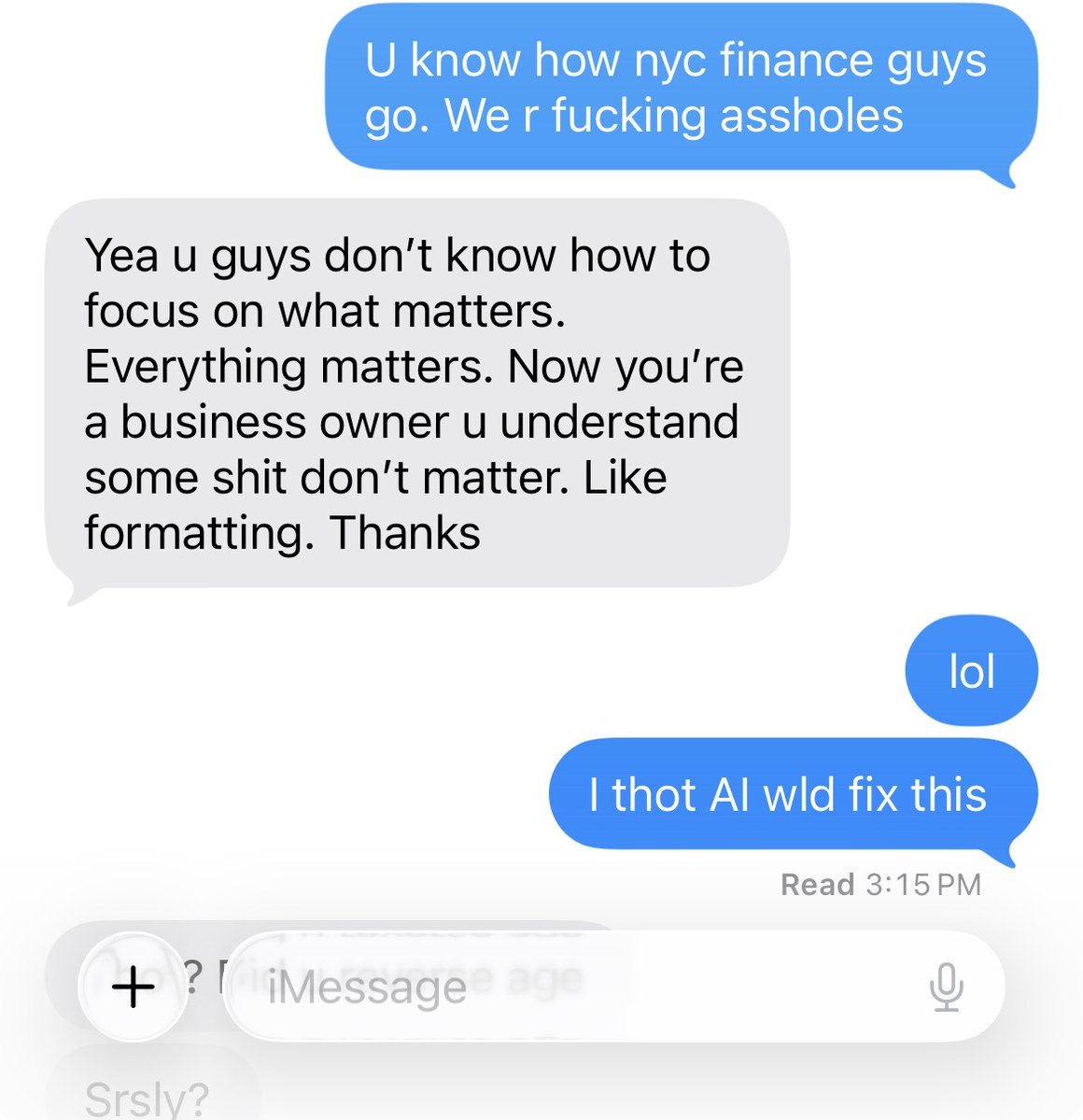
@blueprintsmb22 Who the f**k uses “thot”, “wld”?
English
1
0
13
2.9K
Blueprintsmb
Blueprintsmb@blueprintsmb22·
My friend is smarter than me. She worked with me at Morgan Stanley then did private equity before GSB before doing corporate jobs in Tech. She’s now chief of staff for an AI startup that recently got over $100mm of funding. Her new boss is the COO who is a NYC finance guy. He hilariously cares about formatting. Don’t worry junior bankers, AI won’t take your job. Too much bad muscle memory in middle and senior mgmt focused on turning over decks to “add value.”
Blueprintsmb tweet media
English
11
2
260
96.9K
S retweetledi
peter grouev
peter grouev@pgrouev·
@devahaz Next Pod episode @Jason will back paddle saying he actually always voted Democrat over 20 years and @chamath and @DavidSacks will deny they ever visited Mar-a-Lago
English
1
2
6
1.2K
S
S@jasdev28·
A lot of indirect pricing is Capacity driven which is extremely understated because of US grid being decentralized (to a certain extent). Pure commodity cost and basis cost are drivers but the capacity costs lead pricing directionally and make it inversely correlated at time. Capacity structure varies by each ISO/RTO, effectively by what region of US you live in. Basically not a uniform across the country. PJM & NY ISO market more sophisticated in capacity structure while ERCOT (Texas) is not. Pricing stability wise it can go either way. Ever going debate about which structure is better. But as a commodity analyst, you got to pay attention to capacity markets.
English
1
0
5
2.6K
Restructuring__
Restructuring__@Restructuring__·
I now understand how electricity is priced better than 99% of people after watching this video 2 minutes well spent, watch this ex-Citadel simply explain the power market
English
25
89
1.4K
180.8K