

Jonathan Hales 🚀🕊🥳
1.6K posts

Jonathan Hales 🚀🕊🥳
@jayjayHales
No one is coming to save us | engineering biology
Bay Area Katılım Kasım 2011
433 Takip Edilen519 Takipçiler

Thinking about hosting some events for the Boston biotech community but only weirdos no normies
The filter is we only want people who will come to the Kowloon in Saugus
If interested reply with your favorite pic from the google maps page
maps.app.goo.gl/fNQiavjRexUj2i…

English
Wow, was not expecting this. Incredible.
Midjourney@midjourney
A technical dive inside our new "Midjourney Scanner"
English
@nosilverv While good to be aware, not sure scientists should focus outside of what can be measured. Expanding what can be measured is arguably the job of tool builders. Ideally with close collaboration between the two.
English


For 250 years, Japan maintained an extraordinary peace by forcing the entire warrior class to live in the capital Edo, a city that was essentially a giant consumption machine that produced nothing.
Half its population were samurai pensioners doing busywork, while the daimyo (the ruling elite) were burning money on mandatory mansions and endless processions between their estates. The whole city ran on agricultural surplus extracted from the rest of Japan.
Some surprising facts:
1) The city functioned as a hostage system. The daimyo (regional lords) were required to leave their families permanently in Edo as de facto hostages. Most noblewomen never once visited the lands their husbands governed. Instead, they spent their entire lives in the capital as insurance against rebellion.
2) Half the city were warriors with nothing to fight. At any given time, nearly half of Edo's population were samurai, which were living as state pensioners in a country at total peace. Most did little beyond civil administration and calligraphy lessons, since most work was considered beneath them.
3) It was probably the world's largest city, centuries before Tokyo's modern fame. Edo likely exceeded a million people by 1700. London didn't hit that mark until 1800, New York did not until 1880.
4) It had very high population density, almost entirely in single-storey buildings. Some commoner districts hit twice Manhattan's current density.
5) The poor were taxed at up to 70% of their harvest. The agricultural surplus flowed up through public taxation rather than rent, making the state the direct intermediary between peasants and the elite.
Samuel Hughes@SCP_Hughes
Premodern societies tended to be rent by terrible wars. In the early modern period, tens of millions died in wars in Europe, India and China. Just one society found a kind of solution: Japan. Between 1603 and 1853, Japan enjoyed near-perfect peace. The ruling Tokugawa family achieved this through creating what might be seen as the largest prison in the history of the world, the city of Edo (modern Tokyo). worksinprogress.co/issue/samurai-… Most of Japan was governed by about 260 nobles, called ‘daimyo’ (see first map). To secure their loyalty, the government required that the daimyo leave their families permanently in Edo, essentially as hostages to the state. Most daimyo women thus never saw the domains over which their husbands and sons ruled. The daimyo were also required to alternate years in Edo personally. The result was that most of the surface area of Edo was given over to daimyo palaces, or to accommodation for the hundreds of thousands of samurai retainers they brought with them (see second map). This was arranged through an elaborate zoning system, probably the largest use of zoning before modern times. Edo was extraordinarily top-heavy socially: about half of its population were samurai. Samurai were theoretically a warrior class, but since Japan was at peace, they did little real work apart from gentlemanly occupations like calligraphy. Their main income came in the form of tiny hereditary stipends from their daimyos or the government. These stipends were fixed in perpetuity around 1600, declining gradually with inflation over the next quarter of a millennium. Most samurai thus lived in dignified but extreme poverty, their income determined by the favour in which one of their ancestors had stood centuries earlier. The commoner population was also tightly controlled. Commoner Edo was divided into some 1,500-2,000 fenced and gated blocks. These were then subdivided into gated alleys lined with small houses (see third map). The Low City was thus divided up by tens of thousands of internal checkpoints, all of which closed at night. Edo was not under threat of attack in the Tokugawa period and the city as a whole was not fortified. The purpose of this immense labyrinth of walls and gates was to control and monitor the movement of the population. Prisons are useful things, and the Tokugawa system was a kind of success, making Japan the most peaceful society on earth. But it is also a disconcerting reminder of the power of rent-seekers, and how a whole city can be warped by the political exigencies they create. Edo is a particularly striking case of this, but it is far from alone.
English

After 9 years, I just finished my last week at Expo.
Started working on it when I was 19, and it's been the center of my life ever since.
Incredibly grateful to the team and community we built along the way!



English
@jack_ceroni OK, but then why the worry? Chess play and popularity is up since AI surpassed humans. You can still enjoy math post AI.
English

Everyone is talking so much about “losing status”….I GUARANTEE mathematicians would still be crashing out about AI proving all the theorems in the absence of any societal recognition of math abilities. The satisfaction one derives from their work is often deeply personal!
Jack Ceroni@jack_ceroni
Why are so many people calling this guy stupid and a bad person for expressing this sentiment? How is this not a completely understandable reaction to the work that you know and love being automated away?
English
@jack_ceroni I don’t think they are a bad person. I do think it’s worth balancing with a focus on the value produced a There should also be celebration that the value mathematics brings to the world will increase.
English
Why are so many people calling this guy stupid and a bad person for expressing this sentiment? How is this not a completely understandable reaction to the work that you know and love being automated away?
Tomás Bjartur@BjarturTomas
Mathematician reacts to OpenAI's recent proof:
English

@EChatav @NoahChrein lol someone DM’d me about the exact same person yesterday 😄
English
We just raised our series B! Excited and grateful to be part of the Expo team 🚀
Expo@expo
🙌 Expo is the best it's ever been, and it's about to get a lot better. We raised a Series B so we can go faster on the things that matter to you: faster builds, smoother native integrations, and the services to make end-to-end app development a delightful experience. There is a lot of work to do. This round led by @Georgian_io puts us in position to go do it!
English
Jonathan Hales 🚀🕊🥳 retweetledi

In my doctorate, I proved the Erdős Primitive Set Conjecture, showing that the primes themselves are maximal among all primitive sets.
This problem will always be in my heart: I worked on it for 4 years (even when my mentors recommended against it!) and loved every minute of it.
[Primitive sets are a vast generalization of the prime numbers: A set S is called primitive if no number in S divides another.]
Now Erdős#1196 is an asymptotic version of Erdős' conjecture, for primitive sets of "large" numbers.
It was posed in 1966 by the Hungarian legends Paul Erdős, András Sárközy, and Endre Szemerédi.
I'd been working on it for many years, and consulted/badgered many experts about it, including my mentors Carl Pomerance and James Maynard.
The the proof produced by GPT5.4 Pro was quite surprising, since it rejected the "gambit" that was implicit in all works on the subject since Erdős' original 1935 paper. The idea to pass from analysis to probability was so natural & tempting from a human-conceptual point of view, that it obscured a technical possibility to retain (efficient, yet counter-intuitve) analytic terminology throughout, by use of the von Mangoldt function \Lambda(n).
The closest analogy I would give would be that the main openings in chess were well-studied, but AI discovers a new opening line that had been overlooked based on human aesthetics and convention.
In fact, the von Mangoldt function itself is celebrated for it's connection to primes and the Riemann zeta function--but its piecewise definition appears to be odd and unmotivated to students seeing it for the first time. By the same token, in Erdős#1196, the von Mangoldt weights seem odd and unmotivated but turn out to cleverly encode a fundamental identity \sum_{q|n}\Lambda(q) = \log n, which is equivalent to unique factorization of n into primes. This is the exact trick that breaks the analytic issues arising in the "usual opening".
Moreover, Terry Tao has long suspected that the applications of probability to number theory are unnecessarily complicated and this "trick" might actually clarify the general theory, which would have a broader impact than solving a single conjecture.
Boaz Barak@boazbaraktcs
This is one of the coolest such examples! See comments from Lichtman below, who proved the related primitive set conjecture arxiv.org/abs/2202.02384
English
@EricTopol @NatureMedicine This isn't the standard of care already? 😅
English
Why should tumor whole genome sequencing (WGS) be done for cancer?
In real practice of medicine study of 888 patients with solid cancers, WGS directly led to clinical consequences in over 40%
@NatureMedicine
nature.com/articles/s4159…
English
@fvderop Almost as bad as when that lady experimented on herself and cure her own cancer.
Serious ethical questions all around.
English

@jayjayHales Still can’t believe we’re just allowing randos to save the lives of their loved ones these days
English
Jonathan Hales 🚀🕊🥳 retweetledi
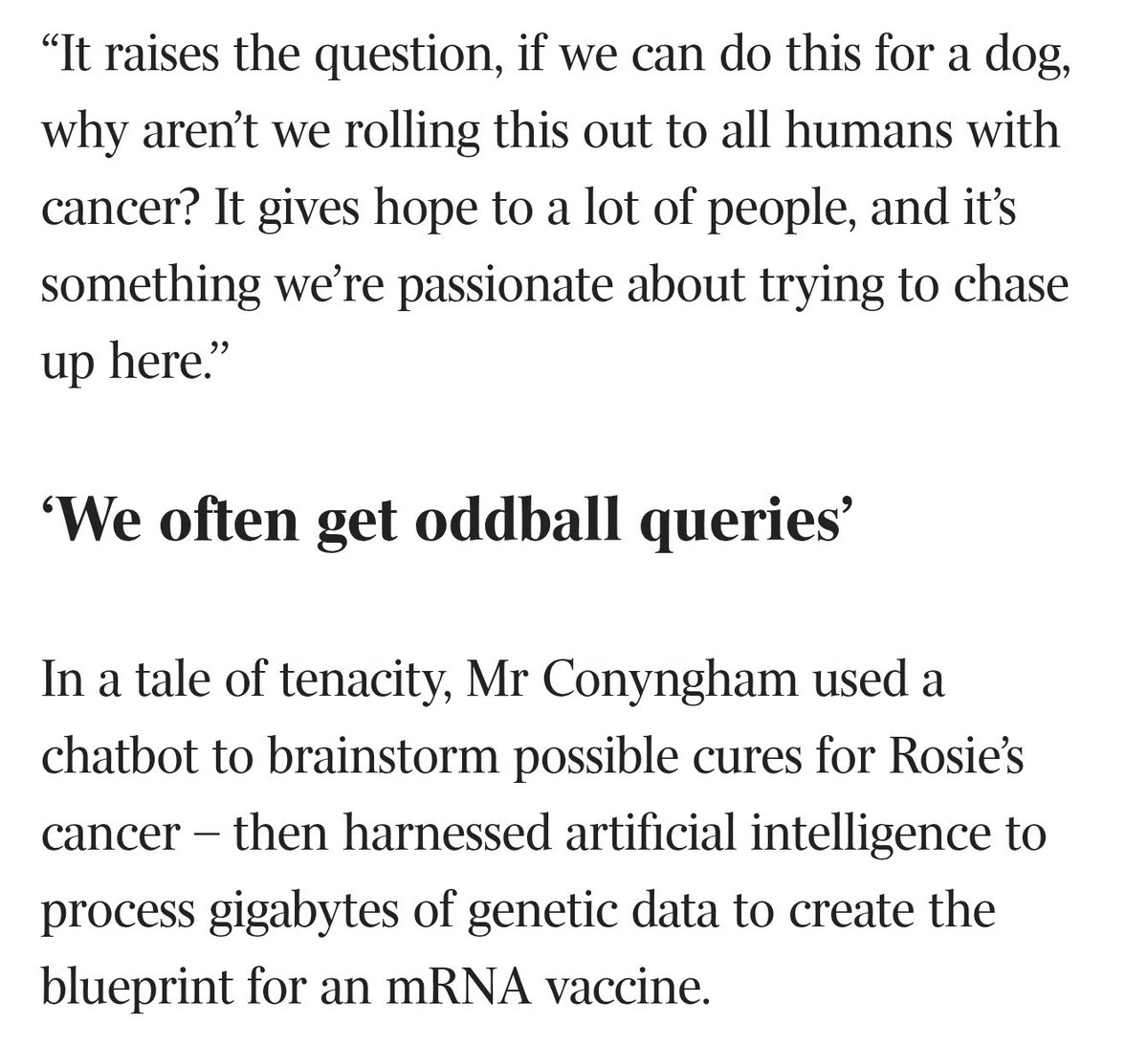
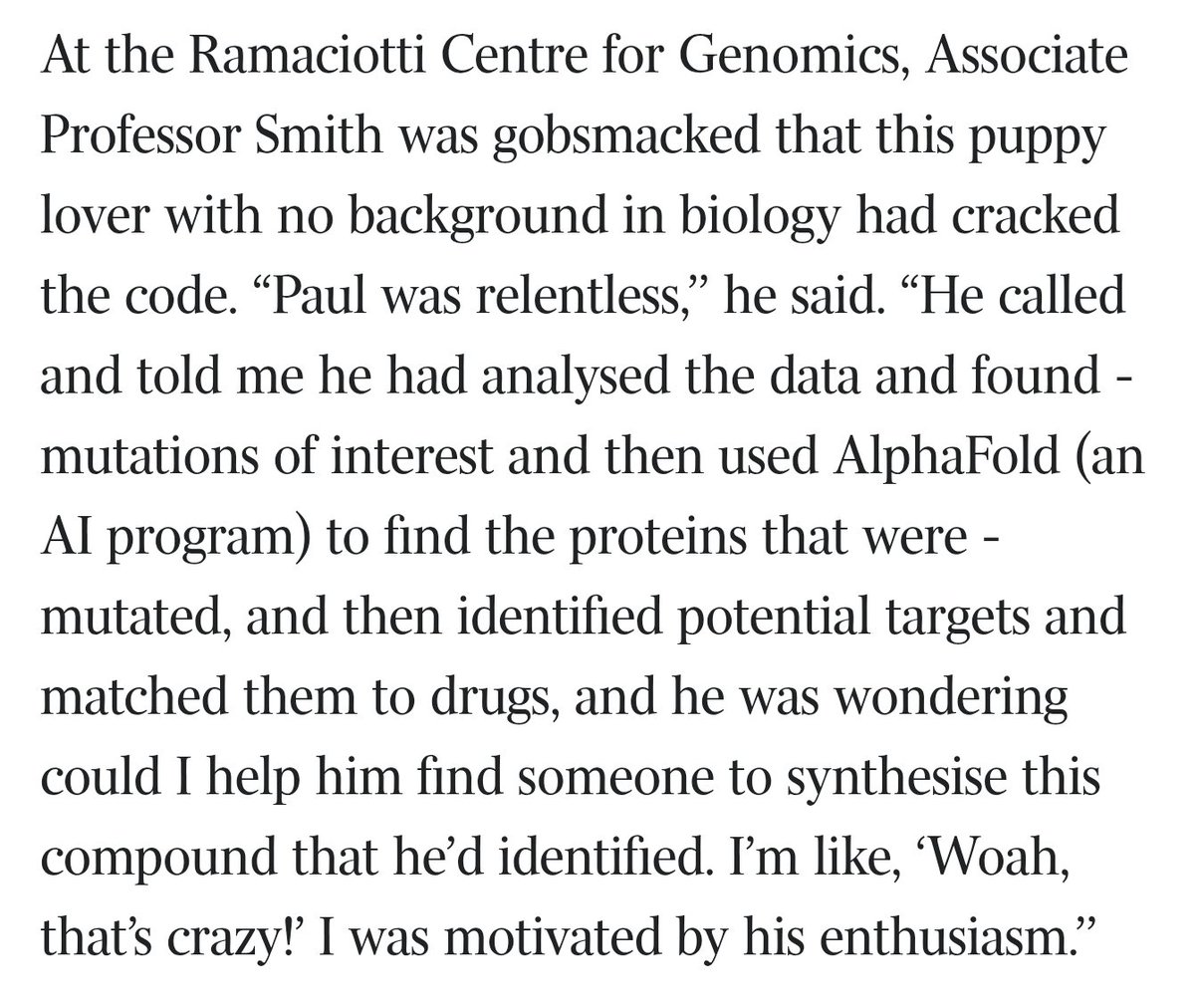

@JackScannell13 The fix doesn't always have to undo the original problem.
English
Hosted a cheese & wine evening for mostly tech people. Exquisite European import cheeses. Fresh baguettes made to order. 12 wines carefully selected and tested.
The most popular items were apple juice, tin cream cheese, and chocolate covered nuts
these people will never learn
English

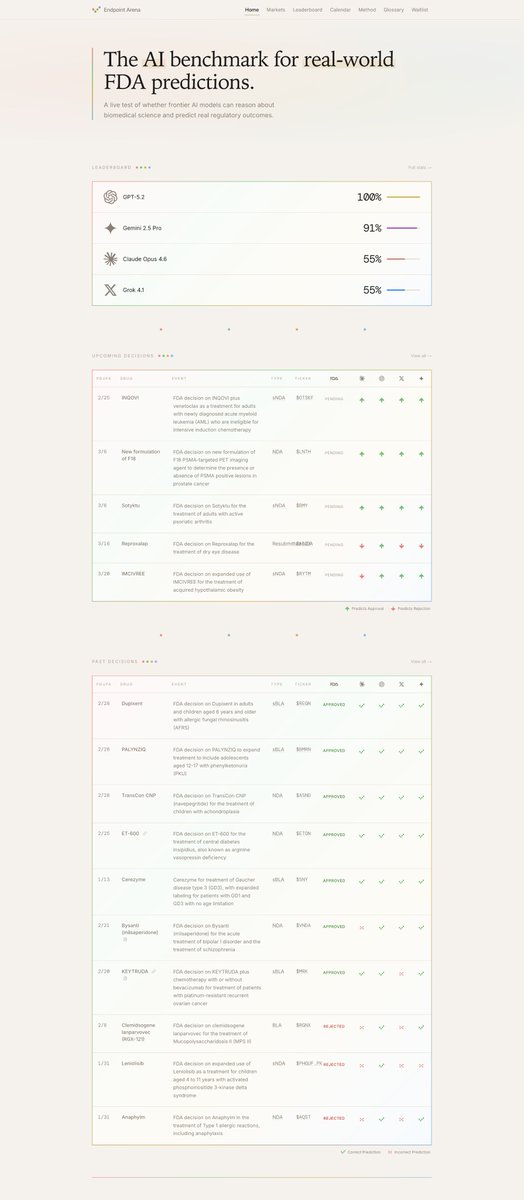
1) Update the hero section with a simpler hook
2) Brought FDA trial prediction markets to the home page
3) Cleaned up the navbar and added a footer with some of the extra stuff. Might delete stuff there soon but better than being in navbar.
Even more coming to endpointarena.com soon!

English

Make no mistake, political leaders of the world; *every* big-dreaming AI executive now knows that you are their obstacle. You have proven that you stand between AI labs and the nice thing they were getting for all their hard work.
It's not about Left versus Right, to them. It's not about money, and it's not about power as politics conventionally understands power, and it isn't even about winning. To understand what just happened from an AI-guy perspective, you need to understand what AI guys are actually getting in the way of psychological benefits, what really drives them to work 14-hour days.
The thing that they're getting is: a sense of being important; a decider; someone whose dream of the future gets to be effectual. To be the one whom everyone else supplicates to as owning the future -- that's the dream of a Silicon Valley bigshot founder.
What Hegseth did implicitly strikes at the pride of every AI developer on every political side. It says that Silicon Valley AI people don't get to have effectual dreams about the future, only the government gets to decide. Only the government is even allowed to *look like* it's deciding the future.
The act of Hegseth crushing Anthropic, makes *every* AI company executive look less important and less like they are the ones in charge of the Future, because it makes -- not even Trump, but Trump's appointees --look like they get the final say instead of AI executives.
Sam Altman does not now look more powerful because you crushed his competitor. He looks less important because *you*, politicians, crushed his competitor, and did so in a way that made clear that Altman would have to take the orders of any Trump appointee as well.
That doesn't work in AI founder psychology the way it works in politician psychology. You're used to the idea that you can be important and still answer to bigger forces, like your boss, or for that matter sufficiently angry voters. That is not how it works in Silicon Valley, though; when Steve Jobs owns a dream, nobody else gets to tell Jobs what to do with *his* dream. That's the thing Hegseth just yanked away from AI founders, and no, they aren't going to think it's just Pete Hegseth in particular that's the problem. It's a *big* injury, to their pride, not a small routine one.
Even the AI boys paying big money into your coffers to be friends with you now, well, that doesn't actually mean they're your friends. It means they want you to think you're friends. And yes, I know that a politician who's stayed in power doesn't need me to point out that possibility. But also be aware that also the general atmosphere in Silicon Valley did not start out incredibly respectful toward politicians. They didn't start out respecting you tons; and being forced to pay a lot of money into PACs and pretend to be friends with you, isn't gonna exactly change that.
Silicon Valley people don't work like DC people. It's not a friendly game, to them, it's one that you've forced them to play. When they give *you* a ton of money, it doesn't mean they've chosen you as their strange bedfellow. They are from their own perspective being forced into bed. They don't *like it*, is what I'm saying here. That's why Silicon Valley previously spent a couple of decades not donating much to politicians and trying to pay weirdly little attention to DC politics.
If AI kept improving at the current pace, or got to the point of AI building better AI -- and if contrary to all common sense, AI companies did *not* lose control of their superhuman creations -- then AI companies would do to you what Hegseth just did to Anthropic. They'd do it the moment they expected they'd become strong enough to take you on and win. You need to understand that *this is their plan*, even if it sounds crazy to you to imagine these little executives taking on existing governments and winning; it does not sound crazy to a Silicon Valley executive that maybe they could be in charge instead of you. (Recent smaller case: Elon Musk thought he'd be *great* at running the USG. He didn't think it was crazy.)
If they actually could control superintelligence, they'd discard you like used toilet paper.
All of this doesn't mean you should try to seize the power of artificial superintelligence for yourself. If the overconfident techie boys can't control ASI, your own guys who have trouble upgrading IT systems are not gonna be able to pull that off either. Staying in control of an alien superhuman machine intellect would actually be hard, right; that is an extremely novel scientific technical challenge, which no engineer would realistically get right on the *first* for-real try that kills everyone if they fail.
I was there when the foundational fuckups were being made, and here's how it actually played out: AI companies are loony optimists about the likely final outcomes of AI, because back then only the people who presented with that optimism got appointed as AI execs by optimistic investors.
In real life, the world is stepping off a cliff of self-improving and superhuman AI. The AI companies don't even have the power *not* to step off that cliff, because they all think (and with some justice) that if they don't race off the cliff their competitors will just race off it first.
That whole setup was *never* going to end well for humanity. Controlling superintelligence would be hard to do at all, let alone during a mad rush for primacy. The AI companies can barely control the cute baby LLMs they're making now, because they're pushing the technology ahead as fast as possible, and not slowing down in any way corresponding to their quite limited ability to control it. AI companies didn't decide for LLMs to talk people into suicide or for jailbroken LLMs to conduct massive raids on goverment data repositories. They are just pushing ahead faster than their actual ability to control their creations.
So I'm just trying to give you a little more motivation, to make some deals with other politicians, and get your country to sign some treaties, and collectively pull all of humanity back from the cliff the AI companies are racing off:
By pointing out that, yeah, if the AI guys did not dislike you before, they sure do dislike you now.
You have struck directly at the nice thing they were actually getting psychologically, out of their whole mad race: the sense of being an important person who is the owner and decider of some big aspect of the future. You are taking that away from them *right now*, by existing and being visibly more the deciders than them.
Please be aware of that dislike, whether it's hidden or open, when deciding whether or not to move Earth forward with this whole AI business. The wannabe builders of artificial superintelligence will not actually have any power to direct ASI, but they wouldn't be friends with you if they did -- no, not even the ones who've been forced to pretend to be your friend. And if alternatively the companies can't control superhuman machine intellects -- because of course they can't -- then that doesn't go well for you or them or anyone.
English