
Sabitlenmiş Tweet
jb smith
2.5K posts


jb smith
@jbs2a
Libertarian. MN Vikings, NC Tar Heels, USD Coyotes, TWolves, Twins; Iraq and Bosnia Vet; Just here for some jokes.
North Carolina, USA Katılım Mart 2010
3.4K Takip Edilen3.8K Takipçiler
@mattyglesias What’s stupid about this conversation is the continued effort by people to put American Politics, parties, and even philosophies on the European political spectrum. Just don’t. There are far too many areas of divergence to make it a useful conversation or comparison.
English

I wouldn’t say this makes me “mad” but it’s definitely stupid
Ken Gardner@KenGardner11
I'm not an "own the libs" guy -- in fact, I am the polar opposite of such people and I especially hate that genre of social media -- but very few things make left wingers madder than pointing out, correctly, that Nazism was a virulently anti-capitalist, pro-socialist movement.
English
@BoeufEtLiberte @RonDeSantis I agree the current system is abused. But if the hiring companies had to pay the salary - plus a 3x fee to the government - the incentive to do so would disappear.
English

@jbs2a @RonDeSantis Theoretically, an H1 visa could work; but we see that they constantly cheat and abuse it. For the next century at least, until people start acting more trustworthy, we can't allow this loophole to exist.
English
@maner_travis Thanks. Wasn’t aware of this.
Not quite what I would propose - as the barrier to entry seems to be high - and a bit subjective.
I think the 3x fee would act as an appropriate barrier and not place an undue administrative requirement.
English

English
Well the initial premise is a lie. Trump didn’t conjure up the idea/term of Domestic Terrorism.
Biden warned of a rise of “political extremism, white supremacy, and domestic terrorism” in his inaugural address.
In 2021 the Biden Administration released the “National Strategy for Combating Domestic Terrorism”
govinfo.gov/app/details/GO…
And of course Biden repeatedly referred to the moron Jan 6 protesters as domestic terrorists as well.
Kind of hard to give your article a lot of credibility when you get such a basic fact badly wrong.
English

I wrote this... at length. It turned out to be a much bigger deal than I had imagined.
newrepublic.com/article/208846…
English
To further illustrate your point, it’s the concept of the “wisdom of crowds”. For things that are subjective, the crowds get it right more than the “experts”.
Almost every NFL team would benefit from just using the consensus big board.
As for those saying “well other teams drafting behind the Vikings liked Banks!” There is another economics concept called “the winner’s curse” when a party pays too much for a valued asset and that overpay represents a net loss of value.
Lastly, we have never seen the Vikings consistently draft so well that they deserve the benefit of the doubt.
English

The consensus concept is so simple, yet it seems to strike such a nerve with some folks.
The historical data basically says that if you love a prospect way more than anyone on the outside, it’s a risky play in the draft.
That’s it. A lot of the responses are like, “how dare you question teams’ flawless process!” as teams continue to have mediocre hit rates
English
Consensus board dialogue reads like when data people were telling coaches to go for fourth downs in like 2014 and coaches kept saying they’d get fired if they did that
(Some teams are using consensus boards themselves though)
English
@BerkleSam11160 @mattvanswol WTF is wrong with you posting someone’s address Twitter? You should delete this.
English



I understand there's a lot going on...
But can someone at the DOJ help me find out why DOZENS of donations were made in my name to ACT BLUE Democrats in KANSAS...
...when I've NEVER been to Kansas or donated to any political candidate in my entire life?
Something is up...

English
We tried the “Low T” approach for the past 25 years and it created a generation of young men lagging behind females in education and work outcomes. More fixated on video games and immediate pleasure seeking than in building and being responsible for themselves and for others.
Past time to try something else.
English
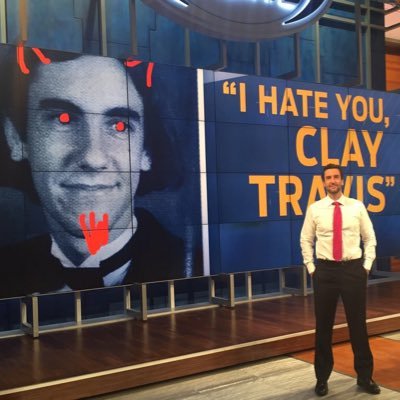
AOC is concerned that Republicans are radicalizing young men by pushing them to be more masculine.
English
Again, that doesn’t address the comparable inefficiency of the city budget. Consolidation should mean that a city should be able to provide services more cheaply.
It is reasonable to expect a larger per capita spend (as I stipulated above due to COL differences). It isn’t reasonable to expect that spend to be about 3x.
Would you, as an investment banker, look at a company paying its back office functions 3x per capita versus that of a comparable company and say “Oh, that’s fine, the company is making more than enough to cover that!” Or would you look at each expenditure on its own merits?
Also, while NYC’s GDP is higher (about 15%), much of that is due to non capital extensive industries. A banker loaning money or stock/real estate speculation doesn’t require much government investment, unlike Florida’s which require more infrastructure provided by the state/local governments.
English

@jbs2a @SamRossEsq @RonDeSantis Somehow you failed to understand that NYC is more productive than the entire state of Florida.
Why does Florida rely on federal funds more than New York?
English
FL = 23+ million people
NYC = 8 million people
Geiger Capital@Geiger_Capital
Zohran Mamdani just proposed a preliminary budget of $127 Billion for NYC… The entire state of Florida is $117 Billion.
English
I’m sorry, but I think you are looking at this wrong
It is much easier (or should be easier) to service 12M people in a 300 SQM space than 27M people in a 60,000 SQM. Yes there are plenty of spaces in Florida that are empty, but with several large population centers (and many small ones) there is far more needs of duplicity - school systems, emergency response, etc. As an investment banker, you know that the first thing done in a merger - which is really consolidation - is the elimination of redundant departments. A state, by necessity, has to have a lot more redundancy which shouldn’t exist in a city system.
And while the infrastructure of those 300 SQM will be under more stress, and therefore may require far more assets than a comparable space in Florida, it is still easier and cheaper to provide that service than to provide across a 200x larger space.
And while I am sympathetic that the higher GDP of NYC does create cost of living issues which necessitates higher salaries and therefore a larger per capita budget, that doesn’t explain the whole difference.
Just look at education. NYC now spends $42K per pupil in k-12 33% more than 5 years ago. And it’s enrollment is falling, which obviously mean its overhead is not also being adjusted downward. K-12 is a jobs program for administrators.
Comparatively, Florida spends $13K per pupil. What does NYC get for spending 3.5x as much? Outcomes that trail the national averages, while Florida’s are above.
So no. NYC is not well run and it is inexcusable for them to have a budget 10x an entire state that is 200x the size and 2x the population.
English
You’re framing this as “tax the few until they flee,” but that wasn’t the argument.
Two things can be true at once:
1.NYC’s GDP is disproportionately driven by high earners and finance/tech sectors.
2.Large urban economies also require massive public infrastructure to function, transit, schools, sanitation, policing, housing support, because of density and cost structure.
Again, comparing NYC’s budget to Florida’s without adjusting for density, wage levels, pension obligations, Medicaid pass-throughs, and cost of living is apples to oranges.
And the “they’ll all flee” argument gets overstated and is just as moot as any other red herring argument. High-income earners move for many reasons, market access, talent pools, capital networks, not just marginal tax rates. If that were the sole driver, NYC’s economy would have collapsed decades ago. It hasn’t.
The real debate isn’t “tax the rich vs chase them out.” It’s how do you fund complex, high-output economies sustainably while staying competitive?
That’s a policy design question, not a GDP scare tactic or GOP emotional blackmail.
NYC voted! Vox populi!!
English
Anyone advocating the elimination of the filibuster is not a conservative and has the IQ and memory of a goldfish. If you recall McConnell’s prophetic warning after Reid eliminated the judicial filibuster, this would be 100x worse.
Eliminate the filibuster and within a decade you’ll see a Universal income; mass restrictions on fossil fuel exploration; further expansion of the government into healthcare; a 2-3x increase in minimum wage; much more open borders; and many other things from the Democrats’ wish list. And their wish list is much longer than the Republicans’.
And this of course ignores the total idiocy of doing it for the SAVE act - which even if it passes will probably be ruled unconstitutional.
The Democrats would love Republicans to jump on this grenade.
English

If you're wondering why John Thune doesn't eliminate the filibuster, I'll tell you.
John Thune, Mitch McConnell and their globalist friends in the Senate who love that big corporate money truly hate President, Trump and MAGA.
We are a existential threat to their globalist dreams. They want MAGA done and gone. If Thune eliminates the filibuster, they know that Trump will win the House and Senate, the last two years of his presidency will be wildly successful and Vance will win in 2028.
And that my friends is why John Thune won't eliminate the filibuster. They want to end MAGA as much as the Democrats do.
English
While I agree that the quote you posted is ridiculous, justifying a use of force in the incident I saw video for is far more ridiculous.
There was no justifiable reason for officers to open fire on her.
Most police involved shootings are justified, or at least understandable in good faith. This is not one. Her crime was interference in their operations (for which she should have been arrested and prosecuted) and then not immediately following orders. Neither of which are (or should be) capital crimes.
And opening fire in a residential is irresponsible and dangerous.
And BTW - I’m an Iraq war vet who had a guy in my unit killed by a person in Iraq who used his vehicle as a weapon. So I’m not insensitive or unaware of the danger.
English

Where do you think a "warning shot" lands? Idiot. Does that bullet just land on the moon?
When you attend USSCA courses, the first thing they tell you is "every bullet has an attorney attached to it"
This "expert" then goes on to lecture about rules of engagement after expressing zero knowledge of LEO enforcement. This is lunacy.
The officer only pulled his firearm after he saw the tires stop from reverse and then rotate forward. That's actually good training.
Fire a warning shot.. JFC..
Stephen L. Miller@redsteeze
This is literal fucking insanity, completely anti-2A and against any logical LEO defense but here's a whole lot of people not arguing it because (obvious) reasons
English
@BenGoessling @BenjaminKnutso2 1977. The Year Tarkenton broke his leg 9 games I to the season.
English

@BenjaminKnutso2 The trivia question for my newsletter this week is about the last time the Vikings finished with a winning record despite not having a QB throw for 2,000 yards in a season. That's where we are.
English
For as many issues as the #Vikings have had this season, consider this:
If they'd stopped the Bears' final drive that began with Devin Duvernay's 56-yard return on Nov. 16, they'd be 9-7 with a chance at a wild-card spot.
And, in that scenario, if they beat the Packers while the Bears lost to Detroit on Sunday, the Vikings would win the NFC North.
English
@TruthNetwork24 @SCViking59 @LeaderJohnThune You are aware that the Democrats will at some point control both houses of Congress and the presidency are the same time right? So at that point do you want mass amnesty for illegals, a wealth tax, and codified net zero emissions laws?
English

@jbs2a @SCViking59 @LeaderJohnThune Currently it is only a guardrail against passing Trump's agenda, the will of the people is being actively stopped.
English

It’s been a long and challenging year here in the Senate, but Republicans have accomplished a lot for the American people.
Thanks to our work this year, Americans will be looking at safer streets, with more money in their pockets, and new opportunities on the way.
English
@TruthNetwork24 @SCViking59 @LeaderJohnThune I will agree that we should go back to making the filibuster the way it was and forcing people to talk the talk.
But I would rather have the current system than no filibuster. It’s the only guardrail against all sorts of trash.
English
Absolutely untrue... The Filibuster was excellent when they actually required them to stand and continuously speak... they do not do that and it was also good when people from both sides would talk and compromise... that does not happen now and the minority is using those facts to issue a veto on anything they do not like.
Sorry , not sorry.
I am a Conservative and nobody can tell me otherwise.
English
@TruthNetwork24 @SCViking59 @LeaderJohnThune Anyone who advocates ending the filibuster forfeits all rights to refer to him/herself as a conservative.
English
Why don’t you review his drafts from 2016-2019? As a whole they are as bad as KAM’s from 2022-2025. And may be a bit worse as KAM had players (such as Blackmon and Ingram) who left here and became at least solid starters elsewhere, or Lowe who is a valued backup in NE. None of the Rick picks that left did anything anywhere else.
I would also say that we should be having serious conversations about our player development under KOC. In addition to the three above, they gave up on Cleveland who is now a good starter in JAX, and Nashon Wright who is tied for the lead in INTs.
All the shade is being directed at KAM, but the problems run a lot deeper.
English

Rick made his share of mistakes but he was a football guy and had a lot hits on picks. I’d take him back in a heartbeat.
Canedad@canedad19
Miss me yet?
English
A part of the judge’s job in the trial is to explain the law to the jury in the instructions.
So, it actually is his/her job.
Whether or not the lawyers are permitted to tell the jury the law may vary from state to state and context. The lawyer’s job is to get the relevant facts and context in front of the jury.
English

@dwoprus @TooWhiteToTweet Isn't the judges job to tell the jury anything. That falls on his lawyer who i guess sucked balls. Judge is to sit and hear all the evidence and make sure no misconduct done. Jury if there is one decides guilt. Lawyer argues this is why it happend and why ok or not.
English

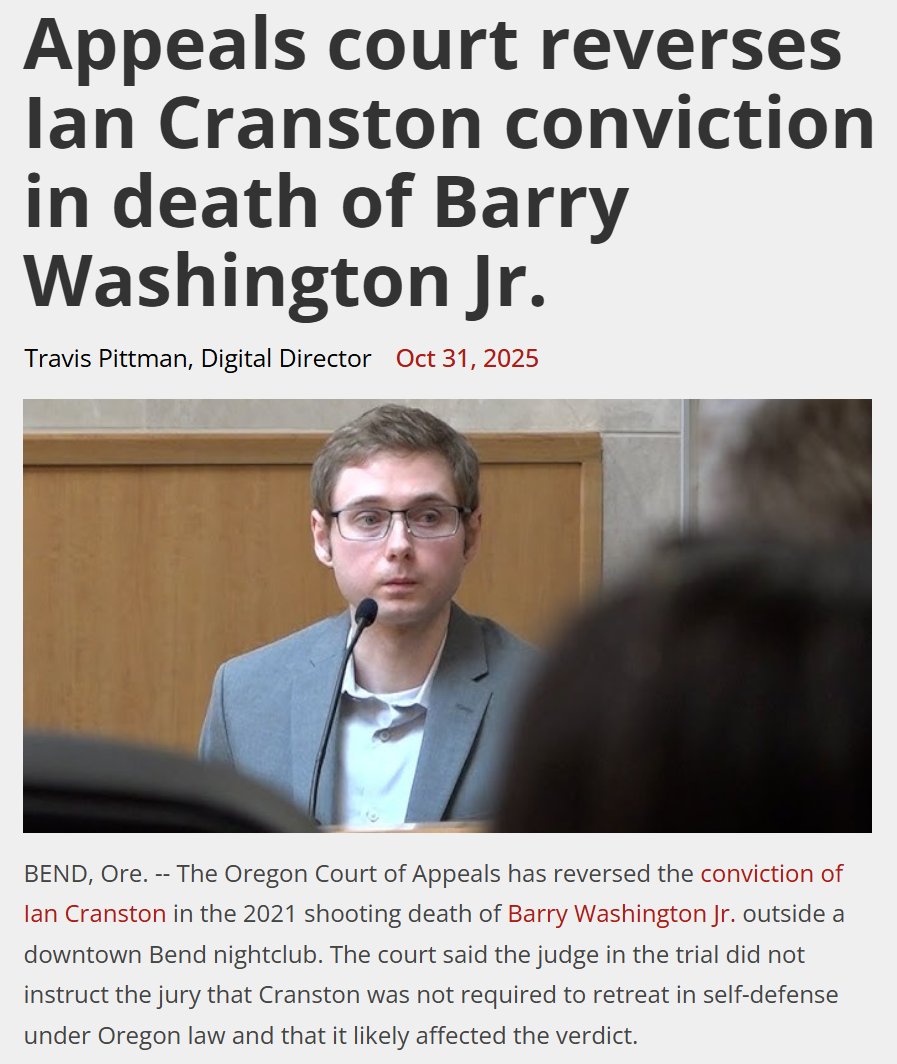
Remember the 2021 shooting in Oregon, where a drunk Black man attacked a White man and his White fiancée, was shot by the man he attacked, and then the White male victim went to prison?
Last month, the Oregon Court of Appeals reversed the decision and remanded the case for a new trial.
Here's a refresher on what's transpired:
~ Barry Washington (Black man) gets drunk at bar, hits on Allie Butler (White girl)
~ Allie tells Washington she's not interested
~ Washington pursues Allie outside, continues to knowingly make unwanted advances
~ Allie's fiancée, Ian Cranston (White man), tells Washington "move along, she's taken"
~ Washington becomes belligerent, shouts "fuck you White boy," and smashes Cranston in the head twice, resulting in a mild traumatic brain injury
~ A face-off ensues between Washington, with 3 male friends, and Cranston, with a male friend and his girlfriend
~ Allie begins recording, at which point Washington strikes her, attempts to knock her phone away, and then lunges at Cranston, who he's already violently assaulted
~ At this moment, Cranston shoots a single round at Washington in self-defense, killing him
~ Anti-White justice systems charges Cranston, the victim, with second-degree murder, first-degree manslaughter, and second-degree manslaughter
~ Jury finds Cranston guilty on both manslaughter charges, which then merge into the higher (first-degree manslaughter) charge
~ During trial, Shitbag judge Beth Bagley refuses to inform the jury that, in the State of Oregon, Ian Cranston had no duty to retreat
~ In October of this year, the appeals court reverses the decision due to shitbag Beth Bagley's withholding of information from the jury
~ Ian Cranston, the White victim, remains locked up, awaiting the state's inevitable petition to review the rejection of the verdict, which will result in either restoration of the original verdict, or Cranston being tried yet again
For four years, Ian Cranston has been locked away - all for defending himself and his girlfriend from a violent, drunken attack.
While the decision from the appeals court is good news, there remains a hell of a long road ahead. At best, Ian, now 31 years old, will have to endure yet another trial. At worst, the original decision will be reinstated upon state's petition and the recent reversal will prove inconsequential.
Defending oneself while White remains a high crime in the United States of America, but we see here a rare chance for a (singular) course correction. Justice would dictate Ian Carroll exiting his prison cell and "Judge" Beth Bagley being led in, but hopefully we'll see the part where Ian walks free sooner than later.
English
@krassenstein @thematthew Providing support and defense of the homeland during natural disasters and civil unrest is exactly what a guardsman signed up for.
English

@thematthew No, the National Guard is a victim here. Nobody wants to be in Washington DC as a national guardsman. This isn’t what they signed up for.
English
It’s honestly sickening. These National Guard troops were only in Washington, DC because Trump fabricated a need for them. And now he’ll twist this tragedy into another excuse to flood American cities with even more military presence.
This never should’ve happened. Those troops were scattered across DC doing nothing but standing around and picking up trash, all on the taxpayers’ dime, because Trump wanted a political photo-op.
English
@Daniel_Penrod11 @KalebNFL That isn’t remotely clear. They offered Jones more money than INDY did - and Rodgers signed with PIT for less than that. If KOC wanted Rodgers, he’d have had him.
English


Vikings fans. Try to find comfort in knowing, Kevin knew who he wanted above all else. Would’ve been the right choice too. Something that arguably hasn’t ever happened here with the draft and the QB position. At least in recent memory. Just couldn’t get it done.
MLFootball@MLFootball
🚨REPORT: UNC quarterback Drake Maye is the “preference” for the #Vikings at QB in this draft, per ESPN. Minnesota has been active in trying to trade up for a top pick.
English