🆘️ WH&S S28 a) & b) 🇦🇺

19.7K posts

🆘️ WH&S S28 a) & b) 🇦🇺 banner
🆘️ WH&S S28 a) & b) 🇦🇺

🆘️ WH&S S28 a) & b) 🇦🇺

@jcooki1

Survival. PSA: We are in a depopulation event. 🇦🇺 Workers: Protect yourself. S28(a) WH&S Act. Sue those in breach of S28(b) w/ Civil Liabilities Act: End HAI

Gold Coast, Queensland ☉ Katılım Ocak 2014
4.3K Takip Edilen1.2K Takipçiler
Sabitlenmiş Tweet
🆘️ WH&S S28 a) & b) 🇦🇺
🇦🇺🇦🇺🇦🇺🇦🇺🇦🇺🇦🇺🇦🇺🇦🇺 Australia: name just ONE workplace that is EXEMPT from WH&S Legislation I'll wait 👇👇👇👇👇👇👇👇
🆘️ WH&S S28 a) & b) 🇦🇺@jcooki1

Aussies: re mask removal workplaces. In all State/Territory WH&S legislations is encoded your fundamental right, duty and obligation to protect your health in order to comply with WH&S No employers can override So let's go State by State South Australia #WHS" target="_blank" rel="nofollow noopener">safework.sa.gov.au/resources/legi…

English

7
35
88
17.5K
🆘️ WH&S S28 a) & b) 🇦🇺 retweetledi
Dr. Pat Soon-Shiong
Dr. Pat Soon-Shiong@DrPatrick·
So the Thymus produces T cells. IL-15 is a T cell growth factor. When the Thymus is removed, there is a 2x higher chance of dying earlier of all causes according to this report. These findings are consistent with the JAMA paper that shows when ALC is less than 1,500 (low T cells) longevity is decreased with increased mortality risk from all causes. The data is consistent: IL-15 is a T cell growth factor and they called T cells because of the T in Thymus. And IL-15 was ranked #1 by NCI and FDA to "cure" cancer as far back as 2007. Now this report links the Thymus (which produces T cells) to longevity - consistent with the JAMA report that 52 million Americans suffer from low T cells, called lymphopenia. IL-15 to treat cancer, enable longevity and to overcome sepsis - Immunotherapy 2.0. Stay tuned. Are the dots connecting that ALC matters? JAMA Zidar 2019: "Association of Lymphopenia With Risk of Mortality Among Adults in the US General Population" jamanetwork.com/journals/jaman… WaPo Gift Link: "The body's most mysterious organ may play a key role in longevity and cancer. What to know about the incredible shrinking thymus"
Dr. Pat Soon-Shiong tweet media
English
43
140
718
34.7K
🆘️ WH&S S28 a) & b) 🇦🇺 retweetledi
Robert (infra 🏛️⌛️)
Remember this? It's guaranteed to happen again if the war doesn't end immediately... and it's just physics. Here's why: During Q2 of 2020, the global economy came to a screeching halt Demand for oil fell by about 23mln barrels per day
English
31
78
359
140.5K
🆘️ WH&S S28 a) & b) 🇦🇺 retweetledi
FuelAustralia.org
FuelAustralia.org@FuelAustralia·
So I dug into where Australia would feel the upstream shock first. Looking at each fuel type separately, the answer was jet fuel - and not by a small margin. In the 12 months to February 2026, just six countries supplied 99.4% of Australia's jet fuel imports (DCCEEW). Three of them - China, Singapore, South Korea - accounted for 75.5%. A year earlier those same three were 67.7%. The concentration tightened by eight points in a single year. China alone was 31.3%. Then on 4 March 2026, China's NDRC banned commercial refined-fuel exports (Bloomberg, S&P Global). Supplier #1 - gone. The two non-banned options have constraints. South Korea capped exports at 100% of 2025 monthly volumes, so we may retain Korean-origin volumes but cannot grow them. Singapore was already running at ~55% utilisation through 2025 per CERA, with crude feedstock tightening as Hormuz pressure works through. Every government supply deal announced since? Diesel. The 16 April EFA shipment from Korea and Brunei, the 400 ML through Viva, Ampol, BP, Park Fuels and IOR, WA's Rio Tinto deal - all diesel. Not a single one carrying jet. I sounded the alarm in the Asian Hub Illusion piece (fuelaustralia.org/research/asian…). This week, Foreign Minister Penny Wong flew to Japan, China and South Korea on an explicit energy-security mission, with Korea framed as "one of Australia's most important sources of refined fuels". Either the government is reading the same data, or they're walking down the same path. Either way, good.
FuelAustralia.org tweet media
English
4
2
67
7.6K
🆘️ WH&S S28 a) & b) 🇦🇺 retweetledi
FuelAustralia.org
FuelAustralia.org@FuelAustralia·
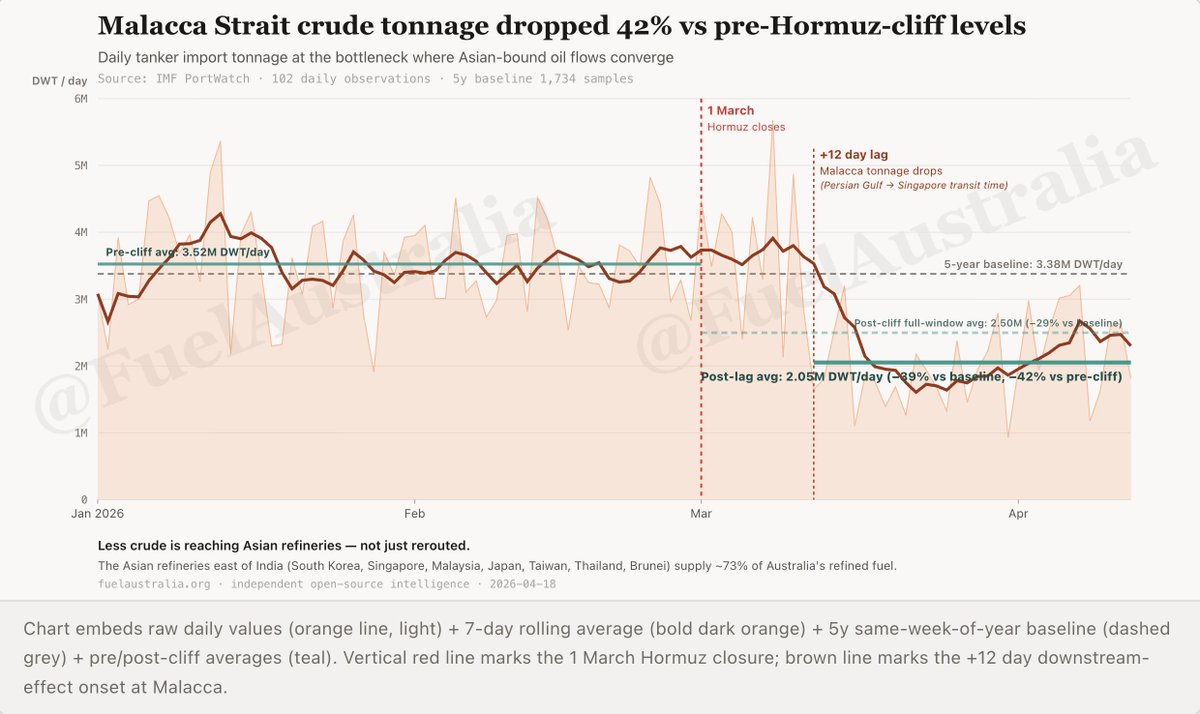
After a week of tracking what was arriving in Australian ports, I realised I had no idea what was happening upstream of the refineries supplying us. So I pulled three years of IMF PortWatch data covering 111 ports - chokepoints, refinery hubs, AU import ports - and started accumulating tanker inflow/outflow data via AIS satellite. One thing was immediately striking: tanker tonnage through the Strait of Malacca was down hard. Allowing for the ~12-day Persian Gulf to Singapore transit lag after the Hormuz cliff, Malacca tonnage dropped ~42% versus pre-cliff. That's the strait the tankers sail through carrying crude to Asian refineries that supply 73% of Australia's fuel. So the immediate problem wasn't building storage. We just needed fuel arriving. I published that in the Hormuz April 2026 piece (fuelaustralia.org/research/hormu…). I was glad to see the government work hard to top up supplies in the weeks since - 400 ML of underwritten diesel through EFA, the Singapore Protocol, WA's Rio Tinto deal. Even sustaining pre-existing flow is a win when every importing country is bidding for the same barrels. But: enough? That depended on where the upstream pressure would reach Australia first.
FuelAustralia.org tweet media
English
1
5
77
8.1K
🆘️ WH&S S28 a) & b) 🇦🇺 retweetledi
FuelAustralia.org
FuelAustralia.org@FuelAustralia·
The first question I had was: why is Australia in a fuel crisis at all? Looking at the data with fresh eyes, the underlying problem is fuel sovereignty. We import roughly 85% of our refined fuel and have only two operating refineries left. That's a long-term issue with a long-term solution (see fuelaustralia.org/made-in-austra…). The more immediate question was resilience. I worked through 35+ supply, demand and storage levers that could buy breathing room (fuelaustralia.org/bridge-the-gap). But I kept hitting the same wall - we don't have the storage capacity to hold extra fuel even if we secured it. Building permanent tank farms takes years. So I published the Double the Reserve piece (fuelaustralia.org/double-the-res…), arguing that getting from a ~30-day buffer to a 60-day buffer is the most urgent structural action available - achievable in months, not years, by underwriting industry-held storage rather than building new tanks. Today, Opposition Leader Angus Taylor announced an $800M Fuel Security Facility that would mandate exactly that: a 60-day onshore reserve plus 1 billion litres of new storage capacity (SMH, Capital Brief, Canberra Times). This is what we need, and work should start now. But further research showed me a more immediate issue.
FuelAustralia.org tweet media
English
4
3
85
8K
🆘️ WH&S S28 a) & b) 🇦🇺 retweetledi
FuelAustralia.org
FuelAustralia.org@FuelAustralia·
Where does Australia stand? A month ago I started doing some research, mostly to verify that fuel was still on its way to Australia, that we weren't on a 25-day countdown to zero, and that my Easter camping trip could go ahead (it did). I released that data publicly and have been adding to it since. I've had a lot of messages asking me what I think will happen, but I decided to stay away from crystal-ball gazing and tried to let the data speak for itself. Having now spent a month with my head in the data, I feel like I have a useful read on the situation. So I'll share where I think Australia stands right now, walking through the research that got me here.
FuelAustralia.org tweet media
English
35
106
515
44.2K
🆘️ WH&S S28 a) & b) 🇦🇺 retweetledi
Dustin
Dustin@DustinHuntwn·
$IBRX Traders have previously expressed optimism that U.S. President Donald Trump could again support international momentum for anktiva, after the founder said earlier that discussions with the president helped advance the therapy’s rollout in the Middle East. Anktiva received approval in 2024 with standard BCG for certain bladder-cancer patients who no longer respond to treatment. It is now being studied in non-small cell lung cancer, pancreatic cancer, colorectal cancer, glioblastoma, and immune-related conditions, including severe pneumonia, sepsis, long COVID, and acute respiratory distress syndrome.
English
0
7
93
5K
Caitlin Johnstone
Caitlin Johnstone@caitoz·
Australia’s “antisemitism envoy” Jillian Segal has published a handbook which unequivocally clarifies that her office exists not to protect Australian Jews from discrimination, but to stomp out criticism of the state of Israel. However bad you’re imagining it is, it’s worse. The handbook, set to be formally launched later this week under the title “Understanding Antisemitism in Australia,” explicitly conflates antisemitism and antizionism with statements like “Antisemitism and antizionism are both expressions of hatred towards Jews” and asserting that it is antisemitic to accuse Israel of “apartheid, oppression, racism and genocide.” It is therefore unambiguously the official position of the Australian government’s appointed authority on antisemitism that it is hateful and abusive toward Jews and their religion to oppose the racist political ideology underpinning the modern state of Israel. So when Australians hear Jillian Segal and government officials talking about how there’s been an increase in “antisemitism” in our country and saying extreme measures must be taken to stop it, it’s important to be clear that this is the “antisemitism” they are talking about. They are talking about criticism of Israel. Let’s go through the handbook together and highlight some revealing excerpts, shall we? The forward in the handbook stresses the importance of the Australian government’s endorsement of the International Holocaust Remembrance Alliance (IHRA) working definition of antisemitism, which has been opposed around the world for its conflation of criticism of Israel with hateful actions toward Jews. Under the IHRA definition it is considered antisemitic to claim that Israel is a racist endeavor, or to compare Israel’s abuses to those of Nazi Germany — both of which are entirely legitimate criticisms which should be put forward far more often than they are. Much of the handbook follows from the premises of the IHRA definition. Segal’s office states that the handbook “is intended as a practical resource for schools, universities, public servants, community organisations and anyone seeking to understand antisemitism today.” Segal’s office says that antisemitism “morphs” over the ages, from the blood libels and “Christ-killer” accusations of the Middle Ages to the racism of Nazi Germany, and has now morphed so that “antisemitic tropes are conveyed and justified in the language of human rights and international legal arguments.” “For example, sometimes Jews are labelled and libelled as ‘settler-colonialists’, ‘oppressors’, and a symbol of a global system of domination that ‘can seemingly accommodate even the murder of Jews as Jews’,” the envoy proclaims. Do you see how the subject was moved to lump medieval superstitions about Jews in with entirely legitimate criticisms of the modern state of Israel? According to Australia’s Special Envoy to Combat Antisemitism, criticising Israel using “language of human rights and international legal arguments” is not meaningfully different from saying that Jews drink the blood of Christian children. This, clearly, is stark raving insanity. “Legitimate criticism of Israel is not antisemitic,” the envoy concedes, then proceeds to completely negate this concession with everything that follows. “However, there are many examples of antisemitic imagery, tropes, conspiracy theories and propaganda (echoing medieval myths) that have found their way into anti-Israel discourse. It is also increasingly common for the word ‘Zionist’ (or iterations of it) to be us ed as cover or proxy for ‘Jew ’.” This is completely made up. The claim that critics of Israel’s abuses use the word “Zionist” when they really mean “Jew” is just something Israel apologists started asserting with no substantiation whatsoever a few years ago. They have no evidence for this assertion apart from the frequency and forcefulness which with they assert it. The envoy defines Zionism as “the belief that the Jewish people have the right to self-determination within their ancestral homeland,” which is misleading at best. That’s not what Zionism is. Zionism is what we see before us today. The genocide, apartheid, ethnic cleansing and nonstop war and abuse. That’s what Zionism is, as evidenced by material reality. The best definition of Zionism is its real-world manifestations. Zionism is what it looks like when you give the Zionists everything they want. “A new variant of antisemitic atrocity denial emerged in the wake of the 7 October 2023 Hamas terrorist attacks — the deadliest day for Jewish people since the Holocaust,” the envoy writes. “Disturbingly, these atrocities have been met by some with denial, minimisation, justification and distortion — echoing Holocaust denial, minimisation, and distortion.” Segal’s office is here telling us that it is antisemitic to talk about the glaring plot holes in the narratives about mass rapes, beheaded babies and babies cooked in ovens on October 7, or to talk about the large number of Israelis who were killed by IDF fire under the Hannibal Directive, or to “justify” the attack by pointing out the monstrous Israeli abuses which gave rise to it. The envoy writes of the importance of “Standing firm against antisemitism parading as ‘anti-racism’,” stressing the IHRA position that framing Israel as a racist endeavor is hateful toward Jews. A flyer saying “We don’t want your two states. We want all of 48” is labeled “antisemitic, because there is only one Jewish country.” Segal’s office warns of the dangers of “Holocaust inversion,” which is when “Israel and Jews are portrayed as Nazi-like perpetrators of mass atrocities and genocide,” which is bad because it “serves to demonise and delegitimise Israel, Israelis and Jews.” To be clear, every relevant humanitarian institution on earth has said that Israel is guilty of genocide in Gaza. These groups include: 1. The United Nations Independent International Commission of Inquiry on the Occupied Palestinian Territory 2. The International Association of Genocide Scholars 3. B’Tselem (an Israeli organization) 4. Physicians for Human Rights-Israel (another Israeli organization) 5. Amnesty International 6. Doctors Without Borders 7. The European Center for Constitutional and Human Rights 8. Human Rights Watch 9. The International Federation for Human Rights 10. The Lemkin Institute for Genocide Prevention The list of humanitarian institutions who say Israel is NOT committing genocide in Gaza includes: 1. Nobody 2. No one 3. Zero 4. Nothing 5. Nada 6. Zilch 7. Sweet damn all 8. A complete absence 9. Diddly squat 10. Bupkis This is not some fringe conspiracy theory. It is a thoroughly established and entirely indisputable fact. Australia’s Special Envoy to Combat Antisemitism is saying that facts are antisemitic. Some examples cited in the handbook of glaring instances of the antisemitic crime of “Holocaust inversion”: — Placards of ‘ Well done Hitler would be proud’ and ‘Same shit Different asshole’, the latter with images of Hitler and Netanyahu, both placards making Nazi analogies to Israel — Three banners of Hitler removing his mask , revealing the face of Netanyahu, making an analogy between Nazism and Israel, on major roads. — Graffiti of a Star of David, equal sign, and Nazi swastika , and another graffiti of ‘End the Genocide’ on a main road. We’re meant to believe it should be a hate crime to say the state that’s waging multiple wars of aggression while mass murdering people because of their ethnicity bears some resemblance to another state which did these things. I don’t know about you, but I find that silly. Australia’s “antisemitism envoy” claims it is antisemitic to say the IHRA definition of antisemitism silences criticism of Israel, arguing that “claims that the leading global definition of antisemitism — which reflects the lived experience of Jewish people worldwide — is designed to intentionally silence criticism echoes antisemitic tropes of Jewish power and control.” That’s right kids: you can’t criticise Israel because that’s antisemitic, and if you complain that your speech is being suppressed, that’s antisemitic too. The handbook includes a hypothetical office group chat which includes a coworker making the statement “But what about the genocidal, racist Zionist project that has oppressed the Palestinians? Zionism is a supremacist ideology invented by Theodore Herzl. They’ve done this through apartheid and ethnic cleansing.” “This is antisemitic,” the handbook argues, dismissing the entirely accurate statement as “Soviet-era antizionist propaganda” and saying it “was antisemitic because it included statements that accused Israel of apartheid, oppression, racism and genocide.” Saying it’s antisemitic to accuse Israel of apartheid, oppression, racism and genocide is as clear an admission that Segal’s goal is to stomp out all criticism of Israel as you could possibly ask for. If that wasn’t clear enough for you, the handbook concludes with the assertion that it is impossible to separate antizionism from antisemitism: “Trying to separate ‘antisemitism’ from ‘antizionism’ ignores the history of misinformation, disinformation and antisemitic propaganda that has shaped narratives about Israel and Zionism,” the envoy asserts. “It also ignores the lived and practical reality that wherever these antizionist narratives have been propagated, it has resulted in discrimination, harassment , vilification, hate and harm towards Jews. For example, Poland’s 1968 antizionist campaign resulted in expulsions and forced emigration of thousands of Jewish Poles.” “Antisemitism and antizionism are both expressions of hatred towards Jews,” the handbook concludes. So there you have it. That settles that. Throughout the handbook, the feelings of Australian Jews are cited over and over again as supremely important and of far more urgent a concern than genocide, apartheid, ethnic cleansing, and wars of immense geopolitical consequence. “Feel more isolated… I feel like I am living the life of a Jew from history, rather than the Jew I was 2 years ago,” reads a quote from an unnamed Jewish person. “I just feel so sad that I need to educate my children in how to respond if they are screamed at in the street,” reads another. “The silence from friends I have known almost all my life, the constant posting of antisemitic slurs and the public broadcasts of factually incorrect reports has been devastating and makes me fearful of what might happen next. Since October 7, when I speak to someone who hasn’t offered any support, I often ask myself ‘would they hide me’ which is a terribly sad situation in our beautiful country where I have always felt safe,” reads another. “A tutor in my university class made antisemitic comments very casually which made me feel extremely uncomfortable and unsafe. I am now nervous when entering a uni class,” reads another. “Being confronted again and again with blind hate towards my people and the place I come from was very painful. It impacted my mood, the way I perceived my community and my place in it, and my daily function,” reads another. Virtually nothing is said about the real victims. The murdered, displaced and terrorized targets of Israeli atrocities in Gaza, the West Bank, Lebanon and Iran. The war orphans. The child amputees and burn victims who were operated on without anesthesia. The people who will carry the physical and psychological wounds from their holocaust with them for the rest of their lives. They are not regarded as important by Jillian Segal. The real crisis, in her mind, is people talking about these things and making Jewish Australians feel upset. Absolutely psychotic. We cannot allow our country to continue to be dragged in this direction.
English
202
1.5K
3.5K
81.6K
Politic@l Spinner.
Politic@l Spinner.@lesstenny·
How's it going, folks who went to Bunnings buying petrol containers and filling them up with fuel and couple of weeks ago, only to realise it is so much cheaper now 😮 whoops😂
Brisbane, Queensland 🇦🇺 English
73
54
500
14.8K
🆘️ WH&S S28 a) & b) 🇦🇺 retweetledi
Jorgen Jensen
Jorgen Jensen@StnJensen·
First trip to town in 15 years…..
Jorgen Jensen tweet media
English
26
13
201
11.2K
🆘️ WH&S S28 a) & b) 🇦🇺 retweetledi
Freedom
Freedom@ActionFixesFear·
$IBRX An early-stage breast cancer patient. She gets chemotherapy and pembrolizumab. She achieves pathologic complete response. Her scan is clean. Her oncologist tells her that her cancer is gone. Then she gets COVID. Her oncologist is watching her tumor markers, her imaging, her symptoms. Her oncologist is not watching her absolute lymphocyte count. Eighteen months later, the cancer comes back in her bones. That population is real. 28,742 patients. UCLA and Mount Sinai. AACR late-breaker, April 21. They diagrammed what drives breast cancer recurrence: NK cell depletion, T cell exhaustion, lymphocytes lost. One FDA-approved drug hits every target on the diagram. Its name isn't in the paper. THE SENTENCE The abstract ends with one line, dropped cleanly, without drama: "Lymphopenia is a potentially modifiable risk factor that warrants prospective study as a therapeutic target." That is a clinical trial protocol written by an 8-author academic team, published in a peer-reviewed AACR late-breaker, calling for a trial of lymphopenia-correcting therapy in breast cancer patients. They did not name which drug. There is one. WHO WROTE IT Authors on the poster: Lisa Shiliang Zhang, Eric Yang, Alexis LeVee, Sonia Hui, Gavin Hui, Marla Lipsyc-Sharf, Carlos Cordon-Cardo, and Aditya Bardia. Lead author: Zhang, UCLA. Senior author: Bardia, UCLA (a renowned breast cancer oncologist). Mount Sinai co-author: Cordon-Cardo, Chairman of Pathology at Icahn School of Medicine. AACR Annual Meeting 2026. Abstract 5418. Cancer Research 2026;86(7 Suppl). (AACR Journals) WHAT THEY STUDIED A multi-institutional retrospective cohort of breast cancer patients from two academic medical centers. Initial cohort: 36,496. After exclusions: 28,742 in the analysis cohort. Stratified by COVID-19 exposure, by lymphopenia status, and by stage. All patients Stage 1 through Stage 3 (curative-intent early breast cancer, not metastatic). Outcomes measured: local recurrence, distant recurrence, and event-free survival. Overlaid onto the clinical data: bulk RNA sequencing from rapid-autopsy studies, used to anchor the mechanism. This is ~80 times larger than the SABCS triple-negative paper PSS surfaced April 20. Same research team, vastly bigger cohort, and now covering every histologic subtype of early-stage breast cancer rather than TNBC alone. THE FINDING THAT MATTERS Read these carefully. Among all COVID-positive breast cancer patients in the cohort: - Local recurrence: HR 2.47 (p<0.001) - Distant recurrence: HR 1.50 (p<0.001) Now split the distant-recurrence average by lymphocyte status: - COVID with subsequent lymphopenia: HR 2.46 (p=0.009) - COVID without lymphopenia: HR 1.11 (not significant, p=0.68) The distant recurrence risk from COVID is not distributed evenly across all COVID-positive patients. It is concentrated entirely in the subgroup whose lymphocyte counts dropped afterward. The subgroup whose lymphocyte counts held firm did not suffer a meaningful increase in distant recurrence. Fix the lymphopenia, fix the risk. In epidemiology, that is a mediation finding. The causal variable has been isolated. And unlike most mediation papers, this one names a variable that is measurable (free, on every CBC), modifiable (lymphocytes can be restored), and already addressable by an existing drug. THE DIAGRAM The paper's Figure 4 walks through the proposed mechanism, arrow by arrow: Local breast disease → COVID-19 infection → four parallel downstream effects: 1. Cytokine storm and inflammation (elevated IL-6, IL-1β, TNFα, IFNγ, IL-10) 2. Lymphopenia and apoptosis (depletion of B cells, CD4+ T cells, CD8+ T cells, and natural killer cells) 3. p53 dysregulation in cancer cells 4. T cell and NK cell exhaustion (elevated PD-1, NKG2A, TIM-3) All four pathways converge on one endpoint: decreased immune surveillance. And from there, distant recurrence. This is the cleanest unified framework the breast cancer field has for how post-treatment recurrence works immunologically, rather than just through cancer biology alone. THE MIRROR IMAGE Now read ImmunityBio's mechanism language, from the April 21 Saudi launch press release: "At the core of our strategy is the Cancer BioShield platform, which is designed to stimulate critical lymphocytes, including natural killer (NK) cells, cytotoxic T cells, and memory T cells via our proprietary IL-15 superagonist." And the Saudi NSCLC accelerated-approval label, quoted verbatim: "Approved under accelerated approval based on the increase of ALC associated with overall survival in single arm study." Place the two pictures side by side. Bardia's diagram lists: low NK cells, exhausted T cells, low CD8+ and CD4+ T cells, elevated PD-1 and NKG2A and TIM-3. ANKTIVA's FDA-labeled mechanism raises NK cells, CD8+ cytotoxic T cells, and memory T cells via IL-15 receptor agonism. Published clinical data across ImmunityBio's program have shown corresponding restoration of absolute lymphocyte counts. Mirror image. Bardia's team drew the problem. The FDA label already describes the tool. The academic team was not required to name a drug class. By calling for a trial of lymphopenia-correcting therapy, they named one anyway. THE DRUMBEAT @DrPatrick numbered his posts on this. #1 (April 20): The UCLA / City of Hope SABCS 2025 paper on early TNBC. N=372. pCR 45.9% vs 63.0% in lymphopenic vs normal arms. (AACR PS4-10-26) #2 (April 21): The 28,742-patient cohort study above. All early-stage breast cancer. Post-COVID framing. Mediation analysis. Mechanism diagram. (AACR 5418) #3 (April 22): Same 372 TNBC cohort tracked through treatment. Lymphopenia rises from 9.9% at baseline to 38.7% pre-surgery. In the subgroup whose lymphocytes crash during chemo: 14.9% complete response vs 82% for those who hold firm. p=0.034. (AACR Abstract C040) Three beats, three days, same senior author, same UCLA / Mount Sinai research program. PSS is explicitly numbering them in sequence. The program is still active. WHAT THIS IS ABOUT Remember the woman from the opening. Complete response. Clean scan. Then COVID. Then eighteen months later, the cancer in her bones. She is one of a population. Approximately 310,000 early breast cancer diagnoses per year in the United States. About 2.3 million worldwide, the vast majority early-stage and curative-intent. A substantial subset experience treatment-related lymphopenia, post-COVID lymphopenia, or both. Some meaningful fraction of their recurrences, this paper argues, is driven by a lab value nobody was watching and that can be raised by a drug already FDA-approved for a different indication. One drug. Already on the shelf. Already reimbursed by Medicare under its own J-code. Already shipping on three continents. Already funded by a sovereign factory in Riyadh. Just not approved for her. Not in the country where it was invented and is manufactured. WHAT SHOULD HAVE BEEN A PRESS RELEASE FIVE TIMES OVER ImmunityBio's Saudi commercial launch landed April 21. The Saudi label is the first in any jurisdiction to cite "increase of ALC associated with overall survival" as the accelerated approval basis for non-small cell lung cancer. Saudi regulators just accepted ALC as a surrogate endpoint for survival. Bardia's team just made ALC a predictor of breast cancer recurrence. The same biomarker. The same drug class. Two countries, two tumor types, on the public record within the same day. Also on April 21, RFK Jr., the US Health Secretary, said on camera: "China is now eating our lunch... They went from running 3% of clinical trials to running 30%... we are fast-tracking approvals now in our country at record levels." PSS reposted that clip to his feed. Five signals. One week. The frame is no longer emerging. The frame is here. THE CLOSE Her scans came back clean. Then she caught COVID. Her lymphocyte count quietly dropped. Nobody was watching it. Eighteen months later, the cancer was in her bones. The drug that could have held the line was already FDA-approved when she started treatment. Just not for her.
Freedom tweet media
English
9
41
156
25.3K
🆘️ WH&S S28 a) & b) 🇦🇺 retweetledi
FuelAustralia.org
FuelAustralia.org@FuelAustralia·
⛽ Daily Briefing -- Tuesday 21 April Prime Minister Albanese quietly shifted Australia's fuel-security posture on Monday night. He called the situation a "long tail" problem and said he will convene national cabinet this week to weigh expanding domestic refining capacity. That is language a government uses when it has stopped assuming the pipeline will normalise on a political timetable -- and it is worth sitting with. The geopolitical backdrop is hardening, not softening. The Washington-Tehran ceasefire expires later this week. Tehran told DW it has "no plans" for the second round of Pakistan-hosted talks, an Iranian-flagged vessel was seized over the weekend, and Trump has signalled no intention to ease the maritime blockade. A narrow face-saving agreement is the likely near-term path -- but the combination of rhetoric and the seizure could readily tip the other way. Reserves are tight but holding. Diesel and jet fuel are the tighter of the three categories, with jet sitting at elevated severity on the MSO. Tankers arriving now were loaded a month or so ago with pre-closure Middle East crude, so what's landing reflects a period before the upstream compression truly began. The signal that matters over the next month or two is Asian refinery-hub output compressing as their crude intake tightens -- the window the "long tail" framing is preparing the country for. Meanwhile Europe is positioning for a post-ceasefire posture rather than pre-empting one: France and the UK stand ready to lead a non-belligerent coalition on a Hormuz navigation mission, but not before the war ends. Risk level: DETERIORATING.
English
3
10
72
3K
🆘️ WH&S S28 a) & b) 🇦🇺 retweetledi
Barry Habib
Barry Habib@barryhabib·
I am the patient Dr Patrick is referring to. The treatment made all the difference. EPOCH R chemo failed. Radiation failed. CAR T failed. Dr Patrick’s Anktiva helped make my T cells and NK cells more effective. It is proven in my bloodwork. As my Lag3 and PD1 levels showed less T cell exhaustion, the tumor shrank and SUV reduced to remission levels
English
23
50
343
20.6K
Anthony Albanese
Anthony Albanese@AlboMP·
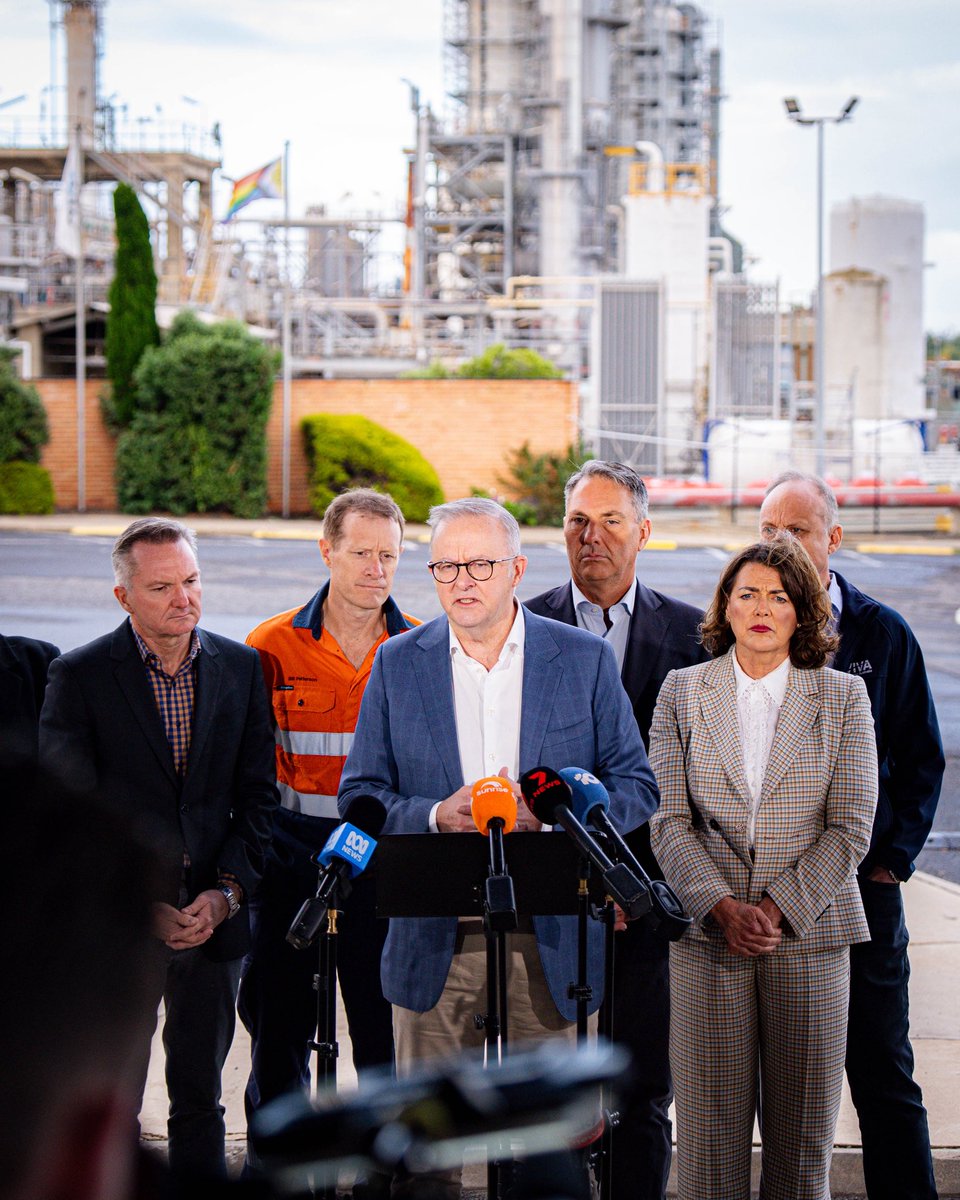
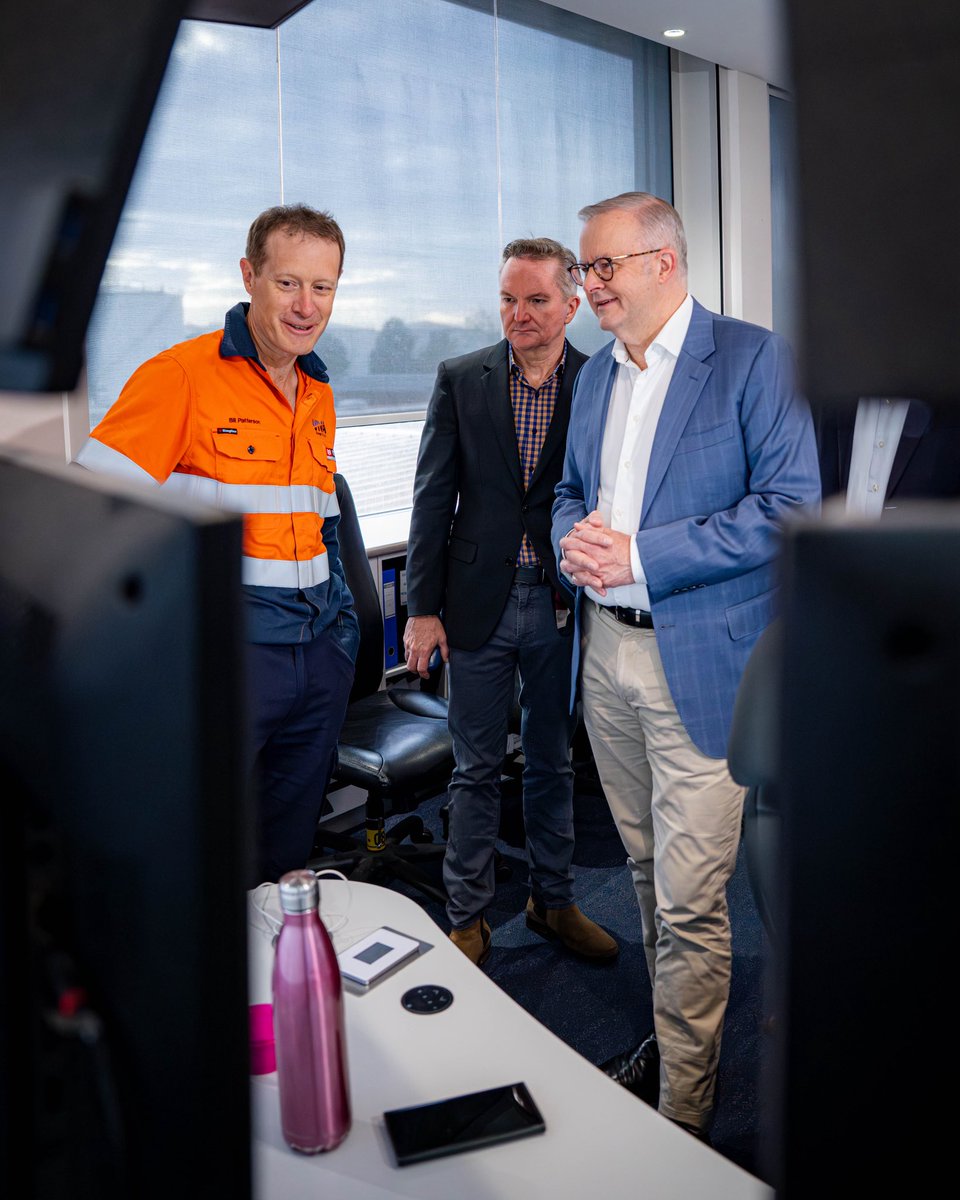
Backing our Australian fuel refineries is more important than ever. The fire at Viva Refinery is under control, and everyone is safe. The workers here power Australia, and we are with them through this, whatever is needed. We’ve been working to shore up supply, with new agreements with Malaysia, Brunei and Singapore to help keep fuel and fertiliser flowing. And we’ll always back Australian refineries like Viva to keep our country moving. Because when the world is uncertain, our focus is right here at home.
Anthony Albanese tweet mediaAnthony Albanese tweet mediaAnthony Albanese tweet media
English
984
164
774
63.8K
🆘️ WH&S S28 a) & b) 🇦🇺 retweetledi
FuelAustralia.org
FuelAustralia.org@FuelAustralia·
A valve failed at Viva Energy's Geelong refinery on Wednesday night. The fire was contained in 13 hours. Nobody hurt. Credit to Fire Rescue Victoria and Viva's operations team -- the containment worked. The interesting question is not what happened at the refinery. It is how this event lands against the fuel system we actually have: two operating refineries, about 80% of our refined fuel imported, the Strait of Hormuz closed since March. Seven questions, worth working through one at a time: 1. How long could Geelong be offline? 2. What does Geelong actually produce, and is any of it irreplaceable? 3. Can imports fill the gap? 4. What happens to pump prices? 5. Why does Australia only have two refineries? 6. Did the PM's "Strategic Reserve powers" announcement do something new? 7. What could change the outlook from here? Thread below.
FuelAustralia.org tweet media
English
2
9
41
1.9K
🆘️ WH&S S28 a) & b) 🇦🇺 retweetledi
Polymarket
Polymarket@Polymarket·
JUST IN: “Long COVID” reportedly projected to cost OECD economies up to $135 billion a year over the next decade.
English
256
515
1.7K
328.1K
🆘️ WH&S S28 a) & b) 🇦🇺 retweetledi
Freedom
Freedom@ActionFixesFear·
$IBRX She beat breast cancer. Went into remission. Then she got COVID. Her lymphocyte count dropped. Her immune system - the same system that had been keeping dormant cancer cells in check - went silent. The cancer came back. Metastatic. UCLA and Mount Sinai clinicians have the data. It will be presented at the American Association for Cancer Research (AACR) annual meeting this month. And one molecule can restore what COVID destroyed. THE MECHANISM In 2007, Monneret et al. published data showing septic shock patients have 60% fewer lymphocytes than healthy volunteers. More than 80% of those who died did so in the immunosuppressed phase - not the inflammatory phase. The immune system didn't kill them by overreacting. It killed them by shutting down. The same year, the NCI ranked IL-15 - the molecule that restores lymphocyte counts - as the #1 immunotherapy agent out of 124 candidates at the Immunotherapy Agent Workshop on July 12, 2007. The molecule that activates NK cells, grows T cells, and reverses the immune collapse that lets infections and cancers win. We wrote about this three days ago in "The Prophecy." The 2007 NCI Workshop got almost every prediction right. Every molecule on their list became a major pharma program. Except #1. Nobody built IL-15 for seventeen years. Now @DrPatrick is connecting the dots publicly. Post by post. Paper by paper. And today, the connection extends beyond cancer and sepsis into something much larger. THE COVID CONNECTION In 2020, PSS co-authored a Cancer Cell paper with Carlos Cordon-Cardo, Chair of Pathology at Mount Sinai, titled "COVID-19: Staging of a New Disease" (PubMed 33086031). The paper staged COVID exactly like cancer - four phases, each defined by the immune system's progressive failure. Published during peak pandemic. The medical establishment was arguing about ventilators. PSS and Cordon-Cardo were mapping the immune collapse underneath. Six years later, clinicians at the same Mount Sinai and at UCLA have data showing that COVID survivors with persistent lymphopenia are developing breast cancer metastases and cancer recurrence at elevated rates. PSS posted today: "Just received concerning data coming soon from UCLA and Mount Sinai clinicians about lymphopenia, covid and breast cancer metastases. Sadly our concerns of the increasing incidence of metastatic disease and recurrences of patients in remission following Covid and worse with lymphopenia is being validated. Data soon at AACR this month." The thesis published in Cancer Cell in 2020 is being confirmed with clinical evidence from two of the most respected cancer centers in the country. NOW IMAGINE Imagine a 58-year-old grandmother. Let's call her Maria. Maria was diagnosed with breast cancer in 2019. She had surgery. She had chemotherapy. She went into complete remission. Her oncologist told her the hardest part was behind her. In January 2022, Maria caught COVID. She recovered in two weeks. She felt fine. But her absolute lymphocyte count dropped and never fully recovered. Her NK cells - the cells that had been patrolling her body for dormant cancer cells every day since her remission - were depleted. Eighteen months later, Maria's breast cancer returned. Metastatic. Stage IV. Maria did not lose to cancer. She lost to lymphopenia. Her immune system stopped doing the job it had been doing since remission. COVID broke the defense. The dormant cells woke up. Now imagine Maria in a world where ANKTIVA exists as a post-COVID immune restoration therapy. Her lymphocyte count is monitored. When it drops, IL-15 is administered. Maria's NK cells recover. Her T cells regrow. The dormant cancer cells stay dormant. Maria lives. That world is what the UCLA and Mount Sinai data points toward. And the molecule that makes it possible was ranked #1 by the NCI nineteen years ago. THREE DISEASES. ONE MECHANISM. ONE MOLECULE. This is now the third leg of the ANKTIVA thesis: Cancer - FDA approved April 2024. 53 months of durability in bladder cancer. BCG-naive expansion filing Q4 2026. Lung cancer approved in Saudi Arabia. Nine indications in the 3-year plan. Sepsis - Phase 3 trial (NCT07492875) starts April 15. 200,000 American deaths per year. No approved immunotherapy. ANKTIVA + iNKT cells. Primary endpoint: 28-day mortality. Long COVID immune collapse - UCLA and Mount Sinai data incoming at AACR this month. COVID-induced lymphopenia driving breast cancer metastases and cancer recurrence in patients who were in remission. Hundreds of millions of people globally have had COVID. If persistent lymphopenia drives cancer recurrence, the addressable population is unlike anything in oncology. All three diseases share one mechanism: the collapse of the immune system. Lymphocyte counts drop. NK cells disappear. T cells exhaust. The body loses its ability to fight what it used to fight. All three diseases have one molecular answer that the NCI identified in 2007: IL-15. One man and his team built it. WHY THIS MATTERS RIGHT NOW The AACR annual meeting is this month. UCLA and Mount Sinai will present their lymphopenia-cancer data. When they do, the long COVID arm of ImmunityBio's thesis moves from aspirational to institutionally validated. Watch for the abstracts. Watch for the Mount Sinai author lists. If Cordon-Cardo's team is behind this data, it means the 2020 Cancer Cell framework is producing exactly the downstream evidence it predicted. PSS co-authored the framework in 2020. He received the data before publication. The record will show he posted today - before AACR, before the abstracts went public. Eight days until the sepsis trial starts. Weeks until the AACR data goes public. The Europe campaign launched yesterday. Cancer. Sepsis. Long COVID. Three legs. One molecule. The thesis is converging. ALC matters.
Freedom tweet media
English
4
31
131
5.9K
🆘️ WH&S S28 a) & b) 🇦🇺 retweetledi
Peter Vogel
Peter Vogel@psvbluemts·
For anyone wanting a deep-dive into the regulation of indoor air quality in Australia, the recent NSW Parliament enquiry into Clean Indoor Air offers a treasure-trove of great information about the present sorry situation and possible ways forward. A recurrent theme of the inquiry has been that there is little we can do about poorly ventilated public buildings because there are no standards to enforce. It’s true that the absence of specific standards for indoor air quality has long been used as an excuse for the indifference to effective ventilation. But I believe that new regulatory frameworks and codes of practice make it clear that even without unambiguous standards, safe indoor air is a non-negotiable legal obligation and the consequences for non-compliance reach all the way to individual principals, executives, and clinicians. Full details here: #dirty-air" target="_blank" rel="nofollow noopener">petervogel.legal/rubyprincess/#…
English
6
63
154
4.1K