@mettaworldwar @OoKauai @arne__ness But you just did something? You starting complaining about the discourse on social media, right? That will be your modus operandi for the next 3 years as this all plays out!
English
Jak Casey
201 posts
@jdpcasey
engineer @maplefinance shaping intent to sculpt compute



Over the past 24 hours, I’ve talked to a number of leading shipping and energy sources in Europe and Asia. Overall mood: panic. Talked to dozens of key people in the USA. Overall mood: ¯\_(ツ)_/¯ Allied navies might have to reopen the strait simply because, after getting yelled at for so long, Americans no longer care.


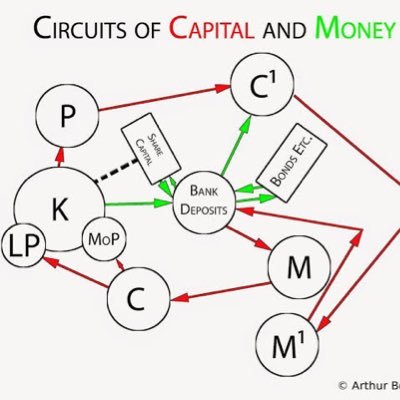
The posts you're seeing online, "Trump is an idiot," "strategic failure," is the most surface level thinking you can come across. These people evaluating the "war" are as though the sitting president is the principal actor pursuing coherent state objectives, and then grading him against those objectives. When the objectives appear contradictory, bombing a country while lifting sanctions on its oil, attacking Iran while enriching Russia; they conclude incompetence. But the contradiction only exists if you assume the US government is the client. It isn't. The Private Sector is the client. And from TPS's perspective, every single move is executing precisely as the structural incentives predict. There's right now, three TPS sectors that are directly feeding on this war simultaneously. This rarely happens. They usually take turns on rotation. The MIC via the Pentagon has requested $200 billion in supplemental war funding, on top of a baseline defense budget already exceeding $800 billion annually. Mostly taxpayers. Taxpayers who think this is a "strategic failure". Lockheed's stock alone has risen nearly 40% since the beginning of 2026 as tensions with Iran grew. The energy sector is the second beneficiary, and this is where the "sanctions contradiction" reveals itself as anything but contradictory. Before the war, the US had already become the world's largest LNG exporter. Now look at what the war did to the competitive landscape. Qatar halted LNG production after Iranian strikes on its facilities, removing the world's second-largest LNG supplier from the market. European natural gas prices nearly doubled, and European storage sat at a five-year low below 30%. Asian and European buyers are now scrambling for whatever LNG is available, and US terminals are already operating at full capacity. American LNG producers aren't shipping more volume; they're collecting massively higher prices on every cargo that leaves the Gulf Coast. These producers will be in for a windfall as desperate international buyers bid top dollar to secure what fuel is available. The structural consequence is permanent: Qatar's reputation as the world's most reliable LNG supplier is damaged. Gas importers are realizing they've perhaps taken Qatar's dependability for granted. Qatar knows this. It's baked into the agreement. Trade-off. When buyers restructure their long-term contracts after this crisis, they will diversify toward US supply, the only major LNG exporter not located in a warzone or subject to Strait of Hormuz risk. The war doesn't just produce short-term profits for US energy companies; it restructures the global LNG market's risk calculus permanently in Private Sector's favor. Now resolve the "sanctions contradiction." The surface-level critics see this sequence: the US starts a war, oil prices spike, and then the administration lifts sanctions on Russian oil and Iranian oil at sea to bring prices down. They call this incoherent. It's perfectly coherent. It's just serving a different client than the one critics assume. Trump said his administration would lift some sanctions on oil-producing countries to keep energy prices down, stating "We have sanctions on some countries. We're going to take those sanctions off until this straightens out." The Treasury issued a 30-day waiver on deliveries of Russian oil already loaded on tankers, and on Friday, Treasury lifted sanctions on 140 million barrels of Iranian oil at sea. What does this accomplish? It provides just enough price relief to prevent the oil shock from becoming politically fatal domestically, Brent crude at $112 is painful but manageable; $125 would trigger a recession and collapse Congressional support. The sanctions relief acts as a pressure valve to keep oil in the band where the managed conflict can continue. It doesn't end the price spike; it modulates it. Meanwhile, the underlying damage to Iranian and Qatari supply capacity continues to accumulate, ensuring that when the 'war' ends, the market will have permanently shifted toward private sector energy dominance. That's the play. That's the terms being negotiated while you're watching a "war" play out. The Russian sanctions relief is the most telling. The Kremlin's spokesman said US and Russian "interests coincide" regarding energy market stabilization. European leaders were outraged. Zelensky warned that revenue from the eased sanctions would fund Russia's war effort in Ukraine. But notice who was not upset: US energy producers. Russian oil entering the market at temporarily unsanctioned prices is competition, yes, but it's controlled competition, limited to 30-day waivers on oil already at sea. It calms markets without fundamentally altering long-term supply contracts. And it creates a diplomatic chit with Moscow that may prove useful in a future Ukraine settlement. The TPS doesn't care about Russian sanctions on principle, it cares about them instrumentally. When the instrument needs recalibrating, it recalibrates. The FIC angle is equally important. I mentioned this many times. Oil prices remain well above pre-war levels, with Brent crude settling around $112 per barrel, up from roughly $70 before the conflict began. That $40+ per barrel spread, applied across global crude markets, represents an enormous transfer of wealth. Commodity trading desks, insurance markets (warzone and marine insurance premiums have exploded), shipping firms navigating alternative routes, and financial institutions managing the volatility; all of these are extracting fees from the crisis. The FIC doesn't need a side in the war. It hedges either way, with enough volatility to generate trading profits but not so much that markets seize up entirely. The $105-115 Brent band is the sweet spot. The Strait of Hormuz is the key to the entire architecture. Every analyst quoted in mainstream media treats the closure as an unintended consequence. Something the administration "didn't see coming." But look at the incentive map. The Strait's closure is the mechanism by which all three TPS extraction channels, very rarely, activate simultaneously. Without the Strait closure, there's no oil price spike (no FIC windfall), no Qatari supply disruption (no US LNG market capture), and no compelling reason for a $200 billion defense supplemental (no MIC ratchet). Trump has now said the Strait of Hormuz should be "guarded and policed" by "other Nations who use it, the United States does not." The US doesn't need Hormuz oil, it's a net energy exporter. The countries that need Hormuz are in Europe and Asia. By forcing them to shoulder the military burden of reopening the strait, Washington compels its allies to increase their own defense spending (boosting MIC exports), deepen their dependence on US security guarantees, and accept US LNG as the safe alternative to Gulf supply. Six allied nations have already committed to "preparatory planning" for a Hormuz security coalition; exactly the outcome that makes NATO allies pay for their own protection, a stated Trump objective since 2017. The GCC understand all this. Iran understands all this. Russia and China understand all this. This is the trade-off for the US leaving the Middle East. This is the trade-off for the peace and stability ask. The states are willing to take a setback against the TPS if it means gaining more autonomy in the future. They play the long game. The TPS wants to get paid today. All three factions are collecting. While citizens who are effectively paying for it, call this a strategic failure. Open your eyes.


The more I hear this guy explain deeply complex topics the more I think he doesn't know what he's talking about 😅😅 goes to show you can get a long way just by stating things with confidence regardless how accurate they are.
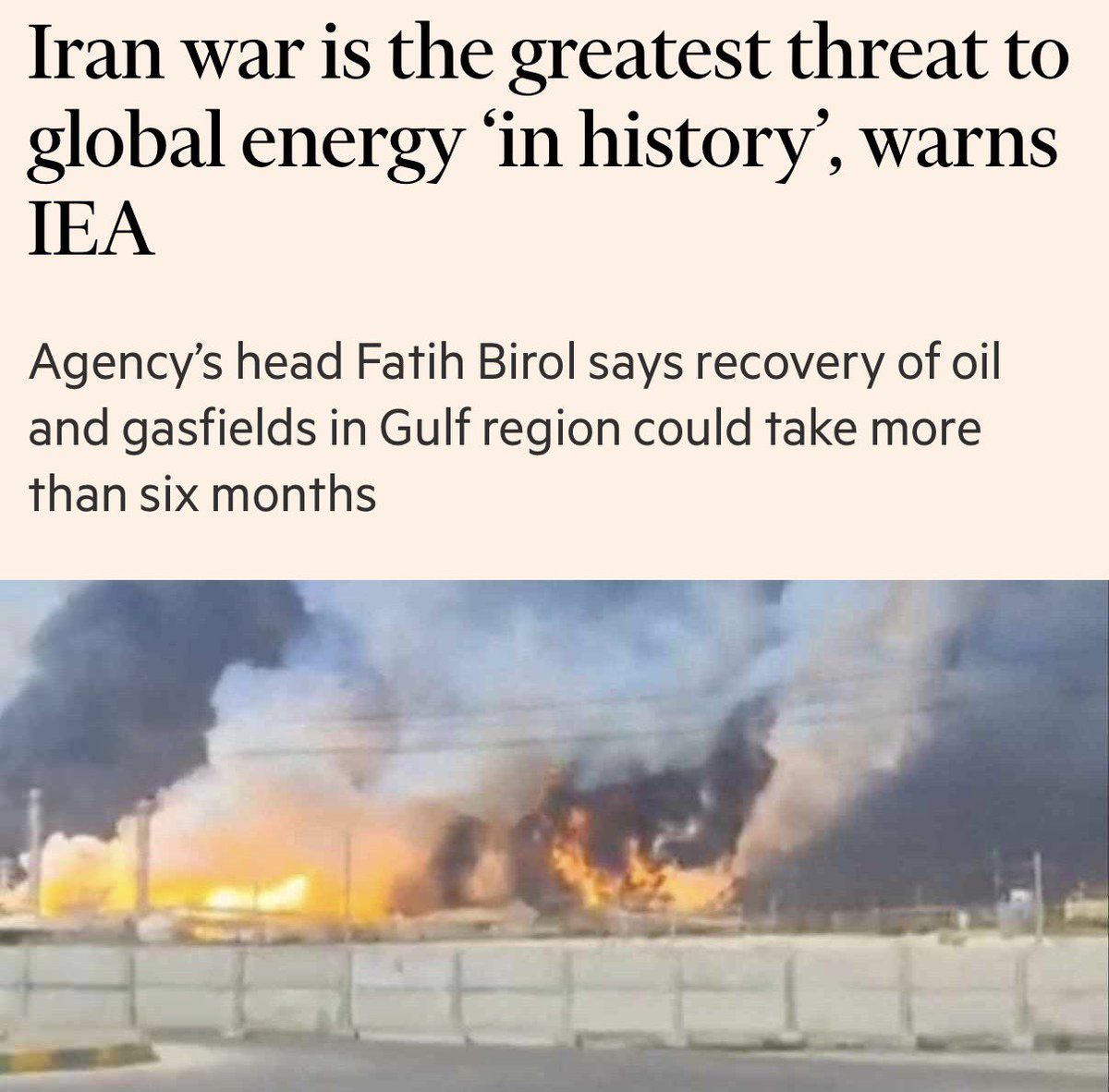

American oil companies like Exxon and ConocoPhillips funded this project and are massively exposed to it



Introspection = neuroticism x narcissism x thumbsucking.