John Kastelein

2.8K posts

John Kastelein banner
John Kastelein

John Kastelein

@JohnKastelein

Professor of Medicine , Lipidologist , Trialist in Cardiometabolic Medicine , Entrepreneur in Biotech , Amsterdam , the Netherlands Husband and Father

Katılım Eylül 2021
282 Takip Edilen3K Takipçiler
John Kastelein
John Kastelein@JohnKastelein·
@MohammedAlo Hey Mohamad , your movie is great , but dont forget rabbits are the only rodent species that can be driven to atherosclerosis by just feeding .. and that is because they have CETP !!
English
1
0
0
145
Dr Alo, DO, FACC
Dr Alo, DO, FACC@MohammedAlo·
🐇 Rabbits don't smoke. They don't stress. They never touch junk food. So why did feeding them cholesterol give them full-blown heart disease? Stick with me. This 1913 experiment is the reason your doctor cares so much about your cholesterol number. In 1913, a Russian scientist
English
8
3
24
2.1K
John Kastelein
John Kastelein@JohnKastelein·
@lipo_fan I love HDL too and we are discovering lots of exciting science that challenges “ rusted “ views on this intriguing particle , Lipofan .. a new paper soon to be announced!
English
0
0
2
74
LipoFan
LipoFan@lipo_fan·
💚 I Love HDL 💚💚 CONTEXT AND DISEASE SPECIFIC 📌 24 Things You Should Know About HDL 1 "The scientific discussion about the biological role and clinical utility of HDL frequently suffers from the false equation HDL=HDL-C"
LipoFan tweet media
English
2
11
29
1.8K
Thomas Dayspring
Thomas Dayspring@Drlipid·
For the deniers: This is an "Oldie but Goodie manuscript (Click to enlarge)- Written 20 years ago it noted that Optimal low-density lipoprotein is 50 to 70 mg/dl: "lower is better and PHYSIOLOGICALLY NORMAL." Note the second slide shows TC, which translates to an LDL-C between 35 and 70 mg/dL. Open access at pubmed.ncbi.nlm.nih.gov/15172426/ @nationallipid @foundationofnla @society_eas @ASPCardio @escardio @atherosociety @TheEndoSociety @FamilyHeartFdn #cholesterol
Thomas Dayspring tweet mediaThomas Dayspring tweet media
English
5
11
45
7.3K
John Kastelein
John Kastelein@JohnKastelein·
@SimonBiohacker @Drlipid ABCA1driven chol efflux is an important marker of HDL particle functionality which has been linked to clinical ASCVD … but for other current markers the consequences are less clear ..
English
2
0
1
213
Simon Campbell
Simon Campbell@SimonBiohacker·
@Drlipid @JohnKastelein What do you both think about Cleveland HeartLab's HDL Function Panel with HDLfx? A panel that incorporates an HDL efflux–related score (HDLfx pCAD) alongside other HDL functionality markers.
English
1
0
0
145
Thomas Dayspring
Thomas Dayspring@Drlipid·
Respectfully John, that is not always true. We have all seen men and more-so women who have very high HDL-C who had no alcohol intake. So your absolute declarative statement does not hold water
John Kastelein@JohnKastelein

@Drlipid @nationallipid @society_eas @ASPCardio @ESC_Journals @atherosociety @FamilyHeartFdn @fhpatienteurope @TheEndoSociety The story that Epidemiology can tell us with observational data that high HDL-c is a bad thing is completely debunked by two recent studies with adequate follow-up and disease specific mortality .. it is ALL alcohol 🍷, so we should not echo these flawed data …

English
3
0
34
11.3K
Eric Topol
Eric Topol@EricTopol·
I'm very pro-statins for their incontrovertible benefit vs atherosclerotic buildup and reduction of cardiovascular adverse events. Their benefits greatly overrides the risks. However, I always keep in mind 2 key side-effects: 1. Inducing Type 2 diabetes, uncommon, but more likely with aggressive dosing of statins. I've written about this concern since 2012 in a @nytimes oped and got a lot of flak for it. Can be missed by clinicians not cued it. nytimes.com/2012/03/05/opi… 2. Myopathy, muscle inflammation, cramps. Not uncommon, hit me after years of taking statins. New paper on the putative mechanism science.org/doi/10.1126/sc…
Eric Topol tweet media
English
69
273
1.2K
148.1K
John Kastelein
John Kastelein@JohnKastelein·
@MChristopher_MD @EricTopol All better is indeed a big word , but for me a very robust improvement , less need for Ibuprofen etc ..I thought it was age related and would never improve anymore .. I was wrong 😑..
English
1
0
2
159
Michael Christopher
Michael Christopher@MChristopher_MD·
@JohnKastelein @EricTopol Honestly- read the paper. Not super impressed with this. Also, cell and in-vivo animal models can be very poor surrogates for humans. Sometimes not, but, this is not where I would hang my hat on. Plus, think about the probabilistic outcome of ten days off all better?
English
1
0
1
199
Pablo Corral MD
Pablo Corral MD@drpablocorral·
👉OVER A CENTURY OF SCIENCE. ONE CONSISTENT MESSAGE. ☝️In medicine, few hypotheses have been tested as rigorously as the relationship between LDL cholesterol and atherosclerotic cardiovascular disease. 🐇 1913 – Nikolai Anitschkow demonstrated that cholesterol-rich diets induce atherosclerosis in experimental models. ❤️ 1948 – The Framingham Heart Study established the association between cholesterol levels and cardiovascular risk. 🏆 1964 Nobel Prize – Konrad Bloch and Feodor Lynen elucidated the biosynthesis and metabolism of cholesterol. 🏆 1985 Nobel Prize – Michael Brown and Joseph Goldstein discovered the LDL receptor, transforming our understanding of cholesterol regulation and familial hypercholesterolemia. 💊 1994 (4S Trial) – Lowering LDL-C with statins reduced cardiovascular events and mortality. 💊+ 💊2015 (IMPROVE-IT) – Further LDL-C reduction with ezetimibe translated into additional cardiovascular benefit. 💉2017–2018 (FOURIER & ODYSSEY Outcomes) – PCSK9 inhibitors demonstrated that achieving very low LDL-C levels produces further risk reduction. 🧬👫🏻🔬🩻Today – Genetics, epidemiology, pathology, imaging, Mendelian randomization studies, and randomized clinical trials continue to converge on the same conclusion. More than a century of basic science and clinical research has consistently pointed in one direction: 👉LDL cholesterol is causal. ☝️Lower is better. ☝️Earlier is better. ☝️Longer is better. When a scientific concept is supported by experimental biology, human genetics, epidemiology, randomized clinical trials, and two Nobel Prizes in Medicine, it is no longer merely a hypothesis. 🙌 It is biology. @society_eas @nationallipid
English
13
42
164
39.6K
John Kastelein retweetledi
Michael  Davidson MD
Michael Davidson MD@mdavidsonmd·
Very proud of my son David Davidson giving a fantastic lecture at the NLA : •Unlocking the Future of Cardiology: The Next Generation of Therapies Driven by Genetic Discovery and my granddaughter Maddie Stevens presenting an original poster on the increases CV risk of having both high Lp(a) and homozygous for 9p21. Three generations of Lipid Researchers at the NLA
Michael  Davidson MD tweet media
English
0
2
37
1.4K
Liam Brunham
Liam Brunham@LiamBrunham·
Great way to end off the week with a letter from @ubcprez! So grateful for the amazing students, colleagues, and mentors I have worked with along the way.
Liam Brunham tweet media
English
8
0
29
2.3K
John Kastelein retweetledi
Dr. Filippo Cademartiri
Dr. Filippo Cademartiri@FCademartiri·
Treat the Plaque. Not the Risk Factors. For decades, preventive cardiology has largely operated under a simple assumption: Measure risk factors. - Estimate risk. - Treat risk. But there is a problem. Many myocardial infarctions occur in patients who would never have qualified for aggressive prevention based on conventional risk scores alone. Meanwhile, many individuals with multiple risk factors will never experience a cardiovascular event. Why? Because risk factors are not the disease. Atherosclerosis is the disease. A patient does not suffer an MI because their SCORE2, PCE, LDL, ApoB, hsCRP, or Lp(a) is elevated. They suffer an MI because they have developed coronary atherosclerosis. Yet we continue to spend enormous effort measuring surrogates while often ignoring the organ that actually matters: the coronary arteries. This review argues that coronary CT may allow a shift from population-based prevention toward disease-based prevention. Not by predicting who might develop atherosclerosis, but by directly visualizing who already has it. Perhaps the most provocative observation is that, in large contemporary cohorts, total plaque burden and non-calcified plaque often outperform stenosis severity itself as predictors of future events. That should make us pause. For years we have been obsessed with narrowing. Meanwhile, the disease was sitting in the vessel wall. The future of prevention may not be: 👉 Treat the cholesterol. 👉 Treat the inflammation. 👉 Treat the risk score. The future may be: - Identify the plaque. - Quantify the plaque. - Track the plaque. - Treat the plaque. Everything else is a surrogate. #CardiacCT #CCTA #Atherosclerosis #PreventiveCardiology #TreatThePlaque #CardiovascularImaging #PrecisionMedicine #PhotonCountingCT #PCCT
Dr. Filippo Cademartiri tweet media
English
11
27
59
5.2K
John Kastelein retweetledi
Jeffrey A. Hirschfield, MD
Jeffrey A. Hirschfield, MD@DrHirschfield·
The U‑shaped curve illusion: why it appears and why it’s misleading. In many observational studies, mortality vs LDL looks like a U‑shaped curve: High LDL → higher mortality (true, causal) Very low LDL → higher mortality (misinterpreted) But the “left side” of the U — the part where low LDL appears harmful — is not due to LDL being too low. It’s due to: Cancer Chronic disease Frailty Liver dysfunction Systemic inflammation Cachexia End‑of‑life physiology These conditions drive LDL down, creating the illusion that low LDL is dangerous. When you remove people with: active cancer chronic inflammatory disease liver disease severe frailty recent weight loss terminal illness- "VOILA" the U‑shape disappears. @NutritionMadeS3 @Drlipid @nationallipid @ethanjweiss @JohnKastelein @Tellit007 @ACLifeMed @AJPCardio
English
6
3
16
2.7K
John Kastelein
John Kastelein@JohnKastelein·
@drpablocorral @MohammedAlo Pablo , please , torcetrapib was off target , dal did not lower LDL , eva’s trial was too short and REVEAL was positive and on the CTT metaregression line ; the Mendelian Rando studies for LOF CETP are wildly positive for ASCVD , Alzheimer and NODDM …
English
1
0
12
674
Pablo Corral MD
Pablo Corral MD@drpablocorral·
☝️Must read (by R. Hegele) 👉 Human genetics has become the most powerful engine for discovering new lipid-lowering therapies—and the evidence is already changing clinical practice. 1️⃣ PCSK9: Individuals born with loss-of-function mutations have lifelong low LDL-C and dramatically lower ASCVD risk. This observation led directly to the development of evolocumab, alirocumab, inclisiran, and now oral PCSK9 inhibitors and gene-editing strategies. 2️⃣ APOC3: Natural APOC3 deficiency results in very low triglycerides and reduced cardiovascular risk, inspiring therapies such as olezarsen and plozasiran, now approved for familial chylomicronemia syndrome. 3️⃣ ANGPTL3: Patients with genetic ANGPTL3 deficiency exhibit combined hypolipidemia and protection from ASCVD, paving the way for evinacumab and next-generation RNA and gene-editing therapies. 4️⃣ HDL-C: Genetics also teaches us what not to target. Mendelian randomization predicted that simply raising HDL-C would not reduce cardiovascular events, a prediction later confirmed by the failure of CETP inhibitor outcome trials. 👉The next revolution is already underway: RNA silencing and gene editing aim to permanently reproduce these naturally protective genetic variants, potentially providing lifelong cardiovascular benefit from a single intervention. 🔗🔓 ahajournals.org/doi/10.1161/CI… @society_eas @nationallipid @AHAScience @JAHA_AHA
Pablo Corral MD tweet mediaPablo Corral MD tweet media
Mar del Plata, Argentina 🇦🇷 English
8
24
64
5.4K
John Kastelein
John Kastelein@JohnKastelein·
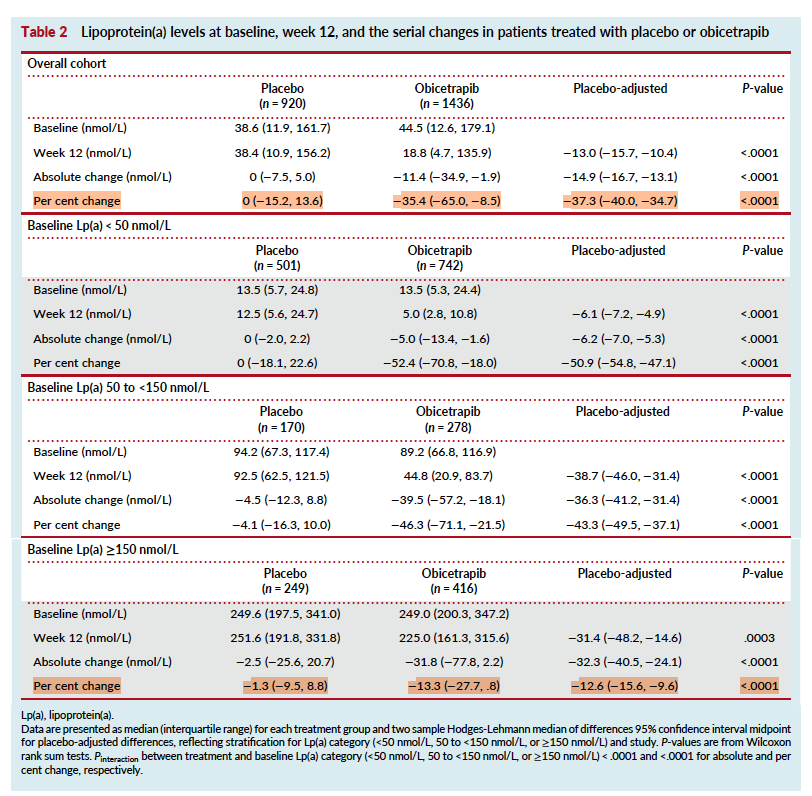
@Lpa_Doc So , if that is true for CETP inhibition in general , it makes sense that this effect has a tougher time at very high Lpa , driven by overproduction of small isoforms .. in that situation you need a hammer , ie a killer of mRNA ..HORIZON will hopefully inform us further indeed 👊
English
0
0
2
256
Sam Tsimikas, MD
Sam Tsimikas, MD@Lpa_Doc·
Interesting obicetrapib/Lp(a) signal: like PCSK9i, the % reduction appears smaller at higher baseline Lp(a). But the absolute reduction is fairly similar once Lp(a) is elevated (~32–36 nmol/L), suggesting a possible “ceiling” in absolute lowering. Mechanism remains unclear. This would be a good nidus for an NIH R01 grant @Philip_Gordts It will also be interesting to see what absolute reduction on Lp(a) may be associated with benefit in Lp(a) HORIZON. academic.oup.com/eurheartj/adva…
Sam Tsimikas, MD tweet media
English
5
10
37
3.9K