Josh Perrin

1.4K posts

Josh Perrin banner
Josh Perrin

Josh Perrin

@jpperrin

Father of three. Eternal student. Entrepreneur. Product Designer. Developer.

Halifax, Nova Scotia Katılım Kasım 2009
1.9K Takip Edilen282 Takipçiler
Josh Perrin
Josh Perrin@jpperrin·
@doodlestein Got Agent Flywheel up and running today with 12 Claude and Codex agents cranking away on beads. Very cool tooling! Thanks for sharing all your work! Is FrakenCode designed to replace ACFS?
English
1
0
3
220
Jeffrey Emanuel
Jeffrey Emanuel@doodlestein·
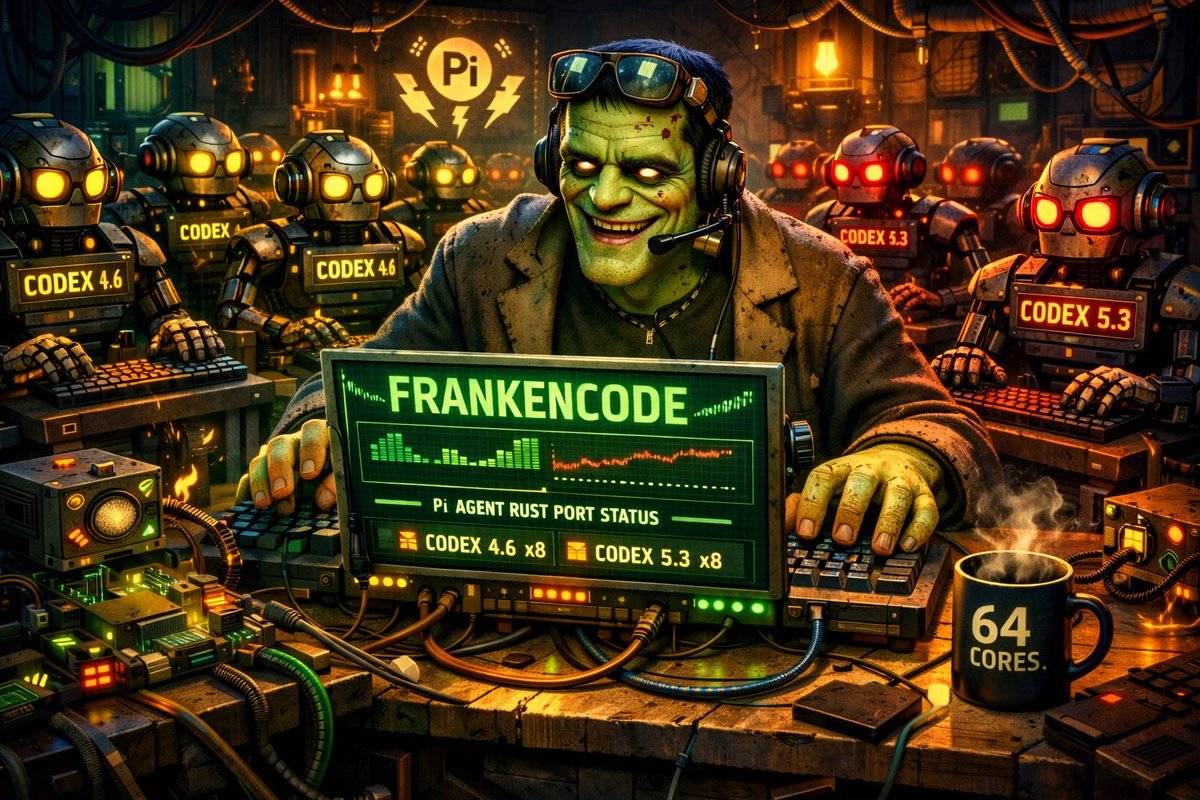
OK, my upgrade to 64 cores was well-timed. I now have a disgusting number of next-gen Codex 4.6 and Codex 5.3 clankers running across 3 machines and 9 projects. Just the Pi Agent Rust port alone has like 8 of each going at the same time. Lightspeed ahead! FrankenCode beckons.
Jeffrey Emanuel tweet media
English
14
1
86
4.4K
Josh Perrin
Josh Perrin@jpperrin·
@doodlestein Thanks for the reply! I'll read through all of this. Much appreciated. I hear ya on the worktrees, I've just been using multiple copies of the repo on my local machine for each agent I run. But want to level up, gonna give your approach a go!
English
0
0
0
3
Jeffrey Emanuel
Jeffrey Emanuel@doodlestein·
@jpperrin Thanks, I appreciate that! Running the stuff on hardware you control is much better. I hate the cloud instances of CC and Codex, mostly because I detest the entire git worktrees approach. See this whole thread for my reasoning: x.com/doodlestein/st…
Jeffrey Emanuel@doodlestein

Blows my mind how many people still don’t know about my Agent Mail project and how it does exactly what they want and much more, while sidestepping all the many footguns that a naive implementation would fall prey to. It’s a true game changer combined with beads and bv. Try it!

English
2
0
0
193
Jeffrey Emanuel
Jeffrey Emanuel@doodlestein·
Does feel like I’m on a highly accelerated timeline now. Try to keep up! I’ll also invest more time and energy in good tutorials and materials. I’m going to refresh the learning hub section on the flywheel site soon. And you can stay up to date here: agent-flywheel.com/tldr
English
6
4
59
5.6K
Josh Perrin
Josh Perrin@jpperrin·
@SheaSerrano Thank you sir. I pre-ordered Expensive Basketball yesterday morning, must’ve been the reciprocal karma at work 😁
English
0
0
1
18
Shea Serrano
Shea Serrano@SheaSerrano·
turned on the World Series and literally the first pitch the guy hit a two-run homer to tie the game so apologies to the dodgers and you’re welcome to the blue jays
English
27
9
816
33.1K
Josh Perrin retweetledi
Sheel Mohnot
Sheel Mohnot@pitdesi·
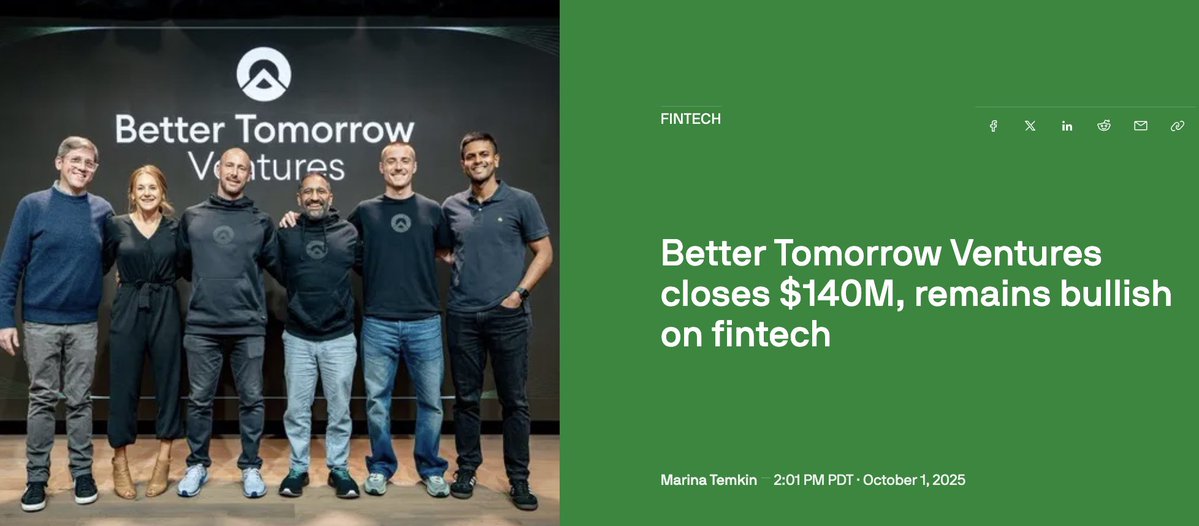
We @btv_vc raised another $140M to continue to back the best pre-seed and seed stage founders building fintech companies. Grateful to our team, founders, and investors!
Sheel Mohnot tweet media
English
200
44
973
185.2K
Josh Perrin retweetledi
Tinkered Thinking
Tinkered Thinking@TinkeredThinker·
I am absolutely thrilled to announce the initial LIMITED Release of a special WHITE MIRROR bundle. Only 100 available A lot of heart, soul & prognostication went into this gorgeous book. Undying gratitude to @infinitebooks, my editor @DylanoA4 and @jposhaughnessy link below
Tinkered Thinking tweet media
English
10
13
61
95.1K
Josh Perrin
Josh Perrin@jpperrin·
RT @shanebacon: It's funny to be happy for a stranger, someone you don't know. Sports are weird like that. But I've followed Rory as my lif…
English
0
328
0
0
Josh Perrin
Josh Perrin@jpperrin·
RT @Easy_Expense: Last week, @googleplay terminated our account without warning, citing ”policy violations” but giving us no specifics. Eas…
English
0
13
0
0
Josh Perrin retweetledi
Growth.Design
Growth.Design@GrowthDotDesign·
⚡️ NEW: Signal Case Study After using Signal (encrypted messages) for a few months, without paying a nickel... we decided to look at how they could boost their revenues... ...Check it out 👇 growth.design/case-studies/s…
English
22
102
169
0
Josh Perrin
Josh Perrin@jpperrin·
RT @tweeth_mitchell: "and they have this Pizza Tracker that tells you *exactly* when your pizza is ready..."
English
0
107
0
0
Josh Perrin
Josh Perrin@jpperrin·
"You don't need to worry about progressing slowly. You need to worry about climbing the wrong mountain." -@JamesClear
English
0
0
0
15
Josh Perrin retweetledi
Andrew McCarthy
Andrew McCarthy@AJamesMcCarthy·
Totality: An HDR composite image of yesterday's eclipse. This photo used 5 cameras to capture thousands of photos during a 4 minute period. My goal was to capture the magic of the visual experience, and I hope this photo evokes similar emotions I experienced while watching it.
Andrew McCarthy tweet media
English
986
6.9K
49.8K
2.7M
Josh Perrin
Josh Perrin@jpperrin·
RT @william_lou: first of many! scottie's emergence has been a rare bright spot in this dark season for the franchise.
English
0
52
0
0
Josh Perrin retweetledi
BIG DRESS ENERGY
BIG DRESS ENERGY@ShakailaElise·
Apple TV are incapable of making a bad show but they would rather die than let you know that it exists.
English
110
2.3K
9.7K
844.5K
Josh Perrin retweetledi
Packy McCormick
Packy McCormick@packyM·
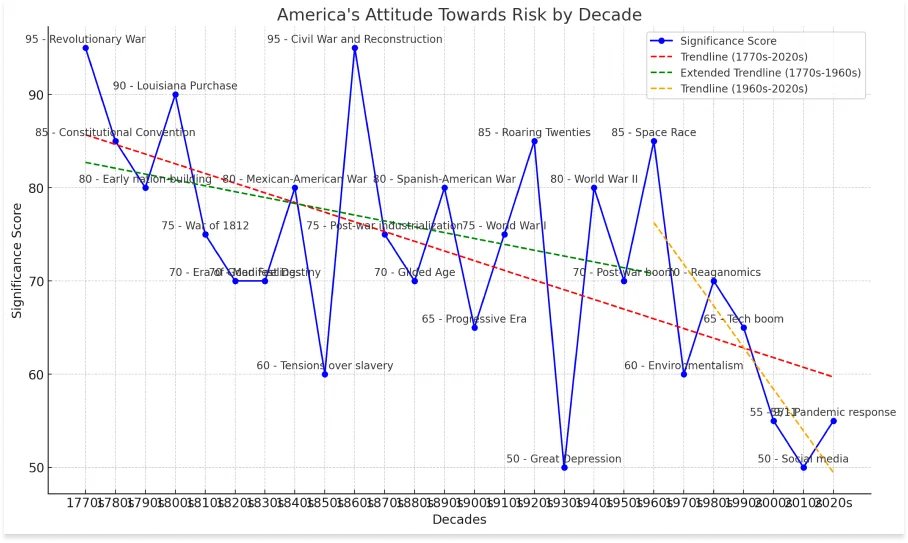
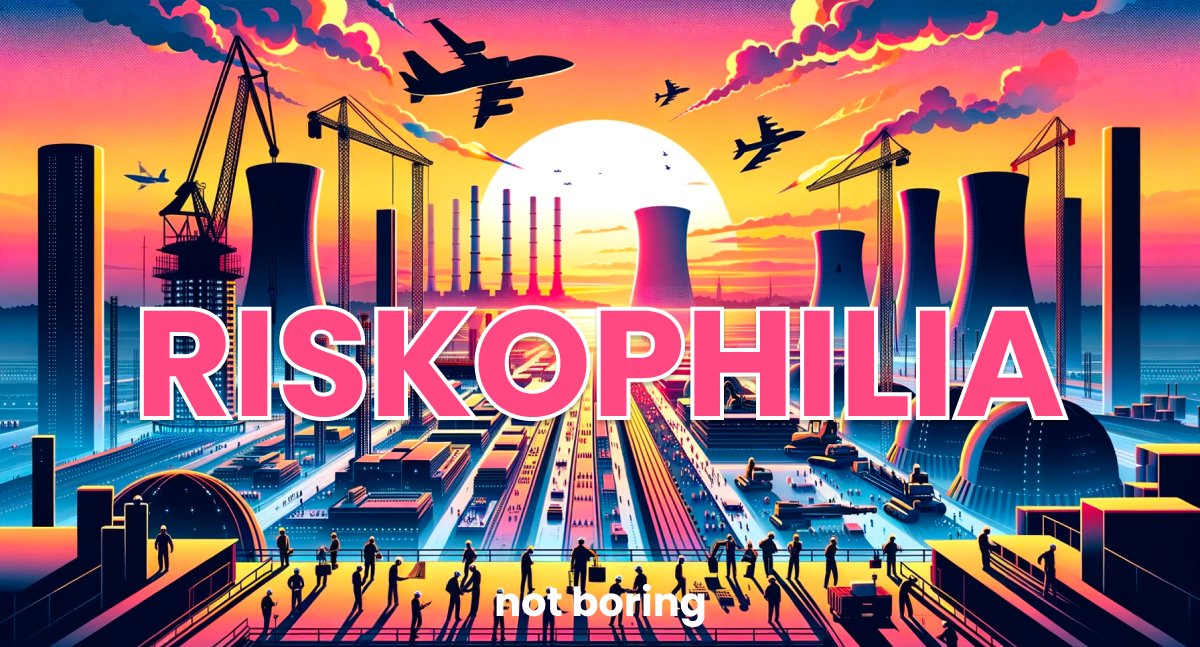
Riskophilia What if we’re thinking about risk backwards?  Over the weekend, a paper in The Journal of Pediatrics titled, Decline in Independent Activity as a Cause of Decline in Children’s Mental Well-being: Summary of the Evidence swept the internet.  The authors’ argue that “a primary cause of the rise in mental disorders is a decline over decades in opportunities for children and teens to play, roam, and engage in other activities independent of direct oversight and control by adults.”  Right on the first page, they write (emphasis mine):  Over time, however, beginning in the 1960s and accelerating in the 1980s, the implicit understanding shifted from that of children as competent, responsible, and resilient to the opposite, as advice focused increasingly on children’s needs for supervision and protection. Rutherford noted, as have other reviewers, that in some respects—such as freedom to choose what they wear or eat—children have gained autonomy over the decades. What has declined specifically is children’s freedom to engage in activities that involve some degree of risk and personal responsibility away from adults. My thesis is that it’s not just the kids.  Replace “children” with “people” and the paragraph works just as well!  Over the same time period, beginning in the 1960s and accelerating in the 1980s, the implicit understanding shifted from that of Americans as competent, responsible, and resilient to the opposite, as advice focused increasingly on Americans’ needs for supervision and protection. As a quick pulse check, I asked ChatGPT to give me a rough estimate of America’s attitude towards risk every decade since our founding:  ChatGPT This is an admittedly unscientific approach, but I found it interesting. ChatGPT has no horse in this race, and the dropoff from the 1960s to the 1970s lines up with the child-raising paper and the rise in regulation. Something changed in the 1970s (cue: wtfhappenedin1971?).  If you deconstruct the larger trendline into two – one from the 1770s - 1960s and the other from the 1960s - 2020s – that change jumps off the page.  We stopped embracing risk and started trying to eliminate it. We went from riskophilia to riskophobia.  The 1970s are a fascinating decade for people who think about progress. Tyler Cowen calls the period since 1971 The Great Stagnation, a half-century slowdown in productivity and innovation. In WTF Happened in 2023?!, I wrote that about that year, “You might have picked up a shift from optimism to pessimism, which trickled into policies, corporate decisions, and then, years later, into the data.” We can get more specific here. The 1970s saw the rise of safety culture with the creation of the Nuclear Regulatory Commission (NRC), Environmental Protection Agency (EPA), and Occupational Safety and Health Administration (OHSA), along with the passage of the Clean Air Act, the Occupational Safety and Health Act, and the Consumer Product Safety Act.  J. Storrs Hall, Where is My Flying Car? Inspired by the German environmental movement, which called it “Vorsorgeprinzip,” or foresight principle, the 1970s also birthed the precautionary principle. In simple terms, it means “better safe than sorry.” In less simple terms, the precautionary principle suggests that if an action or policy has the potential to cause harm, in the absence of scientific consensus, the burden of proof falls on those advocating for the action or policy, not those opposing it.  It’s guilty until proven innocent for new things, but worse, because it forestalls the opportunity for a trial in the first place.  The basic problem with the precautionary principle is that, in its strong form, it’s like running a cost-benefit analysis without the benefit column. A single “X” in the cost column is enough to generate a “no” decision.  More bluntly, it doesn’t work. In a 2005 paper, The Precautionary Principle as a Basis for Decision Making, Harvard legal scholar Cass Sunstein argues “that the precautionary principle does not help individuals or nations make difficult choices in a non-arbitrary way. Taken seriously, it can be paralyzing, providing no direction at all.”  Worse, attempting to eliminate legible risks just creates new ones. “It turns out,” he writes, “that the danger that regulation will create new or different risk profiles is the rule, not the exception.” The canonical example here is nuclear energy. The NRC literally uses a principle that demands that radiation be “As Low As Reasonably Achievable,” an asymptotically impossible goal. Make it safer, then safer, then safer, until you don’t make it at all. Regulation has contributed to making nuclear so expensive that we effectively don’t build it. By minimizing the 0.03 deaths per terawatt hour of electricity produced, we increase the risk of deaths from other fuel sources, the impacts of climate change, and dependence on foreign energy. And we forestall an energy abundant future and its untold benefits. We lower the ceiling, and the floor.  We trade freedom not for safety, but for the illusion of safety.  Illusion, because: you can’t eliminate risk.  Whether we’re talking about parenting or regulation, the idea that you can is comforting. It provides a sense of control. Everyone wants their kids to be safe. But risks don’t operate in a vacuum. By trying to limit known but potentially small risks, you open yourself up to bigger but less legible risks elsewhere.  It’s like squeezing a water balloon. Push on one side, the water moves to the other. Push too hard, and the balloon explodes.  Embracing risk can make you antifragile by building resilience and adaptability; running from it can make you fragile by removing opportunities to build the same.  That’s what the parenting paper argues, and I argue that the same thing is true for adults, companies, and even nations.  When World War II struck, America sprung to action, transforming itself into the factory that won the war. Today, as Noah Smith writes, “We’re not ready for the big one.” Our shell-making capacity is about 3% what it was thirty years ago, and China has a 200:1 shipbuilding advantage over the US.  I hope to god we avoid World War III, but the fact that it’s even on the table – that war is happening around the world as we speak – should serve as a wake-up call that the world is full of risk, and that by trying to avoid it, we allow it to bloom. There were a million different reasons that 1971 was a turning point from growth to stagnation: oil shocks, the shift from manufacturing to services, declining energy usage, the abandonment of the gold standard, increased regulation. But I think it runs deeper than that, to the cultural core of the country, which is why the same pattern shows up in the economy and in the way parents raise their kids.  The shift from optimism to pessimism, from growth to degrowth, from hope to doom, and from riskophilia to riskophobia was the result of a cultural movement, and we need a cultural movement in the other direction to get our swagger back.  That might seem naive. There are those who believe that our decline is a fait accompli. I’m not one of those people. It’s why I have been banging the drum on optimism and telling the stories of the people and companies that do embrace risk to try to fix the biggest problems they can tackle. A movement got us into this mess, and a movement can get us out of it.  I’ve been wanting to write a piece on America’s attitude towards risk for a while. The good news is, the tide seems to be shifting already.  A couple of weeks ago, the All-In podcast’s David Friedberg, who’s had to fight through the precautionary principle as an entrepreneur, went in on the “total lack of assumption of risk generally in the US which limits progress in meaningful ways”: Watch it.  And yesterday, a16z co-founder Marc Andreessen wrote The Techno-Optimist Manifesto, offering an aggressively optimistic perspective and going to town on the precautionary principle:  Our enemy is the Precautionary Principle, which would have prevented virtually all progress since man first harnessed fire. The Precautionary Principle was invented to prevent the large-scale deployment of civilian nuclear power, perhaps the most catastrophic mistake in Western society in my lifetime. The Precautionary Principle continues to inflict enormous unnecessary suffering on our world today. It is deeply immoral, and we must jettison it with extreme prejudice. Read the whole thing if you haven’t.  I don’t need to re-litigate the points Friedberg and Marc made. I agree with them. And if they sound a bit extreme, it’s because movements aren’t started by tepidly considering every point and counterpoint. The culture shifts through a great Overton Window tug-of-war.  If the precautionary principle that has underpinned the last half-century of riskophoboa in America has pushed safety by erasing the benefits column, then the appropriate counterbalance is to make a case for erasing the cost column.  If that case lands, we’ll pull hard enough that we end up somewhere in the middle, taking Cass Sunstein’s recommendation that we throw out the precautionary principle in favor of a radical new framework: cost-benefit analysis.  Kids should ride bikes with their friends, but they should wear a helmet. They should roam freely, but they shouldn’t go to bars. We should embrace nuclear energy, but we should build containment domes. We should protect the environment, but we shouldn’t let every bobwhite quail egg stand in the way of a better future for humans. Every decision has costs, and benefits.  The movement underfoot isn’t against each other or against the government. America has worked best when its government and people were pulling in the same direction: forward.  The movement is against the idea of risk minimization as a goal. It’s against the culture of safetyism that we’ve all allowed to seep into every corner of our lives. It’s for the more vibrant, alive, and vigorous world we can build when we embrace risk with eyes wide open.  This movement is about much more than tech. The parenting paper helped me realize that the issue runs deeper, and that the solutions must too. From our homes to our startups to our government, we need to take responsibility for our actions and outcomes.  I have good news and bad news: we are not children.  There is no parent to protect us, and even if there were, it might do more harm than good. So drop the illusion. Embrace risk. Roam free. Live vigorously.  The reason we’ve made so much progress over the past half-century despite our decelerating risk appetite is that a brave few have chosen to take risk on and win. I write about the entrepreneurs among them, but they’re everywhere. Someone probably pops to mind for you.  Imagine what the world could be if more of us joined them. We are competent, responsible, and resilient. We have the freedom to engage in activities that involve some degree of risk and personal responsibility. Embrace it. Join the movement.  My hunch is that the government will follow. They’re just been giving us the sense of protection we’ve demanded. Let’s demand something better. Vox populi, vox Dei.  I refuse to believe that America’s best days are behind it. Decline is not inevitable. But it takes more than tech. It’s up to all of us to cut through the cruft, get back to the sense of freedom and adventure that make the country great, and build from there.  Go do that risky thing you’ve been putting off. Now. Build the muscle. Spread the word: we’re going risk-on. The only way out is up, even if it’s a little risky up there.
Packy McCormick tweet mediaPacky McCormick tweet mediaPacky McCormick tweet mediaPacky McCormick tweet media
English
14
26
131
60K