

Jarred Colli
336 posts
Jarred Colli
@jred2rs
none of my views are my own.
new york city Katılım Haziran 2009
565 Takip Edilen601 Takipçiler

The fastest way to lower average housing prices in American cities is enforcing the law/reducing criminal activity. Huge chunks of high-density housing are trapped in Bad Neighborhoods, no-go zones depressed well below nearby prices. Nobody with options even considers them.
English
Jarred Colli retweetledi

Imagine not having had any food to give your kids for 10 days.
Motasem A Dalloul@AbujomaaGaza
I swear to God, this what exactly happened: I woke up today morning and found a missed call on my phone coming from a widow with a number of orphan children living next door. I called her back and asked her what she wanted. She said: “I need some flour. Me and my children have been sleeping without food for 10 days.” I replied: “Unfortunately, me and my children have nothing to eat for more than 10 days.”
English
@creativeness @Noahpinion this is the lamest response to an attempted skewering of someone on X of all time. you're the literal definition of a snowflake.
English

@Noahpinion My mom is dying, her Alzheimer’s is taking her life, her body is breaking down. We are looking at Hospice options this week. Any other time this may have been funny. Not today.
English

How can the President set prices by executive order?
The White House@WhiteHouse
JUST IN: PRESIDENT TRUMP'S "MOST IMPORTANT AND IMPACTFUL" TRUTH EVER ISSUED ⬇️ "I am pleased to announce that Tomorrow morning, in the White House, at 9:00 A.M., I will be signing one of the most consequential Executive Orders in our Country’s history...."
English
@pitdesi I will say that sometimes o3's advanced reasoning makes it really bad at basic tasks. It actually overthinks things
English

I use 4o 90% of the time and o3 10% of the time. Do people use the other ones?
when?

English


@auren Would have been a great bet on Nov 7. Maybe it is priced in?
English

am shorting Booz Allen
shorted Booz Allen on May 1 (priced at $118/share at the time). This is my write-up so the internets can critique and review. Absolutely none of this is investment advice.
Booz Allen $BAH is the iconic services firm with 98% of their revenue coming from government customers. This is one of the many firms that have been preying on taxpayers and over-billing the government and building things the government does not need, over-budget, and massively delayed.
This is not really Booz’s fault. The government customer has traditionally not understood software. Most of the people in IT leadership in government have never written even one line of code … and yet they are managing billions of dollars in IT budgets … so it is not a surprise that the money has been wasted.
This bet is that the government is becoming a smarter customer. The bet is that the new people in government IT leadership are more technical and will be able to manage these giant projects better. The bet is that this will happen much faster than people expect and we will see IT government contracts in the tens of billions of dollars canceled in the next few months.
Another reason that government hires all these IT contractors is that most government agencies are not allowed to hire and fire employees quickly. So they hire contractors that are 3-5 times the price because it is the only way to get flexibility and move quickly. The bet is that many of those outdated HR rules will be changing soon. As the government gets more flexible in how it hires and manages its people, it will rely on expensive contractors less.
These government reforms are non-partisan. Everyone wants them to happen. The reason the spending has been out of control and the effectiveness of these outsourced IT engagements are so low are a product of the system. 100% of people want to make this better … but inertia has been a super strong force thus far. The bet here is that this is changing.
Most of the government IT contracts that will be canceled in the next few months are in civilian (non-defense and non-IC) agencies. Only about a third of Booz’s revenue comes from civilian agencies (most comes from defense and IC), but the bet is that it is still significant. And the bet is that the cancellation of the defense and IC contracts is coming and should be known by September.
The market believes some of this. The Booz stock sold off a decent amount (~9% YTD and ~18% over the past year). But earnings estimates have not come down much. 2025 and 2026 estimates really only started to come down a bit in April. P/E NTM is ~19% below its 5 year avg. Analysts still seem fairly bullish / neutral on the stock with target prices in the mid 130’s (the stock is currently at $118). So most people that follow the Booz stock think the downturn is already priced in.
This bet is that the stock is overpriced.
We should learn a lot at the next Booz earnings call (May 23) and the one after that (likely August).
How confident am I? Not super confident.
am betting $152k on it. Mainly wanted to put my money where my mouth is. And will tweet out if I close out the trade or reduce exposure or take profits.
There are many ways to short the BAH 0.00%↑ . You can do a naked short (borrow costs are currently extremely low). You can buy puts. (HT: Rajal Patel from Flex Capital for putting most of this together).
Note: am still long SP500 in my personal portfolio. So that is the guard against the market moving up dramatically and taking $BAH with it.
Auren Hoffman@auren
Booz Allen biz model: ✅ Overcharge the government ✅ Deliver clunky software 5 year late ✅ Blame bureaucrats who think Java is just coffee ✅ Profit $BAH
English
Jarred Colli retweetledi

@pitdesi separately, demand for small cars had been collapsing over the previous 1-2 decades. Companies had only been making small cars and selling them at a loss to try to make their average fleet MPG meet government standards
English
Ever wonder why sedans disappeared and every car is huge now?
"Thanks, Obama!"
His administration changed fuel economy standards in a way that had the perverse impact of making cars even bigger.
Here are all the vehicles for sale by the 3 largest US automakers. 62 vehicles, 4 sedans (6%). 20 years ago this chart would have been ~50% sedans!
What happened?
Obama administration changed auto fuel efficiency rules to tie fuel economy targets to vehicle size.
Under the new system:
-The bigger the car's footprint, the easier the MPG target was.
-Light trucks (including SUVs and crossovers) had far lower requirements than passenger cars.
-Crossovers were quietly reclassified as "trucks," giving them a huge regulatory advantage.
Instead of building lighter, more efficient cars, automakers simply made everything bigger, and made more trucks and SUVs.
Notice that cars that used to be sedans are now crossovers? They do this so it counts as a light truck - they raise ground clearance, square off the rear for cargo capacity, and meet off-road approach minimums so they get qualified as a light truck. Think Subaru Legacy > Subaru Outback.
As you can see in the chart, it's a LOT easier to meet MPG requirements if your vehicle is classified that way.
So cars got LARGER to meet fuel efficiency goals. The new Honda Civic is 20 inches longer and 4 inches wider than it used to be, about the same size as an old Accord. By making the Civic larger, Honda slightly shifted it into a more favorable regulatory category.
...and smaller cars disappeared. The Honda Fit was a great little car, but would have had to hit 67 MPG in 2026, which would be nearly impossible... so instead, Honda stopped selling them.
So, the only way to make small vehicles now is to make them EV's (Chevy Bolt).
The Slate truck that is all the rage now is only possible because it's an EV... otherwise its footprint would have demanded an overly onerous MPG target.
So in short - Obama era CAFE standards had the opposite of the desired impact: sedans died, vehicles ballooned in size, and America's streets turned into an SUV parking lot.
All thanks to a policy that accidentally incentivized bloat instead of efficiency.
Don't get me started on "cash for clunkers!"



English



@elonmusk please fix this
Christina Farr@chrissyfarr
In Nevada, Medicare spent $14m on bandages for a single patient. “The government will reimburse any price that a company sets for brand-new skin substitutes, even if it is far above the market average. The higher the price, the larger the doctors’ cut.” @nytimes
English

In Nevada, Medicare spent $14m on bandages for a single patient.
“The government will reimburse any price that a company sets for brand-new skin substitutes, even if it is far above the market average. The higher the price, the larger the doctors’ cut.” @nytimes

English
English
isn't the whole idea that creating manufacturing capability and knowhow in a country requires encouraging exports and competing globally, not protecting local industries with taxes? just thinking about what I read about south korea, etc in @JoeStudwell's "how asia works." if Trump's goal is reindustrialization, aren't massive tariffs a proven way to fail?
English
This tariff pause is going to be very bad for the domestic shoe-making factory I started building last week.
English

@mattyglesias Nikita is smart enough to know this, he's making a joke and way too many people took it seriously. LIke 80% of his tweets are jokes.
English

I can't wait to see how much Nancy Pelosi made over the last 10 days
English
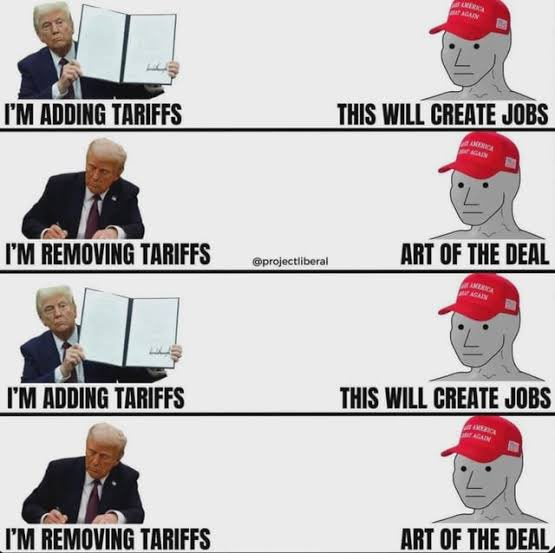

I’m playing everyone’s favorite party game: guess the Trump administration’s strategy. Like most of you, I have no inside information. But that’s what makes it fun. Here’s my best theory.
Some assumptions first:
1) They’re not crazy. There is a strategy. It doesn’t align with conventional economic principles. But there’s something they’re playing toward.
2) They’re not stupid. I know enough of the players involved to know they’re not idiots. They may be making what will turn out to be accurately predicted to be horrible decisions, but they do have a plan and it’s coherent. As part of this, while I think they think they can increase U.S. manufacturing, they don’t really believe they can bring everything on-shore.
3) They’re intentionally being opaque as to what the real plan is. Trump fashions himself a negotiator. Holding his cards close to his vest, even lying about what cards he has, is part of the game.
4) They’re not just in it for themselves. I get that this has become non-conventional wisdom, but I am going to assume for this that the goal isn’t merely grift. Even if you believe it is, suggest that’s an easy out to thinking through what may be more complex motivations.
5) China is the real enemy. China has done some things in the last two years that have made even the China doves in the last administration into hawks. Again, I know there’s lots of media saying Trump wants to kiss up to Xi. But, having spent enough time with enough folks in this and the last administration, they really worry about China morning, afternoon, and all night.
So with that context, I posit the strategy is entirely: destabilize and ultimately decapitate China.
If that’s right, you could just impose tariffs on China. But China has lots of export markets, so goods will just flow out through those. What if instead you impose tariffs on everyone?
While China and the U.S. have similar GDPs, China is much more dependent on exports. That means while the countries of the world like cheap Chinese exports, they don’t depend on the Chinese market for their exports (yet). China has actually been on a nationalistic spree recently so foreign brands are more out of favor, meaning they’re an even less interesting market to sell to.
The U.S., on the other hand, is the world largest buying market. We are the consumers to the world. If we stop buying, everyone suffers. That means nearly everyone needs to come to the table with the U.S. if there are universal tariffs.
The U.S. is also unique in that it is among the only countries that doesn’t need to import anything. Don’t get me wrong, we want to import iPhones and PlayStations and French wine and German cars. But we don’t need oil or food or water or most the other raw materials to make sure people stay alive.
So the U.S. will hurt under a high tariff regime but won’t collapse. Some manufacturing will move back on shore. But the biggest thing is every country needs to negotiate with the U.S.
What does the U.S. ask for? I’m sure a bunch of nits with every country. But what if the big ask is: it’s us or them. You either trade with the United States, or you trade with China, but trading with both isn’t acceptable anymore.
For some countries — Vietnam, Indonesia, Philippines — the promise is to be the next China, but this time under more careful rules dictated by the U.S.
For most the rest of the world, they’re already massive net importers from China. Forced to make a choice between selling to China or selling to the U.S. I’d guess most will pick the U.S. German automakers are terrified of BYD. And the Italians and French haven’t proven they can sell wine or cheese to China at any real volume.
What’s China’s response? It’s tricky because they’ve preached self-sufficiency and internal focus. But if the whole world order suddenly aligns against them, what do they do?
I have no idea if this is the Trump administration’s plan. But it’s the only thing I’ve come up with that passes the sniff test.
English
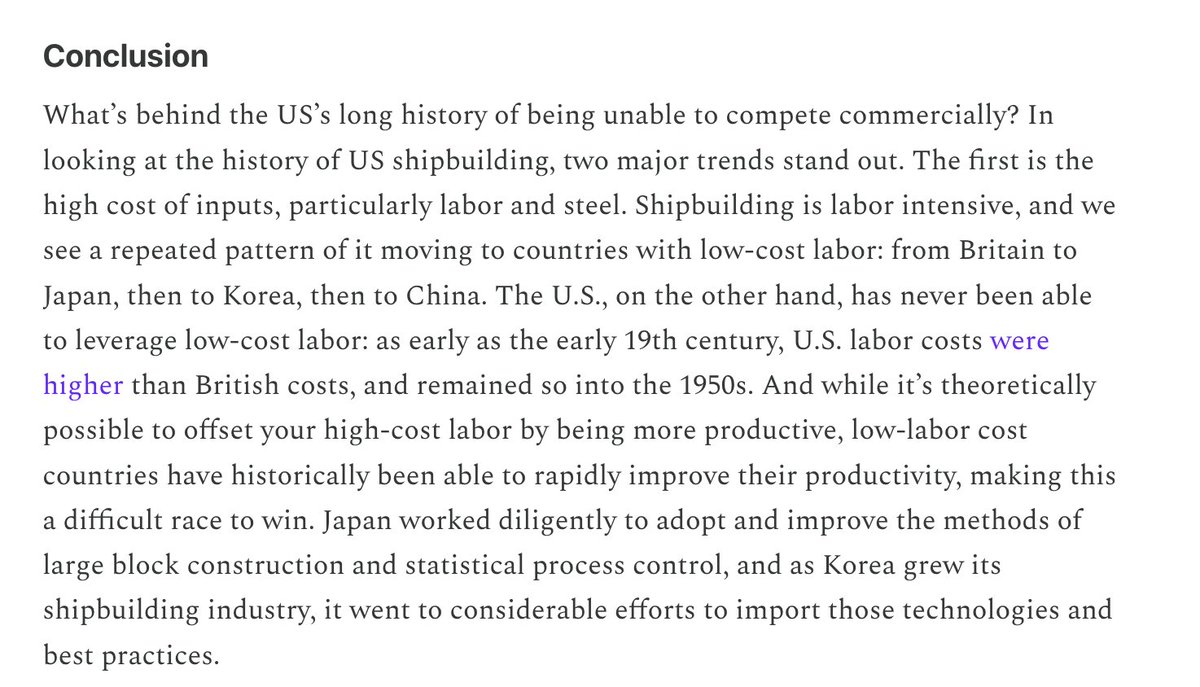
Ryan already know's this, I'm sure, but we've tried to fix the US' ship building productivity a few different times since WW2, and it's never worked. @_brianpotter covered this in @Noahpinion 's excellent newsletter last year. We should call a spade a spade, this is stupid policy from stupid people who have no business running the world's biggest economy
English
On April 17th the U.S. Trade Representative's office is expected to impose fees of up to $1.5M per port call for ships made in China and for $500k to $1M if the ocean carrier owns a single ship made in China or even has one on order from a Chinese shipyard. 🧵 1/
English
@BillAckman @howardlutnick 'I never thought leopards would eat MY face,' sobs woman who voted for the Leopards Eating People's Faces Party.
English

I just figured out why @howardlutnick is indifferent to the stock market and the economy crashing. He and Cantor are long bonds. He profits when our economy implodes.
It’s a bad idea to pick a Secretary of Commerce whose firm is levered long fixed income. It’s an irreconcilable conflict of interest.
English
Jarred Colli retweetledi

