Luke Hutchison
700 posts

Luke Hutchison
@LH
There is always a solution. PhD, MIT. Ex-Google AI research scientist.

Planet Earth Katılım Mayıs 2009
1.8K Takip Edilen2.9K Takipçiler

prototype of a recursive time helix calendar/history, with nested coils from centuries -> decades -> years -> days -> hours -> minutes -> seconds. labels need some work but it's the start of something. based almost entirely on @tr_babb 's sketch/idea. in threejs/webgpu
English

@Rainmaker1973 @philiprosedale There's a documentary on the Overview Effect:
youtu.be/dDfEnKcHBSc?si…

YouTube
English

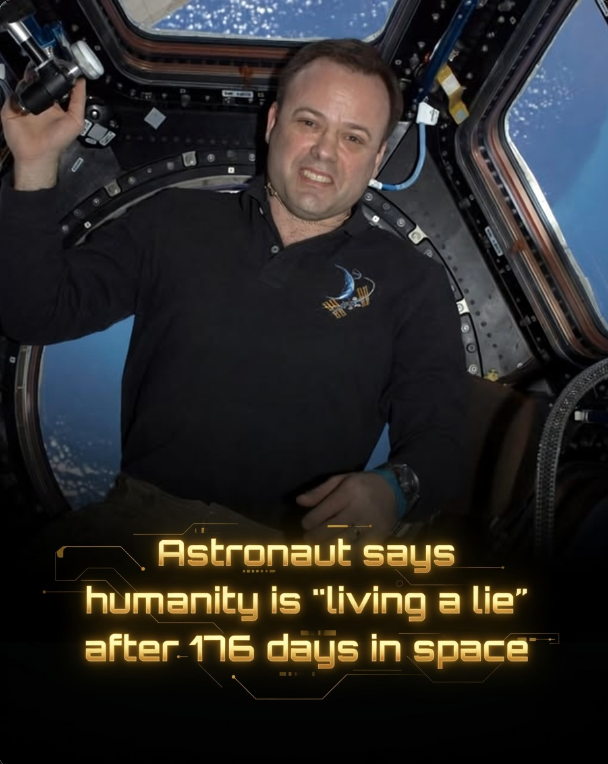
Former astronaut Ron Garan returned from space convinced that humanity is “living an enormous lie.”
During his 178-day mission aboard the International Space Station in 2011—spending nearly six months in orbit and covering over 71 million miles—Garan experienced the transformative “Overview Effect.” From 250 miles above Earth, the planet appeared as a single, delicate blue marble suspended in the void, with no visible borders, nations, or divisions. Political lines vanished; instead, he saw a fragile, interconnected biosphere wrapped in an astonishingly thin atmosphere—the sole protective layer sustaining all life against the deadly vacuum of space.
This perspective shattered his prior worldview. He observed an iridescent, teeming world of life but no trace of the global economy that humans prioritize. Garan realized the “enormous lie” we perpetuate: the illusion that we are separate from one another, from nature, and from the planet itself. Our systems treat the Earth’s life-support mechanisms—air, water, ecosystems—as mere subsidiaries of the economy, when the orbital view reveals the opposite truth: the planet comes first, then society, then economy.
In his words, this realization highlighted how crises like climate change, deforestation, and biodiversity loss stem from this fundamental misperception of separation. Garan argues that embracing this unified, fragile reality—seeing ourselves as crew members on “Spaceship Earth”—is essential for collective survival and effective global stewardship. The view from space didn’t just change his outlook; it underscored an urgent call for humanity to realign priorities with the undeniable interconnectedness of our shared home.

English

The stereo view 🤯
Andrew McCarthy@AJamesMcCarthy
@brandilwells I’ve received threats for posting photos of Saturn I took myself, so it seems any group has the capacity to be triggered. I’m wondering why they don’t do some astronomy and learn things firsthand instead of speaking in memes that contradict centuries of empirical observation.

English
Luke Hutchison retweetledi

@natashajaques Super interesting, and seems true... But for completeness, wouldn't you have to compare with essays of *different* human writers making edits according to the same feedback? It's possible some of the observed changes would have been made by different people, not just LLMs.
English

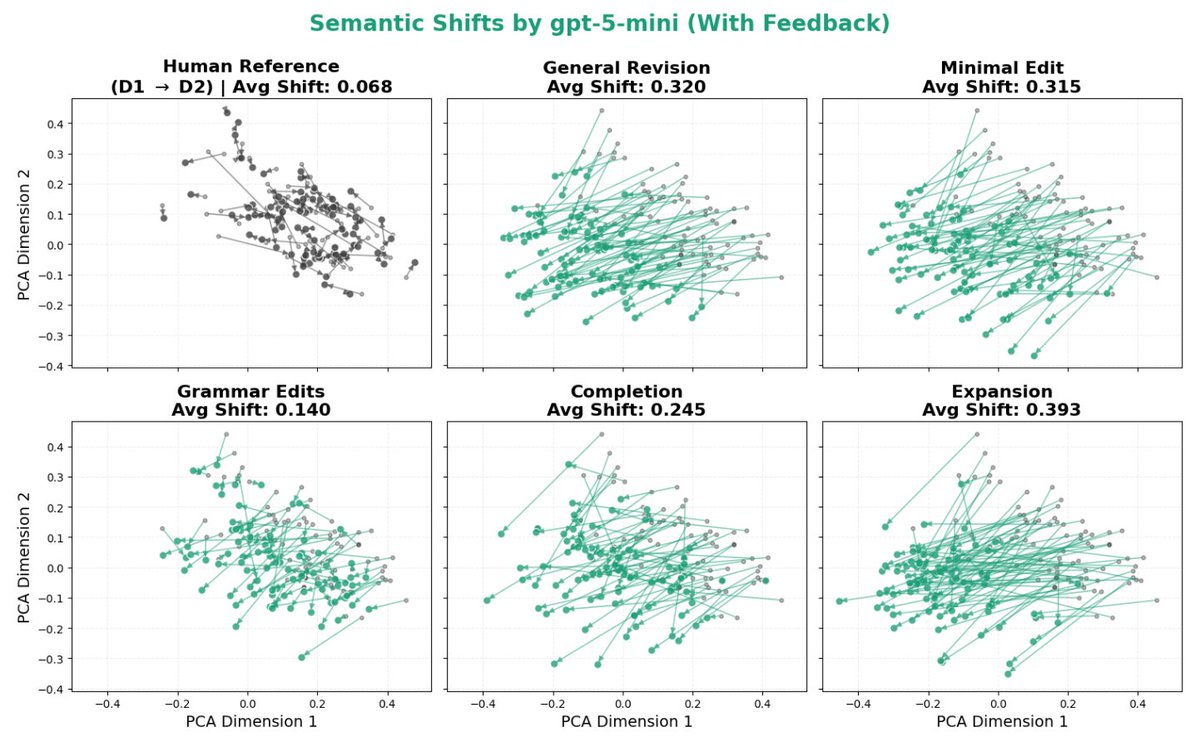
The paper I’ve been most obsessed with lately is finally out: nbcnews.com/tech/tech-news…! Check out this beautiful plot: it shows how much LLMs distort human writing when making edits, compared to how humans would revise the same content.
We take a dataset of human-written essays from 2021, before the release of ChatGPT. We compare how people revise draft v1 -> v2 given expert feedback, with how an LLM revises the same v1 given the same feedback. This enables a counterfactual comparison: how much does the LLM alter the essay compared to what the human was originally intending to write? We find LLMs consistently induce massive distortions, even changing the actual meaning and conclusions argued for.

English

You have to set #ClaudeCode's effort level to the new `max` level to get back any semblance of the old level of reasoning performance. Bascially the new `high` is the old `medium`, and the new `max` (which is not on by default) is the old `high`.
English

If you have noticed that @claudeai (Claude Code Opus 4.6, specifically) suddenly got a lot worse at reasoning in the last few days, you need to know that every Claude Code user had their effort downgraded, without even a public post about it (@bcherny??)
gist.github.com/kellan/ccf6125…
English

@theo It only works well if you make very small incremental changes, and manually check and test everything, going through rounds of polishing before moving on to the next incremental change. It does NOT work well for big bang development.
English

@catalinmpit That's because Anthropic renamed the "high" effort level to "max", and renamed "medium" to "high", then bumped everyone down one level by default, in order to reduce server load. You have to set effort to max under /model to get it to work well again.
English

Lately, Claude makes some shocking mistakes.
⟶ Implements overly complex code
⟶ Ignores the codebase's code style
⟶ Removes working code for no reason
⟶ Replaces code that's out of scope from the task at hand
It feels like it needs 100% supervision. At this point, you're better off writing everything yourself.

English

@skdh Particles don't just act as waves, they *are* waves, propagating according to an underlying probability distribution, until some potential interaction that samples from that distribution "rolls a six", resulting in the collapse of all future possibilities to that single point.
English

The double slit experiment is the probably most misunderstood experiment ever. I have no idea who created the myth that if you 'look' at one of the slits, then the particles (photons/electrons) stop behaving as waves. It's wrong! They of course STILL behave as waves! Because particles are also waves, always.
Photons and electrons make a self-interference EVEN ON A SINGLE slit. Don't believe it? Below an actual measurement from a laser diffracting on a single/double slit from Wikipedia.
What happens if you measure which slit the particle goes through is that you get no interference between BOTH slits. And no, you don't need a conscious observer for this. Believe it or not, there have actually been experiments where they had people literally look at a double slit to see if that makes any difference and the answer is no, it does not.
The entire mystery of the double slit is in the path of the particle TO the double slit. Because it seems that the particle must "know" whether it WILL be measured at one of the slits before it even gets there. It must "know" whether to go through both or just pick one. Seems like the future influences the past? Not really, it just means you have a consistency condition on the time evolution.

English
Luke Hutchison retweetledi

The James Webb Space Telescope has a problem. A beautiful, maddening, keeps-you-up-at-night kind of problem.
Scattered across nearly every deep image it captures are roughly 1,000 tiny red specks. They date from the universe’s first billion years. They are compact, they are bright, and after three years of serious scientific argument, nobody can agree what they actually are.
Three camps have formed. The first says the dots are supermassive black holes wrapped in thick shrouds of dust, feeding voraciously in the infant cosmos. The second argues they are ancient stars in the final act of collapse. The third proposes something even stranger: direct-collapse black holes, objects that skipped the star stage entirely and simply fell straight into darkness.
All three theories have problems. None fits the data cleanly.
So the proposals keep coming. Dozens of them, queued up for Webb’s next observation cycle. Radio telescopes may eventually settle the argument, offering a signal that cuts through the dust and ambiguity alike.
For now, the dots just sit there. Small, red, and completely unbothered by our confusion.
What do you think this means?
Stay connected,
Follow Gandalv @Microinteracti1
English

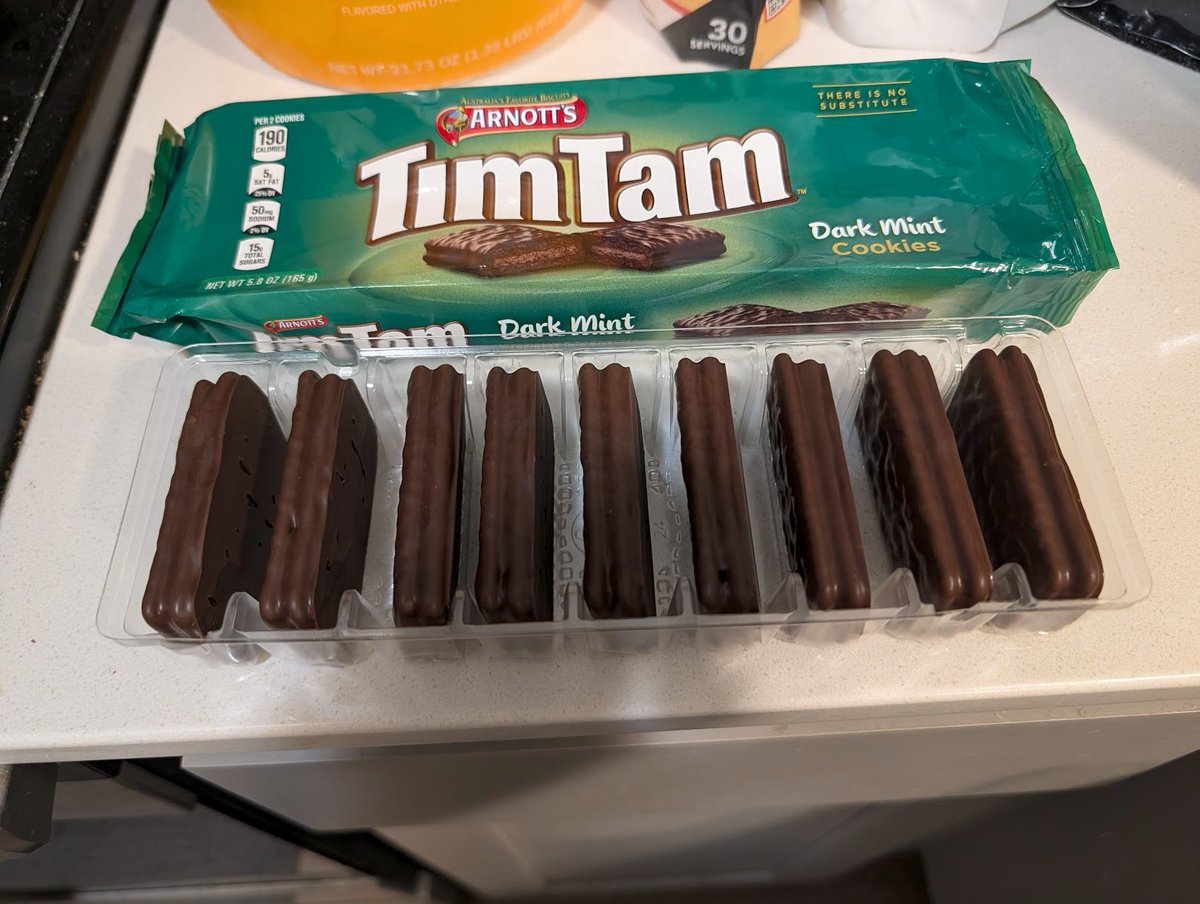
#shrinkflation is getting out of hand. They're putting airgaps between cookies now to make the package look bigger. Shame on you, @ArnottsBikkies .

English

@Math_files Even more influential in general was ALGOL, released the next year (almost all modern languages are ALGOL-like).
English

Before Python, Java, or even C++, there was Fortran—the first major programming language.
In 1957, John Backus and his team at IBM developed Fortran, making coding much easier than low-level machine code. Before Fortran, programmers had to write instructions in binary or assembly—slow and complicated.
Fortran changed everything. It allowed programmers to use simple, math-like commands, making it especially useful for scientists and engineers.
NASA even used Fortran to help land humans on the Moon.
Fortran set the stage for modern coding languages, and it’s still used today in scientific computing.

English

@FangYi11101 In practical terms, your example of summing 10 variables gives something normal-like, but it's not normal yet. The CLT depends on the number of variables summed, not the number of trials (the number of trials just affects noise levels, not the shape of the distribution).
English

@FangYi11101 That's not how the central limit theorem works either. He *is* summing the RVs, but he is summing only *two* of them. The convolution of two rect kernels is a triangular kernel (what we see here). The CLT says this becomes normal only as you sum a large (infinite) number of RVs.
English

A subtle point, but this isn’t how the central limit theorem works. You need to sum the random variables to approximate a normal, all he’s doing is getting a histogram of a triangular distribution.
Dudes Posting Their W’s@DudespostingWs
He rolled dice 10,000 times over 17+ hours and documented the results, an almost perfect normal distribution.
English

@LH @Weekesy_jw @DudespostingWs Finally someone in the comments who understand the convolution of two discrete uniforms ♥
English

@Weekesy_jw @DudespostingWs It's not normal, it's a triangular distribution.
English

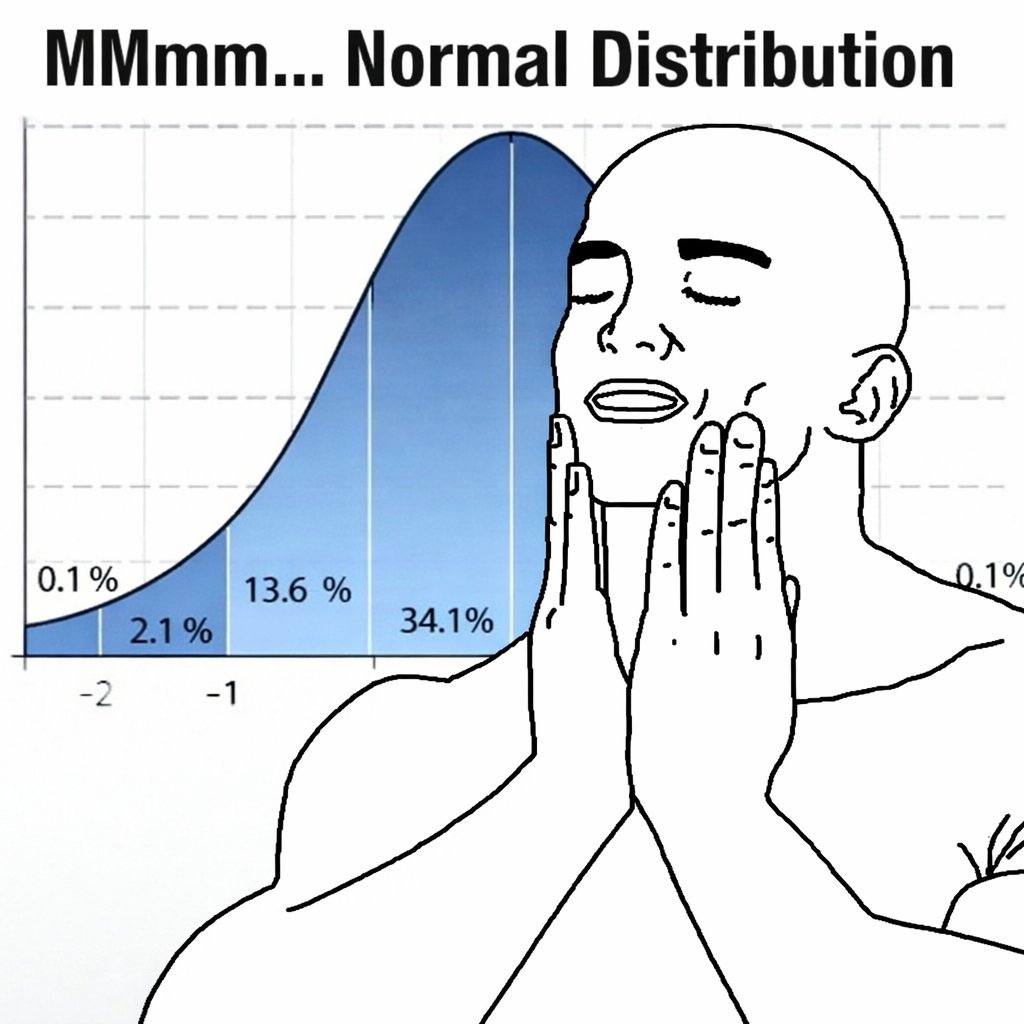
@HarryVincere @DudespostingWs In this case, it's not a normal distribution, it's a triangular distribution, because there are two dice with uniform probability on each number. The distribution would tend to normal only as you add more and more dice rolls together (the Central Limit Theorem).
English

I knew thats what would happen before I watched, before I read the caption.
Normal distribution is everywhere, including nature, it's a law we are bound by.
Also, this should inspire you to be away from the average and closer to the top.
There's only few who do, but the climb, it's worth it.
English