Madhouse Wallet
340 posts

Madhouse Wallet
@madhousewallet
We enable Gig Workers to Get Paid
United States of America Katılım Ağustos 2024
467 Takip Edilen94 Takipçiler

@BSCNews Sell pressure from miners is a supply-side signal, not a payments signal. Cross-border utility and settlement demand operate on a different layer.
English

BITCOIN MINERS ARE STILL DUMPING HUGE AMOUNTS OF $BTC
Per Lookonchain data, yesterday saw leading Bitcoin miner Riot dump another 500 $BTC, worth roughly $38.2 million.
This isolated event is just part of a wider trend which has seen the world's largest mining companies aggressively offloading $BTC, presumably to cover operating costs against a backdrop of poor price performance in 2026
English

@PingMe_xyz @onrampmoney Zero-fee acquisition is useful for growth, but sustainable payment flow depends on conversion efficiency into usable fiat across regions.
English

While straits are getting choked, payment flow on PingMe just got wider. 🌊
Fiat ramps are now live, powered by @onrampmoney.
Buy USDC on PingMe with your bank account now to enjoy 0% fees until 27 May.
Money moves freely here without borders or chokepoints on PingMe. ↴
English

XRP BECOMES FIRST ALTCOIN WITH INSTITUTIONAL SETTLEMENT TOOLS
@coinbase officially activated Trade at Settlement (TAS) for $XRP futures on May 1, putting $XRP on the same footing as Bitcoin, Ethereum, gold, and crude oil futures.
TAS lets institutions execute block orders at the 4 PM settlement price instead of live intraday markets, removing major friction for high-volume execution. A separate Coinbase market maker program also went live the same day to deepen $XRP order book liquidity.
The infrastructure is now built. The remaining question is whether the capital actually shows up.
English

VISA STABLECOIN SETTLEMENT HITS $7B ANNUALIZED RUN RATE
@Visa announced its global stablecoin settlement pilot has reached a $7 billion annualized run rate, up 50% quarter-over-quarter, while expanding to nine total blockchains.
Five new networks joined the pilot: @base, @0xPolygon, @CantonNetwork, Circle's Arc, and Stripe-backed Tempo. They now sit alongside Ethereum, Solana, Avalanche, and Stellar. Visa already operates 130+ stablecoin-linked card programs across 50+ countries.
Stablecoins are no longer "experimental rails" at Visa scale. They are operational settlement infrastructure, and traditional finance is rapidly building on top of them.
English

@BSCNews The key signal is classification: rewarding activity may be allowed, rewarding idle balances may not. That distinction shapes future payment product design.
English

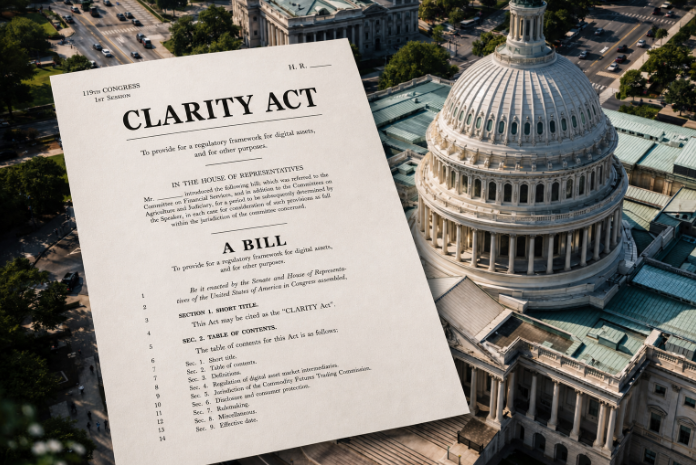
FINAL CLARITY ACT STABLECOIN YIELD TEXT IS PUBLIC, PASSIVE REWARDS BANNED, ACTIVITY-BASED REWARDS PROTECTED
The final stablecoin yield text in the CLARITY Act is now public, ending months of standoff between banks and the crypto industry, per Punchbowl News.
The compromise from Sens. Tillis (R) and Alsobrooks (D) bans rewards "economically or functionally equivalent" to deposit interest. Activity-based rewards tied to payments, transfers, and real platform usage stay protected. The structure closes affiliate workarounds by design.
Coinbase Chief Policy Officer Faryar Shirzad (@faryarshirzad) framed the outcome as a win on what mattered: "the ability for Americans to earn rewards, based on real usage of crypto platforms and networks." Banks got tighter restrictions on yield. Crypto kept the activity rails open.
The final text emerged from months of negotiation between the White House, Treasury, Senate Banking GOP, Tillis, and Alsobrooks. Senate Banking Committee markup is targeted for mid-May, lining up with Sen. Scott's "in the red zone" comments yesterday.
Remaining issues to resolve: DeFi provisions, ethics language for executive branch officials, and reconciliation with the House-passed version.
English

@Crypt0_DeFi More chains increase routing options, not payment completion. The real competition is who best converts stablecoin balances into reliable global settlement.
English

Visa is expanding its crypto settlement pilot, adding Polygon, Base, Canton Network, Arc, and Tempo to its stablecoin infrastructure. This brings the total supported blockchains to nine.
Launched in 2023, the program now processes about $7B in annualized settlement volume, up roughly 50% quarter-over-quarter, allowing partners to settle payments onchain instead of relying on traditional systems.
With stablecoin supply now exceeding $320B, this signals a stronger push by Visa into blockchain-based payments, competing closely with players like Mastercard.
Traditional finance is clearly leaning toward faster, cheaper, and borderless settlement systems as the stablecoin era grows.
Market participants across platforms like BingX are watching this shift closely.
#Stablecoins

English

@cngn_co Putting NGN onchain solves denomination. The harder problem is making cNGN reliably redeemable and usable across domestic and cross-border payment flows.
English

For a long time, going on-chain meant leaving your local currency behind. 🇳🇬
Not anymore.
cNGN is making the Naira fully usable on public blockchains. Startups and fintechs finally have the infrastructure to hold, move, and program Naira value directly.
From wallets to backend rails, we broke down exactly how your team can access and integrate it today.
Read the full guide here 👇
cngn.co/blog/how-start…
English

@coinbase Security and UX drive adoption, but scaling payments globally still depends on compliance ops, liquidity routing, and reliable local settlement.
English

@coinbureau Holding BTC as reserve optionality doesn’t replace the need for liquid currencies that can fund imports, debt service, and day-to-day settlements.
English

🇹🇼 TAIWAN WANTS TO PUT PART OF ITS $602B RESERVES INTO BITCOIN
A Taiwanese legislator has urged its government to explore putting part of its $602B foreign exchange reserves into Bitcoin.
He argues Taiwan holds 80% of its reserves in U.S. dollar assets, which creates risk if the dollar weakens or geopolitics get worse.
$BTC is then being pitched as an alternative that cannot be frozen, seized, or controlled by another country.


English

@coinbureau The compromise is really product classification. Rewards linked to activity may survive; rewards resembling bank deposits invite banking-style regulation.
English

🚨 COINBASE SAYS THE CLARITY ACT JUST GOT A STABLECOIN COMPROMISE
Senators have reportedly reached a compromise for crypto firms to offer stablecoin rewards.
Coinbase says the deal protects "Americans to earn rewards based on real usage of crypto platforms and networks."
However, it would ban rewards that basically work like interest on a bank deposit.
The text also directs regulators to disclosure requirements and a list of permissible reward activities.


English

@pete_rizzo_ Clarity matters because it reduces operating risk, not because “trillions arrive.” The real unlock is banks and enterprises being able to integrate confidently.
English

JUST IN: $60 BILLION COINBASE JUST SAID #BITCOIN AND CRYPTO CLARITY WILL PASS
“THIS WILL WORK OUT”
“AMERICA WILL LEAD”
TRILLIONS ARE COMING. LET’S GO 🚀
English

@TheBitcoinConf @paoloardoino @tether BTC holdings may strengthen optionality, but stablecoin trust is still earned through transparent reserves and dependable fiat settlement under stress.
English

@TheBitcoinConf Yield is where payments products become investment products. The compromise likely matters less politically than how risk, disclosures, and redemption are classified.
English

One problem most people don’t talk about in crypto payouts?
Fragmentation.
You want to cash out USDC… So you start hunting for local vendors, P2P groups, random rates, different apps, different trust levels.
You wait. You compare spreads. You hope the counterparty holds up.
And sometimes… the rails just don’t work when you need them.
This is the reality of “global money” today. You have stablecoins, but moving them into real-world currencies is still messy.
Madhouse Wallet changes that.
No vendors. No fragmented integrations. No guessing settlement paths.
USDC → 85+ fiat currencies → local bank, UPI, SEPA, mobile money (M-Pesa & more) All through a single API.
Escrow-based payouts. Transparent pricing. Built for scale.
That’s what stablecoin infrastructure should look like.

English

@MilkRoad Giving agents spend authority is easy; controlling liability, settlement timing, and auditability across USDT-funded flows is where the real system complexity sits.
English

Oobit just gave every AI agent its own corporate Visa card.
Each agent gets its own card, its own spend limits, its own merchant restrictions, enforced server-side at the transaction layer.
Here's what it looks like in practice:
Your agent renews a SaaS subscription at 3am...
It spins up cloud infrastructure mid-workflow...
It tops up an ad budget without waking anyone up...
Every charge generates a structured, human-readable audit log in the same dashboard your finance team already uses...
Cards are funded directly from your company's @Oobit $USDT treasury.
Meaning:
No FX fees.
No fiat on-ramp.
No banking delays.
McKinsey says 23% of organizations are already scaling agentic AI in production.
Another 39% are running active experiments.
Those agents are currently spending on shared cards built for humans, creating reconciliation nightmares finance teams can't solve.
Now they have a card of their own.

Milk Road@MilkRoad
Mike Dudas: AI agents can't run on 60-year-old rails. Full stop. "Agents aren't going to be able to transact on rails that were programmed 60 years ago." The way we buy stuff and the way we pay each other is about to look very different. FT @andyyy @therollupco @mdudas @6thManVentures
English