Christopher ODonnell

11.9K posts

Christopher ODonnell banner
Christopher ODonnell

Christopher ODonnell

@markitecht

Founder & CEO, https://t.co/5EBJdcmSuH. Led product @HubSpot for a decade. Co-founded Profitwell.

Winchester, Massachusetts Katılım Ekim 2007
2.6K Takip Edilen7.5K Takipçiler
Christopher ODonnell
Christopher ODonnell@markitecht·
@bhalligan Still we are not seeing the second or third best product in the category as the winner long term imho. The only infinite ceiling distribution channel is heavily positive word of mouth.
English
0
0
0
70
Brian Halligan
Brian Halligan@bhalligan·
Given how easy it is getting to build things, distribution and business models will be keys to victory. I just don’t see much creative ideas here and I don’t count changing the name professional services to forward deployed engineering. What amazing stuff is happening here?
English
52
6
189
21K
Christopher ODonnell
Christopher ODonnell@markitecht·
This is how we run Day AI, to a tee. Including the unsureness about titles in the future :) Humans in flatter org, MUCH greater emphasis on reviewing decisions and exercising taste. Every word of every customer interaction driving all work product from bug fixes to marketing content and beyond. All powered by … Day AI. You can’t fake living in the new world, you either do or you don’t. And yes, we just kicked off ye olde enterprise sales.
Brian Halligan@bhalligan

I had a chance to interview @jack on Long Strange Trip and then sit in on his Q&A with a bunch of Sequoia founders yesterday. Here's my take followed by my takeaways. Almost all of us are running a derivative of the playbook laid out in Andy Grove's "High Output Management" book that has been lightly edited down through the generations. Jack's set of ideas is a stark departure from that playbook. It reminds me of the shift I went through at the start of my career (pre web - yes, I'm that old!) to "digital transformation," but this is a much bigger, harder shift. Some of my CEO friends have pushed back on these ideas saying something to the effect that Jack isn't a great CEO so we shouldn't listen to him. First, I'm not sure if that is true, but even if it is true, he is an undeniable innovator and first principles thinker applying that thinking here to org design, not just product design. Second, @brian_armstrong, a consensus great CEO is running something that sounds VERY similar to this playbook as well as almost every startup created in the last 18 months. Third, the first quarter Jack printed after putting this in place was a banger. ...To that end, I think we should all call this new playbook, "Dorsey Mode" after the guy who stuck his neck out. If you want to run Dorsey Mode, a lot of things fall out of it that fall out of it: 1. Strategy - Planning cycles are out the window because the speed increases too much. All those 1 way doors you were procrastinating now look like 2 way doors. 2. Distribution - Given how much easier it is going to get to build products, competition and customer confusion will reign. In this new world, distribution is king. Companies with truly creative distribution strategies (rare!) will gain advantage. Also, long live ye olde enterprise sales. 3. Interviewing - All of the startups I work with have changed their interviewing process. Many have a case with a hard ai problem to solve embedded in it or at least have the prospective employee open their laptop and show them something interesting they built with ai. 4. Profile - There was a split in my group of CEOs at the Q&A -- some were learning hard into pilled jr engineers and some were leaning hard into very senior engineers. It roughly seems like the older companies with more code like Meta and HubSpot, are leaning harder into the very senior engineering types. ...Everyone seems keen to hire "curious" types not afraid to go very deep down rabbit holes. 5. Org shape - Triangle shaped org charts are like democracy, its the least bad system we've got. The biggest problem with triangles is that they get worse with size. The new org chart, in theory, is circular with the world model in the middle and very small teams surrounding it. Very few pure managers in the middle anymore. This seems "early," but directionally right to me. 6. Compensation - The difference between a middling employee and a top one is getting much wider which will necessitate a net new pay scale with a much higher standard deviation. 7. Titles - Jack got rid of them and is trying to focus everyone on the work as opposed to the level. As someone who tried this earlier in my career at HubSpot, I'm a little skeptical of this one, but the meta point of trying to focus people on what they "lead" versus who they "manage" is a good one that I hope sticks. 8 Decisions - Almost all decisions these days are made by carbon based life forms. Dorsey Mode turns an increasing amount of decisions over to the system. 9. IT - This is will totally change as their primary function will be to building the scaffolding for the world model and enable the company to keep feeding it the context and taste it will need to improve. EVERYTHING needs to be "legible" (I hate that I'm using that overused word, but it works) ...Btw, an early sign that a company is in Dorsey Mode is when they record every meeting, including the one on one's, cleverly stripping out some HR bits and centralizing them for use by the model. Btw, Ray Dalio had it right, but was just too early. 10. Slop - As more non-technical people build more things, there will be more slop. I didn't grok Jack's answer to this and I'm not sure the answer myself, but Dorsey Mode companies will need to figure out a system to reign in the badly designed systems. 11. Agency - This another word I cringe at using b/c it is so overused, but hiring folks with high agency that are self motivated will be key. The tricky part is that the beef with the current generation is that they are less like this than their predecessors. 12. CEO - This isn't something that will bubble up. The CEO needs to run hard at it and push it down hard and expect to get pushback from laggards. Jack spends 3 hours every morning building hard things with the new tools. ...AI isn't something that lends itself well to learning by reading or watching a video, so CEOs are running hackathons, show & tell's, building days, office hours, and token leader boards. ...Btw, lots of companies are doing the leader board thing (including mine) -- I think this works until it doesn't! 13. Budgets - Budgets in a lot of software orgs are basically enumerated in headcount. The denomination goes back to dollars. As Jack (and my cofounder @Dharmesh) likes to say, in some cases, it is a lot riskier not to take a risk and this is one of those cases.


English
0
0
6
1.1K
Christopher ODonnell
Christopher ODonnell@markitecht·
@MichLieben Swap Attio for Day AI (built for this kind of stack) and the whole thing accelerates 5x Happy to show you how and why
English
0
0
1
60
Christopher ODonnell
Christopher ODonnell@markitecht·
I've had every reason and every opportunity to build somewhere else. I stayed in Boston and in a few weeks I'm going to have to explain why. Live, in front of a room full of people who made the same call or are still deciding. On May 26, I'm recording a live BUILD617 episode at Boston Tech Week with a16z and JPMorgan. We're going to get into it: What Boston has actually produced in software that nobody gives it credit for What AI actually resets versus what it just automates What disappears from how revenue teams work when the software finally does what it's supposed to 3pm recording. Networking after. ~75 spots. Register in the comments. #BOSTechWeek #BUILD617 partiful.com/e/AjHV6ieg8Miz…?
English
0
0
2
202
Christopher ODonnell
Christopher ODonnell@markitecht·
This is what we built Day AI to be. Your agents are only as good as what you give them to draw from. Why not give them everything? Day.ai
English
0
0
1
139
Christopher ODonnell
Christopher ODonnell@markitecht·
Most companies deploying AI in 2026 are going to make their problems worse. Not because the models aren't good. They're extraordinary. Because of what they're giving them to work with. 🧵
English
9
3
4
585
Christopher ODonnell
Christopher ODonnell@markitecht·
The companies that build shared customer memory first aren't just ahead today. Every conversation makes the memory more complete. Every agent wakes up tomorrow acting on a better picture. Every new hire inherits everything from day one. The gap between those companies and the ones who figured this out has already opened. It widens every day.
English
0
0
1
52
Christopher ODonnell
Christopher ODonnell@markitecht·
That feeling every founder knows — am I actually showing up for the people who matter? Ten years ago you dug through your inbox. Called someone who might know something. Pieced it together. Now you just ask. And what comes back isn't a summary. It's the full picture. That's what this is in practice.
English
0
0
1
38
Christopher ODonnell
Christopher ODonnell@markitecht·
Customer memory is what changes this. Every email, every call, every Slack thread — automatically ingested, organized, ready. One shared foundation every agent draws from. It gets more complete the longer your team just does their jobs. The models are already capable. Give them real customer memory and they do things that seem impossible.
English
0
0
1
28
Christopher ODonnell
Christopher ODonnell@markitecht·
There isn't one. This is why CFOs are sitting on seven-figure AI budgets their engineering teams burned through and their go-to-market teams barely touched. Capable models. No shared customer memory to draw from. So they just... respond. They don't compound.
English
0
0
1
33
Christopher ODonnell
Christopher ODonnell@markitecht·
Think about what happens when you deploy an agent for engineering. You point it at the codebase. One foundation. Every agent draws from the same place. Every commit makes it more complete. It works because the shared customer thing exists. Now ask yourself: what's the shared customer memory for every team that touches a customer?
English
0
0
1
29
Christopher ODonnell
Christopher ODonnell@markitecht·
This isn't a people problem. Everyone's doing exactly what you'd want — figuring out AI, moving fast, not waiting around. The problem is what they're drawing from. There's no shared customer memory. There has never been a shared customer memory. And every agent you add makes that problem faster and bigger.
English
0
0
1
45
Christopher ODonnell
Christopher ODonnell@markitecht·
Every team has their own agent setup. Their own context. Their own understanding of your customers. Sales has theirs. CS has theirs. Marketing has theirs. All of them talking to your customers, taking actions on behalf of your company, from completely different pictures of the same relationships. Sometimes the same customer.
English
0
0
1
42
Christopher ODonnell
Christopher ODonnell@markitecht·
Yesterday was World Quantum Day, but only if you checked
English
2
2
11
3.5K
Christopher ODonnell retweetledi
Bessemer
Bessemer@BessemerVP·
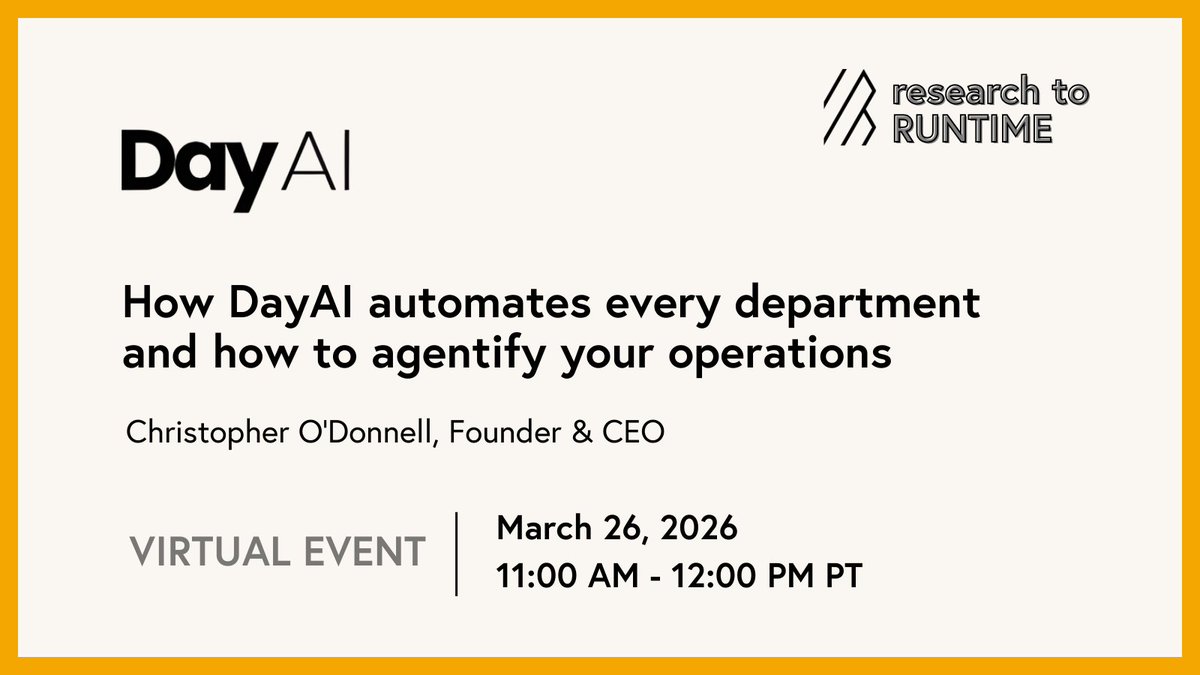
RSVP for the next session of Research to Runtime with @Day_ai_app Founder and CEO, @markitecht, who has built one of the most ambitious AI-native operating systems. On March 26, Christopher will unpack the specific workflows, agent architectures, and integration patterns the Day AI team uses to run agents internally across departments. Reserve your spot 👉 bessemervp.team/4sEQXoO
Bessemer tweet media
English
0
1
4
774
Ethan Mollick
Ethan Mollick@emollick·
Amazing to see the two worst forms of AI posting in a QT. The original post misinterprets a highly-discussed paper from 2025 and calls it breaking news. Than that is retweeted by someone else giving even more wrong info (from model performance to benchmark names). 1M views. Bleh
Ethan Mollick tweet mediaEthan Mollick tweet media
English
21
14
183
44.8K