

Marshall Hawks
383 posts
Marshall Hawks
@marshallhawks
Author | Investor | prev-SVB and 20+ year venture lender. Lift oddly shaped heavy objects for fun.
San Francisco Katılım Ekim 2009
752 Takip Edilen255 Takipçiler
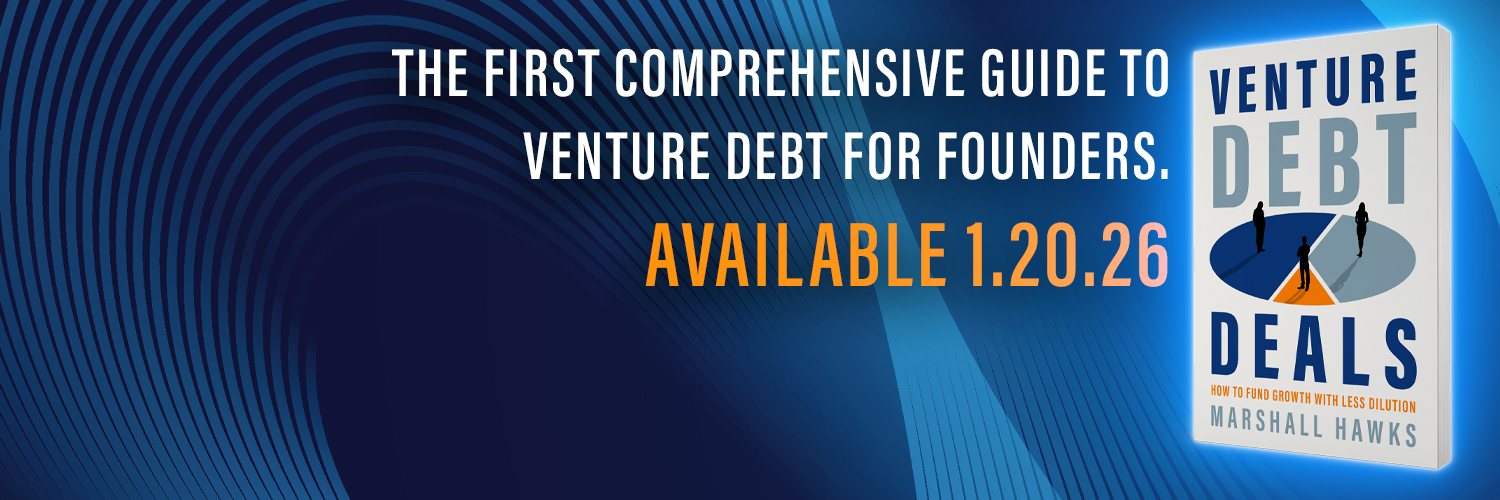
Excited to do a fireside chat and Q&A with Brad on venture lending and my book Venture Debt Deals.
Come join us!
Techstars@Techstars
Navigating the world of venture debt can feel like a balancing act between fueling growth and protecting your equity. This is your chance to get practical advice directly from the experts. Join us for a conversation with Marshall Hawks, author of Venture Debt Deals, and Brad Feld, partner at Foundry, co-founder of Techstars, and author of Startup Communities: Building an Entrepreneurial Ecosystem in Your City. 📆 April 29th at 4pm ET 🔗 tsta.rs/7TgB50YMJLO We’ll dive straight into a fireside chat followed by a Q&A session where you can ask your specific questions about debt structures, timing, and strategy.
English
Marshall Hawks retweetledi

Only one chance in this lifetime…
Like watching sunset at the beach from the most foreign seat in the cosmos, I couldn’t resist a cell phone video of Earthset. You can hear the shutter on the Nikon as @Astro_Christina is hammering away on 3-shot brackets and capturing those exceptional Earthset photos through the 400mm lens. @AstroVicGlover was in window 3 watching with @Astro_Jeremy next to him.
I could barely see the Moon through the docking hatch window but the iPhone was the perfect size to catch the view…this is uncropped, uncut with 8x zoom which is quite comparable to the view of the human eye. Enjoy.
English
Likely my first, best and only Canadian podcast as part of my book tour for Venture Debt Deals. Really fun conversation on Tank Talks with @mattybcohen from @ripple_ventures this week.
Matt Cohen@mattybcohen
Ask ten founders to explain venture debt and you'll get ten different answers. Most of them wrong. New Tank Talks: @marshallhawks spent 16 years at SVB structuring deals for Airbnb, Twitch, and Fitbit. Then watched the third-largest bank failure in US history from the inside. We unpacked what founders actually get wrong about venture debt in 2026, from confusing venture banking with private credit, to obsessing over terms when the lending partner matters more. The market hit $62B in volume with more players than ever. Worth your time if you're thinking about your capital stack. 🎙️ Link below
English

Ask ten founders to explain venture debt and you'll get ten different answers. Most of them wrong.
New Tank Talks: @marshallhawks spent 16 years at SVB structuring deals for Airbnb, Twitch, and Fitbit. Then watched the third-largest bank failure in US history from the inside.
We unpacked what founders actually get wrong about venture debt in 2026, from confusing venture banking with private credit, to obsessing over terms when the lending partner matters more.
The market hit $62B in volume with more players than ever. Worth your time if you're thinking about your capital stack.
🎙️ Link below
English

We raised $72M from Sequoia/YC and hit 8-figures in ARR. Then we shut it all down & rebuilt the company from scratch.
Today we’re launching the new Mutiny: the first AI agent for GTM teams to create anything customer-facing, in minutes.
Comment "Mutiny" to get 3X free credits.
English
Marshall Hawks retweetledi

Earthset.
The Artemis II crew captured this view of an Earthset on April 6, 2026, as they flew around the Moon. The image is reminiscent of the iconic Earthrise image taken by astronaut Bill Anders 58 years earlier as the Apollo 8 crew flew around the Moon.

English
Yep. Amazing how consistently we saw this with portfolio companies at SVB. Money truly does burn a hole in your pocket.
anamitra@anamitra
The universal Law of Runway: irrespective of whether a company raises $1M, $10M, $100M or $100B, they’ll will have a runway of just 18 months.
English
This would be a great addition to downtown SF even if it creates a traffic cluster F of construction traffic by my gym for 15-20 years.
SFist@SFist
A proposed development so massive that Caltrain and developer Prologis seem afraid to show people, just yet, how big the buildings would be, gets a few more renderings this week, as the transit agency submits its application for the long-discussed Railyards project. buff.ly/axzeVTL
English
Another fun conversation about venture debt with Kate Adams @BurklandAssoc. I was fortunate enough to work with Jeff Burkland back when he was a one man shop. Exciting to see how big the firm has become.
Burkland@BurklandAssoc
Startup founders: Curious how #VentureDebt works and whether it belongs in your capital strategy? Tune in to today's #StartupSuccess podcast with Marshall Hawks @marshallhawks, author of "Venture Debt Deals" and a venture lending leader w/ two decades of helping founders fund growth — including 16 years at SVB. Marshall breaks down what venture debt really is and how founders can use it to extend runway while minimizing dilution. 🎧 Listen on Apple or wherever you get your podcasts. podcasts.apple.com/us/podcast/ven…
English
Enjoyed my conversation with @cjgustafson on Run The Numbers. Only thing I’d change, if I could, is the shine coming off my bald head!
CJ Gustafson@cjgustafson
Most founders assume venture debt gets repaid the same way traditional bank loans do. It doesn’t. Venture lender Marshall Hawks explains the three real sources of repayment lenders rely on when financing startups — and why the next equity round is often the most important one. Drawing on decades of experience working with companies like Airbnb, Cloudflare, Okta, and Twitch, this conversation unpacks how venture lenders actually think about risk, repayment, and startup capital structure. Watch the full episode: youtu.be/JAkobXpiTNY #venturedebt #startupfunding #venturecapital #startups #cfostrategy
English
Marshall Hawks retweetledi


Marshall Hawks retweetledi
Johnny and Meredith Gaudreau's children and Dad's sweater.
Good Lord, I'm a puddle.

English
I spent the better part of a week last November in a recording booth, narrating the audiobook version of Venture Debt Deals.
There is no better way to check your ego than to read a book you wrote, out loud. Correctly pronouncing words like "amortization" and "contingency funding clause" across multiple chapters required more than a few takes. Finding the occasional typo (now fixed) while reading when you thought the book was "done", is an exercise in anger management. Holding consistent energy levels and tone across the whole of the book gave me an appreciation for the skill voice actors or narrators bring everyday.
If you'd like to marvel at my ability to read multi-syllabic words and several complete sentences in a row, the audiobook version of Venture Debt Deals is now available for preorder, on Audible and Amazon.
amzn.to/4pr75bJ
tinyurl.com/5n7cx54r

English
I talk about this Wait But Why post/graphic a lot. Good reminder for life.
Tim Urban@waitbutwhy
It’s that day when I make you all look at this
English
Good thread from @cjgustafson with data and frameworks that come from my new book, Venture Debt Deals. If you don’t get his email newsletter and your work in tech finance, sign up. His podcast is also great. I’ll be on it in 2026!
CJ Gustafson@cjgustafson
SVB collapsed. I thought venture debt was dead. 3 years later, it's more than DOUBLED to $58B in deal volume. But most founders still don't understand the 3 fees that actually drive lender economics: 🧵
English
Marshall Hawks retweetledi

Sure thing. You asked for a post explaining the nuance so here you go! I'm sorry for the length; you'll see that at the end it all ties back to funding health insurance for your constituents…
As you know, companies can be private or public. Holders of public company stock can trade in liquid, public markets after the lock-up period expires.
Let's ONLY focus on startups that are private because this is an absolutely critical policy point. It's very easy to accidentally kill the goose (Silicon Valley) that lays the golden eggs (startups that get big and create tax revenue for California).
From your reply, I think you are assuming that the situation where a private company founder has "truly illiquid" stock is an exception. This is not the case.
Example: a private company raises a new round at a multi-billion dollar valuation! Everyone is excited! This thing might actually work!
Some shareholders like the founders (and potentially early employees) might now need to pay the wealth tax, but they can’t pay a tax in company stock. Assuming a typical situation where the founder’s net worth is entirely tied to their company, they will need to sell more than the $$ amount levied by the wealth tax because they need to first pay capital gains. In other words, they face a double tax event.
Now let's fast forward a single year. Unfortunately things haven’t gone according to plan (either due to macro events or other factors) and the company can’t raise an up-round or even execute a tender offer at the same valuation again. There isn't any secondary demand at the last round price; there are simply no buyers.
Now the founders need to pay the 1-2% wealth tax again. But all their “wealth” is “paper money” from the company stock they hold at the last valuation.
What can they do? Three options come to mind. LMK if I’m missing something.
(1) Since the founders can’t sell stock at the last round valuation, they could reduce the valuation of the company through a down round. This risks key team members leaving. It also might be harder to recruit new key talent. And this is assuming there's an investor willing to do a down round, which is not always the case. This is also ethically complicated… if the founders choose this option purely due to a personal tax situation, they might be prioritizing their needs above the needs of their team.
(2) The founders could take out a big loan to pay a tax bill that might not even be accurate. This is very risky. Even if the company executes perfectly, the macro environment might falter and the founders might never be able to repay the loan. The founders are potentially risking personal bankruptcy.
(3) If it's a California wealth tax... then the founders could just leave California.
This is not a contrived situation. Most startups don't work out. Almost all private startups have ups and downs... even in the “growth” stage with "billions" in market cap. And the oscillations of these ups and downs are happening faster and faster these days for many private companies.
The best startup founders plan ahead and feel responsibility for their employees. If they think staying in California is a risk to their business, their employees, their families... then they will simply leave for somewhere else.
Silicon Valley startups (ironically) follow the herd. Once enough respected companies / founders establish a pattern, other startups will follow, even if the wealth tax does not apply to them yet. (Every startup founder believes their company will be the next big thing.)
So, in summary, if there's a California wealth tax that applies to the founders of private companies:
1. There are many situations where the founders of private companies will not be able to pay it and will be forced to consider leaving California.
2. Smart founders thinking ahead will mitigate this risk by leaving California before the situation applies.
3. The herd will follow the best and brightest founders / companies.
4. California will lose the next generation of big, important, job / tax generating companies.
5. This will lead to less tax revenue, less state healthcare funding, less education funding, etc.
I hope this post helped explain why it's a bad idea to try and implement a California based wealth tax that targets the unrealized gains of private company stock. This is just ONE aspect of why a California wealth tax is bad policy. Happy to discuss further…
English