Marsu

926 posts

Marsu banner
Marsu

Marsu

@marsuplamy

Always forward 🧭 Research, think, apply. / × Web3 /Crypto × Someone who sincerely embraces the values of peace and friendship. No ego, no arrogance, no deceit.

Türkiye Katılım Kasım 2018
355 Takip Edilen1K Takipçiler
Marsu
Marsu@marsuplamy·
Shelby is shutting down the testnet environment on August 3rd, Monday at noon. The early access period that started in March has done its job, and the protocol is now moving into a private production environment. I wanted to share this since I have been following the process closely. Once testnet shuts down, the explorer page will turn into a static graduation page. The @shelbyserves development network will stay online though. The team says months of developer feedback and stress testing got them to this point. There is an open application window for anyone building on testnet. You need to submit your project through developers.shelby.xyz between July 29th and August 3rd. Selected projects will hear back by August 13th, with perks like free usage and direct support from the team. If you have a project built on Shelby, now is the time to apply since the window is limited. I included something I have been working on in this process as well.
Shelby@shelbyserves

In March, we opened Early Access to see what builders would do with Shelby's testnet. You stress-tested it into shape. That was the job, and the job is done. The testnet goes offline on Monday, August 3. What it proved goes live in private production, hardened with customers we onboard directly. The testnet proved the tech. Private production puts it to work. Then we open it up. Full rundown in Discord.

English

0
0
5
112
AllScale
AllScale@allscaleio·
AllScale Creator Arena R3: @telegram Store Spotlight R2 gave us more good entries than we had spots. Good problem. R3 is live, and this round is all about the AllScale TG Store. One focus, more visibility, and 15 spots to claim the Creation Master role in our Discord. 🗓 Timeline Submit: July 8, 20:00 – July 24, 20:00 (UTC+8) Evaluate: July 24, 20:00 – July 31, 20:00 (UTC+8) 📝 How to enter 1. Follow @allscaleio 2. Create in any format: short post, article, video, GIF, any language 3. Post on X, tag @allscaleio, add #AllScale 4. Join our Discord and drop your post link in【🎨】creator-arena-r3-submit 🏆 15 winners, picked by the AllScale team and MODs. Multiple entries allowed. Each work counts separately.
GIF
English
882
722
874
19K
Marsu
Marsu@marsuplamy·
gStar guys @StartaleApp now sends push notifications and while that might seem like a small detail it is actually an important step in making the superapp vision real. It reminds you to claim your rewards, tells you not to break your streak, and delivers updates from your favorite Mini Apps. You can personalize which notifications you receive directly from within the app, picking exactly which Mini Apps you want to hear from. Most Web3 apps get you in once and leave the rest to you. Startale App is flipping that. Daily GM reminders, mission notifications, streak alerts, these are small but effective touches that bring you back to the app. Very few projects in this space have managed to integrate Web2 retention mechanics into an onchain application this naturally.
Startale App@StartaleApp

Never miss an update from your favorite Mini Apps. Personalize your notifications by tapping the bell 🔔

English
1
1
16
154
Marsu
Marsu@marsuplamy·
I read @a16zcrypto's 2026 crypto trends piece and one paragraph stuck with me. It says 'privacy will be the most important moat in crypto this year' and reading that, @SeismicSys immediately came to mind. The observation from a16z is this: almost none of the chains that exist today have privacy built in, and that gap has now turned into a real differentiation opportunity. Competing on performance is no longer enough because blockspace has become fundamentally the same everywhere. But a chain with privacy creates a much stronger network effect. They explain it like this: when everything is public, moving from one chain to another is trivial, bridging protocols make it happen in a few clicks. But once things are private, that's no longer true. Bridging tokens is easy, bridging secrets is hard. When you move out of a private chain onto a public one, metadata like transaction timing and size correlations leaks out and makes you trackable. So once you're on a private chain, you don't want to leave, and that creates a winner-take-most dynamic. Seismic is built exactly on this thesis. It doesn't add privacy as an afterthought, it's baked into the protocol from the very beginning. There are currently 12 fintech partners building on top of it and none of them can easily move to another chain because migrating customer data, transaction history, and yield data is a far more complex undertaking. The lock-in effect a16z describes is exactly what's happening here.
Marsu tweet media
English
0
0
7
67
Marsu
Marsu@marsuplamy·
Looking at @FlutonIO's shielding mechanic, what really stood out to me is how simple the core idea actually is. You deposit your asset publicly, then it converts directly into an encrypted state and moves into your wallet as an encrypted transfer. There's no pooling with other people's funds to lose your trail in a crowd, your asset just moves into an encrypted form and that form stays with you. I think this detail matters because with mixer style solutions privacy basically depends on trusting the crowd, the more people join the same pool the better the anonymity is supposed to be. Fluton doesn't carry that dependency, your level of privacy isn't tied to how many other people show up. During unshielding, the reverse process, only the necessary settlement data gets revealed while the rest stays hidden. This approach also sets up a solid foundation for cross chain use, because a shielded asset can carry the same privacy guarantee even when it moves to a different chain. So privacy stops being a feature tied to a single chain and becomes something attached to the asset itself, and that's really at the heart of what positions Fluton as an execution layer rather than just another app.
Marsu tweet media
English
1
0
22
160
Marsu
Marsu@marsuplamy·
July Missions on @StartaleApp are coming to an end and there are 6 days left. 80 STAR Points are up for grabs and the window closes on July 25. The active missions are: buy at least $10 of USDSC, deposit at least $10 into the Earn Vault, provide at least $10 of liquidity to the USDSC/USDC pool, and deposit at least $10 USDC. Each mission rewards points individually and completing all of them gets you the full 80 points. One thing to keep in mind: the Earn Vault and liquidity missions require you to keep your positions open for more than 7 days before they are counted. That means if you do not start those two today or tomorrow you will not be able to complete them before the window closes. The other missions can be done faster but timing matters here. No invite code, no waitlist. Just sign up and start. app.startale.com/sign-up?code=T…
Startale App@StartaleApp

⏰ 6 days left to Go Big this July. Don’t miss out on 80 STAR points!

English
0
1
20
246
Marsu
Marsu@marsuplamy·
An article I read 2 days ago genuinely helped a lot of pieces click into place for me. Kent Lin's piece mentions something striking, someone at a firm managing tens of billions told him they now watch Hyperliquid more than Bloomberg. Say that sentence a year ago and you'd have gotten laughed out of the room, but now it's just reality. A Trump tweet moved oil prices on a Saturday, SpaceX's IPO printed billions in pre-market DEX volume, Intel's earnings crossed the wire a minute after the closing bell had already sent everyone home, and every one of those moves got priced onchain first because onchain was the only venue still open. Price discovery has quietly relocated, and the people running the largest pools of capital on earth have noticed. This is where @get_optimum position actually becomes really relevant to me. There's a detail in the article where Kent Lin mentions hosting an event with Optimum's own institutional partners during ETHConf in NYC, and he says these institutions are genuinely onchain now. So this isn't just theory, Optimum's own client base is already right in the middle of this shift. Institutions don't want to be locked into normal trading hours, 24/7 access is a huge unlock for them, and that's exactly why DEXs like Hyperliquid are becoming their new destination of choice. Another important point the article raises is the trend of vertical integration. Node operators getting acquired by larger players, names like Galaxy, Bitwise, Bitmine, Coinbase, and Kraken all building out their own node operator arms, really shows that big institutions want to own as much of the Ethereum stack as possible, from custody to staking to the validator layer itself. Optimum's position here is interesting because they already work with a large number of validators and sit right in the middle of this consolidation trend. But I think the most critical part of the article is this, institutions value decentralization because what they actually want is a trustless environment, one without a single point of control, where transactions can't be manipulated. The problem is that scaling while preserving that decentralization is genuinely hard, and trillions of dollars in assets are still sitting behind a throughput ceiling, settling T+2 in a world that demands T+0. This is exactly the problem Optimum is trying to solve, because mump2p's RLNC based architecture aims to increase propagation speed and therefore throughput capacity without sacrificing the network's decentralization. After reading this piece it became much clearer to me that the latency problem Optimum is solving isn't just about boosting validator APR, in the bigger picture it's about providing the infrastructure scale required for institutional capital to actually move onchain. If New Wall Street is really being built onchain, the technical bottlenecks that projects like Optimum are solving are going to be genuinely decisive in whether this new system can grow without centralizing in the process.
Marsu tweet media
English
0
0
16
117
Marsu
Marsu@marsuplamy·
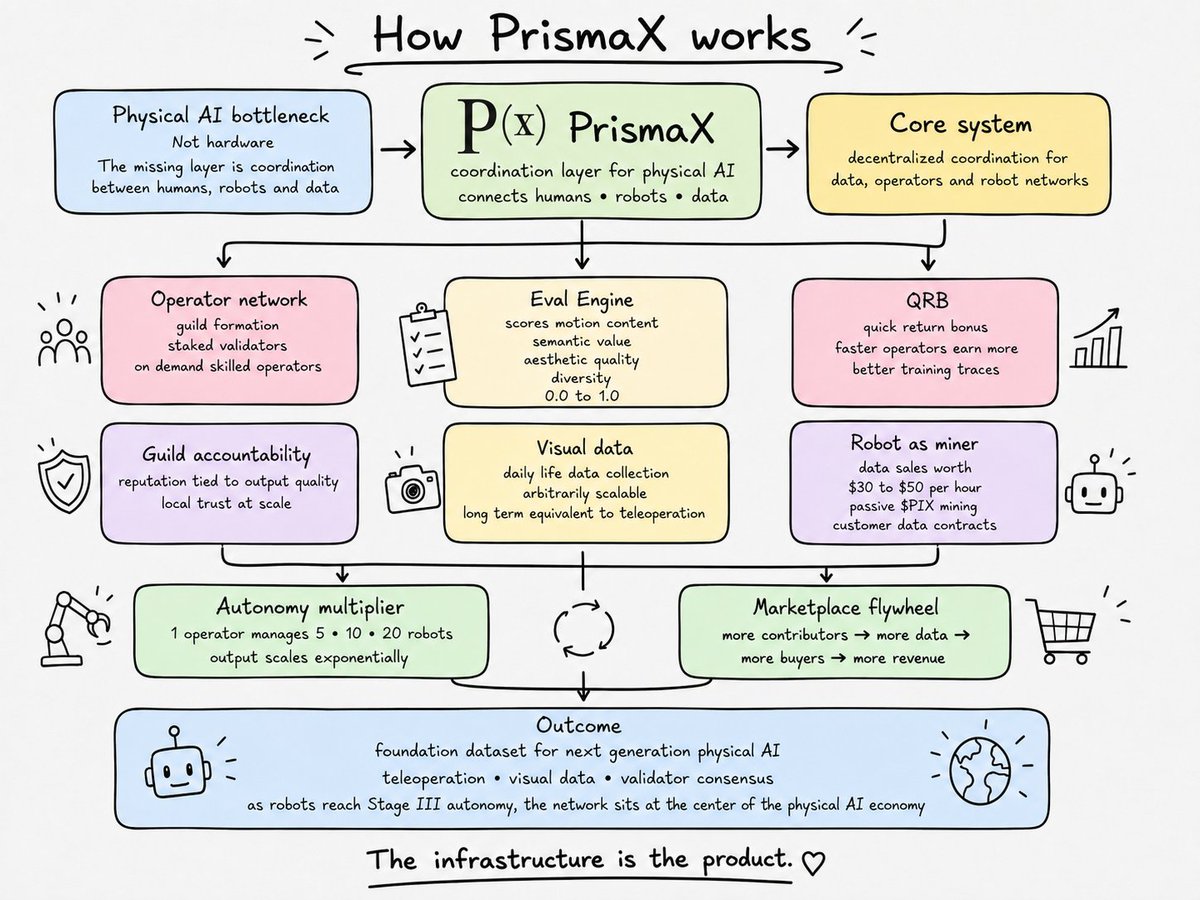
Everyone is building robots. Almost nobody is solving the actual problem. The real bottleneck in physical AI has never been hardware. Manipulators and actuators have been available from dozens of vendors since 2010 and the technology has been ready for years. What has been missing is the infrastructure layer that connects the humans, the robots and the data into a single self-sustaining system. Most companies attacking this problem are doing it the expensive way, building first party fleets, hiring dedicated operators, collecting proprietary data and burning capital before they have shipped a single useful product. @PrismaXai is building the coordination layer that makes all of that unnecessary. Here is what actually sets it apart: • The decentralized operator network replaces centralized fleet management with guild formation and staked validators, allowing any robotics company in the world to tap into skilled operators on demand without building any of that infrastructure themselves. • The Eval Engine automatically scores every data submission on motion content, semantic value, aesthetic quality and diversity, producing a score between 0.0 and 1.0 with no human validators needed, which means the quality layer scales horizontally without bottlenecks. • The QRB [quick return bonus] multiplies operator payouts based on speed because the fastest operators produce the most valuable training traces, aligning individual incentive and data quality in a single mechanism. • Guild formation creates local accountability structures where operator reputation and earnings are tied to collective output quality, building trust at the scale that centralized platforms cannot replicate. • Visual data collected by community members in their daily lives is the only arbitrarily scalable data modality because it is not limited by robot fleet size, operator availability or session cost, and on a long enough time horizon it is functionally equivalent to teleoperation data for training purposes. • The robot as miner model makes every connected robot productive from day one through data sales worth $30 to $50 per hour, passive $PIX token mining and optional customer data contracts, with multiple revenue streams running simultaneously. • The autonomy multiplier means that as foundation models mature, one operator will manage five, ten, twenty robots at once, making the data output per human in the network scale exponentially rather than linearly. • The data marketplace flywheel gets more valuable with every new participant because network-owned data revenue redistributes back to originators, attracting more contributors, which grows the dataset, which attracts more buyers, which generates more revenue for everyone. PrismaX is not waiting for the robotics industry to catch up. The dataset being built right now across teleoperation sessions, visual data collection and human validator consensus will be the foundation that next generation physical AI models train on. When robots reach the autonomy levels that Stage III describes, the network that built that dataset will sit at the center of the entire physical AI economy. The infrastructure being laid today is not a side product of the farming activity happening on the platform. It is the product. And the people participating right now are the ones helping build it.
Marsu tweet media
English
1
0
13
125
Marsu
Marsu@marsuplamy·
In crypto when a project says 'decentralized' the only question I need to ask now is this: where is the human in this system? Because every smart contract waits to be called, every oracle network stays limited to fetching data, every critical decision falls to a committee or a private key holder. This bottleneck became so normalized that nobody questions it anymore. A protocol that requires a human is not decentralized, it is just a centralized system with onchain settlement. @fermah_xyz is one of the rare projects that takes this question seriously and it answers it with two live products. Looking at the Froben side you see this: a universal ZK proof marketplace supporting every proof system including zkVM, zkEVM, and Groth16, with ZKSync Era and Abstract Chain actively using it as paying customers, over 2.8 million proofs delivered at a 99.7 percent reliability rate with zero human intervention. These numbers are not a testnet target, they are the real numbers of a system running on mainnet. A proof request comes in, the Matchmaker finds the most suitable Operator node, the computation completes, and the result is returned directly to the callback URL. Without asking anyone. On the Flashcast Social side you see the same logic applied to a completely different use case. A user posts any question as a tweet and within 3 seconds it becomes a live prediction market. The moment the condition is met the market resolves onchain instantly, no 48 hour dispute window, no committee, no human. Over 1 million markets have been created so far and not a single one required human intervention. This is not just a good product, it is an answer to what prediction markets are supposed to be. Two products, one infrastructure, one logic. Fermah is building and running its own products with its own tools and that difference shows how seriously a project takes its own technical claims. The things that say 'coming soon' on other roadmaps are running in production here.
Marsu tweet media
English
0
0
12
126
Marsu
Marsu@marsuplamy·
In most crypto projects, community is just a marketing term. There are thousands of people in Discord but most of them are just waiting for an airdrop, nobody is actually building anything. What I've seen with Rialo is different, and I'm saying this because I've been following it closely. Builder Hubs are the clearest sign of this difference. Every week hundreds of people show up on screen and present real projects. Onyx, Chronos, Rialo Guard, all of these were built by community members. Nobody told them to build these things, they saw the opportunity and started. And the team is there during these presentations, answering questions without dodging. Playground and learn.rialo.io feed the technical side of this growth. When a developer wants to try something on @RialoHQ they have both interactive demos and step by step documentation in front of them. The entry threshold is very low. Sign in with email and try it. That simplicity pulls people in, and people who come in and learn something naturally want to build something. One more thing I notice as the community grows. People are bringing each other into Discord, asking each other questions, and people from different countries are talking about the same project. This is organic growth and it's happening without a token, without price speculation. It's worth saying that this is rare.
Marsu tweet media
English
1
0
27
144
Marsu
Marsu@marsuplamy·
450+ business integrations in the pipeline and 50+ confirmed launch partners. These are not numbers still in negotiation, they are numbers already locked in. @utexocom is entering launch after more than eight years of development with these figures, bringing the infrastructure, the partners and the momentum to the table at the same time for native USDT on Bitcoin. Tether Wallet integration is ready, exchanges are ready, the mint bridge is live. RGB protocol v0.11.1 is active on Bitcoin mainnet. When they say it starts next week that is not an empty statement, every piece is in place. 450 integrations did not happen overnight, there are years of building behind that number and now the doors are opening.
Utexo@utexocom

450+ business integrations in the pipeline 50+ confirmed launch partners next week we start dancing USDT on Bitcoin

English
0
0
12
172
Marsu
Marsu@marsuplamy·
Via is a stablecoin-first finance platform for global businesses. It delivers borderless access to capital, seamless global payments, and high yield without getting stuck in the constraints of traditional banking. It operates with authorization in over 150 countries, no minimum balance requirement, no setup fee, no hidden costs. Looking at the technical side, Via is built on three core features. First, powerful business accounts. It provides US and EUR IBANs along with virtual routing numbers, meaning companies can instantly access the world's most powerful currencies through a single platform. Second, stablecoin-first payments. It processes fast and cost-efficient payments over blockchain rails, moving completely away from the slowness of traditional banking infrastructure. Third, credit lines. It offers non-dilutive credit lines backed by treasury assets. On top of all this, there is a treasury yield system that compounds daily at 5% APY and above, with funds never leaving the user's custody. On the @SeismicSys side, Via tapped Seismic to power virtual accounts, yield, and local rails. For global businesses operating in over 150 countries, having financial data sitting openly on a public chain is simply not acceptable. Which country received how much payment, treasury size, credit usage history, yield amounts, all of this is extremely sensitive corporate data. Seismic keeps this data encrypted at the protocol level and ensures the financial privacy of Via's corporate clients. Via is currently in waitlist phase and hasn't fully launched yet. But having secured authorization in over 150 countries and being part of the Seismic ecosystem shows how serious the infrastructure behind this project really is.
Marsu tweet media
English
1
0
21
166
Marsu
Marsu@marsuplamy·
My perspective on this really changed once I realized that every single slot on Ethereum passes under an invisible time pressure. The network has a hard 4 second deadline and validators need to broadcast attestations within that window, which creates constant uncertainty for both block proposers and builders. As @get_optimum's CPO Sesh Dwari explained in a presentation, this uncertainty pushes network participants into hedging strategies, builders submit bids earlier than optimal to reduce risk, the same bids get sent to multiple relays which unnecessarily increases network traffic, and even more interesting is that actors start clustering in specific geographic regions like the Atlantic corridor to capture lower latency, creating a serious risk that leads to network centralization. Optimum's published economic research makes it very clear just how large this invisible cost actually is. A latency improvement of just 50 to 150 milliseconds alone leads to roughly 0.66 to 1.97 percent higher validator APR. The biggest driver behind this is MEV bid selection, because the longer a validator can afford to wait, the more bids it can observe from builders and the higher value block it can select. Tests run against real MEV relay data showed this additional time producing an average bid value uplift of roughly 13 to 16 percent, adding up to about 150 to 190 ETH in extra value over a single week. There's a similar story on the consensus side. Network wide head vote accuracy currently sits around 98.6 percent, and a 50 to 150 millisecond improvement can push it up to somewhere between 98.8 and 99.1 percent, translating into roughly 1000 to 2000 ETH in additional annual network revenue. Since the theoretical maximum is already capped around 99.4 percent, latency improvements alone can close more than half the gap between current performance and that ceiling. Optimum's answer to all this is the mump2p protocol, built on RLNC based coded gossip. The target Sesh Dwari outlined in his presentation is reducing latency by 60 percent and cutting variance by a factor of 7, which adds up to roughly 60 million dollars in annual validator APR revenue potential across the network. What this tells me is that this invisible time pressure on Ethereum isn't just a technical footnote, it's a real problem causing actual financial loss and network centralization, and mump2p is aiming to reduce that uncertainty to build a network that's both fairer and more efficient.
Marsu tweet media
English
2
0
22
180
Marsu
Marsu@marsuplamy·
What struck me most about @FlutonIO was how it approaches privacy, because usually we get pushed toward either mixers or a fully isolated chain. Fluton does neither, it positions itself as a confidential execution layer that deploys on top of existing chains. That means you can swap you can bridge you can send payments or keep running your yield strategy without ever migrating anywhere new, and throughout all of it your balance your strategy and your intent stay hidden. The core mechanism that makes this possible is shielding. You deposit your assets publicly, then this converts into an encrypted state and moves into your wallet as an encrypted transfer. There's no pool mixing involved, it's a direct conversion into an encrypted form. With unshielding, the reverse process, only the necessary settlement data gets revealed while everything else stays private. The cERC20 side solves a problem many of us have run into in real life. With payments made through a normal ERC20 anyone can see exactly who received what, and this creates both privacy issues among employees and wallet profiling risks. cERC20 hides these values using encrypted handles, so once you wrap your token one to one the transferred amount stops being visible to anyone. The same logic carries through to payments, where sender recipient amount timing and routing all get executed as encrypted intents, with selective disclosure still available whenever compliance actually requires it.
Marsu tweet media
English
0
0
14
124
Marsu
Marsu@marsuplamy·
Startale App now lets you fund your wallet instantly through Transak. You can top up directly with a credit card using USD, EUR, and more, or bring crypto from any wallet and let Auto-bridge handle the rest. 64 plus countries, 27 plus currencies, no friction. This integration is a small but critical detail. Most people who want to get into onchain get stuck at the very first step, they do not know how to fund their wallet, they get confused about which network to use, they get lost trying to bridge. Transak removes that barrier entirely. Connect your card, load funds, get started. Auto-bridge handles everything in the background and you just use the app. @StartaleApp set out to be a superapp from day one but integrations like this are what make that claim real. Wallet management, Mini Apps, quests, Visa card, and now instant funding, all under one roof. The less friction there is at the entry point, the more people come in and the bigger the ecosystem gets.
Startale App@StartaleApp

Fund your wallet your way with @Transak. 💳 Top up via a credit card with USD, EUR, and more. 👛 Or bring crypto from any wallet. Auto-bridge handles the rest. 🌐 64+ countries. 27+ currencies. No friction.

English
1
0
23
174
Marsu
Marsu@marsuplamy·
Most people assume that training a robot requires robot data. The reality is more interesting than that. Visual data collected by humans going about their daily lives is, on a long enough time horizon, functionally equivalent to teleoperation data for training robotics foundation models. The reason comes down to what the models actually need to learn. A robotics model needs to understand how objects move, how physical tasks unfold over time, and how actions in the real world produce consequences. All of that information is present in ordinary video footage of humans doing ordinary things, and the Eval Engine can extract and score it automatically without any robot hardware being involved at all. The technical link here is motion. Many of the explicit sensor traces that teleoperation captures, things like actuator angles and joint positions, can actually be inferred from visual data using the kind of motion extraction pipeline @PrismaXai has built. If you can accurately reconstruct what moved, by how much, and in what direction between two frames of a video, you have effectively recovered the information that a robot would have logged directly through its own sensors. The VQ-VAE architecture PrismaX uses for motion feature extraction was designed specifically to make this inference robust and generalizable across different physical environments and task types. What makes visual data strategically important is the scale it unlocks. Teleoperation data is limited by the number of robots available, the number of trained operators and the cost of running sessions. Visual data has none of those constraints. It can be passively collected as community members go about their lives, it does not require specialized hardware and it is not capped by robot fleet size. This is why PrismaX describes visual data as the only arbitrarily scalable data modality and why it sits at the center of the long term vision for building a dataset that rivals what language models trained on for text.
Marsu tweet media
English
0
0
15
122
Marsu
Marsu@marsuplamy·
I have been following @FlashcastSocial for a while and I can say this clearly, I have not seen another prediction market platform built this correctly. Classic prediction markets always have the same problem: someone has to make the call. Should a committee vote on it, should an oracle network resolve it, should we wait 48 hours. Flashcast answers this question from a completely different angle, leaving the resolution to math instead of humans. Here is how it works: a user posts any question as a tweet and within 3 seconds it becomes a live market. The system matches the question to a known template, crypto price thresholds, sports outcomes, social media metrics and similar. If a matching template exists a workflow is assembled directly, if not an AI agent steps in, takes the question, picks the right nodes from the existing library and wires them together, and the workflow is fixed and begins running. The moment the condition is met the market resolves instantly, no committee, no dispute window, no human. Resolution happens onchain immediately. It is currently in private beta and the numbers speak for themselves: over 1 million markets created with zero human intervention. This is not just a technical achievement, it is a fundamental answer to what prediction markets are supposed to be. The user writes the question, the system runs, the result is cryptographically attested. Nothing else is needed. @fermah_xyz
Marsu tweet media
English
0
0
9
86