

mart michmd
722 posts

mart michmd
@martmd
Emergency Doc and football mom (!) bearing witness to the US healthcare crisis
Katılım Mart 2009
1.9K Takip Edilen241 Takipçiler
mart michmd retweetledi
JUST IN: Tim Tebow shows senators a map of the United States showing every single location where someone is downloading, sharing, or distributing CSAM.
“We are losing the battle, and we are losing the war, and boys and girls are suffering for it…”
“Every red dot that is on there is someone that is downloading, sharing, or distributing [CSAM].”
“55% to 85% of them are also hands-on offenders, and we know that your average offender has thirteen victims in their lifetime.”
“The scale of harm right here in America is, to a certain extent, hard to comprehend, but that's why we're here.”
English
mart michmd retweetledi

LASIK eye surgery cost $2,200 per eye in 2000. Today it's around $1,000 per eye despite 24 years of inflation. Meanwhile, an MRI that cost $1,200 in 2000 now costs $3,000+. The difference? LASIK operates in a free market with no insurance interference and minimal regulation.
When patients pay directly, providers must compete on price and quality. LASIK clinics advertise prices, offer financing, and constantly improve technology to attract customers. Compare this to hospital procedures where prices are hidden, patients never see bills, and insurance companies negotiate opaque rates that somehow always increase faster than inflation.
Cosmetic surgery follows the same pattern. Breast augmentation, rhinoplasty, and other elective procedures have become more affordable and safer over decades. Surgeons invest in better techniques and equipment because they must satisfy paying customers, not insurance bureaucrats or hospital administrators focused on maximizing reimbursements.
The lesson is clear: remove third-party payment systems and excessive regulation, and you get Austrian economics in action. Prices fall, quality rises, and innovation accelerates. Healthcare costs aren't rising because of aging populations or new technology—they're rising because we've destroyed the price mechanism that makes markets work.
English
mart michmd retweetledi

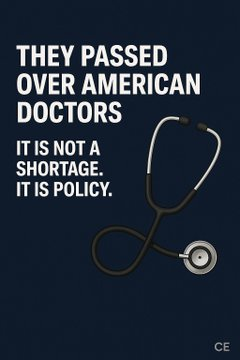
They Passed Over American Doctors
The biggest lie in the U.S. healthcare debate is that we do not have enough American doctors. The truth is simple. We produce them. We just refuse to train them.
In 2024 nearly 20 percent of U.S. medical school seniors failed to match into a residency. That is 8,869 qualified graduates who spent years in school, passed their boards, took on massive debt, and still never got the one thing they need to practice medicine.
At the same time more than 9,700 foreign trained doctors matched into U.S. residencies in 2025. Many hospitals prefer them because they accept lower pay, longer hours, and have no leverage to complain. You cannot practice medicine in the United States without residency. So if Americans are locked out, someone else will fill the spot.
The choke point is not medical school. It is the federally funded residency cap. Congress has not increased these slots fast enough while medical school enrollment has exploded. The result is a rigged bottleneck that leaves American doctors unmatched while taxpayer dollars train replacements from overseas.
The Resident Physician Shortage Reduction Act of 2025 would add 14,000 residency slots over seven years. Even that will not undo years of damage, but it is proof that Washington knows the system is broken.
Until Congress expands residency slots at the scale required, the United States will keep graduating qualified doctors who never get to practice. Then hospitals will turn around and say there is a physician shortage and use it as an excuse to import more foreign labor.
It is not a shortage. It is policy.
Citations
• AMA, Biggest Match Day Ever, 2025 data
• AAMC, Medical School Enrollment Growth vs Residency Bottleneck
• Educational Commission for Foreign Medical Graduates, IMG Match Statistics 2025
• Norton Rose Fulbright, Congressional Inquiry into Residency Accreditation and Matching Practices
• People Magazine, U.S. Graduate Denied Residency, 2024
English
mart michmd retweetledi

A physician needs prior authorization to prescribe a $40 medication.
A home health agency in Brooklyn needs nothing to bill $1.27 billion.
Same Medicaid system.
Same taxpayer dollars.
One of them faces audits, board certification, peer review, and utilization management.
Guess which one.
English
mart michmd retweetledi
Calling this a “scandal” is like calling a casino a “charity that occasionally takes your money.”
The PBM model isn’t broken; it’s doing exactly what it was designed to do.
It creates opacity and extracts value.
The most expensive part of a prescription isn’t the drug; it’s the series of invisible hands it passes through….
Forest Park Pharmacy@ForestParkPharm
🚨 SCANDAL IN TENNESSEE: How a PBM "Stole" $30,000,000 from Taxpayers 🚨 A bombshell audit by the Tennessee Department of Commerce and Insurance has just exposed the shady underbelly of Pharmacy Benefit Managers (PBMs). The target? Express Scripts. The findings are a wake-up call for anyone wondering why healthcare costs are spiraling while local pharmacies are disappearing. The Breakdown: 1. Favoritism & "Self-Dealing" 💊 The audit found that Express Scripts was paying its own pharmacies significantly more than independent ones for the exact same medications. Out of 2,318 drugs reviewed, Express Scripts played favorites on 568 of them. 2. The $30 Million "Spread" 💸 Ever heard of Spread Pricing? It’s when a PBM charges the state one price for a prescription but pays the pharmacy a much lower price—and pockets the difference. Tennessee was charged $30,000,000 in "spread" across 753,000 prescriptions. That’s an average of $40 per prescription "stolen" by the middleman. 3. Breaking Tennessee Law ⚖️ Tennessee law requires a minimum dispensing fee for low-volume pharmacies to keep them afloat. The audit found that in 100% of cases tested, Express Scripts failed to pay this fee. 4. A Broken Appeals Process 🚫 When pharmacies tried to appeal these violations, Express Scripts mismanaged the process 95% of the time. Essentially, they were the judge, jury, and executioner of their own rules. 📉 The Impact This isn't just about money—it's about the degradation of healthcare. When PBMs squeeze independent pharmacies and inflate costs, the patients and taxpayers are the ones who suffer. 💡 The Solution? The audit’s current recommendation? "Review your policies." (Yikes.) But there’s a better way. We are cutting out the middleman entirely to provide transparent, fair pricing that is often cheaper than using insurance. It’s time to fire the middleman.
English
mart michmd retweetledi

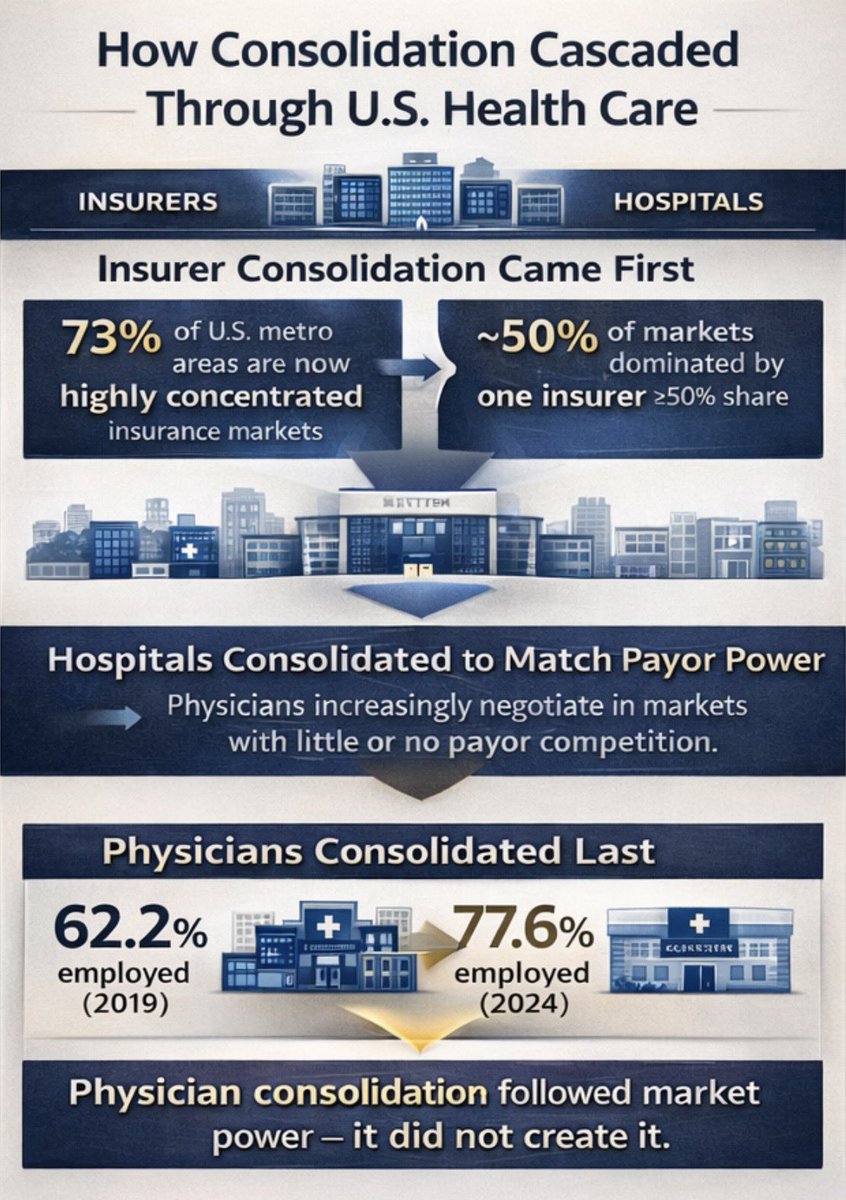
Physician consolidation isn’t some isolated trend or voluntary lifestyle shift. The data shows it’s the downstream consequence of consolidation that happened first among insurers, then among hospitals.
Insurers consolidated first
AMA’s Competition in Health Insurance reports lay it out clearly:
- 73% of U.S. metro areas are now highly concentrated insurance markets
- Nearly half are dominated by a single insurer holding ≥50% market share
- In Medicare Advantage, most counties are effectively controlled by one payer with real pricing power
For independent practices, that means negotiating in markets where leverage barely exists. Smaller groups get take-it-or-leave-it contracts, aggressive utilization management, and relentless downward pressure on professional fees.
Hospitals responded by consolidating
Over the last two decades, most U.S. hospitals have joined large health systems. Mergers and affiliations have dramatically reduced the number of independent contracting entities and “local” hospitals. This scale gave hospitals referral control, balance-sheet strength, and, perhaps most importantly, access to facility fees and site-of-service differentials that insurers couldn’t easily erase.
Hospitals could absorb insurer pressure in ways small physician groups never could. They had size, diversified revenue, and billing structures that let them extract higher total reimbursement even as professional fees stagnated or fell. Hospitals were riding their guaranteed inflationary updates with physicians left in the dust through downward pay related to budget neutral adjustments.
Physicians consolidated last, often because they had no real choice
IQVIA OneKey data tells the story:
- 62.2% of physicians were employed by hospitals or corporate entities in 2019
- By January 2024, that number jumped to 77.6%
- More than 5 percentage points of the increase happened in just the last two years
- The recent surge has been driven primarily by hospital employment, not independent corporate groups
Fewer than one in four physicians now practices independently. This wasn’t about wanting to be employed. In many markets the math was brutal. Insurers could suppress rates for small practices while hospitals could offer meaningfully higher take-home pay by leveraging facility fees, site-of-service shifts, and system-wide contracting leverage. Employment became the only realistic path to income stability and administrative survival.
At the end of the day, as insurers and hospitals accumulated market power, physicians were forced to consolidate to stay viable and many ultimately gave up ownership in the process.
We are at an inflection point today due to structural changes, not ideological underpinnings. Physician employment is the end-stage response to a market that had already consolidated around them.
Tomorrow we’ll look at what this level of consolidation actually does to prices, quality, and competition once real alternatives disappear.
@IndeMedAction

English
Intentional policy grift to decrease spending on quality education for our docs. #fixhealthcare
Chief_Engineer@ChiefEngineerCE
They Passed Over American Doctors The biggest lie in the U.S. healthcare debate is that we do not have enough American doctors. The truth is simple. We produce them. We just refuse to train them. In 2024 nearly 20 percent of U.S. medical school seniors failed to match into a residency. That is 8,869 qualified graduates who spent years in school, passed their boards, took on massive debt, and still never got the one thing they need to practice medicine. At the same time more than 9,700 foreign trained doctors matched into U.S. residencies in 2025. Many hospitals prefer them because they accept lower pay, longer hours, and have no leverage to complain. You cannot practice medicine in the United States without residency. So if Americans are locked out, someone else will fill the spot. The choke point is not medical school. It is the federally funded residency cap. Congress has not increased these slots fast enough while medical school enrollment has exploded. The result is a rigged bottleneck that leaves American doctors unmatched while taxpayer dollars train replacements from overseas. The Resident Physician Shortage Reduction Act of 2025 would add 14,000 residency slots over seven years. Even that will not undo years of damage, but it is proof that Washington knows the system is broken. Until Congress expands residency slots at the scale required, the United States will keep graduating qualified doctors who never get to practice. Then hospitals will turn around and say there is a physician shortage and use it as an excuse to import more foreign labor. It is not a shortage- don't believe it. It is policy to intentionally keep American doctors out. Citations • AMA, Biggest Match Day Ever, 2025 data • AAMC, Medical School Enrollment Growth vs Residency Bottleneck • Educational Commission for Foreign Medical Graduates, IMG Match Statistics 2025 • Norton Rose Fulbright, Congressional Inquiry into Residency Accreditation and Matching Practices • People Magazine, U.S. Graduate Denied Residency, 2024
English
mart michmd retweetledi

Come on NY. This is important for NY patients. CT launches country's first public dashboard to track and fix emergency room overcrowding ctpublic.org/news/2026-01-2…
How about it? @GovKathyHochul @NYStateofHealth @NYACEP
English
mart michmd retweetledi
The level of consolidation in our health system helps explain why Americans feel anxious about their health care – because the coverage they have, the drugs they rely on, and the doctors they can see, are increasingly controlled by the same corporate families.
English
mart michmd retweetledi

Have you ever heard the Declaration of Independence read out loud?
You should. It’s the greatest break-up letter ever written.
At just 33 years old, Thomas Jefferson, with cold moral clarity, told the British government to pound sand:
“Whenever any Form of Government becomes destructive of these ends [life, liberty, and the pursuit of happiness], it is the Right of the People to alter or to ABOLISH it.”
The power of that line isn’t just what it says. It’s how it’s said.
Jefferson wasn’t writing from a place of outrage. He was transmitting conviction — moral clarity delivered from a steady frame of mind.
It’s said Jefferson revised the Declaration of Independence with the help of Franklin and Adams dozens of times before it was finalized.
And that deliberate, cutting language paired with emotional steadiness is precisely why the words still land nearly 250 years later. 🧵
English
mart michmd retweetledi

Emergency physicians don’t age gracefully in medicine, we die young…or disappear. So poignant Dr Mike Rubin. #fixmedicine open.substack.com/pub/mikerubinm…
English
mart michmd retweetledi

NEW: Insurance giants are hiding billions meant to lower Americans’ drug costs.
Our year-long investigation details how CVS, UnitedHealth, and Cigna created shell companies to evade reform efforts and hide payments received from drugmakers.
Cc: @mcuban
English
mart michmd retweetledi
This barely made the news — but it’s huge. Eli Lilly just dropped CVS Caremark as its PBM. If Big Pharma starts cutting out the middlemen, everything changes. #healthcare #pbm #pharma
English
mart michmd retweetledi

mart michmd retweetledi
Walk into a hospital today and you’ll see nurses huddled over computers instead of standing at the bedside. Why? Electronic records replaced ward clerks and turned nurses and doctors into data-entry staff. #medicine #healthcare #patientsfirst
English
mart michmd retweetledi
