
Marty Cornish

724 posts

Marty Cornish banner
Marty Cornish

Marty Cornish

@martycornish

CEO @workpackai

Miami, FL Katılım Şubat 2011
157 Takip Edilen205 Takipçiler
Marty Cornish retweetledi
a16z
a16z@a16z·
Narrative violations abound: - Demand for software engineers is rising - Software devs are rising as a share of new jobs - AI exposed industries are seeing above-trend wage growth - Open PM jobs haven't been higher since 2022 More from a16z's David George on the "AI job apocalypse" myth: a16z.news/p/the-ai-job-a…
a16z tweet mediaa16z tweet mediaa16z tweet mediaa16z tweet media
David George@DavidGeorge83

x.com/i/article/2052…

English
123
377
2.5K
731.4K
Marty Cornish retweetledi
Chamath Palihapitiya
Chamath Palihapitiya@chamath·
On page twenty-six of “The Billionaire Tax” proposal in California, it explains how the state legislature can convert from a Billionaire Tax to an Everyone Tax without voter approval. They can also adjust the tax to be a yearly tax, not just one time…again, without your approval. Intelligence test for you: if this was meant to just target Billionaires, why did they write this in?
Chamath Palihapitiya@chamath

The Billionaire Tax is actually an Everyone Tax. The Billionaire Tax is a new tax proposal written by four professors who don't believe in the American dream. Some of them aren’t even American…go figure. Despite its name, it applies to every California resident who currently has assets or ever will. The creators named it the Billionaire Tax so you would get into a froth andwouldn't look closely at what it actually does to you. On page twenty-six, it explains how the government can convert to an Everyone Tax without voter approval. They can also adjust the tax to be a yearly tax, not just one time…again, without your approval. Here's how the tax would work: As a voter, you're being asked to approve a tax that would require you to: 1. list all your assets and the value of each, then submit them to the California Franchise Tax Board. 2. authorize the tax board to appraise your assets and confirm the value of each. 3. pay a penalty of up to forty percent of your tax bill if the board determines your reported value was too low in their opinion. 4. allow the tax board to subpoena your financial records from every one of your financial institutions for auditing. This Everyone Tax runs 34 pages of shifty language describing how the government plans to take your assets. Read the fine print and decide for yourself. If this were truly a billionaire tax, it would be 3 pages. It’s 34 pages so that it can create the mechanisms to steal from all of you.

English
1.2K
9.9K
35.9K
4.4M
Marty Cornish retweetledi
Hemant Mohapatra
Hemant Mohapatra@MohapatraHemant·
99.9% of the world is completely unaware what is going to hit them in <5yrs: incredibly powerful, cheap intelligence. The way we are all addicted to information, glued to our screen 24x7, we are about to get addicted to hyper-intelligence. Work is growing 10x from here, unf, not reduce.
English
139
171
2K
408.8K
Sam Blond
Sam Blond@samdblond·
Who is the greatest founder poker player in the world? We'll find out in just over 2 weeks at the largest founder poker tournament of all time, the $100,000 cash prize, no buy-in, Monaco Invitational. Invitations are going out now. If you think you qualify, comment below.
Sam Blond tweet media
English
49
8
83
296.2K
Auren Hoffman
Auren Hoffman@auren·
Mini golf is much more fun (and takes more skill) than regular golf
English
7
0
10
1.8K
Marty Cornish
Marty Cornish@martycornish·
I heard a great line a few years ago from Jeff Weiner (former CEO LinkedIn): “trust equals consistency over time, and there’s no shortcut for either.” While it sounds good, I would argue that healthy conflict does act maybe not to “shortcut” time, but to accelerate it, because it allows people to demonstrate their behavior outside of a normal expectation frame and build stronger trust faster than under unremarkable circumstances. When expectations exist that don’t match reality, breaking those expectations will initially cause resentment. If communication is direct and effective, and both people are flexible enough to change as appropriate to form a new shared reality, that resentment will be short lived, and stronger trust forms on the other side.
Marty Cornish tweet media
English
0
0
0
20
Skip Holtz
Skip Holtz@CoachSHoltz·
My father passed away today resting peacefully at home. I appreciate everyone’s thoughts and prayers over the last couple months! He was successful, but more important he was Significant.
Skip Holtz tweet media
English
6.1K
6.6K
89.3K
1.1M
Marty Cornish retweetledi
Naval
Naval@naval·
The cost of code is coming down, so we will consume more of it. The productivity of coders is going up, so they will become more valuable. Coding now includes training and driving models.
English
550
905
13.3K
484.6K
Sawyer Merritt
Sawyer Merritt@SawyerMerritt·
I’m now maxed out on referrals for the rest of the year. Time to help you guys get some Tesla referrals! Drop your referral links below and I’ll send people asking for a code to the comment section to select one. Won’t be able to help everyone, but will do what I can. For those curious, here's what people ordered using my code: • Model Ys: 6 • Cybertrucks: 3 • Model 3: 1
Sawyer Merritt tweet media
English
5.9K
197
3.9K
407.2K
Marty Cornish
Marty Cornish@martycornish·
The other important set of challenges here is 1) of course some individual companies and bureaucrats will make mistakes, 2) if a startup gets caught up in this they will not be able to raise money, 3) most startups do not have the cash or time to allocate to fighting. De facto death sentence for most.
Garry Tan@garrytan

The people who wrote the California Asset Seizure Tax say: “Don’t worry, if the state mis-prices your startup, you can bring in ‘independent appraisers’ to argue with them. And if you can’t pay 5% right now, they’ll put you on a five‑year payment plan. With interest.” That’s not a safeguard. That’s: we take the money, you fight the DMV on hard mode to get it back.

English
0
0
0
38
Marty Cornish retweetledi
david friedberg
david friedberg@friedberg·
California started with the Gold Rush and might end with the Golden Exit. it has been underreported how much wealth has left CA because of the asset seizure tax being proposed. a private poll was conducted amongst affected individuals a few days ago and 80-90% surveyed said they have already left CA in 2025 or will leave in 2026 if the ballot measure looks likely to pass. $2-2.5T of assets gone, representing about $20B of annual revenue for the state government. and likely hundreds of thousands of jobs now at risk. less reported is the bigger exodus underway from folks who are NOT directly affected but worry (as they should) that this law will quickly transition from billionaires to everyone else... the initiative actually gives CA legislators the right to take anyone's post-tax assets anytime in the future based on a majority vote. this isn't about billionaires. it's a new "tax system" that simply destroys private property rights in America. all private property is now public property. even after paying your taxes, it's not legally your property anymore. it's the government's, you're just borrowing it. legislators will decide what you get to keep and temporarily use each year. countless founders, CEOs, and other business leaders are actively looking to move their companies out of state. not just tech, not just AI, not just billionaires, but the core engine of California's prosperity since 1847 is unraveling. and here is how this initiative risks unraveling America: - ~10 states have explicit or implicit prohibitions against an asset seizure tax... - individuals affected in CA (and other states trying to do the same) will move to these states that endow private property rights. - CA already has a $20-30B annual budget deficit, an unfunded ~$1T pension liability for public employees/unions, and $500B of debt outstanding. the state can not afford to borrow much more and will launch more asset seizures to meet its obligations. - asset seizures will first transition to "millionaires" and eventually to the entire middle class as more asset seizures drive more people to leave the state. - the deficit, debt, and job loss will spiral. the Golden Exit. - no US state has ever declared bankruptcy. in addition to CA, dozens of other states face similar fiscal crises - legislators promised future benefits that can't be paid or theft and waste have been allowed to run rampant and unabated for years. - struggling states will eventually request federal government assistance, as they always have in times of fiscal crisis, effectively "federalizing state debt". - states not in crisis will declare "enough is enough", individuals in those states will refuse to pay their federal taxes (why pay for other people's mistakes?), some states may try to secede from the Union, and a constitutional and civil crisis will erupt. this may seem far-fetched but it is the obvious domino effect of selectively deleting private property rights for some people in some states. i am not a billionaire and this CA bill does not affect me, but i care about the country and the state of CA. i want both to thrive. it's obvious that there are people in CA in desperate need of support and assistance, and inequities may exist that need to be rectified, but eliminating private property rights is the wrong path for everyone. a few alternatives to consider first: 1) with a $350B annual budget, CA can cut programs that result in theft and little-to-no benefit for citizens. $50B per year is likely recoverable. 2) if more taxes are needed, tax loans against unrealized capital gains (very few objections will arise), eliminate tax-free rollover of certain appreciated assets (real estate industry will fight), create a step up in basis on inheritance (some will fight but most will support). likely $10Bs of incremental revenue can be realized. 3) restructure all public retirement programs from Defined Benefit to Defined Contribution. eliminating the unfunded retirement liabilities ($1T+) will be the release valve on the future the state so desperately needs. we must address what ails us without dividing and destroying our state, our nation, our home. ignore the rhetoric, these are the facts.
English
877
1.6K
14.1K
2.3M
Marty Cornish retweetledi
The Boring Company
The Boring Company@boringcompany·
Vegas Loop dropoff at the Airport! Still in the early phases of the program, providing a small number of rides each day. The ride includes both a tunnel portion and a long surface portion, with the latter shifting to subsurface when the 2.25 mile Airport Connector twin tunnels open, hopefully in Q1 2026. Thanks to @LASAirport @LVCVA @ClarkCountyNV @NevadaDBI in reaching this milestone.
The Boring Company tweet media
Mick Akers@mickakers

Boring Co. Vegas Loop begins Reid airport rides reviewjournal.com/local/traffic/… #vegas #boringcompany #elonmusk

English
262
641
4.8K
1.1M
Marty Cornish
Marty Cornish@martycornish·
Cool
Aakash Gupta@aakashgupta

The entire robotics industry is about to compress a decade of progress into 18 months, and nobody’s pricing it in. The hardware has been ready for years. Boston Dynamics had Atlas doing backflips in 2018. The bottleneck was never motors or actuators. It was that every robot behavior had to be hand-coded. Pick up a box? That’s one program. Pick up a bottle? Different program. Move the box from shelf A to shelf B in a warehouse with slightly different lighting? Start over. Foundation models broke this completely. Before VLAs, teaching a robot one skill gave you exactly one skill. Zero compounding. Zero transfer. A robot trained to fold shirts couldn’t fold towels without starting from scratch. The labor intensity of data generation meant robotics datasets stayed narrow, robots overfit, and small variations like object weight or table height caused failures. Now a single Gemini Robotics model handles tasks it has never seen in training. Google’s On-Device model learns new behaviors with 50-100 demonstrations. Not 50,000. Fifty. That’s a 1000x reduction in the data requirement for new capabilities. The speed implications cascade through everything. First order: deployment timelines collapse. What took robotics teams 6-12 months of custom programming now takes days of fine-tuning. Second order: the addressable market explodes. Tasks that were never economical to automate suddenly are, because the integration cost dropped by orders of magnitude. Third order: the data flywheel accelerates. Every robot running Gemini Robotics feeds learning back into the foundation model. More deployments means faster improvement means more deployments. Physical Intelligence raised at $2.4B because investors finally understood this. Boston Dynamics partnered with Toyota Research Institute to bolt Large Behavior Models onto Atlas. Every humanoid company is scrambling to either build or license the intelligence layer they don’t have. The market is still valuing robotics companies on their hardware differentiation. But hardware is commoditizing. Boston Dynamics spent a decade perfecting locomotion, and now that’s table stakes. The value is migrating entirely to whoever owns the foundation model that generalizes across embodiments. Google trained Gemini on the largest multimodal corpus ever assembled. Then they added physical actions as an output modality. That’s not a robotics company bolting on AI. That’s an AI company whose models now output motor commands. The companies pricing this correctly are building around foundation model access, not around proprietary hardware. The companies pricing this wrong are still acting like the moat is in the mechanical engineering. AGI moving into the physical world isn’t a 10-year prediction. Gemini Robotics shipped in March. The 1.5 version with chain-of-thought reasoning shipped in September. They’re iterating on a 6-month release cycle while hardware companies iterate on 3-year cycles. The gap between software intelligence timelines and hardware development timelines is the entire trade.

English
0
0
0
24
Eric Weinstein
Eric Weinstein@ericweinstein·
So if you feel like no one cares about you I’d like the chance to wish 5 or so of you a merry Christmas if that would merely brighten your day even a little. Just leave a reply and I will pick about 5 at random and dm you for a number. Don’t share yours in the open please. And if you have a little extra in your heart this year, feel free to join me in offering the same. There are always a lot of us who could use some kindness on the holidays.
English
80
11
476
27K
Eric Weinstein
Eric Weinstein@ericweinstein·
Xmas is a tough day in some Christian lives when you draw a bad hand, while everyone is wishing each other Merry Christmas. We have a tradition most years where I make 5 or so calls to people who feel like maybe they drew a bad hand this year. Judeo-Christian is 2-way street.
English
126
26
806
47.5K
Marty Cornish
Marty Cornish@martycornish·
@DavidSacks @Jason @ThomasSowell Bessent did answer this question better. Prices are still high and continue to rise, because reducing inflation, if above zero, doesn’t reduce prices from the already high level they were at. Many are still hurting, even though the overall economic metrics are good.
English
3
0
8
1.1K
David Sacks
David Sacks@DavidSacks·
@Jason @ThomasSowell That is not economic data. In light of today’s 4.3% q3 GDP growth rate (beating expectations of 3.3%), it’s also clearly looking in the rear-view mirror.
English
137
70
2.7K
269K
Thomas Sowell Quotes
Thomas Sowell Quotes@ThomasSowell·
Jason Calacanis: "The American people are very disappointed in the Trump administration's first year when it comes to inflation and the economy." David Sacks: "I don't understand how the numbers could be any better."
English
178
91
2K
389.1K
Marty Cornish retweetledi
David Sacks
David Sacks@DavidSacks·
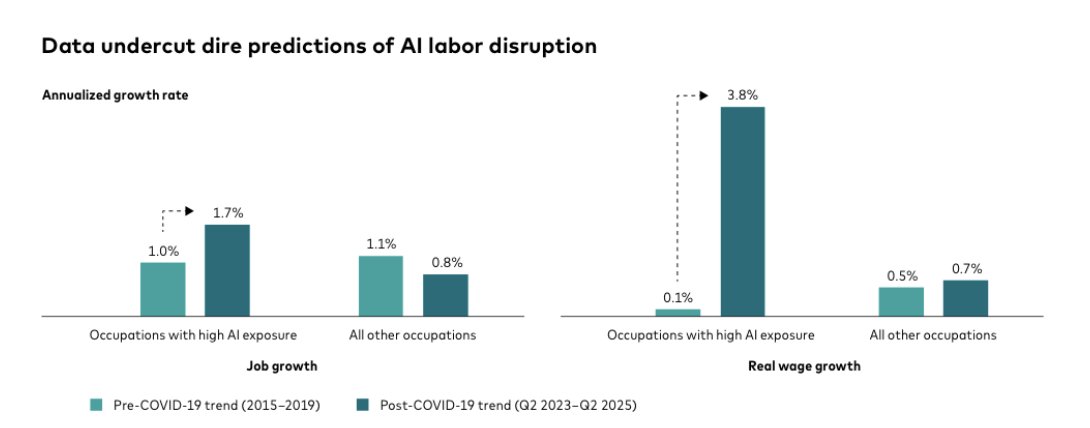
AI JOB LOSS HOAX EXPOSED According to a new study from Vanguard, the "occupations most exposed to AI automation are actually outperforming the rest of the labor market in terms of job growth and real wage increases." Job growth was up 1.7% in occupations with high AI exposure, compared to 0.8% in all other occupations. Real wages increased 3.8% in occupations with high AI exposure, compared with 0.7% in all other occupations. Rather than causing job loss, AI is making workers more productive, driving gains in both jobs and wages.
David Sacks tweet media
English
364
283
2.2K
295.7K
Marc Andreessen 🇺🇸
David Sacks @DavidSacks is a throwback to the era of American greatness in which the most capable private sector citizens selflessly volunteered for government service in moments of peril for a dollar a day. He is a credit to our nation, and we need more like him, not fewer. 🇺🇸
English
1.1K
2.3K
28.6K
24.6M
Marty Cornish retweetledi
Andrej Karpathy
Andrej Karpathy@karpathy·
Sharing an interesting recent conversation on AI's impact on the economy. AI has been compared to various historical precedents: electricity, industrial revolution, etc., I think the strongest analogy is that of AI as a new computing paradigm (Software 2.0) because both are fundamentally about the automation of digital information processing. If you were to forecast the impact of computing on the job market in ~1980s, the most predictive feature of a task/job you'd look at is to what extent the algorithm of it is fixed, i.e. are you just mechanically transforming information according to rote, easy to specify rules (e.g. typing, bookkeeping, human calculators, etc.)? Back then, this was the class of programs that the computing capability of that era allowed us to write (by hand, manually). With AI now, we are able to write new programs that we could never hope to write by hand before. We do it by specifying objectives (e.g. classification accuracy, reward functions), and we search the program space via gradient descent to find neural networks that work well against that objective. This is my Software 2.0 blog post from a while ago. In this new programming paradigm then, the new most predictive feature to look at is verifiability. If a task/job is verifiable, then it is optimizable directly or via reinforcement learning, and a neural net can be trained to work extremely well. It's about to what extent an AI can "practice" something. The environment has to be resettable (you can start a new attempt), efficient (a lot attempts can be made), and rewardable (there is some automated process to reward any specific attempt that was made). The more a task/job is verifiable, the more amenable it is to automation in the new programming paradigm. If it is not verifiable, it has to fall out from neural net magic of generalization fingers crossed, or via weaker means like imitation. This is what's driving the "jagged" frontier of progress in LLMs. Tasks that are verifiable progress rapidly, including possibly beyond the ability of top experts (e.g. math, code, amount of time spent watching videos, anything that looks like puzzles with correct answers), while many others lag by comparison (creative, strategic, tasks that combine real-world knowledge, state, context and common sense). Software 1.0 easily automates what you can specify. Software 2.0 easily automates what you can verify.
English
553
1.5K
12.4K
2.1M
Marty Cornish retweetledi
bradford cross
bradford cross@bradfordcross·
One of the biggest mistakes is that folks lump everything into "AI" There are at least three important and distnct buckets right now; 1) big horizontal models, 2) apps built on these models, 3) actual vertical AIs with their own training data within a specific domain -- drug discovery, materials discovery, robotic manufacturing, etc. 1) big models aren't in a bubble, and aren't going anywhere. this is going to continue to be one of the biggest areas of investment by the worlds most important bigtech and startups for many years to come. that includes the trend to massive AI training data centers and hunger for more chips and cheap energy. We can debate current LLM research strategy and what new ideas and approaches will be tried successfully in coming years to get new breakthroughs, but the idea of a handful of bigtech and startup AI companies spending a fortune and maintaining these monster models is here to stay. 2) apps build on the big horizontal models could be in a bubble. The majority of capital invested here is by folks with no clue about AI, its past, or its future. There's no real tech in most of these and they should not be called "AI Startups" -- they are just normal apps, nothing new, we've been embedding AI/ML into apps like this for well over a decade. I think most of these companies just get washed way one wave after another as the big model companies roll out new models and new apps on top of their models. If there's a bubble and a place to avoid investing or building, I think its here. 3) proper vertical AI companies are massively underfunded because its way too complex for the fast-follow VCs that make the boneheaded bets in #2. These vertical AI startups take the same R&D approach as the big horizontal model companies, but instead applying it to deep self-generated vertical data through automated research experimentation. This is like the automated materials discovery lab at LBNL science.org/content/articl… or like Isomorphic Labs that spun out of Deep Mind, or Insilico Medicine doing some cool work in generative chemistry. #3 is the real near term future of AI -- where we stack it with the other hard sciences and hit R&D home run after home run nonstop for decades. Its going to change the world far more than everyone understands. Once we start to see more of these wins people will be a lot more concerned about how they can live to 200 years old or have an iPhone that almost never needs to be charged, and we will all be a lot less worried about the Big Bad Superintelligence.
David Sacks@DavidSacks

The two biggest narratives about AI right now are that (1) it’s a massive bubble (i.e. totally fake) and (2) about to give rise to superintelligence (i.e. totally real). Both narratives can be fake (which is what I believe) but it’s very unlikely that both can be true.

English
2
3
15
2.7K