

11.7K posts

@mattsonlyattack
Serve the bits, serve the people. Making the amaze @RocketTech. Previously Served Soul Food @kalamazoox.
Kalamazoo Katılım Mart 2008
1.1K Takip Edilen714 Takipçiler


[email protected] retweetledi

When I heard about Senator Graham’s death last night, the first thing I thought about was not all the things he said and did in service of Donald Trump. I thought of the time before Donald Trump when he was a brother to Senator John McCain.
A time when senators from different parties could fight about politics and still be friends. A time when a conservative Republican from South Carolina could say of my father: “If you can’t admire Joe Biden as a person, you’ve got a problem. He’s the nicest person I’ve ever met in politics. As good a man as God ever created.”
That is the Senator Graham I will remember today. Not because I have forgotten what came after. Because in that memory there is hope. Hope for a country where brothers can fight like hell over policy and still share a meal, and a laugh, and the loss of the people they love.
I will choose to remember the time before Trump. Because I believe in an America after Trump.
English
I heard @kitlangton does voice overs for Half-Life 3. Launching next week.
English
[email protected] retweetledi

Amongst my friends, Spotify is the lowest quality consumer app we still pay for. It certainly hasnt gotten noticeably better in the last couple years (arguably worse). So, this is not the positive look Ant and Spotify are spinning here.
Bigger picture, this is the problem with a lot of AI reporting. It reports completely meaningless metrics like deploys per day or LoC. Why don’t we start reporting consumer satisfaction reports? Actually end state research results.
All the no nuance AI people always come out and think that this is anti AI. Again, I think AI is great and Claude is great. But this is bad marketing and makes both look like clowns.
ClaudeDevs@ClaudeDevs
Boris sat down with Spotify VP of Engineering Niklas Gustavsson. Spotify ships 4,500 production deploys a day, and 73% of PRs are now AI-assisted.
English
[email protected] retweetledi

WOW.
AlJazeera just dropped a ONE HOUR documentary about ISRAEL’s CRIMES against the PALESTINIANS.
This is very HARD TO WATCH.
English
@vxunderground There's also a floppy in steel mountain
English

This is very real and very true
All student loans are stored in a Microsoft Excel spreadsheet. All hackers need to do is hack the mainframe and delete the spreadsheet. Why don't they?
It's very shrimple. It is because that Excel spreadsheet is password protected with a 79 character long password and it can't be cracked
👑@King2Eclipse
Hackers are utterly incapable of hacking shit that would actually benefit people. Want them to hack the FAFSA to get rid of student loans?? Sorry their too busy hacking cartoon studios and threatening to release something people were already planning on watching
English
@vxunderground They're still probably the least worst
English
All these fucking dorks at Anthropic do is yap about how insane their product is and how end-of-the-world it will be
Someone tell these jabronis to shut the fuck up, holy Christ they're so annoying
Polymarket@Polymarket
JUST IN: Anthropic co-founder Jack Clark reportedly warned new recruits to “get hobbies that aren’t computers,” saying the company is building a “superhuman coder with nation-state hacking capabilities.”
English
Currently using Claude to configure Codex app automation to provide context for scheduled Slackbot skill based tasks. I need some Hermes.
English

[email protected] retweetledi

[email protected] retweetledi

It is a source of continuous delight to watch the AI community rediscover the fundamentals and the dynamics of software engineering as they take those things and embellish them with AI adjectives, making them sound all fresh and new and sparkly while in truth, those fundamentals remain, well, fundamental.
Remove AI from the discourse below, and what Andrew promotes are things one heard all the time as we saw - starting decades ago - the transition from assembly language to FORTRAN and COBOL, from structured to object-oriented, from waterfall to agile.
The past, as is said, does not repeat itself but rather rhymes.
Don’t get me wrong: I celebrate what Andrew et al are doing: developing software-intense systems that are meaningful and that endure requires intention and discipline, and I embrace that.
Two dangling threads before I close:
I don’t grok the semantics of “traditional teams”. The cosmos of computing is so wide and deep and diverse and crosses so many domains, I conclude that “traditional teams” is what one says when their experience is in a relatively narrow space, and they are witnessing a shift from what they grew up with in the Valley in particular, where web-centric systems of global elastic scale remain the primary focus.
Second, I am dismayed at the focus on speed. If you are driving head long Thelma and Louise style toward an IPO then certainly speed will be a critical factor. But for most of the domain of computing, for systems that are meaningful and that endure, other factors are far more important: correctness, repeatability, safety, maintainability, these dominate, and as such, don’t be distracted by the noise and smoke and heat and light of an AI first style that may get you out of the starting gate quickly, but will fail you in the ultra marathon of most development.
Andrew Ng@AndrewYNg
AI-native software engineering teams operate very differently than traditional teams. The obvious difference is that AI-native teams use coding agents to build products much faster, but this leads to many other changes in how we operate. For example, some great engineers now play broader roles than just writing code. They are partly product managers, designers, sometimes marketers. Further, small teams who work in the same office, where they can communicate face-to-face, can move incredibly quickly. Because we can now build fast, a greater fraction of time must be spent deciding what to build. To deal with this project-management bottleneck, some teams are pushing engineer:product manager (PM) some teams are pushing engineer:product manager (PM) ratios downward from, say, 8:1 to as low as 1:1. But we can do even better: If we have one PM who decides what to build and one engineer who builds it, the communication between them becomes a bottleneck. This is why the fastest-moving teams I see tend to have engineers who know how to do some product work (and, optionally, some PMs who know how to do some engineering work). When an engineer understands users and can make decisions on what to build and build it directly, they can execute incredibly quickly. I’ve seen engineers successfully expand their roles to including making product decisions, and PMs expand their roles to building software. The tech industry has more engineers than PMs, but both are promising paths. If you are an engineer, you’ll find it useful to learn some product management skills, and if you’re a PM, please learn to build! Looking beyond the product-management bottleneck, I also see bottlenecks in design, marketing, legal compliance, and much more. When we speed up coding 10x or 100x, everything else becomes slow in comparison. For example, some of my teams have built great features so quickly that the marketing organization was left scrambling to figure out how to communicate them to users — a marketing bottleneck. Or when a team can build software in a day that the legal department needs a week to review, that’s a legal compliance bottleneck. In this way, agentic coding isn’t just changing the workflow of software engineering, it’s also changing all the teams around it. When smaller, AI-enabled teams can get more done, generalists excel. Traditional companies need to pull together people from many specialties — engineering, product management, design, marketing, legal, etc. — to execute projects and create value. This has resulted in large teams of specialists who work together. But if a team of 2 persons is to get work done that require 5 different specialities, then some of those individuals must play roles outside a single speciality. In some small teams, individuals do have deep specializations. For example, one might be a great engineer and another a great PM. But they also understand the other key functions needed to move a project forward, and can jump into thinking through other kinds of problems as needed. Of course, proficiency with AI tools is a big help, since it helps us to think through problems that involve different roles. Even in a two-person team, to move fast, communication bottlenecks also must be minimized. This is why I value teams that work in the same location. Remote teams can perform well too, but the highest speed is achieved by having everyone in the room, able to communicate instantaneously to solve problems. This post focuses on AI-native teams with around 2-10 persons, but not everything can be done by a small team. I'll address the coordination of larger teams in the future. I realize these shifts to job roles are tough to navigate for many people. At the same time, I am encouraged that individuals and small teams who are willing to learn the relevant skills are now able to get far more done than was possible before. This is the golden age of learning and building! [Original text: deeplearning.ai/the-batch/issu… ]
English
[email protected] retweetledi

Israel's values are not aligned with human dignity, let alone every law and treaty they break.
English

I think I'm going to put #Linux on an old laptop that's struggling on Win10, due to a lack of TPM2 module. Old me would use Debian. More recent me would use Ubuntu. However, I know a lot of really good distros have come out lately. So, mostly dev, what distros should I look at?
English
[email protected] retweetledi

I invite all speaker friends to consider submitting proposals for CincyDeliver, scheduled for July 24. The Call for Proposals (CFP) is open until March 16. New speakers are encouraged to submit. Complete details are available at cincydeliver.org.

English

I have no idea why people would still be using Claude, Codex is so much better and it’s been like this for months since October
English
@aarondglover @shanselman Not the Microsoft I grew up with, it's refreshing.
English

@shanselman Give credit where credit is due. I'm pleasantly surprised with the speedy response and open sourcing of this component. #aspiredev #MSFT
English

[email protected] retweetledi

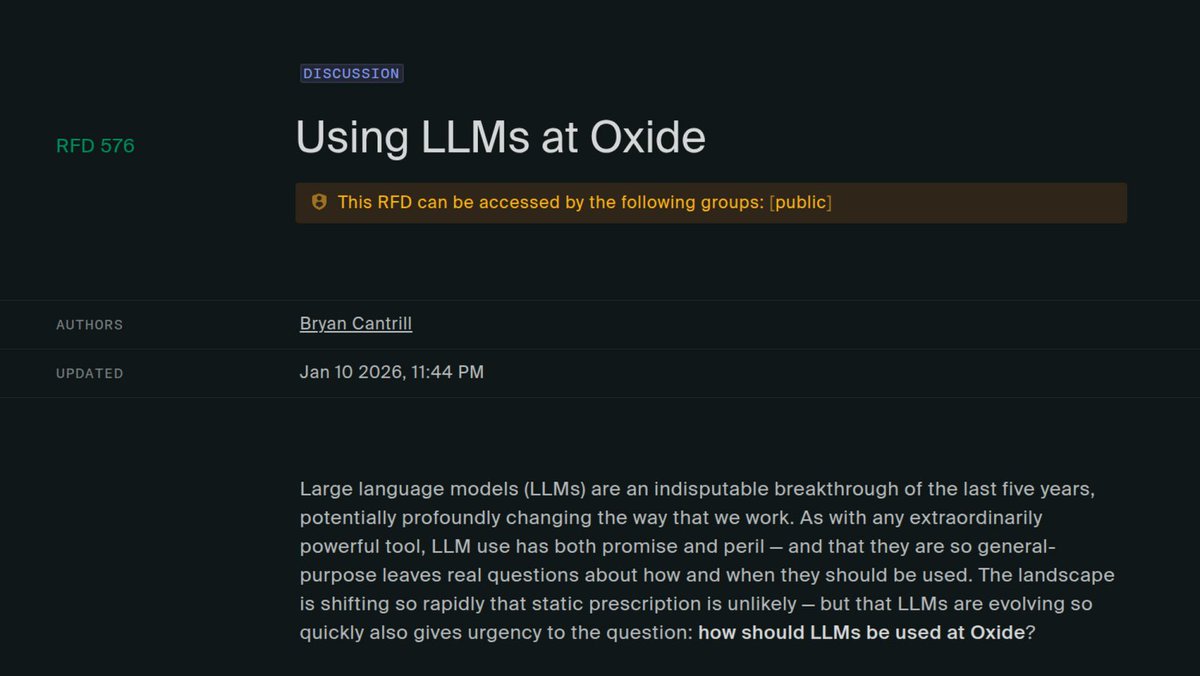
One of my favorite people in tech is @bcantrill and he wrote one of the most thoughtful essays about LLMs I've read in the last two years:
rfd.shared.oxide.computer/rfd/0576
English