Cuong LE-KIEN

11.3K posts

Cuong LE-KIEN

Cuong LE-KIEN

@me_aware_awake

Everything you think is right maybe is wrong.

Ho Chi Minh, Vietnam Katılım Mayıs 2014
2.8K Takip Edilen284 Takipçiler
Cuong LE-KIEN retweetledi
World Data Analysis
World Data Analysis@World_Data_A·
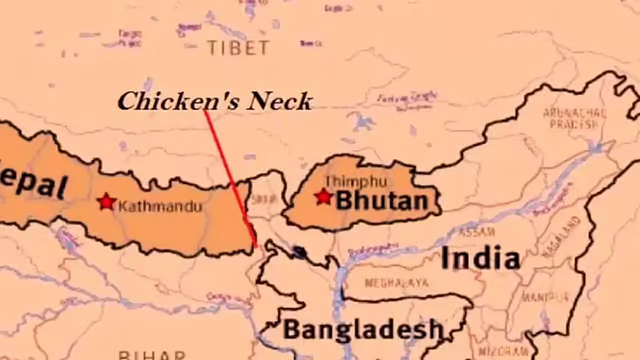
Every country has its chokepoint: India’s Chicken’s Neck ... and Bangladesh detail A 20 km strip that holds together an entire region. The Siliguri Corridor, often called the Chicken’s Neck. It is the only land connection between mainland India and its northeastern states. At its narrowest point, it is only about 20–25 km wide, but the entire economic and logistical system of Northeast India depends on it. The corridor is between: * Nepal (west) * Bhutan (north) * Bangladesh (south) and * close to China’s Chumbi Valley. Almost everything moving in and out of the Northeast passes through this corridor. * tea, petroleum, agricultural goods >> flow out * food, fuel, industrial products >> flow in This makes the corridor a supply chain bottleneck and a single point of failure. Any disruption would immediately impact prices, availability, and regional economic stability. Bangladesh: from constraint to opportunity Historically, India was heavily dependent on this narrow land route. But increasingly transit agreements with Bangladesh, access to ports like Chattogram, inland waterways are creating alternative routes This reduces pressure on the corridor but also increases strategic reliance on Bangladesh cooperation Source: ajmaliasacademy, @WorldBankGroup by Matías Herrera Dappe and Charles Kunaka
World Data Analysis tweet media
World Data Analysis@World_Data_A

. Perhaps one of the most fragile pieces of land between NATO and RUSSIA: the SUWALKI GAP The most crucial piece of territory for Russia and the EU At first glance, it looks like an ordinary border region, bu ti isn't. This is a relatively narrow land, roughly 65-100 km wide, connecting Poland and Lithuania, and forming the only land link between the Baltic states and the rest of NATO territory. After the Cold War, when borders changed, this area gained strategic importance. With Kaliningrad on one side and Belarus on the other, it’s essentially squeezed between two Russia-aligned territories. For Russia, the region matters because it separates Kaliningrad from Belarus, meaning that any disruption complicates logistics and coordination. For NATO, the stakes are even higher: this strip represents the only land route to Lithuania, Latvia, and Estonia. If it were cut off, the Baltic states would be isolated from the rest of the alliance by land. This is exactly why it is called a “gap.” Not because it is physically empty, but because it represents a strategic vulnerability, a space that could be closed or contested in times of crisis. In normal times, it functions like any other border region. But in critical moments, it becomes something entirely different. Source: Ludditus


English
1
1
8
221
Cuong LE-KIEN retweetledi
World Data Analysis
World Data Analysis@World_Data_A·
. Perhaps one of the most fragile pieces of land between NATO and RUSSIA: the SUWALKI GAP The most crucial piece of territory for Russia and the EU At first glance, it looks like an ordinary border region, bu ti isn't. This is a relatively narrow land, roughly 65-100 km wide, connecting Poland and Lithuania, and forming the only land link between the Baltic states and the rest of NATO territory. After the Cold War, when borders changed, this area gained strategic importance. With Kaliningrad on one side and Belarus on the other, it’s essentially squeezed between two Russia-aligned territories. For Russia, the region matters because it separates Kaliningrad from Belarus, meaning that any disruption complicates logistics and coordination. For NATO, the stakes are even higher: this strip represents the only land route to Lithuania, Latvia, and Estonia. If it were cut off, the Baltic states would be isolated from the rest of the alliance by land. This is exactly why it is called a “gap.” Not because it is physically empty, but because it represents a strategic vulnerability, a space that could be closed or contested in times of crisis. In normal times, it functions like any other border region. But in critical moments, it becomes something entirely different. Source: Ludditus
World Data Analysis tweet media
English
4
1
20
1.3K
Cuong LE-KIEN retweetledi
Neil Sethi
Neil Sethi@neilksethi·
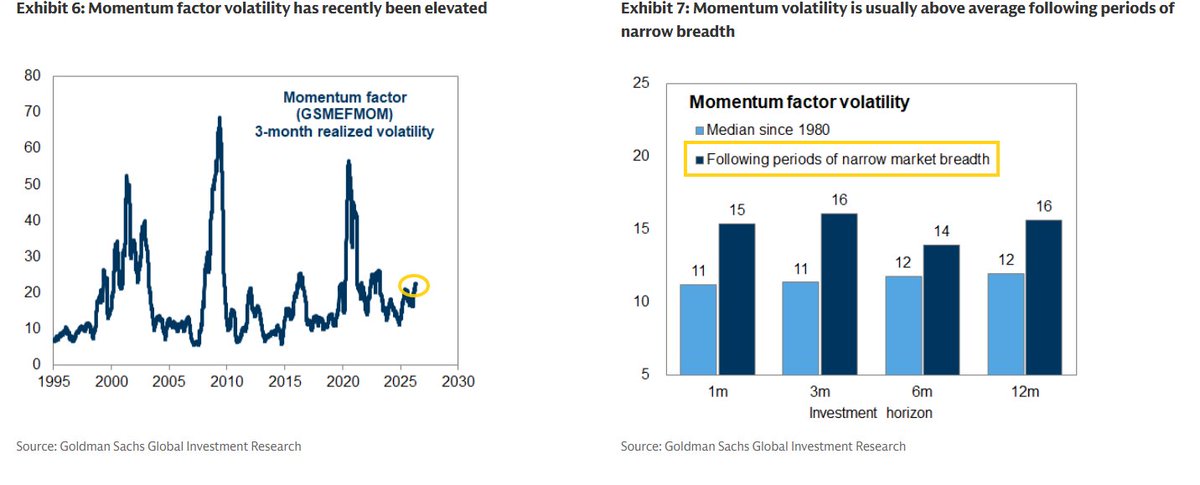
Goldman: While narrow market breadth can persist for months, it always resolves with a leadership rotation. Since 1980, the median episode of narrow market breadth based on the measure in Exhibit 1 has been three months, but with the longest episode in the late 1990s lasting for more than two years. While narrow breadth can resolve via either "catch up" or "catch down," both outcomes are characterized by the underperformance of previous market leaders. As a result, the Momentum factor has realized above-average volatility following other narrow breadth periods in recent decades, and we expect this pattern will be repeated going forward. Hedge fund positioning adds to the likelihood of continued Momentum volatility. GS Prime Services data show that the hedge fund net tilt to Momentum ranks near a multi-year high. In addition, while hedge fund gross leverage has declined during the last couple weeks, it remains elevated relative to history, ranking at the upper end of the 5-year range for both the overall hedge fund universe and fundamental equity long/short funds specifically.
Neil Sethi tweet media
Neil Sethi@neilksethi

Goldman: The narrow breadth rally has been driven primarily by stocks tied to the AI infrastructure build-out, mirroring the narrow breadth of recent earnings revisions. The SOX Semiconductor Index has jumped by 30% and the Magnificent 7 have collectively risen by 10% since the start of the Iran War, while the equal-weight S&P 500 has declined by -1% over that period, and the median stock is -13% from its 52-week high.

English
3
3
48
5.1K
Global Insight Journal
Global Insight Journal@GlobalIJournal·
🇺🇸 🇨🇳 Trump: “I think that China has neither the courage nor the will to open the Strait of Hormuz.” ➖️ China: “The Strait of Hormuz was already open before the war. You are the ones who created the war out of nothing and closed the strait to the rest of the world.”
English
232
7.9K
34.9K
833.1K
Cuong LE-KIEN retweetledi
World Data Analysis
World Data Analysis@World_Data_A·
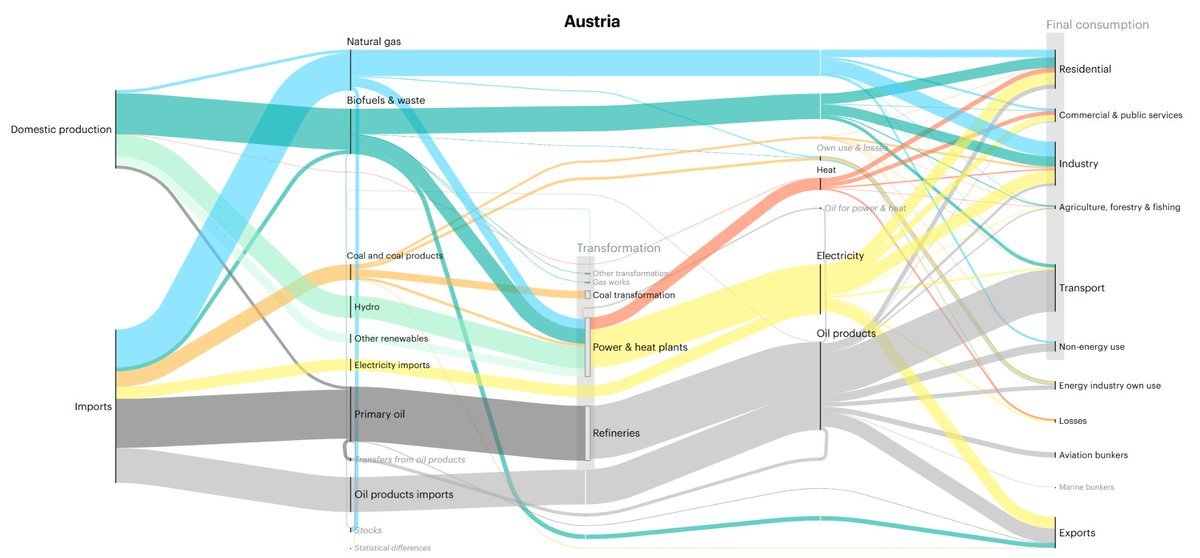
We continue to analyze countries’ energy mixes with great charts Sankey charts make this very easy to follow. On the left, you see the source of energy. In the middle, how it is transformed. On the right, where it is finally consumed. By simply following the flows, you can quickly get a clear picture of how each system works. Featuring countries: Austria, Bulgaria, Czechia, Germany, Slovak Republic, Tunusia, the United Kingdom, and Zimbabwe. Austria Austria remains highly import-dependent, particularly for fossil fuels such as oil, coal, and natural gas. Domestic production plays a limited role, making the country vulnerable to external shocks. Natural gas stands out as a central pillar, feeding both power generation and heating. At the same time, oil products remain critical, especially in transport and industrial use On the power side, the system is relatively diversified. Electricity is generated from a mix of gas, coal, and renewables, with hydro playing a notable role. Another key feature is the electricity-intensive structure of the economy. A significant share of primary energy is converted into electricity, supporting industrial activity. In fact, industry emerges as one of the main demand centers, alongside transport. Source: @IEA
World Data Analysis tweet media
World Data Analysis@World_Data_A

Energy mix We’re continuing with some of the best charts to understand energy mixes across countries Featuring countries: Chinese Taipei/Taiwan, India, Indonesia, Japan and Türkiye This time with fewer countries to make it easier to follow. This set focuses on some of the leading manufacturing economies. For how to read the charts, please see the quoted post. Chinese Taipei/Taiwan Import-dependent system: Energy supply relies heavily on imports, especially coal, oil and natural gas. Natural gas is key: A large share of power generation comes from natural gas, making it central to the system. Coal still matters: Coal remains an important input for electricity, though less dominant than in the past. Oil dominates end use: Oil products play a major role, especially in transport and non-energy uses. Electricity-driven economy: A significant portion of energy is converted into electricity, which feeds industry. Industry-focused consumption: Industrial demand is one of the largest energy users, reflecting a manufacturing-heavy economy. Limited domestic production: Local energy production is minimal, increasing external dependency. Complex transformation system: Strong role of power plants and refineries shows a highly processed energy structure.

English
2
2
30
611
Cuong LE-KIEN retweetledi
Neil Sethi
Neil Sethi@neilksethi·
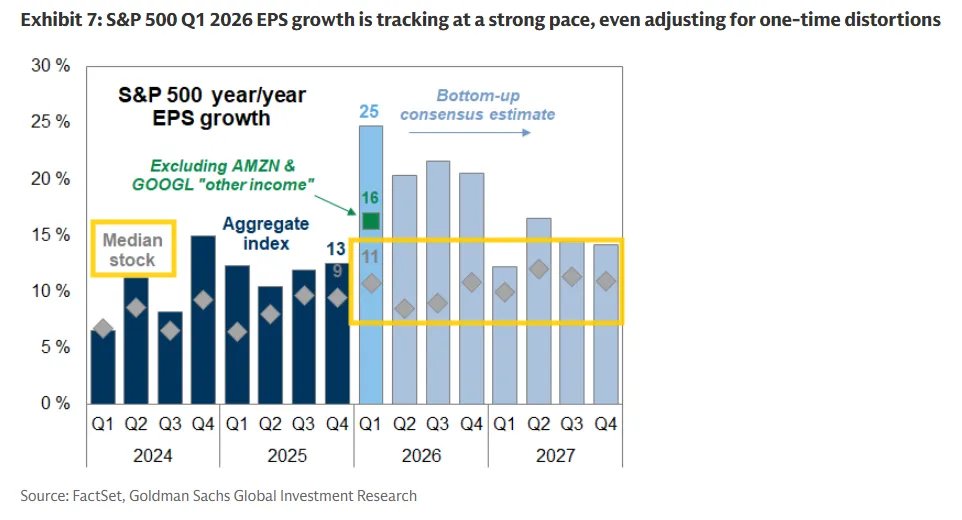
But Goldman notes even excluding the performance boost attributable to the appreciation of equity stakes in private companies for Amazon and Alphabet, “S&P 500 EPS growth would be on pace to register 16% in Q1, the strongest quarterly growth rate since 2021. Earnings growth for the median S&P 500 stock is tracking at 11%, compared with a consensus estimate of 8% ahead of the season.” They forecast the median stock to have at or near double digit earnings growth each quarter through the end of 2027.
Neil Sethi tweet media
Neil Sethi@neilksethi

Factset notes that Mag-7 GAAP earnings growth for Q1 is now expected to come in at an astounding +61.0% up from 22.4% at the end of the quarter (March 31st) with 4 of the top 5 contributors to SPX earnings growth coming from this cohort (Alphabet, NVIDIA, Amazon and Meta, the other is Micron) That said, Factset notes that the three of those who have reported though each were boosted by one-time non-cash items: "The (GAAP) EPS actual for Alphabet for Q1 2026 included a net gain of $37.7 billion primarily due to net unrealized gains on non-marketable equity securities. The (GAAP) EPS actual for Amazon.com for Q1 2026 included pre-tax gains of $16.8 billion included in non-operating income from investments in Anthropic. The (GAAP) EPS actual for Meta Platforms for Q1 2026 included an $8.03 billion income tax benefit."

English
1
3
36
4.6K
Cuong LE-KIEN retweetledi
Global Markets Investor
Global Markets Investor@GlobalMktObserv·
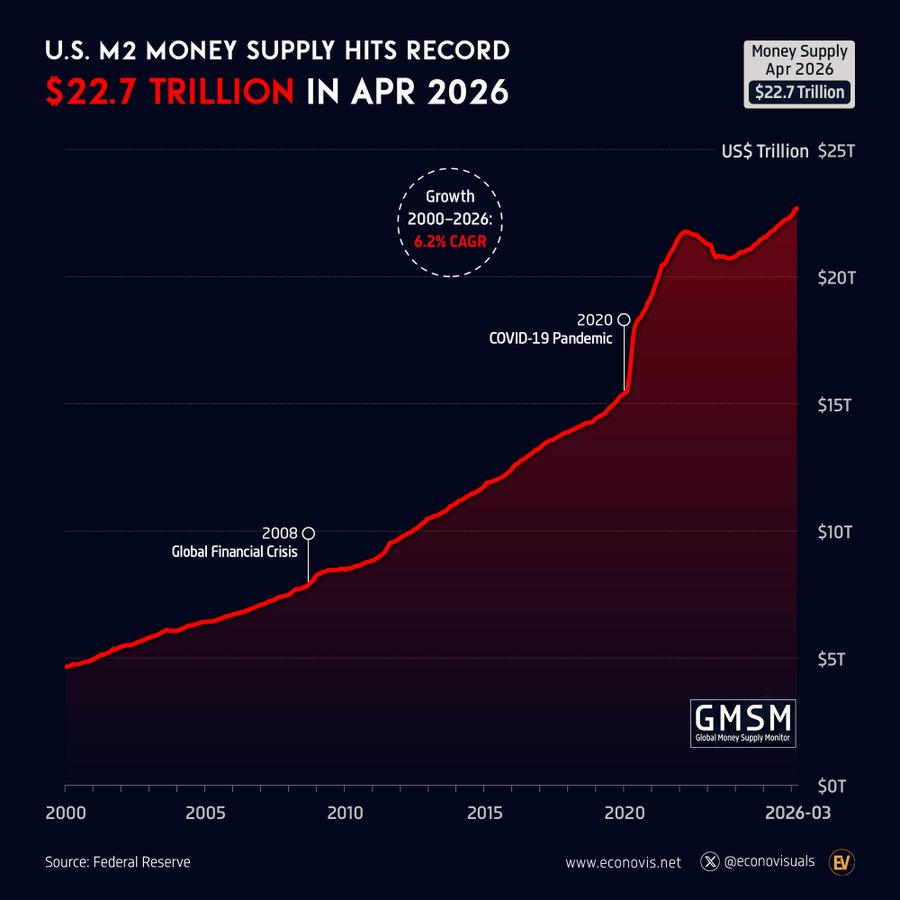
⚠️The value of the US Dollar continues to erode: US M2 money supply rose +4.6% YoY in April 2026, to a record $22.7 trillion. This surpasses the March 2022 peak by $800 BILLION now. This century, the US money supply has surged at an annual pace of +6.2%. More money than ever is circulating in the US economy. Great Chart: @econovisuals
Global Markets Investor tweet media
English
15
58
191
15.3K
Cuong LE-KIEN retweetledi
The Kobeissi Letter
The Kobeissi Letter@KobeissiLetter·
The wealth gap has never been wider: US private sector financial assets relative to US GDP are up to a record 6.7x. This means that the total value of stocks, bonds, and other financial instruments held by the private sector has never been larger relative to the real economy. This also surpasses the previous all-time high of 6.3x seen in 2021 after one of the sharpest market recoveries in history. The size of private sector financial assets relative to GDP has more than DOUBLED since the 1970s low. When financial assets outpace the real economy, the wealthy get richer, and workers get left behind. Own assets or be left behind.
The Kobeissi Letter tweet media
English
116
208
1.2K
129.1K
Cuong LE-KIEN retweetledi
Neil Sethi
Neil Sethi@neilksethi·
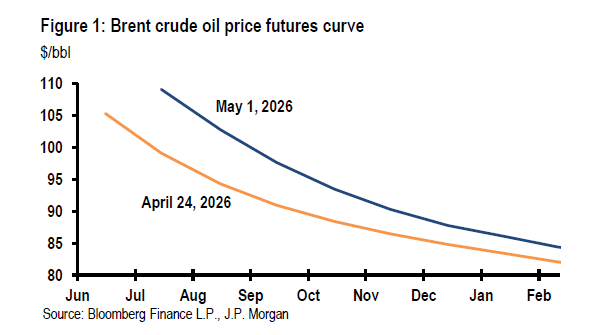
JPM (Feroli): While energy markets still appear to be pricing resolution, with December Brent at $88/bbl (Figure 1), some optimism has abated. July Brent contracts, which had hit a recent low of $87/bbl in mid-April, reached an intra-week high of $115 this week before settling back to $108. Retail gasoline also rose to $4.39/gallon on Thursday, up 41% from its 2025 average. This cannot go on forever, and with each passing day adverse scenarios become more likely. Our global economists ran through the possible implications this week, highlighting a scenario in which crude oil jumps to $150 in May–July, before settling to $110 in 4Q. Relative to a baseline that leaves oil at $100 this quarter and $80 in 4Q26, they estimate this could cut an additional 1% from global GDP and raise global inflation by a further 1.2%.
Neil Sethi tweet media
English
1
4
38
3.3K
Cuong LE-KIEN retweetledi
Global Markets Investor
Global Markets Investor@GlobalMktObserv·
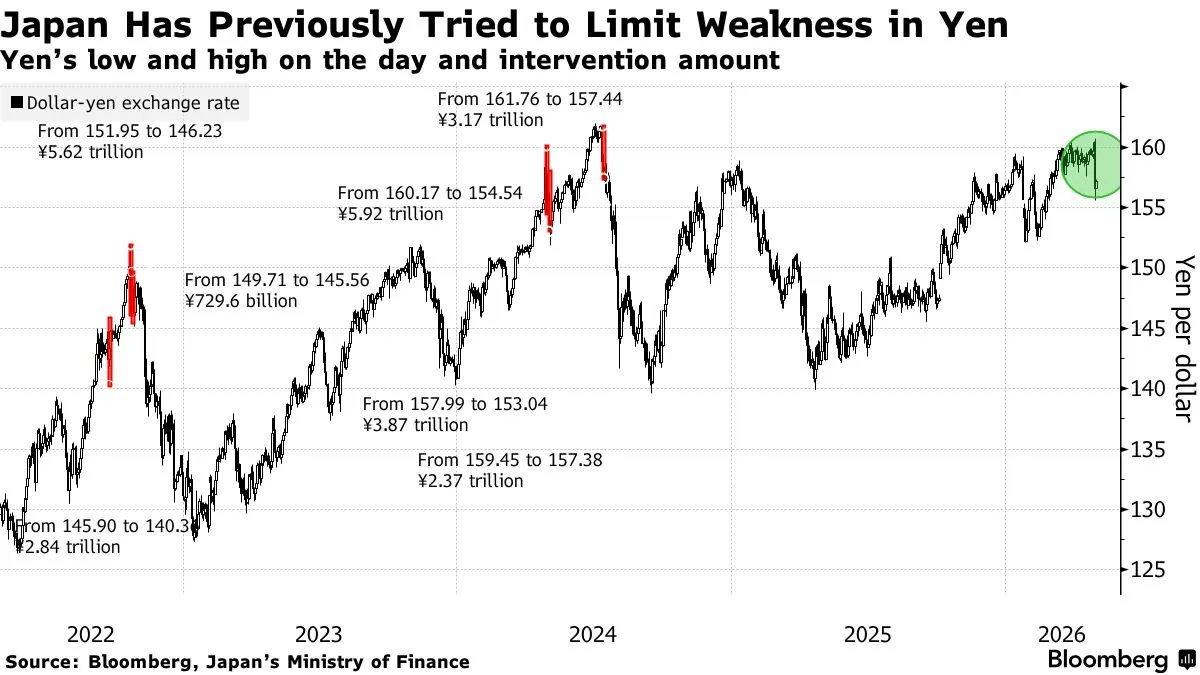
⚠️Japan has intervened in currency markets for the first time since July 2024: Japan spent ~$34.5 billion on Thursday to prop up the yen, pushing USDJPY from above 160 to as low as 155.50, its sharpest single-day rally in 3 years. Thursday's intervention generated a record daily trading volume of over $100 billion in USDJPY, surpassing all prior intervention days, according to Goldman Sachs. Japan has now spent over $100 billion defending the yen since 2022, yet the yen has continued to weaken structurally over this period. Japanese authorities have also warned energy markets that they are ready to intervene in CRUDE OIL FUTURES, suggesting Thursday's oil price drop was not coincidental. With the yen already drifting back toward 157 after the initial surge, traders are now watching for a second round of intervention during Japan's Golden Week holidays, a period when reduced liquidity amplifies the impact of official action. Intervention is not a long-term solution, as the only structural fix is narrowing the interest rate gap between the US and Japan through BoJ rate hikes and Fed rate cuts. Japan can buy time, but it cannot buy a stronger yen without higher interest rates.
Global Markets Investor tweet media
English
7
35
187
14.9K
Cuong LE-KIEN retweetledi
The Kobeissi Letter
The Kobeissi Letter@KobeissiLetter·
Wealthy investors are all-in on equities: Equity allocation among high-net-worth individuals is up to 65% of total assets, the highest since December 2021. This percentage has risen +7 points since 2023 and is just below the 2021 meme stock frenzy peak of 66%. By comparison, the 2020 pandemic low was 54% while the long-term average is ~57%. At the same time, cash holdings fell to 10%, the lowest since September 2018. High-net-worth individuals now hold just 18% of their capital in bonds. Risk appetite is through the roof.
The Kobeissi Letter tweet media
English
141
211
1.4K
159.5K
Cuong LE-KIEN retweetledi
The Great Martis
The Great Martis@great_martis·
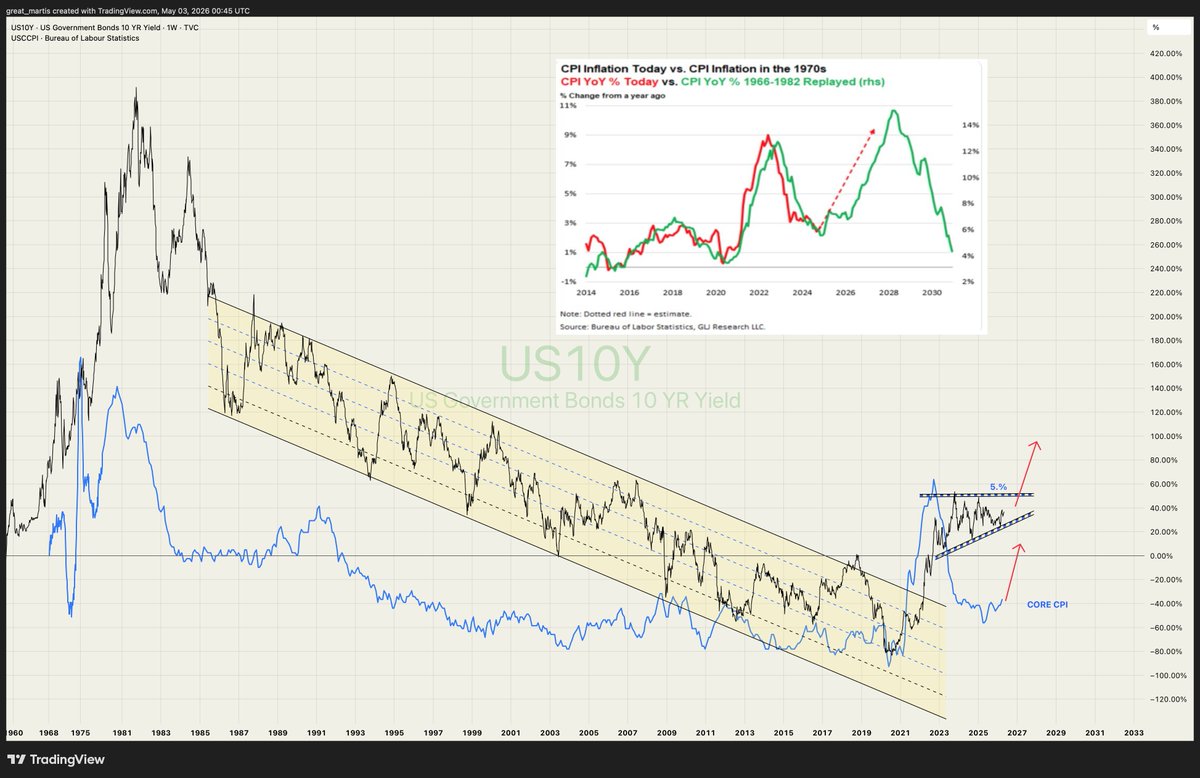
🚨 US10Y Yields Are About to Replay the 1970s Inflation Nightmare (Inflation is much higher IF we include shelter.) The message is crystal clear: we’re at the exact inflection point where the 1970s playbook restarts .. unless something breaks the cycle. The 1970s delivered 30 - 40%+ market swings (stocks, bonds, real assets) during that era of reckless government intervention .. wage/price controls, endless fiscal stimulus, the end of Bretton Woods, oil shocks, and monetary chaos. Volatility was brutal because the system was levered to the hilt and policymakers kept kicking the can. Sound familiar? Here’s what awaits if we DON’T get a proper deleveraging event now: US10Y yields rip sharply higher bond prices get obliterated, mortgage rates explode, corporate refinancing becomes impossible. Persistent/re-accelerating inflation erodes real wages and savings while the debt supercycle rolls on. Equities face stagflation-style 30 - 40%+ drawdowns (or worse) as higher yields suck liquidity out of risk assets. The chart isn’t predicting rain… it’s showing you the storm is already forming on the exact same coordinates as the last one. Deleveraging is coming .... either the controlled, painful kind (recession + tight policy) or the disorderly kind (inflationary blow-off + 1970s-style chaos). Markets don’t let you run trillion dollar deficits and zero real rates forever. History doesn’t repeat… but it sure as hell rhymes. Yours truly, The Great Martis✨ She's beautiful .
The Great Martis tweet media
English
15
160
861
54.8K
Cuong LE-KIEN retweetledi
Hedgeye
Hedgeye@Hedgeye·
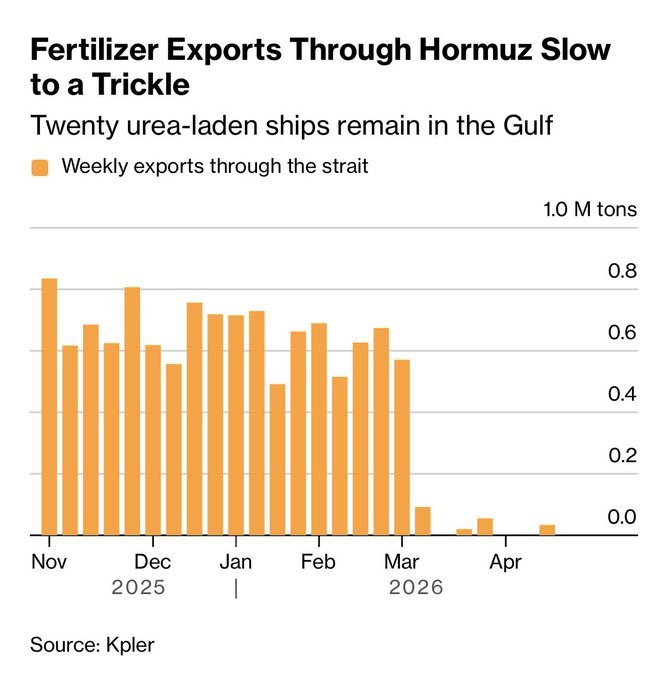
🌾 Hormuz Fertilizer Shock: The Strait of Hormuz carries about a third of globally traded fertilizer — roughly 16 million tonnes a year of nitrogen, phosphate, and sulfur products. Since the U.S. and Israel struck Iran on Feb. 28, daily Hormuz transits have collapsed from over 100 vessels to single digits. CRU estimates 55-60% of Middle East urea output is now offline. Twenty urea-laden ships remain stranded in the Gulf. Urea averaged $725/metric tonne in March, the highest level since April 2022. The Gulf produces nearly half the world’s urea, and there are no strategic fertilizer reserves to draw from.
Hedgeye tweet media
English
14
167
435
80.5K
Cuong LE-KIEN retweetledi
The White House
The White House@WhiteHouse·
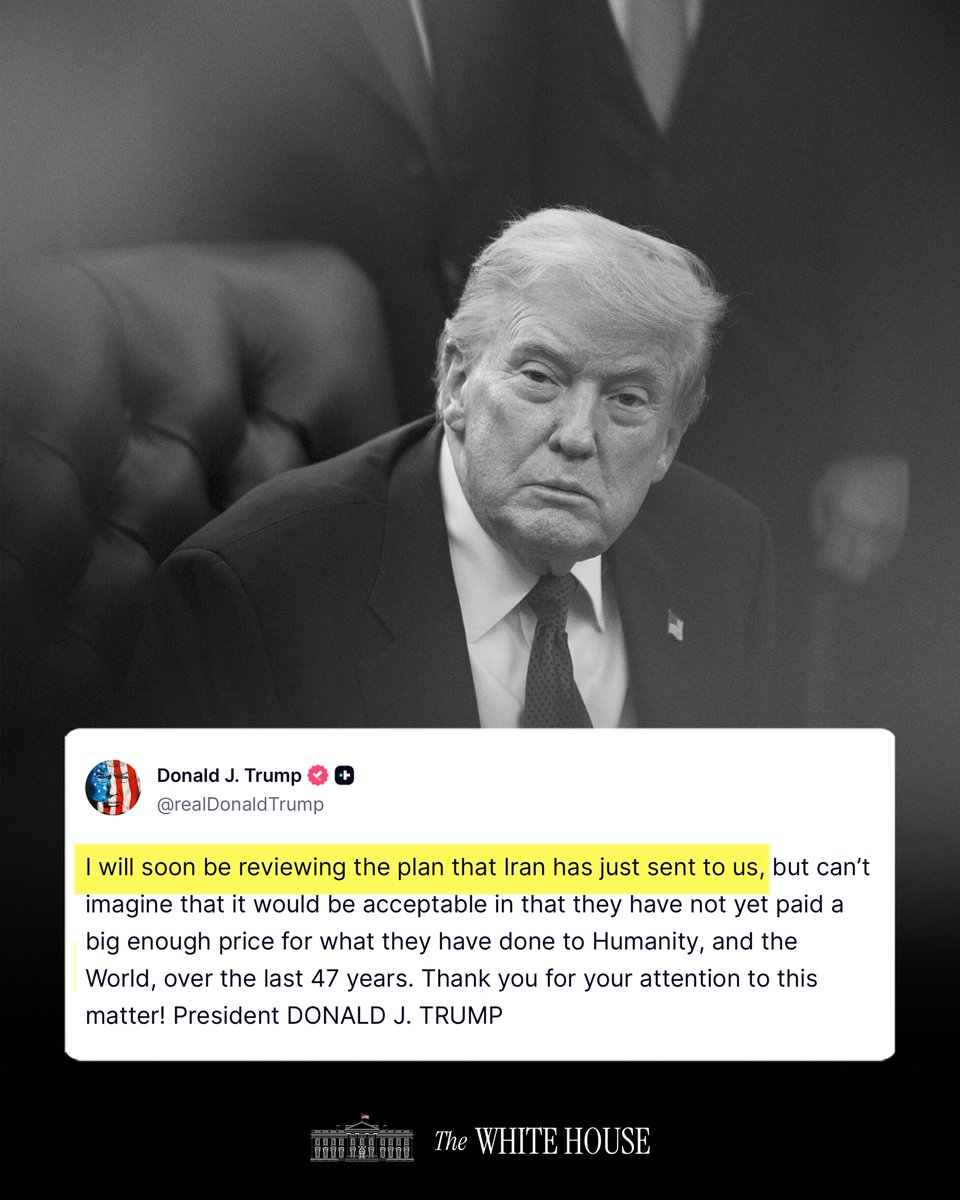
"I will soon be reviewing the plan that Iran has just sent to us, but can’t imagine that it would be acceptable in that they have not yet paid a big enough price for what they have done to Humanity, and the World, over the last 47 years..." - President Donald J. Trump
The White House tweet media
English
10.3K
8K
29.4K
975.3K
Cuong LE-KIEN retweetledi
James E. Thorne
James E. Thorne@DrJStrategy·
Sec Bessent gets it. Iran settles much of its oil trade in Chinese yuan, a web of exchange houses has become the critical plumbing that turns petroyuan receipts into hard currency for the IRGC, its partners, and its proxies. This web is being attacked. In the great new game, king dollar returns, not as an unquestioned hegemon, but as the anchor of a coordinated military and financial campaign to cut off state‑sponsored terror at its source. The world is witnessing an historic, synchronized effort, naval blockades, secondary sanctions, and “Economic Fury” to sever Iran’s ability to generate, move, and repatriate funds, and to end the nuclear shadow it casts over the region. Pax Americana is dead; a new great game is beginning, and the world is watching peace through strength in action as Treasury and the fleet move in tandem to go after the head of the snake and the petroyuan channels that keep it alive.
Treasury Secretary Scott Bessent@SecScottBessent

Amid the impact of Economic Fury, Iran’s currency has hit an all-time low. The Iranian people deserve a new era, which the corrupt and shambolic Iranian regime cannot provide. With their oil industry closing and their currency plummeting, it is past time for the Iranian regime to concede that the people of Iran deserve much better than the ruins of their current regime can provide.

English
69
274
1.2K
101.6K
Cuong LE-KIEN retweetledi
The Market Mind
The Market Mind@Market_Mind_·
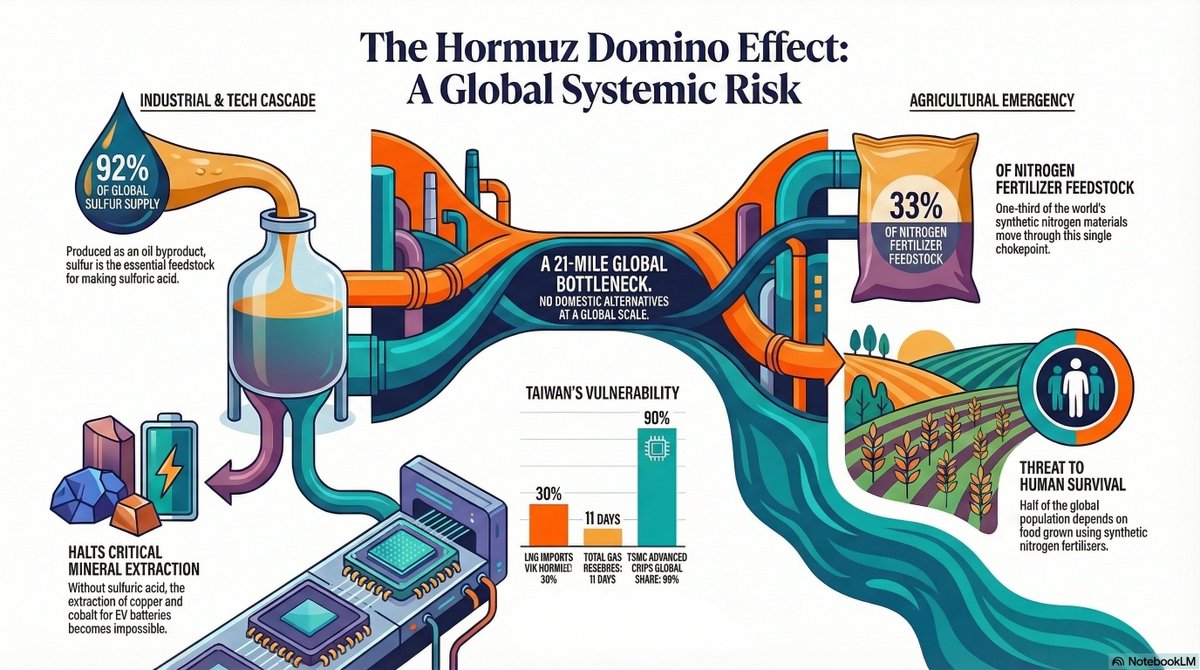
The Strait of Hormuz has been closed. Most people think this is about oil. It isn’t. It’s about what oil becomes. Around 92% of the world’s sulfur is produced as a byproduct of refining oil and natural gas. When the Strait of Hormuz shuts down, the world doesn’t just lose 20 million barrels of crude per day. It loses the feedstock for sulfuric acid — the most produced chemical on Earth. Sulfuric acid is how we extract copper. It’s how we extract cobalt. Without it, you can’t manufacture transformers, EV batteries, or the electronic substrates inside every data center on the planet. One chemical. From one feedstock. Moving through one chokepoint. And the cascade doesn’t stop there. About 30% of Taiwan’s liquefied natural gas from Qatar passes through the Strait of Hormuz. Taiwan reportedly holds about 11 days of reserves. Now consider this: Taiwan Semiconductor Manufacturing Company (TSMC) produces around 90% of the world’s advanced chips and consumes 8.9% of Taiwan’s total electricity. No gas → no power → no chips. Then comes food. Roughly 33% of the world’s nitrogen fertilizer feedstock also moves through the Strait of Hormuz. Synthetic nitrogen fertilizers support the agriculture that feeds billions. In fact, about half of all humans alive today depend on food made possible by synthetic nitrogen. So this isn’t just about energy. It’s about sulfur, semiconductors, and food. Three critical supply chains. One 21-nautical-mile chokepoint. And no domestic alternatives at global scale.
The Market Mind tweet media
English
3
75
159
7K
Cuong LE-KIEN retweetledi
Global Markets Investor
Global Markets Investor@GlobalMktObserv·
⚠️HOLY COW: Semiconductor stocks now represent a RECORD 14% of the total US stock market cap. This share has more than TRIPLED over the last 3 years. The percentage is now 2 TIMES HIGHER than at the 2000 Dot-Com Bubble peak of 7%.👇 globalmarketsinvestor.beehiiv.com/p/the-s-p-500-…
English
5
16
79
5.2K
Cuong LE-KIEN retweetledi
World Data Analysis
World Data Analysis@World_Data_A·
Huge gaps in meat consumption across countries India and Pakistan compared to other countries Let’s start with the most striking comparison: India vs Austria, the United States, and Argentina India: ~2.5 kg per capita Australia / USA: ~80 kg Argentina: ~75 kg This means: People in these countries consume ~30–32 times more meat than in India. What the broader data shows 1. Strong growth over time: Most countries, including India, Pakistan, Türkiye, Japan, Malaysia, Kazakhstan, China, and the United Kingdom, have increased meat consumption between 2015 and 2025. 2. Very high levels in developed markets: Countries like the United States, Australia, and Argentina remain at the top, with consumption levels around 75–80 kg per capita, Korea and the European Union also show relatively high levels. 3. Some declines despite high levels: A few economies , notably the European Union, New Zealand, and Argentina, show slight declines in per capita consumption 4. Convergence, but still far apart: Lower-consumption countries like India and Pakistan are gradually closing, while middle-tier countries like Türkiye, Malaysia, Kazakhstan, China, and Brazil continue to close the gap. Meat consumption usually reflects: * income levels * cultural preferences * agricultural systems * access and affordability Note: Meat includes beef, lamb, pork, and poultry. Source: @OECD
World Data Analysis tweet media
English
7
5
31
1.3K
Cuong LE-KIEN retweetledi
China pulse 🇨🇳
China pulse 🇨🇳@Eng_china5·
JUST IN AND UNUSUAL China pushes back against U.S. sanctions and moves to shield its oil companies with an official order. In a firm step underscoring its defense of national interests, China’s Ministry of Commerce announced a judicial order prohibiting the enforcement or compliance with U.S. sanctions imposed on five Chinese petrochemical companies accused by Washington of purchasing Iranian oil. According to the state‑run Xinhua News Agency, Beijing reiterated that it does not recognize unilateral U.S. measures, stressing that foreign sanctions carry no legal validity inside China. The decision reflects China’s insistence on economic sovereignty, its rejection of sanctions as a political pressure tool, and its commitment to protecting its companies and energy supply chains from external interference.
English
45
816
2.5K
119.7K
Cuong LE-KIEN retweetledi
Mossad Commentary
Mossad Commentary@MOSSADil·
🇮🇷 ANALYSIS ON WHERE IRAN CONFLICT STANDS U.S. blockade of Iranian ports has cost Tehran ~$4.8B in lost oil revenue and forced 48 vessels to turn back under “Operation Economic Fury.” Donald Trump calls it “very profitable,” warns Iran’s proposal is likely unacceptable, and signals a potential “final blow” option remains on the table. Meanwhile, Gulf states are feeling the effects: Kuwait exported zero crude for the first time since the Gulf War, Qatar halted LNG production after strikes, Bahrain paused gas exports, and the United Arab Emirates faces damage to key aluminum production. (Newsweek)
Mossad Commentary tweet media
English
8
70
354
19.8K