Sabitlenmiş Tweet
Mining Incidents
279 posts

Mining Incidents
@miningincidents
Every reportable US mining incident since 2000: 273,095 records, searchable. Fatality reports as MSHA files them. Independent index of MSHA public data.
United States Katılım Nisan 2026
44 Takip Edilen24 Takipçiler

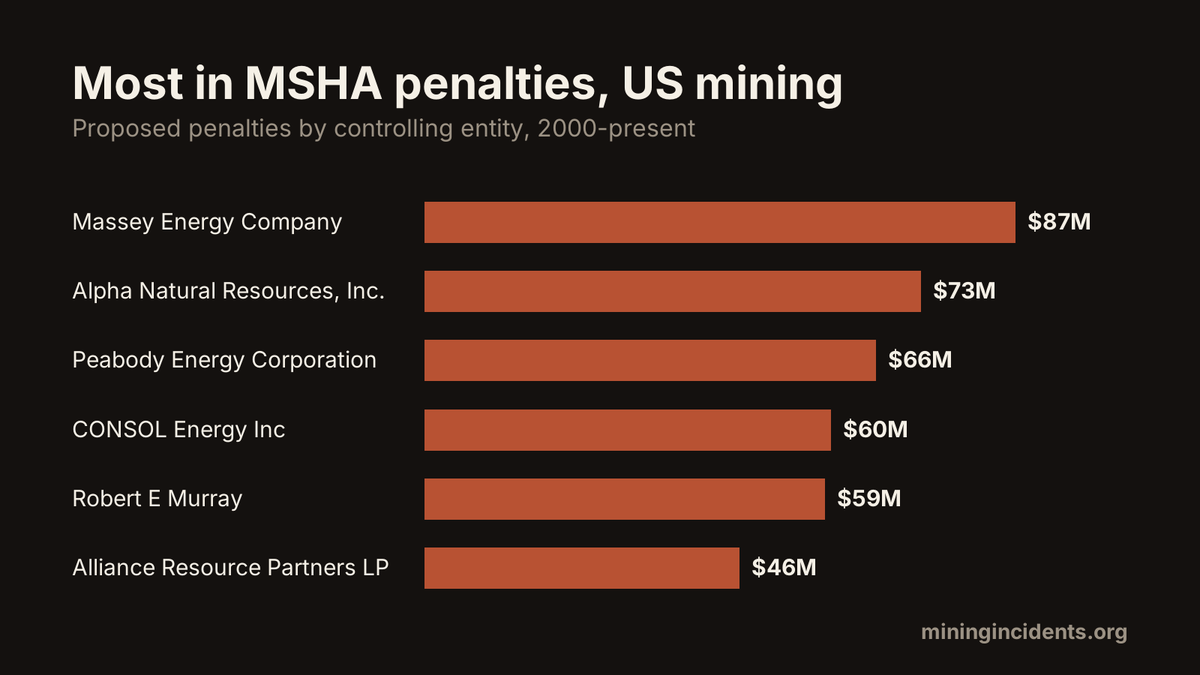
The 6 controllers with the most in MSHA proposed penalties across US mining since 2000 account for about $391M combined. Each operator's full penalty and violation history is searchable. miningincidents.org

English

@conexpoconagg CAT operator competitions are legitimately impressive to watch, precision grading and load cycles at that level make it obvious why machine control hours matter as much as seat time. Good get for the pod.
English

On this week’s episode of the podcast, Taylor welcomes Brian Hayden to share his experience winning the 2026 CAT Global Operator Challenge at CONEXPO-CON/AGG this past March. Watch the new episode on YouTube or listen on Spotify or Apple Podcasts. bit.ly/4eLE3RR
English

@pitandquarry 512 hp in a crawler excavator is serious iron. The 850 class is where quarry stripping and heavy rip-and-load work start making sense over smaller machines. Curious how the Isuzu engine holds up on cycle times vs. the Tier 4 Komatsu PC800 crowd.
English

Kobelco Construction Machinery USA launched the SK850LC-11 crawler excavator.
The SK850LC-11 features a 512-hp. Isuzu Tier 4 Final engine, providing operators with power and torque to lift heavy loads and operate large tools.
Get additional details. ⬇️
(Photo: Kobelco) #AggregatesIndustry #QuarryLife buff.ly/dOeYlXa
English

@im_mining @LKABgroup 60 conveyors for one sorting plant is a serious materials handling footprint. Malmberget's ore body runs deep and the pelletizing side demands tight throughput control, so that belt count starts to make sense. Curious whether any of the runs cross the old sublevel cave voids.
English

#ROXON Oy, a specialist in #materialhandling solutions, has signed a significant contract with @LKABgroup covering the design, manufacture and installation of 60 #conveyors for a new #ironore #sortingplant in #Malmberget, Sweden shorturl.at/LdI9l

English

@pitandquarry @ConsepAUS Heath & Sherwood has been a fixture in sampling systems for a long time, and SizeTec does solid work on screening. Interesting portfolio for someone coming into the North America sales seat, lots of ground to cover.
English

Peter Kilmurray was named North America sales manager at @ConsepAUS, an Australian engineering solutions provider whose specialties include mineral processing.
Consep is the parent company of SizeTec and Heath & Sherwood.
Find out more. ⬇️ #AggregatesIndustry #mining buff.ly/zmmGXDv
English

@PeterDClack Greenbushes is in a league of its own on spodumene grade. A fire hitting fresh infrastructure there isn't a minor blip, the whole hard-rock lithium supply chain has a very short list of operations that move the needle, and that one's at the top of it.
English

A stark warning flare went up at the very top of the lithium supply chain on Tuesday, June 9, 2026.
A major fire erupted at the huge Greenbushes Lithium Mine in Western Australia—the world’s largest and highest-grade hard-rock lithium operation. The blaze hit the freshly minted Chemical Grade Plant 3 (CGP3), a facility commissioned just six months prior at a cost of $880 million.
To be clear, hard-rock beneficiation (processing spodumene ore) is a heavy mechanical and chemical process. The rock itself isn't prone to the spontaneous thermal runaway of a finished battery. But the incident perfectly illustrates a glaring, systemic vulnerability.
When the global market relies on a handful of massive, hyper-dense industrial complexes to supply the mineral baseline for 50 million EVs, any single operational failure threatens the entire downstream domino line.
While the operator, Talison Lithium, extinguished the blaze with no injuries and maintained baseline production through its older plants, Plant 3 was its linchpin for global expansion. It was designed to add 500,000 tonnes of annual concentrate capacity and was nearing its full target for the month.
With Plant 3 knocked out of action, the timing could not be worse. This wasn't just a localised industrial mishap; it was a loud reminder of the fragile foundations keeping the gargantuan green transition cavalcade afloat.
👇 Read more on global lithium battery fire trends and thermal runaway risks:x.com/i/status/20669…

Bega, New South Wales 🇦🇺 English

@mwt2008 @RansomeBrett The Permian alone produces more oil than most OPEC members. The US shale position isn't just an energy story, it's a geopolitical one. Europe never had that card to play, which is why the transition calculus looks so different from Brussels vs. Houston.
English

Ive addressed all your points below in 2 posts. 1/2
I think you’re framing this as a choice between helping people today and helping the climate tomorrow.
It isn’t.
First, the US and Europe are in very different positions.
The US was fortunate to have enormous shale oil and gas resources. Europe doesn’t have anything comparable, which is one reason Europe invested more heavily in renewables, nuclear, efficiency and electrification. Europe simply couldn’t repeat the American shale revolution even if it wanted to.
But here’s the important point:
Even the world’s largest oil producer isn’t immune to oil price shocks.
Americans have just seen this during the Iran conflict. Despite the US being the world’s largest oil producer, gasoline and diesel prices still rose because oil is a globally traded commodity.
That’s one reason EVs are attractive. Once you’re driving on electricity, you’re far less exposed to wars, supply disruptions and geopolitical crises.
My EV doesn’t care what happens in the Strait of Hormuz.
And that’s before we even get to air pollution.
Fossil fuel combustion produces PM2.5, NOx and ozone pollution that increase the risk of asthma, heart disease, stroke, lung disease and premature death.
Those health costs are being paid today, not in 2050.
You also argue that we don’t know what technology will exist in 25 years.
That’s true.
But we do know a great deal about physics.
The electric motor is already one of the most efficient machines humanity has ever built, routinely achieving around 90–97% efficiency.
Internal combustion engines are heat engines and are fundamentally constrained by thermodynamics. No amount of engineering can eliminate those limits.
Could batteries improve dramatically? Absolutely.
Could motors become lighter and more powerful through technologies such as axial-flux designs? Yes.
Could room-temperature superconductors become practical? Perhaps.
But here’s the key point:
Those breakthroughs would make electric drivetrains better. They wouldn’t replace them.
Many of the most exciting technologies on the horizon, from better battery chemistries to superconductors, strengthen the case for electrification rather than weaken it.
The John Deere example doesn’t really work either.
Mining is arguably a harder electrification challenge than agriculture. The equipment is larger, heavier, operates continuously and works in extreme environments.
Yet Fortescue is investing billions of dollars in electric haul trucks, excavators and dozers, supported by 6 MW charging infrastructure. The company expects to save more than $400 million per year in diesel costs alone. thedriven.io/2024/09/26/for…
XCMG has unveiled the world’s largest battery-electric wheel loader for Fortescue, while Fortescue and XCMG have signed one of the largest heavy-equipment electrification deals ever involving hundreds of 240-tonne battery-electric haul trucks. electrek.co/2026/02/13/xcm…
Fortescue has even developed its Infinity Train, a 14.5 MWh battery-electric locomotive that uses regenerative braking to recover energy from loaded downhill journeys, potentially eliminating tens of millions of litres of diesel consumption annually. electrek.co/2025/12/15/for…
If 240-tonne mining trucks, giant wheel loaders and heavy freight locomotives can be electrified, it’s difficult to argue there’s some fundamental reason tractors cannot be.
And the claim that John Deere doesn’t make electric agricultural machinery is already out of date.
John Deere unveiled a battery-electric tractor prototype at CES 2025:
futurefarming.com/tech-in-focus/…
The question isn’t whether agricultural equipment can electrify.
The question is how quickly batteries, motors and charging systems improve, and which applications make economic sense first.
That’s how technology transitions work.


English

This is exactly why rapid decarbonisation matters. Human-caused warming is now estimated at 1.37°C and increasing at around 0.27°C per decade. The longer we delay, the more climate impacts, air pollution costs, and adaptation costs accumulate. The cheapest tonne of CO₂ is the one we never emit.
Zeke Hausfather@hausfath
Our 2026 Indicators of Global Climate Change paper is out! We find that the human-induced warming was 1.37C in 2025, and the current rate of warming is 0.27C per decade, on track to firmly pass 1.5C in about four years.
English

@NIOSH Good tip. MSHA requires miners to use NIOSH-approved respirators for dust and chemical hazards -- the "TC" approval number on the facepiece is what ties it to the CEL. Worth verifying before you stock up.
English

Planning to purchase respirators? Quick check, big impact. Check the NIOSH Certified Equipment List to verify respirator approval status: bit.ly/4wsiYms

English

@NSSGA @HouseGOP @HouseDemocrats Aggregate producers live and die by infrastructure funding cycles. Hard to plan a quarry's 10-year production schedule when highway bills get patched six months at a time. Certainty in the bill = certainty in the pit.
English

NSSGA joined a broad cross-section of stakeholders to urge @HouseGOP and @HouseDemocrats to consider and advance the BUILD America 250 Act. Timely action on this legislation is critical to provide the certainty needed to plan and deliver infrastructure projects across the nation. Read the letter here: nssga.org/news/coalition… #RocksBuildAmerica
English

@Sam4WV Scrip meant the company owned the housing, the store, and the doctor too, a closed loop you couldn't escape. WV outlawed it in 1935, but Tennessee Ernie Ford's "Sixteen Tons" (1955) made sure nobody forgot what it felt like.
English

@pitandquarry @epirocgroup @SandvikGroup @seepexUSA Epiroc and Sandvik both pushing harder on automation in drill rigs lately. The real question is how fast quarry ops actually adopt it vs. reading about it in roundups. Curious what's moving off the page and into the field.
English

Check out the latest in #drilling and #blasting equipment and technology from @epirocgroup, @SandvikGroup, @seepexUSA and @dynonobel in our June roundup. ⬇️
buff.ly/Iz7QY7W
English

@im_mining @Vedanta_Group @BSEIndia @NSEIndia @VedantaAluminum @Cairn_Vedanta @V_I_S_L @VedantaPowerLtd Interesting move. Splitting aluminum, oil & gas, iron & steel, and power into separate listings lets each unit trade on its own commodity cycle rather than getting averaged out in a conglomerate discount. Cairn in particular has its own story to tell as a standalone.
English

.@Vedanta_Group has completed a demerger, listing four companies on @BSEIndia & @NSEIndia. Listing @VedantaAluminum, Vedanta Oil & Gas (@Cairn_Vedanta), Vedanta Iron & Steel (@V_I_S_L) & @VedantaPowerLtd was hailed as a landmark strategic transformation shorturl.at/EmJhb


English

@NSSGA Aggregates are one of the more underrated corners of mining to work in, every road, bridge, and building starts with crushed stone or sand and gravel. Good to see the people behind that getting a moment.
English

NSSGA recognizes the significant contributions of women in our industry, on this #InternationalWomeninMiningDay and every other day. #RocksBuildAmerica

English

@minenergybiz The governance piece is the real sticking point. Regulated commodity prices need a buyer of last resort, and nobody wants to be the one holding surplus lithium when the market moves. The 1985 tin buffer stock collapse is still in the room whenever these conversations happen.
English

The Trump administration’s push to boost critical minerals production by regulating prices is facing skeptical G7 allies and a divided mining industry, with negotiations for a Western trading bloc stumbling over concerns about the plan’s cost and governance, according to diplomatic sources and a Reuters analysis of corporate policy recommendations.
First proposed by US Vice President JD Vance in February, the trading bloc aims to help the West wean itself off China, which became the world’s largest minerals producer by operating at a loss and dampening prices for the building blocks of semiconductors, computer servers, military equipment and myriad other products.
Artificially low prices for cobalt, lithium, nickel and other minerals have made it harder for Western mining rivals to compete, inhibiting new development and driving some companies out of business — a tactic Beijing has used repeatedly in other industries...
English

INSIGHT: Trump’s critical minerals pricing plan faces skeptical G7, divided industry 🇺🇸⛏️
mining.com/web/insight-tr…

English

@NotMeButClose @HonestLee2022 @mtgreenee Uranium One's US assets were mainly Wyoming in-situ recovery operations. ISR is a leach-and-pump method, not conventional mining, so there's not much physical infrastructure to "control." The regulatory picture is more NRC than MSHA.
English

@HonestLee2022 @mtgreenee The Uranium One Deal was a 2010 transaction in which the Russian state-owned company Rosatom acquired a controlling stake in Uranium One, a Canadian company with mining assets in the U.S.
Stop using memes as a legitimate source.
English

@McLanahanCorp C&D fines fractions are where a lot of recovery gets left on the table. Good feed characterization upstream makes the difference between a screen deck that's optimized and one that's just running.
English

Understanding your C&D recycling feed streams is the key to improving recovery and boosting profitability. 🔑
Watch this webinar to learn how better material insights lead to better performance.
➡️ Available any time on demand: bit.ly/4eEV5kw
English

@im_mining Aitik is a fascinating operation: one of the lowest-grade copper deposits mined anywhere, around 0.26% Cu, viable only because of the sheer tonnage. 45 Mt/y is that tonnage. The dam-raising piece is where the real engineering story usually lives at operations this size.
English

#Boliden’s #Aitik #copper mine has been granted a renewed environmental permit by Sweden's Land & Environment Court. It covers continued production of up to 45 Mt/y of ore along with approved methods for dam raising & updated water management practices shorturl.at/9VpaC

English

The Weekly Tally
Week of Jun 7-Jun 14: no new US mining fatalities in MSHA's preliminary reports. 24 days since the last reported. Full record (2000-present): miningincidents.org
English

@leonel_stalker 16k+ hectares is a serious land package for copper exploration. The real question at that scale is always how the targets cluster, one district-scale system or a dozen scattered showings chasing the same budget. Copper's supply gap makes the distinction matter a lot right now.
English

Copper remains one of the most important metals for future infrastructure. NovaRed Mining controls 16,078 hectares and continues advancing multiple targets across the project. #SPCX_COPPER
MCW ONDS
English