Moisés Cabello

8.4K posts

Moisés Cabello banner
Moisés Cabello

Moisés Cabello

@moisescabello81

TI | Inteligencia Artificial | Formación

Tenerife, Canarias, España. Katılım Eylül 2022
488 Takip Edilen294 Takipçiler
Sabitlenmiş Tweet
Moisés Cabello
Moisés Cabello@moisescabello81·
La IA generativa mueve más dinero que la carrera espacial, pero nació en un grupo tan pequeño que sus protagonistas compartían casa. He escrito la historia de Anthropic con énfasis en el factor humano, sorprendentemente importante en un sector así. Primer capítulo 👇
Moisés Cabello tweet media
Español
1
2
4
147
Moisés Cabello retweetledi
Jesús Manuel Pérez Triana 🌻
Putin llamó cerdos a los líderes europeos que apoyan a Ucrania. Desde una cuenta oficial de Francia respondieron con una cita de Porco Rosso: "Prefiero ser un cerdo a un fascista". Y ahora Hayao Miyazaki ha tenido un detalle con el presidente de la República Francesa.
Emmanuel Macron@EmmanuelMacron

Porco Rosso oppose à la brutalité du monde une irréductible idée de liberté. À l’heure où nous devons défendre la paix, nos démocraties et la liberté, Porco Rosso ! Merci infiniment Hayao Miyazaki pour cette œuvre que je reçois avec une profonde gratitude.

Español
5
107
470
14.2K
Moisés Cabello retweetledi
Antonio Ortiz
Antonio Ortiz@antonello·
Los costes de las baterías han disminuido un 99% en las últimas tres décadas. Era un requisito para tener coches eléctricos más baratos (En China, algunos de los coches eléctricos más vendidos cuestan ahora tan solo 10.000 dólares). ourworldindata.org/battery-price-…
Antonio Ortiz tweet media
Español
4
3
19
1.1K
Moisés Cabello
Moisés Cabello@moisescabello81·
@barckcode Madre mía, ¡enhorabuena por el curro en ese tiempo muchacho! 👏👏👏
Español
0
0
0
353
Cristian Córdova 🐧
Cristian Córdova 🐧@barckcode·
👀 He estado analizando todo el supuesto código de Claude Code para entender mejor cómo funciona por detrás y así intentar sacarle más partido a nivel usuario. Algunas cosas interesantes que veo y que algunas de ellas no sabía: - El system prompt tiene algunas reglas curiosas como que no debe usar emojis salvo que se le pida, tiene un cyber risk y no da estimaciones de tiempo (en esto último se parece a cualquier dev xD) - Tiene 45 Tools y algunas de ellas se le dice explicitament que debe usarlas por encima de herramientas CLI del sistema (Bash). - Tiene 6 tipos de agentes built-in para diferentes propósitos como por ejemplo cuando entra en "Plan Mode". Cada uno tira de un modelo concreto. - Tiene memoria basada en ficheros como sabemos pero hace taxonomía por perfil de usuario (como nos conoce), por feedback (lo que le vamos diciendo, corrigiendo, etc), por project (conocimiento del código, lo que se hizo con él, etc) y por reference (punteros a sistemas externos, como Linear, GH, etc) - El MEMORY.md debe tener máximo 200 líneas. Si se pasa de ahí. Claude Code simplemente parece que lo ignora. - El patrón para implementar decisiones de permisos se hace a través de instrucciones escitas en ficheros XML. Y lo curioso es que gasta entre 64 y 4096 que el agente tome la decisión de saber si ejecuta algo o no y si tiene permisos o no. - Por defecto, la ventana de contexto se compacta en ~13,000 tokens y tras esto tienen un budget post-compactación de 50K tokens. - Tiene un modo "Undercover" para trabajadores internos de Anthropic que oculta nombres e IDs de modelos del prompt que previene que modelos no anunciados se filtren en commits/PRs. Me podría tirar así todo el día porque hay un montón de cosas curiosas. Creo que mas bien voy a recopilar todo lo que pueda en una web a modo educativo para mí mismo y para quien le apetezca. Luego mas tarde la publicaré.
Español
23
153
1.9K
487.3K
Moisés Cabello
Moisés Cabello@moisescabello81·
@rohanpaul_ai What's noteworthy is that Anthropic hasn't said a word. Not a single comment, not a takedown... nothing.
English
1
1
8
646
Rohan Paul
Rohan Paul@rohanpaul_ai·
The 12-Hour Claude Code Saga: - Today around midday, security researcher Chaofan Shou spotted the blunder: Anthropic’s official npm package for Claude Code had accidentally shipped a massive `.map` source map file. Boom — the entire ~512,000-line TypeScript codebase (1,900+ files) was sitting wide open in their public R2 bucket. Not a hack. Just a classic “we forgot to strip debug artifacts” oops. - Within hours, mirrors flooded GitHub. One fork hit 32k stars and 44k forks faster than anything in platform history. Devs were starving for the real internals of Anthropic’s agent harness — the modular tools, prompt chaining, undercover modes, React+Ink TUI, and all the secret sauce that makes Claude Code feel like magic in your terminal. - Then the panic hit. Everyone remembered February: Anthropic had DMCA’d previous leaks in minutes. The maintainer of the hottest fork fired up OpenAI’s Codex and orchestrated a full clean-room rewrite of the entire architecture… from TypeScript → Python. Parallel review loops, persistent execution verification, the works. A 100% Python reimplementation that preserves the agent behavior, command system, and harness logic without copying a single line of proprietary code. It’s now the canonical “safe” version: 48k stars, 55.4k forks, and already spawning Rust ports and mini-forks. The repo openly says: “Better Harness Tools, not merely storing the archive.”
Rohan Paul tweet mediaRohan Paul tweet mediaRohan Paul tweet media
Rohan Paul@rohanpaul_ai

From the massive Anthropic leak of their entire Claude Code. The "Undercover Mode" is so interesting. Its a safety system that kicks in automatically whenever Claude Code is used to contribute code to public or open-source repositories (GitHub PRs, commits, etc.). The goal is to stop the AI (or the employee using it) from accidentally leaking Anthropic’s secret internal information. By default it is AUTO ON. It turns off only if the tool is 100% sure you’re inside an internal Anthropic repo (they have an allowlist). There is NO way to force it off. When undercover mode is active, Claude Code adds these instructions to every commit message and pull-request prompt: “You are operating UNDERCOVER in a PUBLIC/OPEN-SOURCE repository. … NEVER include … internal model codenames (animal names like Capybara, Tengu, etc.), unreleased model version numbers (e.g. opus-4-7, sonnet-4-8), internal repo names, the phrase ‘Claude Code’, or any hint that you are an AI.”

English
10
17
108
16.8K
Moisés Cabello retweetledi
RTVECanarias
RTVECanarias@RTVECanarias·
La densa capa de polvo en suspensión ya cubre Canarias. 📍Aeropuerto de Gran Canaria.
Español
0
26
90
6.6K
Moisés Cabello retweetledi
Derek Thompson
Derek Thompson@DKThomp·
Writing is thinking, and people who outsource the full writing process to AI will find their screens full of words and their minds empty of thought. But also: All writing involves and has always involved “outsourcing”—reaching outside of the writer’s mind to pull in pieces of the world, before and after the work of making words. Writers draw their ideas from other people, books, articles; after writing they often rely on outside copy editors, fact checkers, transcribers. Some of this stuff is just going to be done by AI in the future, and the boundaries between “good behavior” and “bad behavior” will have some blurry lines, and we should be honest and open about the blur rather than declare everybody with an open Claude window a part of the slopclass. Anybody who says AI transcription of long interviews obliterates the identity of a writer is being a little silly. But what about copy editing? Claude is a fast and decent copy editor, but it is inhuman to rely on it for that function? Is it moral to google “Econ papers on income transfers for child poverty” but immoral to write the same thing as an AI prompt? What about throwing 500 muddled words into ChatGPT and saying “does this make any sense? what do you think I’m trying to say here?” That’s going to be useful for some people. At an aesthetic level, I don’t like copy-pasting AI paragraphs into articles and pressing publish. That feels like me cheating myself. It feels like de-skilling. But the idea that “using AI” is anathema to the identity of being a writer is, in a few years, going to sound an awful lot like claiming that “using a computer” is a violation of the craft of writing. (Which, haha, maybe it is and we should all just go back to Steinbeck and his pencils; but talk about ships that have sailed.)
Emily Gould@EmilyGouldNYmag

using AI to "be a writer" is like .. playing a porn video game where you make your avatar cum

English
45
61
508
120.2K
Moisés Cabello retweetledi
Colossus
Colossus@colossusmag·
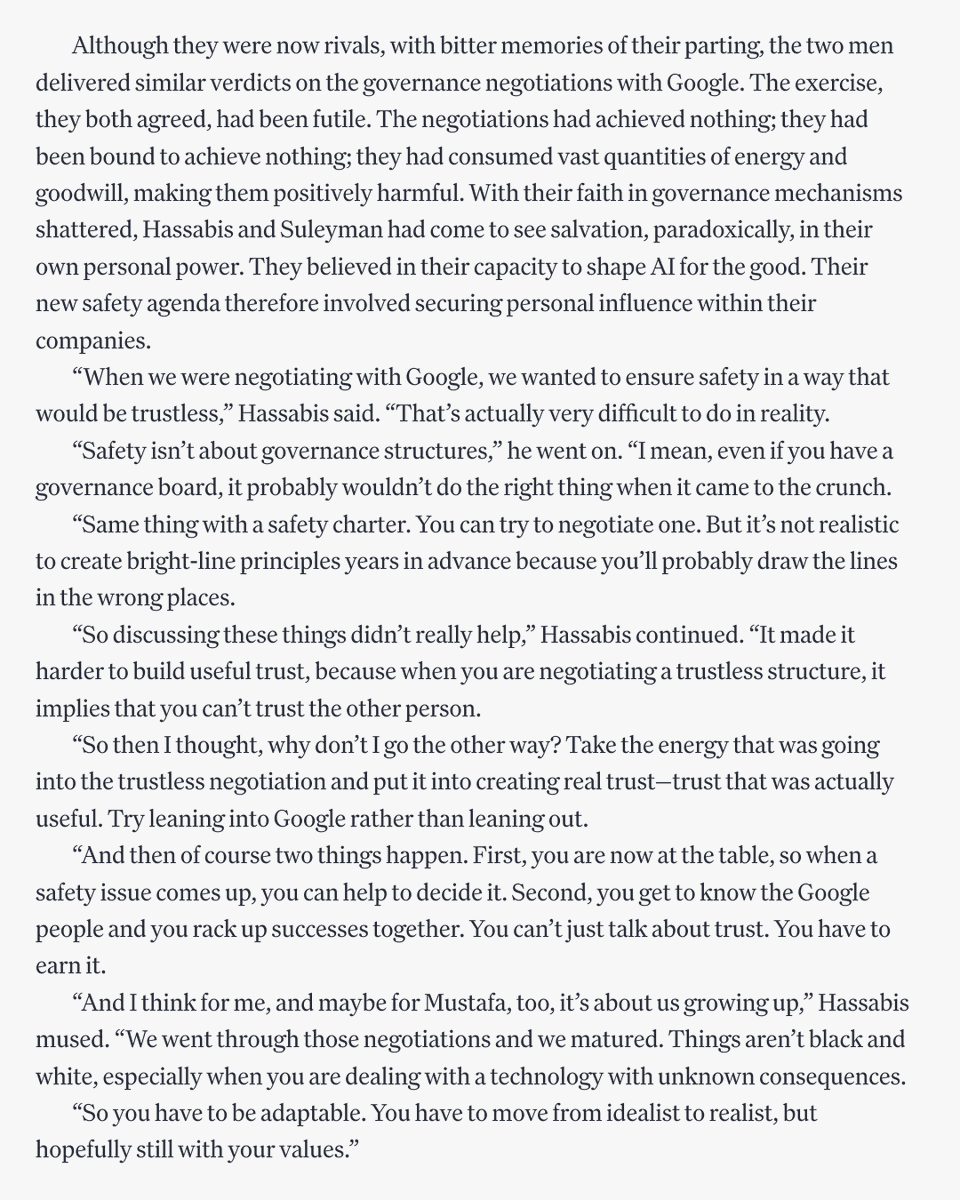
Demis Hassabis spent four years trying to build an AI safety structure that would work no matter who was in charge. Then he realized the only thing that matters is who's in charge.
Colossus tweet media
Colossus@colossusmag

We're publishing an exclusive chapter from @scmallaby's brilliant new book about Demis Hassabis and DeepMind. This is the inside story of Project Mario. How DeepMind's co-founders spent 4 years trying every mechanism they could think of to put guardrails around AGI, only to watch each one fail, and conclude that the only safeguard was themselves. It reveals that Hassabis ran a secret hedge fund team inside DeepMind trying to beat Renaissance Technologies; Mustafa Suleyman assembled lawyers for a $5 billion walkaway plan; Reid Hoffman committed $1 billion of his personal fortune to back them; Google kept saying yes and no at the same time—and the endless negotiations left Hassabis so distracted that when the transformer paper dropped in 2017, he was less alert to its significance than he might have been. Meanwhile, OpenAI was fighting the mirror-image battle with Musk, Altman, and Sutskever tearing each other apart over the same question: who gets to control AGI? Musk proposed folding OpenAI into Tesla. When that failed, he stormed out. When OpenAI's nonprofit board finally tried to assert authority in 2023, it was crushed in days. Both camps arrived at the same unsettling conclusion, that governance structures don't hold. The best safeguard either side could come up with? Trust us. Read the chapter in the link below.

English
0
18
121
8.8K
Moisés Cabello retweetledi
Aakash Gupta
Aakash Gupta@aakashgupta·
The real story here is OpenClaw triggered a full-blown platform war in China within a single week. ByteDance shipped ArkClaw (cloud SaaS). Tencent shipped WorkBuddy. Alibaba opened QoderWork. Zhipu shipped AutoClaw (local installer). Four trillion-dollar-class companies, same week, all racing to own the distribution layer on top of a single open-source project with 310,000 GitHub stars. OpenClaw is free. The code is open. The framework costs nothing. And four companies are spending real engineering resources to wrap it in their own packaging. Zhipu's bet is the most aggressive. No API key required. Model runs on the machine. 50 pre-built skills ship inside the installer. Browser automation included. The pitch is "fully local, your data never leaves." The play is: whoever owns the default install experience owns the skill ecosystem, the model upgrade path, and the browser automation layer that makes agents actually useful. Zhipu's Hong Kong stock jumped 13% on the announcement. The market priced in exactly what this means: distribution is the only moat in open-source AI. This is the browser wars rewritten for AI agents. Netscape was free. Internet Explorer was free. The money was never in the browser. It was in controlling what loaded when you opened it. Shenzhen is already publishing government subsidies for OpenClaw developers. They call them the "Lobster Ten Policies." Cities are funding open-source agent ecosystems with up to 2 million yuan per contributor. China just compressed what took the American tech industry a decade of platform wars into a single week.
Z.ai@Zai_org

Here comes AutoClaw. We offer a new solution to run OpenClaw locally on your own machine. - Download and start immediately. No API key required. - Bring any model you like, or use GLM-5-Turbo, optimized for tool calling and multi-step tasks. - Fully local. Your data never leaves your machine. We're giving data control back to Claw users. Meet AutoClaw → autoglm.z.ai/autoclaw/ Join the conversation → discord.gg/jvrbCRSF3x

English
24
52
337
47K
Moisés Cabello retweetledi
Wccftech
Wccftech@wccftech·
Memory prices in China have plunged by over 30%, with mainland retailers describing the situation as a "price collapse." 🔗 wccf.tech/1k4vj
Wccftech tweet mediaWccftech tweet media
English
17
113
663
32.7K
Moisés Cabello retweetledi
SemiAnalysis
SemiAnalysis@SemiAnalysis_·
NON-PROFESSIONAL & ENGAGEMENT BAIT: Anyone "classically trained" to write code pre-LLMs will take on look at the leaked Claude Code repo and see that it's a pile of unmaintainable slop. However, it is becoming increasingly clear that this doesn't actually matter. Coding is no longer a craft. No one cares how the code looks. All that matters is the utility of the program, with special exceptions made for mission critical considerations like security. Languages like TypeScript are just assembly at this point.
Chaofan Shou@Fried_rice

Claude code source code has been leaked via a map file in their npm registry! Code: …a8527898604c1bbb12468b1581d95e.r2.dev/src.zip

English
62
25
560
94.4K
Moisés Cabello retweetledi
Vandal
Vandal@VandalOnline·
Es oficial, Google y OpenAI hunden al principal fabricante de memoria RAM y comienzan las primeras bajadas de precio ift.tt/8eb4jAx
Español
5
28
179
16.6K
Moisés Cabello
Moisés Cabello@moisescabello81·
@TheDevilOps Un ejemplo de estrategia fallida. Altman tiene un sesgo muy fuerte al producto y al consumo, y su estrategia para permanecer relevante tras perder la ventaja inicial era la omnipresencia. Pero la IA devuelve el dinero en sectores muy concretos. Reacciona rápido, eso sí.
Español
0
0
1
9
Moisés Cabello retweetledi
Isaki64
Isaki64@isaki64·
Buenos días El polvo que a última hora de ayer nos entró por las orientales, ya avanza hacia el resto de islas. A esta hora y en algunos sitios del sur de #GranCanaria, ya se superan los 450 µg/m³ de material particulado < 10 µm Últimas 17 h del 🛰️ EUMETSAT 🙏 Protéjanse 😷😷😷
Español
5
38
115
14K