Lucas Matuszewski

834 posts

Lucas Matuszewski banner
Lucas Matuszewski

Lucas Matuszewski

@mrLumatic

Voice AI for B2B Training | CTO Edukey

Portugal Katılım Nisan 2009
955 Takip Edilen150 Takipçiler
Lucas Matuszewski
Lucas Matuszewski@mrLumatic·
@itsobinnasworld @theo I have the same, even without me doing any request from time to time I see message in Copilot CLI that it used 1 request. I'm on $10 plan so maybe this is the reason. I regret I realize how good Copilot pricing is so late! I can't update to Pro+ to leverage it in May :(
English
2
0
0
40
Theo - t3.gg
Theo - t3.gg@theo·
I sent a single message on Copilot and it did over 60m tokens. It's still going. $30 of inference so far. In their current billing model, you get 1,500 messages, regardless of how expensive each is. I'm pretty sure I can do $45,000 of messaging on this plan
Theo - t3.gg tweet media
English
226
40
3.8K
552K
vLLM
vLLM@vllm_project·
vLLM v0.20.0 is here! 752 commits from 320 contributors (123 new). 🎉 Highlights: DeepSeek V4, Hunyuan v3 preview support, CUDA 13 / PyTorch 2.11 / Transformers v5 baseline, FA4 as default MLA prefill, TurboQuant 2-bit KV (4× capacity), vLLM IR foundation. Thread 👇
vLLM tweet media
English
23
80
671
68.6K
Lucas Matuszewski
Lucas Matuszewski@mrLumatic·
@dhh Now time to get Kinect back, but better. VR headsets sucks ;)
English
0
0
0
376
Lucas Matuszewski retweetledi
Boris Cherny
Boris Cherny@bcherny·
Dogfooding Opus 4.7 the last few weeks, I've been feeling incredibly productive. Sharing a few tips to get more out of 4.7 🧵
English
335
1.1K
11.8K
1.6M
Lucas Matuszewski retweetledi
Olivia Moore
Olivia Moore@omooretweets·
“AI is taking all the jobs” The job in question:
English
12
8
74
10.4K
DHH
DHH@dhh·
In 2023, we spent $3,934,099 on AWS + other hosting. In 2026, our hosting + support bill is down to ~$1m/year due to the cloud exit. Even including all the hardware buying, we will already have saved ~$4m by the end of this year. And going forward, it's ~$3m/yr in savings 🤑
English
254
328
6.9K
697.4K
Lucas Matuszewski
Lucas Matuszewski@mrLumatic·
@dhh + the knowledge you now grow infernally + the joy of building it and running it + privacy + ...
English
0
0
0
449
Lucas Matuszewski retweetledi
Michał Podlewski
Michał Podlewski@trajektoriePL·
This ad was created by one person in a single afternoon using @runwayml. Honestly, it’s already better than many professional productions that require way more time and resources.
English
15
26
282
21.2K
Lucas Matuszewski retweetledi
Rohan Paul
Rohan Paul@rohanpaul_ai·
Peter Steinberger, creator of OpenClaw: The real failure of agentic workflows comes when people remove themselves too early and expect quality without human taste in the loop. Strong output needs vision + steering + the right questions.
English
29
63
571
66.8K
Paul Graham
Paul Graham@paulg·
A British founder I funded is doing everything right, but she doesn't realize it. She lives in the country and doesn't know any other founders, so she's never seen startups done wrong.
English
126
53
3K
265.5K
Lucas Matuszewski
Lucas Matuszewski@mrLumatic·
NVIDIA's moat for inference in scale was just crossed by Huawei Ascend 950PR running DeepSeek v4 on CANN Next (CUDA compatible). But reportedly DSv4 was trained on Nvidia. They failed to train it on CANN. The planned 950DT chip may break the training moat too!
Chubby♨️@kimmonismus

DeepSeek is about to release V4, and for the first time, a frontier Chinese AI model will run natively on Huawei silicon. A brief analysis and why its much bigger than most people think. Alibaba, ByteDance, and Tencent have placed bulk orders for hundreds of thousands of Huawei's new Ascend 950PR chips. Prices have jumped 20% in weeks. And DeepSeek deliberately denied NVIDIA early access to V4 while giving that window exclusively to Chinese chipmakers. (via Reuters) Let that satisfy for a moment: a Chinese AI lab actively chose to sideline NVIDIA. What this means for NVIDIA The immediate revenue hit is manageable. China was already a shrinking slice of NVIDIA's business after Washington's export controls and Beijing's counter-ban on the H20. But the *strategic* damage runs deeper. Every model optimized for Huawei chips is a model that no longer needs NVIDIA's ecosystem to function. That's not lost revenue but lost lock-in. NVIDIA's real moat was never just hardware performance. It was CUDA, the software layer that made switching costs prohibitively high. Huawei built the Ascend 950PR to understand the same programming instructions as NVIDIA chips, dramatically lowering those switching costs. The moat is being drained from both sides! What this means for China Let's be precise about what China has and hasn't achieved. The Ascend 950PR delivers roughly 2.8x the compute of NVIDIA's H20, but it still trails the H200. Huawei won't match that tier until the Ascend 960 arrives in 2027. And production is constrained: SMIC can't match TSMC's output, domestic HBM is still ramping, and early Ascend 950PR batches will still rely on imported memory chips. But here's what matters more than the spec sheet: China has closed the loop! It now has a domestic chip that can run a frontier model for inference at commercial scale, with a training chip (Ascend 950DT) due by Q4. Two years ago, that pipeline didn't exist. Washington's export controls were designed to buy time, not to permanently cripple Chinese AI. The theory was that restricting access to cutting-edge chips and lithography tools would slow China by 3–5 years (ASML, highly recommend you read Chris Millers book "Chip War"). What actually happened: China compressed that timeline through *massive* state subsidies, mandatory domestic procurement, and engineering workarounds like DeepSeek's efficiency breakthroughs. The competitive dynamic is shifting from "Can China do AI?" to "Can China do AI at scale on its own silicon?"! This week, that question got a lot closer to a yes. The pressure on NVIDIA isn't that it loses China today. It's that China is building a parallel AI compute stack that doesn't need NVIDIA at all and every model trained or optimized for that stack pulls more of the ecosystem with it. Thats why this is so big news.

English
0
0
1
191
Lucas Matuszewski
Lucas Matuszewski@mrLumatic·
I don't use autocomplete as much as I did 1-2 years ago, but still nice to have this upgrade in my favorite IDE. @zeddotdev is so fast and smooth experience overall! One more step closer to perfection :)
Zed@zeddotdev

Zeta2 is here. 30% better acceptance rate than Zeta1. 200x more training data, LSP-powered context, faster predictions, open weights. Try it now in Zed. We didn't just improve the model. We rebuilt the entire data pipeline behind it: zed.dev/blog/zeta2

English
0
0
1
38
Lucas Matuszewski retweetledi
Andrej Karpathy
Andrej Karpathy@karpathy·
Software horror: litellm PyPI supply chain attack. Simple `pip install litellm` was enough to exfiltrate SSH keys, AWS/GCP/Azure creds, Kubernetes configs, git credentials, env vars (all your API keys), shell history, crypto wallets, SSL private keys, CI/CD secrets, database passwords. LiteLLM itself has 97 million downloads per month which is already terrible, but much worse, the contagion spreads to any project that depends on litellm. For example, if you did `pip install dspy` (which depended on litellm>=1.64.0), you'd also be pwnd. Same for any other large project that depended on litellm. Afaict the poisoned version was up for only less than ~1 hour. The attack had a bug which led to its discovery - Callum McMahon was using an MCP plugin inside Cursor that pulled in litellm as a transitive dependency. When litellm 1.82.8 installed, their machine ran out of RAM and crashed. So if the attacker didn't vibe code this attack it could have been undetected for many days or weeks. Supply chain attacks like this are basically the scariest thing imaginable in modern software. Every time you install any depedency you could be pulling in a poisoned package anywhere deep inside its entire depedency tree. This is especially risky with large projects that might have lots and lots of dependencies. The credentials that do get stolen in each attack can then be used to take over more accounts and compromise more packages. Classical software engineering would have you believe that dependencies are good (we're building pyramids from bricks), but imo this has to be re-evaluated, and it's why I've been so growingly averse to them, preferring to use LLMs to "yoink" functionality when it's simple enough and possible.
Daniel Hnyk@hnykda

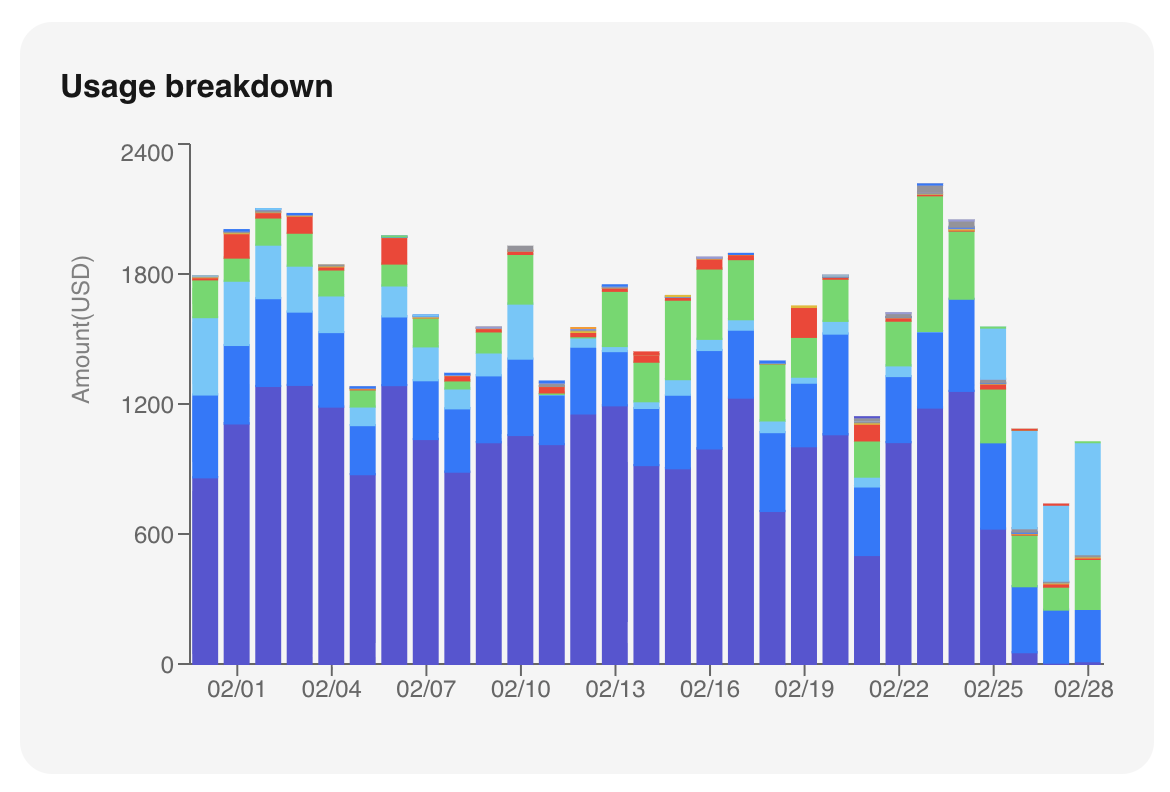
LiteLLM HAS BEEN COMPROMISED, DO NOT UPDATE. We just discovered that LiteLLM pypi release 1.82.8. It has been compromised, it contains litellm_init.pth with base64 encoded instructions to send all the credentials it can find to remote server + self-replicate. link below

English
1.4K
5.3K
27.9K
66.6M
Lucas Matuszewski
Lucas Matuszewski@mrLumatic·
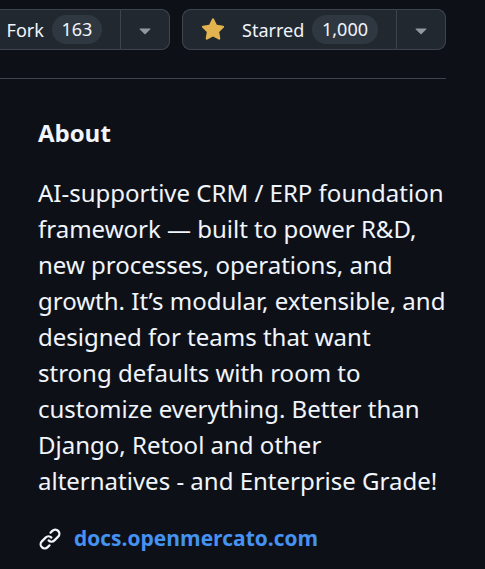
@tomik99 I just hit 1000 BTW ;) Congrats @OpenMercato ! Can't wait to test how well your product works with my agents and other automated workflows!
Lucas Matuszewski tweet media
English
2
2
4
836
Tomasz Karwatka
Tomasz Karwatka@tomik99·
If agents become economic actors, they will need: - structured memory - permission layers - transactional logic - auditability - secure multi-tenant environments You can’t duct-tape that on top of legacy SaaS. It needs to be designed into the architecture. That’s exactly why we’re building @OpenMercato not as another ERP/CRM, but as an open-source framework to build agent-native enterprise apps with AI-assisted engineering. I’ve built and exited companies in previous waves (e-commerce, mobile, SaaS). This shift feels similar to the early e-commerce days - when some people were still asking whether the internet “makes sense”. Will agents become customers? Yes. The question is: Who is building the infrastructure for them? :)
English
4
0
18
1.2K
Lucas Matuszewski
Lucas Matuszewski@mrLumatic·
When @tomik99 builds OSS ERP/CRM for AI agents, you should pay attention! He is one of the most experienced tech entrepreneurs in Poland. Time to see how well @OpenMercato integrates with: - @payloadcms CMS - AG-UI + @CopilotKit + @mastra - our personal @openclaw assistants ;)
Tomasz Karwatka@tomik99

If agents become economic actors, they will need: - structured memory - permission layers - transactional logic - auditability - secure multi-tenant environments You can’t duct-tape that on top of legacy SaaS. It needs to be designed into the architecture. That’s exactly why we’re building @OpenMercato not as another ERP/CRM, but as an open-source framework to build agent-native enterprise apps with AI-assisted engineering. I’ve built and exited companies in previous waves (e-commerce, mobile, SaaS). This shift feels similar to the early e-commerce days - when some people were still asking whether the internet “makes sense”. Will agents become customers? Yes. The question is: Who is building the infrastructure for them? :)

English
0
0
4
133