

@martinbeckford @nmdacosta They seem to have removed whatever you linked to. Can you tell us more?
English
Tim Ferris
1.4K posts
@mrtimferris
Ancient Briton


The Pound is softer, yields are higher on the Josh Simons/ Burnham news. This is not trying to “constrain democratic choice” this is rational repricing of expectations for more Gilt issuance, and more inflation.



🔴Lucy Powell is an underpriced option in all this leadership speculation She was seen as the rebel’s choice in the deputy leadership contest, but has showed total loyalty to Starmer in the role - batting for him before and after the locals, and at his ‘make or break’ speech (which you might expect from a deputy). If there is a contest and Starmer decides to run, it’s expected she wouldn’t stand, and her allies believe there would be a case for Starmer appointing her deputy PM. If he doesn’t stand, there’s a chance she could end up as the soft left’s choice if neither Andy Burnham nor Angela Rayner are in a position to run - and if Ed Miliband decides he doesn’t want a second hit at the leadership (which is what his team say is the case at the moment). If Miliband does run, it’s not clear whether she would run against her former boss - but some do believe that right now, she is the soft left candidate with the least amount of baggage



Just as Hiroshima and Nagasaki were grotesquely out of proportion to the evil of the Pearl Harbor attack, what was done to Gaza is grotesquely out of proportion to the evil of the October 7 attack. What begins as a just cause is often corrupted by war’s self-righteous bloodlust.

A new study in Austria has found that 41 per cent of young Muslims agree with the statement that their religious beliefs supersede the country's laws.


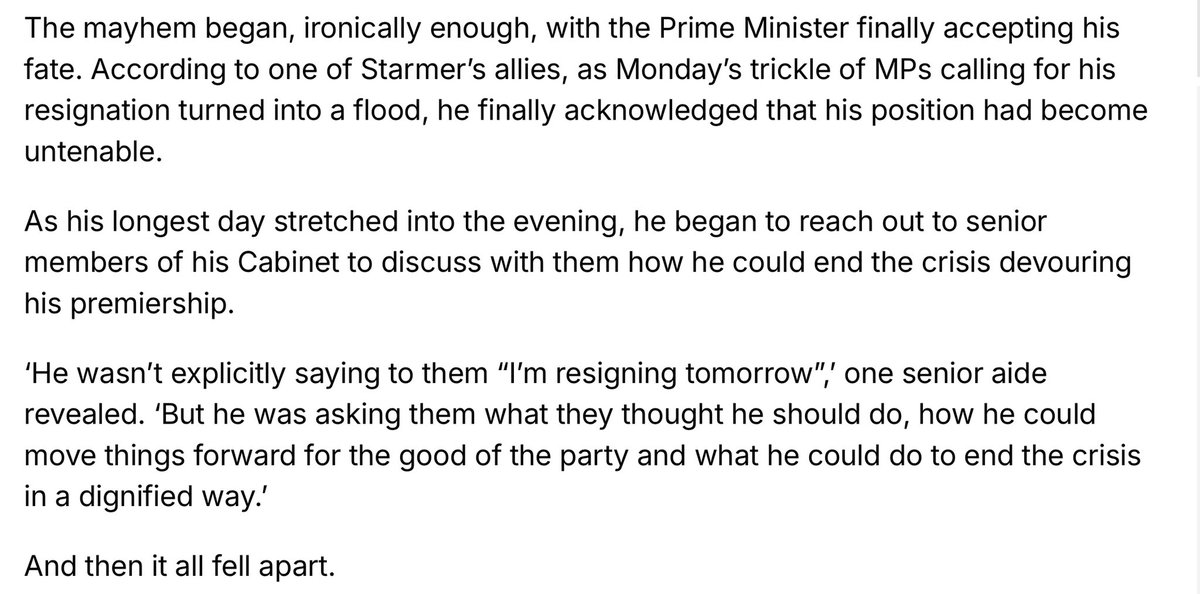
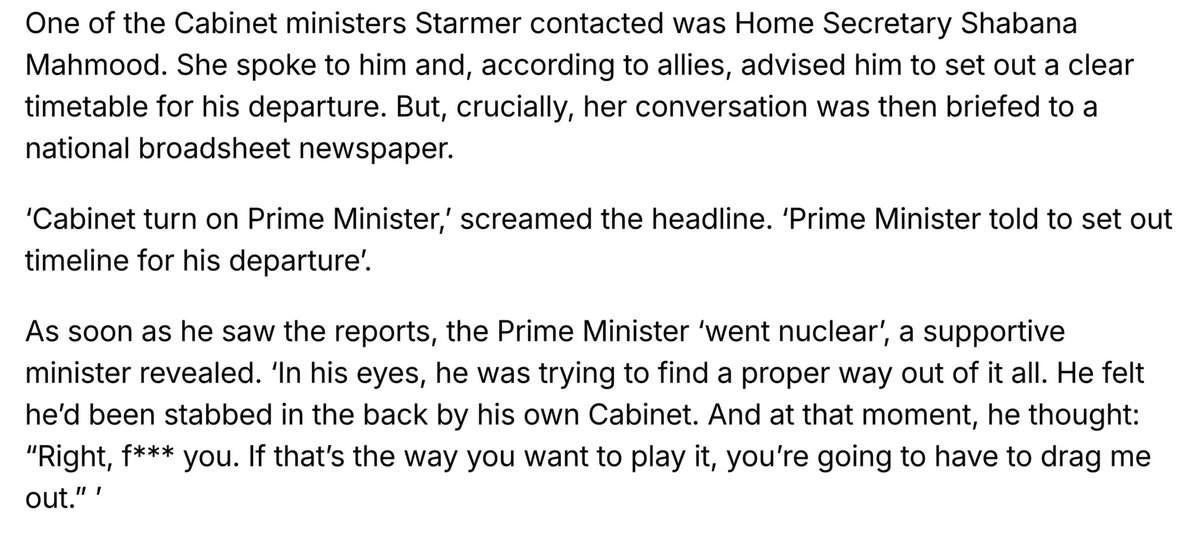



There are apparently 149 ministerial posts held by 122 people. Of these, 93 currently sit in the House of Commons, meaning just under a quarter of Labour’s MPs are government ministers. Do we really need that many?

Wes Streeting tried to see Keir Starmer after cabinet. But Starmer said in Cabinet that he won’t discuss the elections or his leadership, and that he will only speak to cabinet ministers about that individually. Then after the meeting he refused to see Streeting one on one.




Watching what’s left of Starmer’s authority turn to dust has horrible similarities to the demise of almost every recent PM, and, given the state of our nation makes the success of future incumbents equally uncertain. Someone should write a book called “Ungovernable” …


I got my Claude to do a UK version. … Fun prompt. Below is my honest swing at it for the UK. Caveat upfront: "fix everything switch" overstates things — these are policies where I think the case is unusually strong and the standard objections look weak relative to the upside, not magic wands. Confidence ratings are about "this would meaningfully improve UK welfare/growth if well-implemented," not "this is politically easy." 1. Radical planning liberalisation (housing + infrastructure) Confidence: Very high. Reasoning: The UK's discretionary planning system is the single biggest unforced error in British policy. It drives the housing crisis, suppresses productivity (workers can't move to high-wage cities), worsens regional inequality, slows clean energy buildout, kneecaps infrastructure, and arguably depresses fertility. Most rich-country peers build more housing per capita. Moving to a zoning/rules-based system with by-right approval, looser greenbelt around stations, street votes, and curtailed judicial review on planning would be transformative. Why not done: Homeowners are an enormous, high-turnout voting bloc whose paper wealth depends on scarcity. Greenbelt is politically sacred. The losses are visible and concentrated (a new block next door); the gains are diffuse and slow. Both main parties have flirted with reform and flinched. 2. Council tax revaluation and property tax reform Confidence: Very high it's needed; high it would be beneficial. Reasoning: Council tax bands are still based on 1991 property values. A flat in Hartlepool can pay more council tax than a mansion in Westminster. This is regressive, distorts the housing market, and starves councils. Revaluing — or better, replacing council tax and stamp duty with a proportional property tax or land value tax — is one of the most-endorsed-by-economists reforms going. Why not done: Revaluation creates visible losers (London/South East homeowners) and quieter winners. Treasury also fears the transition. The Mirrlees Review laid this out in 2011 and basically nothing has happened since. 3. Abolish stamp duty on primary residences Confidence: High. Reasoning: Stamp duty has among the worst deadweight losses of any UK tax — it taxes transactions, so it discourages downsizing, labour mobility, and matching people to suitable homes. The empirical literature on this is unusually unified. Why not done: It raises ~£12bn and is invisible to most voters most of the time. Replacing it (ideally with #2 above) needs political capital nobody wants to spend. 4. Build clean energy and grid infrastructure fast Confidence: High. Reasoning: UK industrial electricity prices are among the highest in the OECD, which is quietly hollowing out manufacturing. Cheap, abundant electricity is the most undervalued input to almost every modern industry. Streamlining onshore wind, solar, nuclear (SMRs and large), and especially grid connections and transmission would compound for decades. Connection queues currently stretch into the 2030s. Why not done: Planning (see #1), Ofgem incentives that historically rewarded keeping grid investment low, judicial review, NIMBYism around pylons, and a regulatory culture that treats new build as risky and the status quo as safe. 5. Devolve real fiscal and policy power to cities and regions Confidence: High. Reasoning: The UK is one of the most fiscally centralised democracies in the OECD. Manchester, Birmingham, Leeds, Glasgow are dramatically underpowered relative to peers like Munich or Lyon. Mayors with proper tax-raising power, transport authority, and skills budgets would let cities tailor solutions and compete. Most evidence on agglomeration economics suggests this matters a lot. Why not done: The Treasury genuinely hates losing control of money; this is a deep institutional preference that survives changes of government. Westminster MPs don't like rival power centres either. 6. A genuinely competitive high-skilled immigration regime Confidence: Medium-high. Reasoning: Top-talent immigration is close to a free lunch for receiving countries — fiscally positive, innovation-boosting, and concentrated in tradeable sectors. The UK has the language and the universities; it's leaving money on the table with slow visas, high fees (the NHS surcharge plus visa costs for a family is brutal), and a Global Talent visa that's narrower than it looks. Why not done: Immigration politics is toxic and the public doesn't reliably distinguish high- from low-skilled flows. Total numbers have been high recently, which makes it hard to argue for more of any category even when the composition matters more than the total. 7. Childcare cost reform Confidence: Medium-high. Reasoning: The UK has among the highest childcare costs in the OECD as a share of household income. This depresses female labour force participation, suppresses fertility, and acts as a giant marginal tax on the second earner. The recent expansion of "free hours" helps but the supply-side problem (provider economics, ratios, planning for nurseries) isn't fixed. Why not done: It's expensive, the sector is politically diffuse, and ratios/quality regulations have genuine trade-offs that aren't easy to legislate around. 8. NHS productivity reform plus sustained capital investment Confidence: Medium. Reasoning: NHS productivity has fallen meaningfully since 2019 even as funding rose. The UK has unusually few CT/MRI scanners per capita, old buildings, and weak digital infrastructure. Capital investment with productivity-linked reform (better IT, more diagnostic capacity, GP/secondary care interface) is probably higher-ROI than another marginal headcount increase. Why not done: The NHS is genuinely a political third rail; structural reform gets framed as privatisation regardless of content. Capital is the easiest budget to cut in any given year, so it gets cut repeatedly. 9. Curtail judicial review of major infrastructure Confidence: Medium. Reasoning: HS2, Heathrow, nuclear, transmission lines — UK infrastructure costs are 2–4x peer countries partly because of endless legal challenges and the consultations that anticipate them. A narrower "did the decision-maker follow the process" standard, with tight time limits, would lower costs without sacrificing core rule-of-law protections. Why not done: Constitutionally fraught, lawyers and the legal establishment push back hard, and any government doing this is accused of authoritarianism — sometimes fairly. 10. Reform the pensions triple lock and the wider intergenerational settlement Confidence: Medium-high on the need; medium on whether reform alone "fixes" much. Reasoning: The triple lock ratchets state pension spending up faster than wages or prices and is a major driver of long-run fiscal pressure. Combined with NI exemption for pensioners and protected pensioner benefits, the UK has built a fiscal regime that systematically transfers from young workers to older asset-holders. Untangling this would free fiscal space for investment in #4, #7, #8. Why not done: Pensioners vote at roughly 75% turnout; under-30s at roughly 50%. The maths is unforgiving. A few honourable mentions I cut: tax simplification (genuinely good but rarely "fix everything"), proportional representation (large effects but unclear sign), drug policy reform (good evidence base, narrower scope), regulator growth duties / a serious bonfire of Quangos rationalisation, and reforming the apprenticeship levy. The pattern. Almost every item above is blocked by the same underlying thing: a system that makes losses visible and concentrated while gains are diffuse and slow, in a country where homeowners and pensioners vote heavily. The "switch" in the meme exists; it's just wired to a circuit that the median voter has a strong short-run reason to leave alone. That's not a reason not to flip it — it's a reason the case has to be made repeatedly and honestly. Standard disclaimer: reasonable people disagree on all of this, especially #6, #9, and #10, and "well-implemented" is doing a lot of work in every line above.
I don't think the problem of dissipating talent in politics is unique to the Labour Party, but you do have to marvel at the fact that they've got 403 MPs and find themselves in this situation


