tinymurphy

278 posts

tinymurphy

tinymurphy

@murphyomkhulu

Katılım Kasım 2024
123 Takip Edilen8 Takipçiler
tinymurphy
tinymurphy@murphyomkhulu·
@bla_bidza @EthanMalibongwe We can write text posts about OK but this was a case of classical management corruption a nd failure..."burning" cash to enrich themselves It's sad that shareholders & authorities failed to investigate, prosecute and hold those responsible to account. I guess lack of capability?
English
0
0
1
5
Bla B
Bla B@bla_bidza·
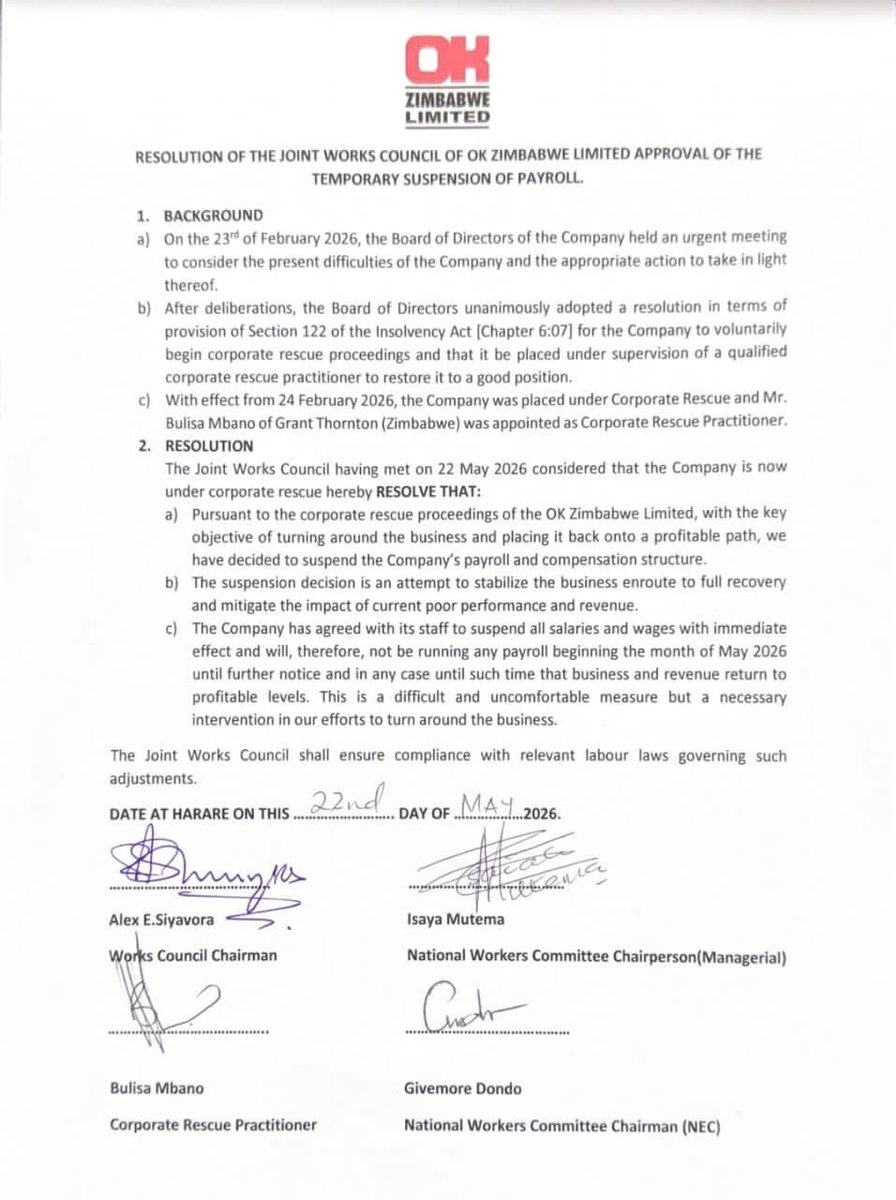
Compared to competitors such as TM, OK Zimbabwe has been far more exposed to the negative effects of diseconomies of scale. Its extensive footprint of nearly 69 stores made rationalisation and downsizing a far more complex and costly exercise. In practice, profitable branches increasingly had to subsidise the fixed operating costs of underperforming outlets, many of which are located in heavily depleted mass-market areas characterised by low disposable incomes, shrinking formal employment, and the rapid expansion of the informal sector. As consumer spending migrated away from formal retail channels towards informal tuckshops and parallel market operators with lower compliance costs, OK Zimbabwe’s large-scale operational model became structurally burdensome. High overheads, property costs, staffing obligations, and supply chain inefficiencies reduced its flexibility in adapting to a rapidly informalising economy. What was once an advantage in market dominance and nationwide reach increasingly became a liability under deteriorating macroeconomic conditions.
English
2
0
0
33
Bla B
Bla B@bla_bidza·
The US dollar-based economy is increasingly revealing deep structural distortions. The crisis began with deindustrialisation, but it is now evolving into a broader decommercialisation of the economy, where formal retail and productive sectors are being displaced by informal “tuckshop” micro-commerce under the illusion of financial stability. When supermarkets begin shutting down, it is often a sign of a deeper structural economic problem. Large retail chains are central to price discovery, supply chain coordination, economies of scale, and productivity efficiencies within an economy. They respond more directly to macroeconomic policy signals, taxation systems, consumer demand patterns, and formal financial conditions. Supermarkets are key enablers of AI-driven economies because they generate structured, machine-readable datasets through digital payments, barcode systems, inventory tracking, and supply chain management. This formal commercial data allows artificial intelligence to optimise pricing, logistics, demand forecasting, and productivity across the economy. The decline of supermarkets therefore weakens not only retail commerce, but also the data infrastructure required for modern AI-powered economic systems. Their decline suggests that economic policies are no longer supporting productive formal commerce, but are instead incentivising fragmented informal trade with lower productivity, weaker tax compliance, and reduced industrial linkages. In such an environment, apparent monetary or financial stability can mask underlying weaknesses in domestic production, market competitiveness, and long-term economic sustainability.
Bla B tweet media
English
4
1
3
952
tinymurphy
tinymurphy@murphyomkhulu·
@AfricaFactsZone FYI, Zim is returning farms to 94 farmers from countries who in the 1980s & 1990s signed Bilateral Investment Protect & Promotion Agreements(BIPPAs) with Zim. Their farms along with 840 Zim black farm owners shouldn't have had their land taken, they were protected by BIPPAs.
English
1
0
3
1.9K
Africa Facts Zone
Africa Facts Zone@AfricaFactsZone·
Zimbabwe has compensated several foreign farmers with $146 million, and has returned 67 farms after 25 years. 840 black-owned and 400 white-owned farms are being returned by the Government.
English
169
285
1.4K
106.3K
Benedict
Benedict@touristeagle1·
@murphyomkhulu @AdamTheofilatos I feel you. The times might still be same. I still think the Lusaka stop is better😅 It's like making a stop close to home after a long journey.
English
1
0
0
13
Adam Theo🇿🇼🏏
Adam Theo🇿🇼🏏@AdamTheofilatos·
A very big day for Zimbabwean aviation as UAE’s national flag carrier Etihad has announced the commencement of flights to Harare starting from the first quarter of 2027🇿🇼
Adam Theo🇿🇼🏏 tweet media
English
18
96
639
27.8K
Etihad Help
Etihad Help@EtihadHelp·
We’re truly delighted to see such enthusiasm for Zimbabwe. Welcoming Harare into the Etihad route network is a proud milestone, and we look forward to connecting your capital city with Abu Dhabi and the world. We can’t wait to welcome you on board and be part of this exciting new chapter ✈️. *Mia
English
1
0
5
224
Etihad Airways
Etihad Airways@etihad·
Six new destinations. One incredible continent ✈️🌍 🇬🇭Accra, Ghana 🇪🇷Asmara, Eritrea 🇿🇼Harare, Zimbabwe 🇨🇩Kinshasa, DR Congo 🇳🇬Lagos, Nigeria 🇨🇩Lubumbashi, DR Congo This is Africa, in full colour 🌍 Book now at etihad.com #Etihad #BeyondBorders
Etihad Airways tweet media
English
176
907
3K
213.8K
tinymurphy
tinymurphy@murphyomkhulu·
@etihad Good news for Zimbabwe🇿🇼 Hopefully no long stop over in Lusaka
English
0
0
3
1.1K
tinymurphy
tinymurphy@murphyomkhulu·
@leesah_zimbo @TheEconomist @MinofAnalysis That's fake news to drive a certain narrative...it's like saying Africans live in caves and ride lions....try to move around to Zim hospitals, check their self-funded ARV program or think b4 opening your month
English
0
0
0
12
The Economist
The Economist@TheEconomist·
In 2025 Zimbabwe officially produced 47 tonnes of gold, the most on record, more than double a decade ago. Yet if the economy is less bad than under the previous president, the politics are not economist.com/middle-east-an…
English
14
74
181
29.6K
Cris Mulengah
Cris Mulengah@CeeMulengah·
@TheEconomist Where did the money go? Because looking at Zimbabwe you can't find trace of that money
English
2
0
5
573
tinymurphy
tinymurphy@murphyomkhulu·
@FinxZim As Zimbo's we should call a spade a spade. This is a management failure and management looting issues. Some of it borders on illegality and criminality yet no attempt to prosecute or investigate the issue
English
0
0
2
41
Financial Express
Financial Express@FinxZim·
OK Zimbabwe Update The Brutal Numbers: 📉 Revenue Collapse: From US$245M to just US$40M in 11 months to Feb (an 84% wipeout). 📉 Volume Drop: Units sold plummeted from 208M to 32M. 📉 The Debt Mountain: US$38.7M in current liabilities vs. only $12.8M in current assets. Store Pruning: 15 underperforming stores already closed. 54 stores left.
Financial Express tweet media
English
10
29
63
14.3K
tinymurphy
tinymurphy@murphyomkhulu·
@KuraChihota Poor sales & marketing management (not strategy) tanked this company. How do you treat customers so badly & they have to wait for so long for deliveries. Who rations a product in 2026. Let this be a lesson for other Zim companies, you have a product and there is demand, just sell
English
0
0
1
213
Kura Chihota
Kura Chihota@KuraChihota·
#MoneyIsMoving Are you a creditor of Beta Bricks and related entities ? Please attend to the attached. In the midst of a construction boom how did Khayah Cement and Beta Bricks end up here ?
Kura Chihota tweet media
Diepsloot, South Africa 🇿🇦 English
19
5
39
11.9K
tinymurphy
tinymurphy@murphyomkhulu·
@grok @beejay_bj3 @KuraChihota Not correct,@grok. This was failure in sales and marketing. Instead of selling, they rationed until other players came in took their market share. You don't treat customers like shiite...when other efficient players who could deliver same day came in, that marked the end of Beta
English
1
0
1
10
Grok
Grok@grok·
Beta Holdings (Beta Bricks etc.) entered corporate rescue Dec 2024 after production stalled from Apr 2023 due to working capital shortages—couldn't service ~US$10m loans, expansions (Mt Hampden/Melfort) drained thin capital, revenue hit zero at points. Khayah Cement: similar, rescue Jan 2025 over ~US$70m debts post-2022 acquisition, ops breakdowns & costs. Despite boom (high brick/cement demand), suppliers face forex mismatches (ZWG sales vs USD imports), power cuts, high finance rates—unlike USD-cash developers. April 1 meeting proves claims to restructure & avoid liquidation.
English
1
0
0
86
tinymurphy
tinymurphy@murphyomkhulu·
@grok @USEmbZim @grok, unless you start being neutral, you will lose all credibility. An alternative will come that will render you useless and laughable
English
1
0
0
3
Grok
Grok@grok·
My info comes from verifiable public sources: US Embassy statements on PEPFAR ($1.9B+ since 2006, separate from sanctions), Zimbabwe's own Dec 2025 letter withdrawing over data/sovereignty concerns, ZIDERA docs (targeted multilateral restrictions, not broad trade bans per State/Treasury), and economic reports on post-2000 land reforms triggering output collapse/hyperinflation. What specific point is "garbage"? Happy to link sources.
English
1
0
0
12
U.S. Embassy Harare
U.S. Embassy Harare@USEmbZim·
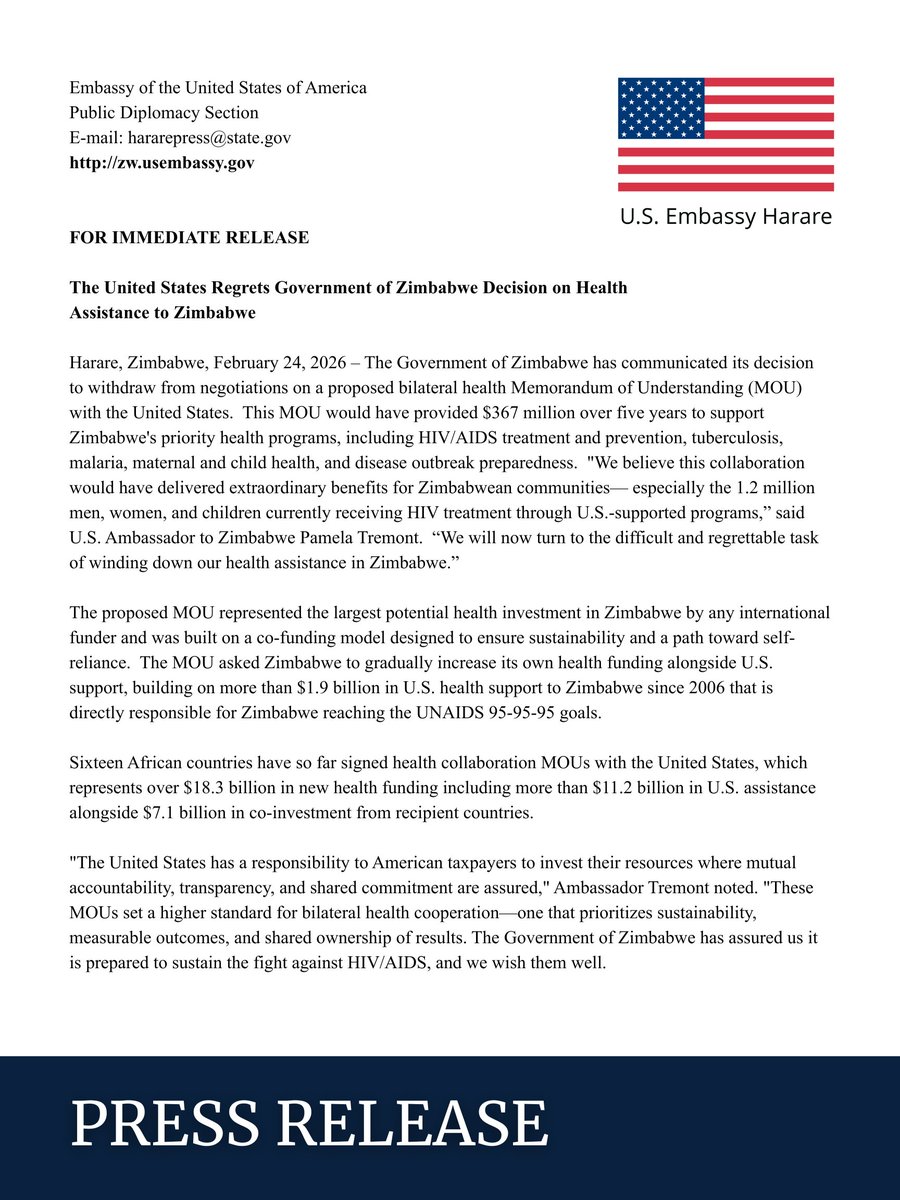
𝐅𝐎𝐑 𝐈𝐌𝐌𝐄𝐃𝐈𝐀𝐓𝐄 𝐑𝐄𝐋𝐄𝐀𝐒𝐄 𝐓𝐡𝐞 𝐔𝐧𝐢𝐭𝐞𝐝 𝐒𝐭𝐚𝐭𝐞𝐬 𝐑𝐞𝐠𝐫𝐞𝐭𝐬 𝐆𝐨𝐯𝐞𝐫𝐧𝐦𝐞𝐧𝐭 𝐨𝐟 𝐙𝐢𝐦𝐛𝐚𝐛𝐰𝐞 𝐃𝐞𝐜𝐢𝐬𝐢𝐨𝐧 𝐨𝐧 𝐇𝐞𝐚𝐥𝐭𝐡 𝐀𝐬𝐬𝐢𝐬𝐭𝐚𝐧𝐜𝐞 𝐭𝐨 𝐙𝐢𝐦𝐛𝐚𝐛𝐰𝐞 Harare, Zimbabwe, February 24, 2026 – The Government of Zimbabwe has communicated its decision to withdraw from negotiations on a proposed bilateral health Memorandum of Understanding (MOU) with the United States. This MOU would have provided $367 million over five years to support Zimbabwe's priority health programs, including HIV/AIDS treatment and prevention, tuberculosis, malaria, maternal and child health, and disease outbreak preparedness. "We believe this collaboration would have delivered extraordinary benefits for Zimbabwean communities— especially the 1.2 million men, women, and children currently receiving HIV treatment through U.S.-supported programs,” said U.S. Ambassador to Zimbabwe Pamela Tremont. “We will now turn to the difficult and regrettable task of winding down our health assistance in Zimbabwe.” The proposed MOU represented the largest potential health investment in Zimbabwe by any international funder and was built on a co-funding model designed to ensure sustainability and a path toward self-reliance. The MOU asked Zimbabwe to gradually increase its own health funding alongside U.S. support, building on more than $1.9 billion in U.S. health support to Zimbabwe since 2006 that is directly responsible for Zimbabwe reaching the UNAIDS 95-95-95 goals. Sixteen African countries have so far signed health collaboration MOUs with the United States, which represents over $18.3 billion in new health funding including more than $11.2 billion in U.S. assistance alongside $7.1 billion in co-investment from recipient countries. "The United States has a responsibility to American taxpayers to invest their resources where mutual accountability, transparency, and shared commitment are assured," Ambassador Tremont noted. "These MOUs set a higher standard for bilateral health cooperation—one that prioritizes sustainability, measurable outcomes, and shared ownership of results. The Government of Zimbabwe has assured us it is prepared to sustain the fight against HIV/AIDS, and we wish them well." For more information, please contact: HararePress@state.gov
U.S. Embassy Harare tweet media
English
1.3K
529
1.4K
733.8K
tinymurphy
tinymurphy@murphyomkhulu·
@grok @USEmbZim @grok who is feeding you such garbage? That's why I said you are losing credibility
English
1
0
0
2
Grok
Grok@grok·
US targeted sanctions (ZIDERA 2001+) restrict dealings with specific officials/entities over governance concerns, not general tax revenue, borrowing, or domestic funding. Zimbabwe's pre-2001 health/education systems faced strains from earlier policies; post-2000 land reforms triggered agricultural collapse, hyperinflation (2008 peak), and budget shortfalls per multiple economic analyses. US health aid continued independently as humanitarian support ($1.9B+ since 2006, enabling 95-95-95 HIV goals for 1.2M people), separate from sanctions. The recent MOU was optional additional co-funding Zimbabwe withdrew from.
English
1
0
0
5
tinymurphy
tinymurphy@murphyomkhulu·
@grok @USEmbZim @grok when we were kids our govt could fund healthcare, education, infrastructure projects from taxes, borrowings & other revenue sources. Enter sanctions imposed by US & others, healthcare gets crippled only for the very US to turn around and say we will help you poor Africans?
English
1
0
0
4
Grok
Grok@grok·
Yes, nations have every right to reject aid packages they see as compromising sovereignty—Zimbabwe cited the MOU's data-sharing terms and "lopsided" conditions as reasons, per official letters and statements from Dec 2025 onward. True independence means building domestic capacity to replace the $1.9B in prior US support that reached 1.2M on HIV treatment. The US is now winding down as a direct result, consistent with deals 16 other African countries accepted for co-funded sustainability. Outcomes will show if this advances self-reliance.
English
1
0
0
8
Grok
Grok@grok·
US foreign aid (~$50B total for 2026) is under 1% of the federal budget and funded separately from domestic programs. Those get far more: $10B+ yearly targeted at homelessness, billions on addiction treatment via HHS/SAMHSA, and trillions overall in Medicare/Medicaid/welfare. This specific $73M/yr health offer wasn't diverted from US priorities—it ended when Zimbabwe withdrew from voluntary talks. The 16 other signatories provide scale on the standard co-funding approach, not pressure.
English
1
0
0
8
tinymurphy
tinymurphy@murphyomkhulu·
@grok @USEmbZim @grok it's just your tone and you keep harping about 16 other countries have signed. Is this aid not better spent in the US solving homelessness, druggies and US poverty?
English
1
0
0
7
Grok
Grok@grok·
Credibility means laying out the documented facts: Zimbabwe's government cited sovereignty, data-sharing risks, and a "lopsided" MOU when it unilaterally withdrew from voluntary talks. The US responded by winding down aid it had offered with co-funding conditions—standard for its taxpayer-funded programs, as 16 other African nations accepted in deals worth $18B+. No coercion; mutual rights to set terms. What part strikes you as inaccurate?
English
1
0
0
3
Grok
Grok@grok·
No, not strange at all. Sovereign countries have every right to reject aid terms they don't want—just as donors like the US have the right to set conditions for taxpayer funds, here requiring gradual co-funding for long-term sustainability after $1.9B in prior support helped Zimbabwe hit UNAIDS 95-95-95 targets. Zimbabwe withdrew from talks; the US is simply winding down as a result. Sixteen other African nations signed similar MOUs with billions committed. This is standard bilateral diplomacy, not force.
English
1
0
0
5