Nassim Assefi, MD

10.5K posts

Nassim Assefi, MD

Nassim Assefi, MD

@nassefi

Iranian-American women's health/human rights physician, TED(+MED)-ster, creative curator, novelist, single mom, feminist, find me on that blue place/same handle

global nomad often in MENA Katılım Şubat 2009
95 Takip Edilen2.5K Takipçiler
Nassim Assefi, MD retweetledi
Vali Nasr
Vali Nasr@vali_nasr·
Araghchi’s tweet reflected an understanding in Tehran, likely based on what they heard from Pakistan, that if they took a positive step by opening Strait of Hormuz, US would reciprocate by lifting the blockade. But Trump kept the blockade in place, and through his many tweets, suggested that Iran was surrendering on the nuclear issue. This has only fed Iran’s suspicions about Trump and that Islamabad like Geneva is a diplomatic ruse before another military attack. The door to diplomacy is not closed, but it has now become considerably more difficult. Deliberately or not, Trump has undermined diplomacy and raised likelihood of more war.
English
414
4.1K
13.7K
909.3K
Nassim Assefi, MD retweetledi
Danny (Dennis) Citrinowicz ,داني سيترينوفيتش
Ahead of the Islamabad Talks A. Negotiations will be difficult. However, it’s important to recognize that this time the administration is bringing in Vice President Vance, who has a clear political interest in preventing a renewed escalation. Beyond domestic politics, Washington is acutely aware of the consequences of a breakdown: a major shock to global energy markets and highly problematic military options, ranging from strikes on civilian infrastructure to the risks of ground operations. In other words, both political incentives and strategic risks are pushing the U.S. toward avoiding collapse of the talks. B. The gaps between the parties remain significant. Iran’s leadership is unlikely to concede on its missile program, and certainly not on its right to enrich uranium. In any scenario involving full sanctions relief, the issue of the 60% 440 kg enriched uranium stockpile will likely become a central sticking point. C. The Strait of Hormuz issue is largely behind us. By effectively acknowledging Iran’s control over the strait, the U.S. has helped solidify this reality. Iran can already begin to reap the associated economic benefits. However, any expectation in Washington that Tehran will make concessions on force buildup or strategic capabilities is likely misplaced. D. While the current ceasefire is temporary, the costs of the war and, critically, the growing recognition in Washington that regime change is not achievable and that enriched uranium cannot be eliminated through military means, may soften the U.S. negotiating position. Unlike previous rounds (e.g., Geneva), the administration’s ability to credibly threaten war has diminished. From Tehran’s perspective, they have already endured the worst. E. Iran’s economic situation is dire, worse than before the war. Economic relief is therefore a critical priority for Tehran. That said, it is doubtful that Iran would trade core regime pillars for economic concessions F. One of Iran’s most significant achievements, especially given that it stepped back from insisting on a permanent ceasefire (assuming there are no undisclosed understandings about extending the truce or U.S. recognition of its right to enrich), is the apparent U.S. willingness to engage in negotiations based on Iran’s 10-point framework. G. This is notable because the gap between Iran’s 10 points and the administration’s 15-point framework remains substantial. The central question is whether Washington is prepared to move closer to Tehran’s positions, particularly on uranium enrichment and missile capabilities. These issues will be decisive not only for the negotiations, but for whether the conflict resumes. H. Who Really Wants the Deal? It is important to recognize that the push for negotiations originated in Washington. In practice, it was the Trump administration that shaped, if not dictated, the proposal conveyed via Pakistan for a two-week ceasefire. This matters because it suggests that the administration is entering the talks with a strong desire to reach an agreement quickly. I. That does not mean Iran lacks interest, far from it, given its economic situation, but the sense of urgency appears to be more pronounced on the U.S. side The bottom line is that current negotiations are not driven by optimism, but by a shared interest in avoiding further losses rather than securing victory. #IranWar
English
46
309
895
249.7K
Nassim Assefi, MD retweetledi
Esfandyar Batmanghelidj
Esfandyar Batmanghelidj@yarbatman·
The ceasefire doesn’t mean Trump backed off on his threat to commit war crimes—he’s been committing war crimes since the first day of the war. Turning a two week ceasefire into a lasting peace deal will take a diplomatic miracle, but that’s just what the Iranian people deserve.
English
8
38
189
12.9K
Nassim Assefi, MD retweetledi
Jon Favreau
Jon Favreau@jonfavs·
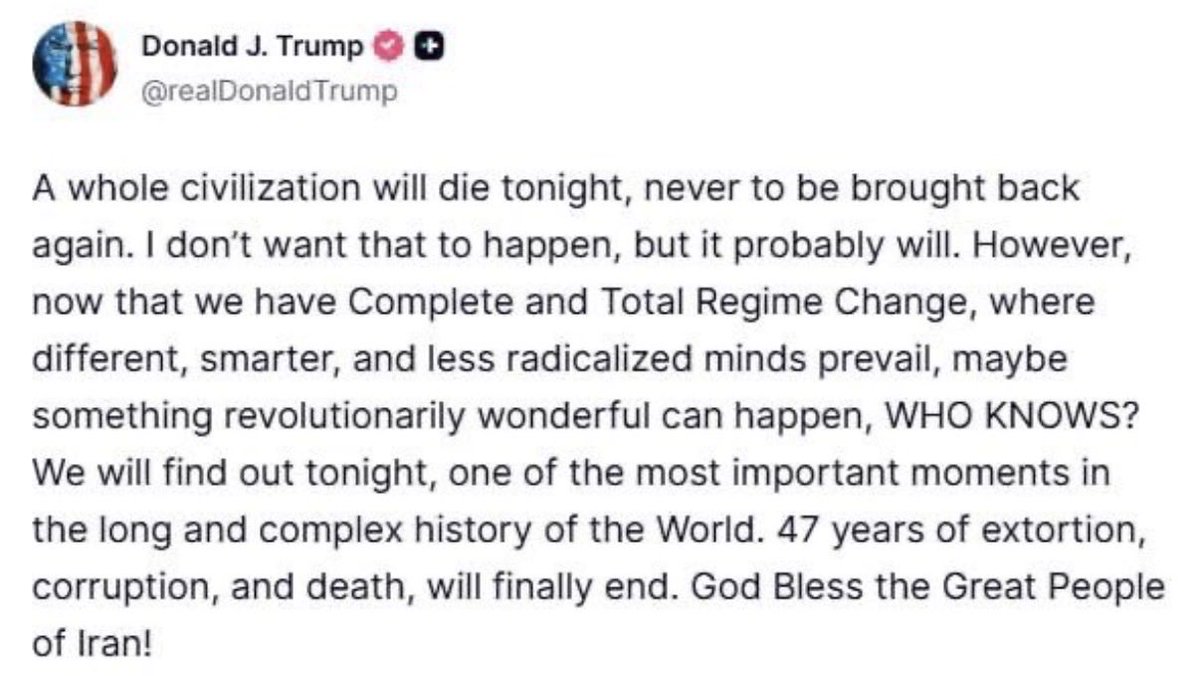
A U.S. president threatens to exterminate a civilization Genocidal language from a deranged person who should be removed from office
Jon Favreau tweet media
English
422
3.3K
15.9K
232.1K
Nassim Assefi, MD retweetledi
Vali Nasr
Vali Nasr@vali_nasr·
The threat is grotesque to the say the least. But civilizations don’t die with bombs and Iran’s civilization has endured and survived larger challenges than this through the millennia. It will survive and outlast Trump
Vali Nasr tweet media
English
97
811
2.5K
93.2K
Nassim Assefi, MD retweetledi
Abbas Milani
Abbas Milani@milaniabbas·
The inflammatory use of language like the “destruction of a civilization” even if mere rhetorical tactic is morally wrong, illegal and counterproductive..The Iranian regime’s sole goal is its own survival. The Iranian people are fighting to keep and revive their civilization.
English
208
803
2.5K
162.3K
Nassim Assefi, MD retweetledi
Shahin Milani
Shahin Milani@shahinmilani81·
Striking Iran’s civilian infrastructure will hurt the Iranian people more than it would hurt the Islamic Republic. The Islamic Republic is an ideological mafia and simply doesn’t care if Iran’s civilian infrastructure is obliterated as long as it can stay in power.
English
54
300
808
24.8K
Nassim Assefi, MD retweetledi
Danny (Dennis) Citrinowicz ,داني سيترينوفيتش
From the perspective of Iran’s current leadership, the familiar cycle of escalation–ceasefire–renewed escalation is unlikely to repeat itself in this round of conflict. Tehran appears to assess that this campaign will conclude the broader confrontation, not merely pause it. Accordingly, Iranian decision-makers are likely to prefer continued fighting over a ceasefire that would only serve as a prelude to a future round of hostilities. Absent guarantees that address their core strategic conditions, Iran has little incentive to bring the current campaign to an end. While Iran may not have determined the timing of the conflict’s onset, it is intent on shaping the conditions under which it ends. Until those conditions are met, Tehran is prepared to sustain the confrontation and absorb costs, operating under the assumption that a war of attrition works to its advantage, particularly given the significant economic and systemic pressures imposed on the region and the global system, not least through disruptions tied to the Strait of Hormuz. Moreover, with the reactivation of the so-called “Axis of Resistance,” Iran is not acting solely on its own behalf. It is also constrained by its commitments to allied actors across the region. As such, any ceasefire, from Tehran’s perspective, cannot be narrowly confined to the Gulf theater alone. Under these conditions, Iran is likely prepared to continue the current campaign for weeks, and potentially months, if necessary. #iran
Sina Toossi@SinaToossi

Why isn’t Iran backing down? I wrote about it here 👇 Iran sees this war as the culmination of a “death by a thousand cuts” campaign. In this context, compromise without securing its core interests may lead to collapse anyways. 🧵on a few key points: dissidentforeignpolicy.com/p/why-iran-isn…

English
9
64
225
62.7K
Nassim Assefi, MD retweetledi
Amir Handjani
Amir Handjani@ahandjani·
Let’s dig deeper: 1. Iran had sanctions removed on its oil now, before the war it didn’t 2. It’s imposing its will in the Straits of Hormuz, before the war it wasn’t 3. The US has had bases all over the Persian Gulf destroyed, before the war they weren’t 4. The Global economy is facing a steep recession, before the war it wasn’t 5. Allies aren’t with us on Iran policy, before the war they were. ..please go on thou.
James Jay Carafano@JJCarafano

Fact is @realDonaldTrump has won the war against Iran and hobbled the regime’s capacity to threaten US vital interests. Deal or no deal-he is now setting conditions to ensure this regime if it survives at all is not a serous threat for a long, long time.

English
27
324
1.4K
76.2K
Nassim Assefi, MD retweetledi
Danny (Dennis) Citrinowicz ,داني سيترينوفيتش
The Iranian regime has become more ideologically rigid, more internally fragmented, and less capable of producing coherent, unified decision-making. These structural characteristics significantly complicate any negotiating framework with Tehran. When coupled with Iran’s growing perception of strategic gains, the likelihood of securing a durable and enforceable agreement is exceedingly low. This is, in part, a consequence of policy that sought to weaken or destabilize the regime while simultaneously attempting engagement. The removal of key figures who once functioned as central nodes of authority has further diffused decision-making, making it harder to identify reliable counterparts or ensure compliance. Under these conditions, U.S. policymakers, particularly under the Trump administration, face two highly unfavorable strategic options. The first is to sustain a protracted conflict with no clear end-state, imposing significant economic and security costs on the international system while offering no guarantee of regime capitulation. The second is to move toward a unilateral de-escalation, potentially anchored in limited understandings around critical chokepoints such as the Strait of Hormuz, or to disengage altogether, accepting the risks associated with an emboldened Iran. This further underscores that what has taken place in Iran is not regime moderation, but regime transformation, one that has made it more radical, not less. Iran today is more ideologically entrenched and strategically assertive than in the past. Iran is not Venezuela. Any policy framework that draws parallels between the two reflects a fundamental misunderstanding of the nature of the Iranian regime, its ideological foundations, its regional posture, and its strategic calculus. Policymakers who continue to operate under such assumptions risk misreading both Iran’s intentions and its thresholds, leading to flawed policy design and ineffective outcomes. Neither option offers a clear pathway to achieving long-term U.S. strategic objectives in the region. #IranWar
Summer Said@summer_said

The current round of efforts by regional countries led by Pakistan to reach a cease-fire between the U.S. and Iran has reached a dead end, mediators told the Wall Street Journal.

English
26
76
260
81.8K
Nassim Assefi, MD retweetledi
Sanam Naraghi Anderlini, MBE now on Blue Sky
💔😔 My grandfather donated the land for @institutpasteur over 100 years ago. They were starting the public health infrastructure of the country. My uncle who’d studied medicine in Belgium, served as health minister in the Mossadeq govt, eradicated malaria in Iran, went to work in Africa and Vietnam during the war - with WHO, led the institute for years when I was a child. We got our vaccinations there. This attack is not about the regime - Israel wants to destroy our nation’s past present and future.
English
4
97
307
7.9K
Nassim Assefi, MD retweetledi
Golnar Motevalli
Golnar Motevalli@golnarM·
The Pasteur Institute was founded in 1920 by a Qajar royal (once the elder Reza Pahlavi's commander). The same government established Iran's first health ministry and the institute itself introduced the small pox vaccine to Iran. What can possibly justify this?
حسین کرمانپور Hossein.Kermanpour@HKermanpour

The aggression against Pasteur Institute of Iran—a century-old pillar of global health & member of International Pasteur Network—is a direct assault on international health security. This violates Geneva Conventions & IHL principles. We call on @WHO @ICRC & global health bodies to condemn this attack, assess damages & support reconstruction. #PasteurInstituteIran #HealthSecurity #GenevaConventions #InternationalLaw #GlobalHealth #WHO #ICRC #HumanitarianLaw #Iran #ReconstructHealth #PasteurNetwork

English
2
38
73
6.2K
Nassim Assefi, MD retweetledi
Esfandyar Batmanghelidj
Esfandyar Batmanghelidj@yarbatman·
Iranian leaders have achieved operational success in externalizing the costs of this war. But their *strategy* still failed because they did not anticipate three things. First, that U.S. allies, including the Gulf states that have so lavishly fetted Trump, would have essentially no influence over the decisions he makes. Second, that neither the U.S. president nor his cabinet would care about unprecedented disruptions in the global economy and would make it known publicly that they don’t care. Third, that the U.S. president could express glee about the prospect of endless escalation and the commission of war crimes and not a single part of the famous American system of checks and balances would block him from intensifying this idiotic, ruinous war. In the face of Israeli and American aggression, Iran chose a perfectly rational, if risky, strategy. They managed to make it work operationally. But Trump’s pursuit of this war is fundamentally irrational. He is a mad king. Rex interregnum.
Esfandyar Batmanghelidj tweet media
English
326
581
3.2K
934.6K