niki parmar

200 posts

niki parmar banner
niki parmar

niki parmar

@nikiparmar09

Working @Anthropic. Views expressed here are my own.

San Francisco, CA Katılım Ağustos 2013
937 Takip Edilen15.8K Takipçiler
niki parmar retweetledi
Ashish Vaswani
Ashish Vaswani@ashVaswani·
We are beyond thrilled to share our first flagship models, Rnj-1 base and instruct 8B parameter models. Rnj-1 is the culmination of 10 months of hard work by a phenomenal team, dedicated to advancing American SOTA OSS AI. Lots of wins with Rnj-1. 1. SWE bench performance close to GPT 4o. 2. Tool use outperforming all comparable open source models. 3. Mathematical reasoning (AIME’25) nearly at par with GPT OSS MoE 20B. ….
Essential AI@essential_ai

Today, we’re excited to introduce Rnj-1, @essential_ai's first open model; a world-class 8B base + instruct pair, built with scientific rigor, intentional design, and a belief that the advancement and equitable distribution of AI depend on building in the open. We bring American open-source at par with the best in the world.

English
104
169
1.8K
605.6K
Azalia Mirhoseini
Azalia Mirhoseini@Azaliamirh·
Thrilled to share that @annadgoldie and I are launching @RicursiveAI, a frontier lab enabling recursive self-improvement through AIs that design their own chips. Our vision for transforming chip design began with AlphaChip, an AI for layout optimization used to design four generations of TPUs, data center CPUs, and smartphones. AlphaChip offered a glimpse into a future where AI designs the silicon that fuels it. Ricursive extends this vision to the entire chip stack, building AI that architects, verifies, and implements silicon, enabling models and chips to co-evolve in a tight loop. We sat down with WSJ’s @berber_jin1 to discuss Ricursive: wsj.com/tech/this-ai-s…
Ricursive Intelligence@RicursiveAI

Introducing Ricursive Intelligence, a frontier AI lab enabling a recursive self-improvement loop between AI and the chips that fuel it. Learn more at ricursive.com

English
125
136
1.5K
230.2K
niki parmar
niki parmar@nikiparmar09·
Opus 4.5 continues to improve the pareto frontier. We're seeing early glimpses of models working through hard problems autonomously. If you are excited to push capabilities further on long horizon, real world tasks that require sustained reasoning and oversight, come join us!
Claude@claudeai

Introducing Claude Opus 4.5: the best model in the world for coding, agents, and computer use. Opus 4.5 is a step forward in what AI systems can do, and a preview of larger changes to how work gets done.

English
2
4
17
7.1K
William Fedus
William Fedus@LiamFedus·
Today, @ekindogus and I are excited to introduce @periodiclabs. Our goal is to create an AI scientist. Science works by conjecturing how the world might be, running experiments, and learning from the results. Intelligence is necessary, but not sufficient. New knowledge is created when ideas are found to be consistent with reality. And so, at Periodic, we are building AI scientists and the autonomous laboratories for them to operate. Until now, scientific AI advances have come from models trained on the internet. But despite its vastness — it’s still finite (estimates are ~10T text tokens where one English word may be 1-2 tokens). And in recent years the best frontier AI models have fully exhausted it. Researchers seek better use of this data, but as any scientist knows: though re-reading a textbook may give new insights, they eventually need to try their idea to see if it holds. Autonomous labs are central to our strategy. They provide huge amounts of high-quality data (each experiment can produce GBs of data!) that exists nowhere else. They generate valuable negative results which are seldom published. But most importantly, they give our AI scientists the tools to act. We’re starting in the physical sciences. Technological progress is limited by our ability to design the physical world. We’re starting here because experiments have high signal-to-noise and are (relatively) fast, physical simulations effectively model many systems, but more broadly, physics is a verifiable environment. AI has progressed fastest in domains with data and verifiable results - for example, in math and code. Here, nature is the RL environment. One of our goals is to discover superconductors that work at higher temperatures than today's materials. Significant advances could help us create next-generation transportation and build power grids with minimal losses. But this is just one example — if we can automate materials design, we have the potential to accelerate Moore’s Law, space travel, and nuclear fusion. We’re also working to deploy our solutions with industry. As an example, we're helping a semiconductor manufacturer that is facing issues with heat dissipation on their chips. We’re training custom agents for their engineers and researchers to make sense of their experimental data in order to iterate faster. Our founding team co-created ChatGPT, DeepMind’s GNoME, OpenAI’s Operator (now Agent), the neural attention mechanism, MatterGen; have scaled autonomous physics labs; and have contributed to some of the most important materials discoveries of the last decade. We’ve come together to scale up and reimagine how science is done. We’re fortunate to be backed by investors who share our vision, including @a16z who led our $300M round, as well as @Felicis, DST Global, NVentures (NVIDIA’s venture capital arm), @Accel and individuals including @JeffBezos , @eladgil , @ericschmidt, and @JeffDean. Their support will help us grow our team, scale our labs, and develop the first generation of AI scientists.
William Fedus tweet media
English
427
440
4.2K
3.5M
niki parmar
niki parmar@nikiparmar09·
We just dropped Sonnet 4.5, the best coding model! Agents are truly here now -- autonomous task solving, complex multi-step tasks, parallel agents, combined with new tools and features and a lot more.. Check it out here 👇
Claude@claudeai

Introducing Claude Sonnet 4.5—the best coding model in the world. It's the strongest model for building complex agents. It's the best model at using computers. And it shows substantial gains on tests of reasoning and math.

English
14
5
217
36.8K
niki parmar retweetledi
Claude
Claude@claudeai·
Keep thinking.
English
866
3K
26.5K
5.9M
niki parmar retweetledi
Aurko Roy
Aurko Roy@aurko79·
Excited to share what I worked on during my time at Meta. - We introduce a Triton-accelerated Transformer with *2-simplicial attention*—a tri-linear generalization of dot-product attention - We show how to adapt RoPE to tri-linear forms - We show 2-simplicial attention scales better under token constraints than dot product attention It was fun collaborating with amazing folks including @dvsaisurya @_arohan_ and others
Aurko Roy tweet media
English
26
94
809
147.2K
Sharon Zhou
Sharon Zhou@realSharonZhou·
Excited to share big news! 🎉 I'm joining @LisaSu at @AMD to work on what I love most: AI research & teaching Dream: Everyone becomes GPU-rich, scaling laws hit their asymptotic limits, and we democratize those sweet matmuls Several intense, cute Laminati from @LaminiAI are also joining me on this mission! We'll be joining a smart, humble, and mighty crew: Vamsi Boppana, @roaner, and @AnushElangovan at @AIatAMD 🙂 Ping me to parallelize this vision or just geek out on making GPUs go brrr... ➡️ If you're around town, see you at the #AdvancingAI conference
Sharon Zhou tweet media
English
61
30
613
131.7K
niki parmar
niki parmar@nikiparmar09·
Claude Opus 4 and Sonnet 4 are the best coding models, setting new records across the board. 🚀 We are pushing the limits (80.2% on SWE-Bench!!), advancing the frontier while keeping up the momentum. The benchmarks may soon become saturated but the capabilities will not!
Anthropic@AnthropicAI

Introducing the next generation: Claude Opus 4 and Claude Sonnet 4. Claude Opus 4 is our most powerful model yet, and the world’s best coding model. Claude Sonnet 4 is a significant upgrade from its predecessor, delivering superior coding and reasoning.

English
6
4
94
10K
niki parmar retweetledi
Alexander Ku
Alexander Ku@alex_y_ku·
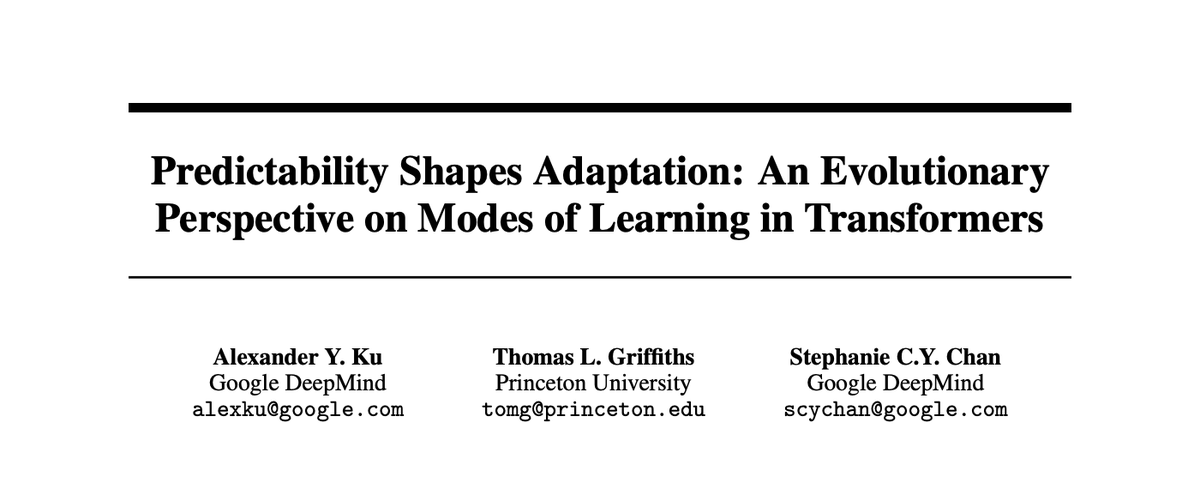
(1/11) Evolutionary biology offers powerful lens into Transformers learning dynamics! Two learning modes in Transformers (in-weights & in-context) mirror adaptive strategies in evolution. Crucially, environmental predictability shapes both systems similarly.
Alexander Ku tweet media
English
12
25
167
26.2K
Sherjil Ozair
Sherjil Ozair@sherjilozair·
Today I'm launching my new company @GeneralAgentsCo and our first product. Introducing Ace: The First Realtime Computer Autopilot Ace is not a chatbot. Ace performs tasks for you. On your computer. Using your mouse and keyboard. At superhuman speeds!
English
346
324
2.9K
869.9K
niki parmar
niki parmar@nikiparmar09·
Today is as good a day as any to share that I joined Anthropic last Dec :) Claude 3.7 is a remarkable model at complex tasks, especially coding, and I'm thrilled to have contributed to its development. From winning Pokémon badges to vibes coding, Claude's got you covered!
Anthropic@AnthropicAI

Introducing Claude 3.7 Sonnet: our most intelligent model to date. It's a hybrid reasoning model, producing near-instant responses or extended, step-by-step thinking. One model, two ways to think. We’re also releasing an agentic coding tool: Claude Code.

English
61
42
1.6K
272.2K
Aidan Gomez
Aidan Gomez@aidangomez·
The most beautiful, intelligent, and kind woman I’ve ever known agreed to marry me.
Aidan Gomez tweet mediaAidan Gomez tweet mediaAidan Gomez tweet media
English
153
9
1.4K
162.9K
Aravind Srinivas
Aravind Srinivas@AravSrinivas·
Excited to announce we've raised 62.7M$ at 1.04B$ valuation, led by Daniel Gross, along with Stan Druckenmiller, NVIDIA, Jeff Bezos, Tobi Lutke, Garry Tan, Andrej Karpathy, Dylan Field, Elad Gil, Nat Friedman, IVP, NEA, Jakob Uszkoreit, Naval Ravikant, Brad Gerstner, and Lip-Bu Tan.
English
192
275
4.2K
1.2M
niki parmar
niki parmar@nikiparmar09·
Thrilled to announce our company, essential.ai 🚀 We are in an exciting era of human-computer collaboration evolving the way we will reason with, process and generate information. At Essential AI, we are passionate on advancing capabilities in planning, reasoning, tool use and continual learning that will be critical to bridge the knowledge and skill gap between humans and computers.
GIF
English
36
37
579
162.9K