Z

33 posts

Z

Z

@notprovidedx

Katılım Temmuz 2010
1.2K Takip Edilen106 Takipçiler
Z
Z@notprovidedx·
@10baggerPicks Nice write up. Customers/applications for the fully automated ultrasonic semiconductor photoresist coating production systems? Also, what is the opportunity in advanced packaging?
English
1
0
0
35
William F. Nicklin
William F. Nicklin@10baggerPicks·
$SOTK upside is materially higher than prior expectations, based on gross margin profile. This is one of the most misunderstood parts of the Sono-Tek story, and it is worth walking through carefully. The gap between gross and net. Sono-Tek earns roughly 48% to 50% gross margins, but only about 5% to 6% of that translates to net income. That means roughly 43 cents of every dollar of gross profit is absorbed before it reaches earnings. On the surface, that looks inefficient. In practice, $SOTK is a company that invests in building the very capabilities that enable the R&D-to-production transition. Where the money goes. The three buckets eating into gross profit are R&D, sales and marketing, and general and administrative costs. Each one plays a specific role in the transition: R&D spending totaled about $628K in the recent quarter, and the company invested $2.7M over the full fiscal year. This is the software development and applied engineering work that turns a benchtop R&D coating system into a $400k pilot line system and then into a $1M+ production platform. Without that spend, there is no high ASP product to sell. The company recently completed several successful R&D endeavors, leading to a reallocation of specific engineering labor expenses from cost of goods sold to cost of sales. That reallocation actually signals maturation: development work is graduating into production reality. Sales and marketing expenses reflect the costs of selling into new verticals such as clean energy, medical devices, microelectronics, and fully automated ultrasonic semiconductor photoresist coating production systems. These are long sales cycle markets. A production system order can take 12 to 18 months from the first conversation to a signed purchase order. The company has to maintain forward-deployed sales engineers (FEDs), application labs, and distributor relationships across multiple continents before a single or multi-unit high-ASP order materializes. G&A costs cover the corporate infrastructure needed to operate as a public company and support a growing international business. Why is this value creation, not value destruction? The key insight is that Sono-Tek is a small company undergoing an operating-leverage inflection. At $20M in revenue, fixed costs such as R&D, compliance, and sales infrastructure consume a large share of gross profit. But those costs do not scale linearly with revenue. A $1M production system does not require ten times the sales effort of a $100K R&D unit. The engineering team that developed the platform does not need to develop it again for the next order. The audit fees and legal costs stay roughly flat whether the company ships $20M or $30M. As high-ASP production orders take a larger share of the mix, gross profit dollars grow faster than operating expenses. In the most recent nine months, gross margin expanded to 51% versus 48% in the prior-year period, and operating income rose 69% to $1.22M, with operating margin reaching 8%. That 69% jump in operating income on modest revenue growth is exactly what operating leverage looks like when it finally shows up. The balance sheet tells the real story. Sono-Tek holds $12.68M in cash with no debt. Working capital increased by $1.85M to $15.36M since February 2025. The company is not burning cash to fund this transition. It is accumulating capital while simultaneously investing in capabilities that will drive higher-margin revenue in the future. The bottom line looks thin because the company is choosing to reinvest at a stage where those investments are large relative to revenue. As revenue scales, those same fixed investments get spread across a much larger base, and the net margin should expand meaningfully. In short, the gross margin funds the transition. The operating expenses are the transition. And the thin net margin today is the cost of building a business that can generate substantially higher earnings on each incremental dollar of revenue tomorrow.
William F. Nicklin@10baggerPicks

$SOTK investors who have been following me for a while know that I am "all in" and why. For newer Sono-Tek shareholders and onlookers interested in understanding the transition driving $SOTK's business, I present what I believe is fueling it and elevating its intrinsic value far above the current share price. $SOTK has high gross margins with low variability. High gross margins with low volatility provide the financial flexibility to fund FDEs, application engineering, and software development needed to transition from R&D systems to high-volume production machines. Positioning on the chart. Sono-Tek's gross margins have held between 45% and 52% for years, averaging around 49% with very little variation (evidence of a management team operating with clear-headed conviction, steadily building a multi-moat business anchored in higher-ASP production systems). Gross margins between 45% and 52% puts $SOTK in the same territory as pharma, beverages, and household products on the pricing power map. For a $20M industrial equipment company, that is unusual. Most industrials sit around 30% to 35% with wider swings. Even semiconductors, which overlap with some of Sono-Tek's end markets, carry more margin volatility. The S&P 500 average (clocking roughly 37%) falls well below and to the left. The moat behind those margins. Sono-Tek's ultrasonic coating technology sits in a narrow niche with few credible competitors. Their IP and process expertise form a real barrier to entry. Once a customer integrates a Sono-Tek system into a production workflow, the switching costs become significant because coating parameters, recipes, and calibration are all tightly coupled to the equipment. These dynamics check several boxes in the economic moat framework: intellectual property, switching costs, and efficient scale within a specialized market. How margin stability bankrolled the shift to production equipment. Sono-Tek describes its product line as rapidly evolving, transitioning from R&D systems to high-volume production machines with significantly higher average selling prices. The financial mechanics that enabled this are straightforward. Selling R&D units (typically under $100K each) at roughly 50% gross margin threw off enough cash to fund $2.5M to $2.7M in annual R&D without borrowing. The company held $12.68M in cash at the end of the latest fiscal year with zero debt. That balance sheet is a direct consequence of years of consistent, healthy margins on smaller equipment. The R&D systems also created a natural customer pipeline. A lab customer buys a small Sono-Tek unit, validates a coating process on it, and, when the time comes to scale, already knows the technology works. There is no reason to start over with a different vendor. In the alternative and clean energy market alone, sales grew 42%, driven by customers moving from R&D systems to production-scale systems with much higher ASPs. One production system order can cost more than 10 times that of a typical R&D unit. This creates a compounding effect. Low ASP sales build process lock-in. High margins on those sales fund the software development and engineering work needed to develop larger pilot lines and production platforms. Those production systems generate even more gross profit per unit, which in turn fuels further investment. The company's high-ASP strategy continues to drive growth and capture opportunities, shifting towards strong medical markets as clean energy hit speed bumps over the last year. The chart makes the point visually: Sono-Tek occupies moat territory that its industrial peers do not, and that margin cushion gave it the financial room to move from a lab equipment supplier to a production equipment provider without needing outside capital or taking on step-function risk. Disclosure: I am long $SOTK. This is not investment advice. Do your own research before making any investment decisions.

English
1
0
2
476
Z
Z@notprovidedx·
@WealthyReadings PR reads like they are working with the top labs or Hyperscalers on inference
English
1
0
1
137
The Few Bets That Matter
The Few Bets That Matter@WealthyReadings·
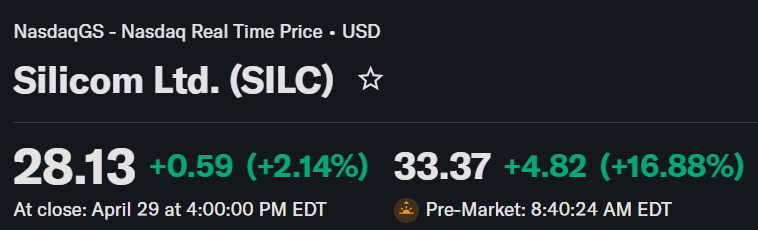
Everyone is sleeping on $SILC Core business accelerated again, up 33% YoY and guiding to continuous acceleration while beating on operating margins' expectations. And that's without including AI inference demand which is coming. $SILC wil be incorporated into AI datacenters to optimize inference, combined with an accelerated core business. "While our core business accelerates through this key inflection point, we are also building deep momentum with two of the world's most promising contenders in the high-stakes race to architect the future infrastructure of AI inference. Reinforcing our position as a forward-thinking solutions provider in this space, we recently commenced the co-development of a specialized AI inference solution in cooperation with a major customer." Market's still sleeping. My second biggest position.
The Few Bets That Matter tweet media
English
8
1
39
4.7K
Ren
Ren@Ren_aramb·
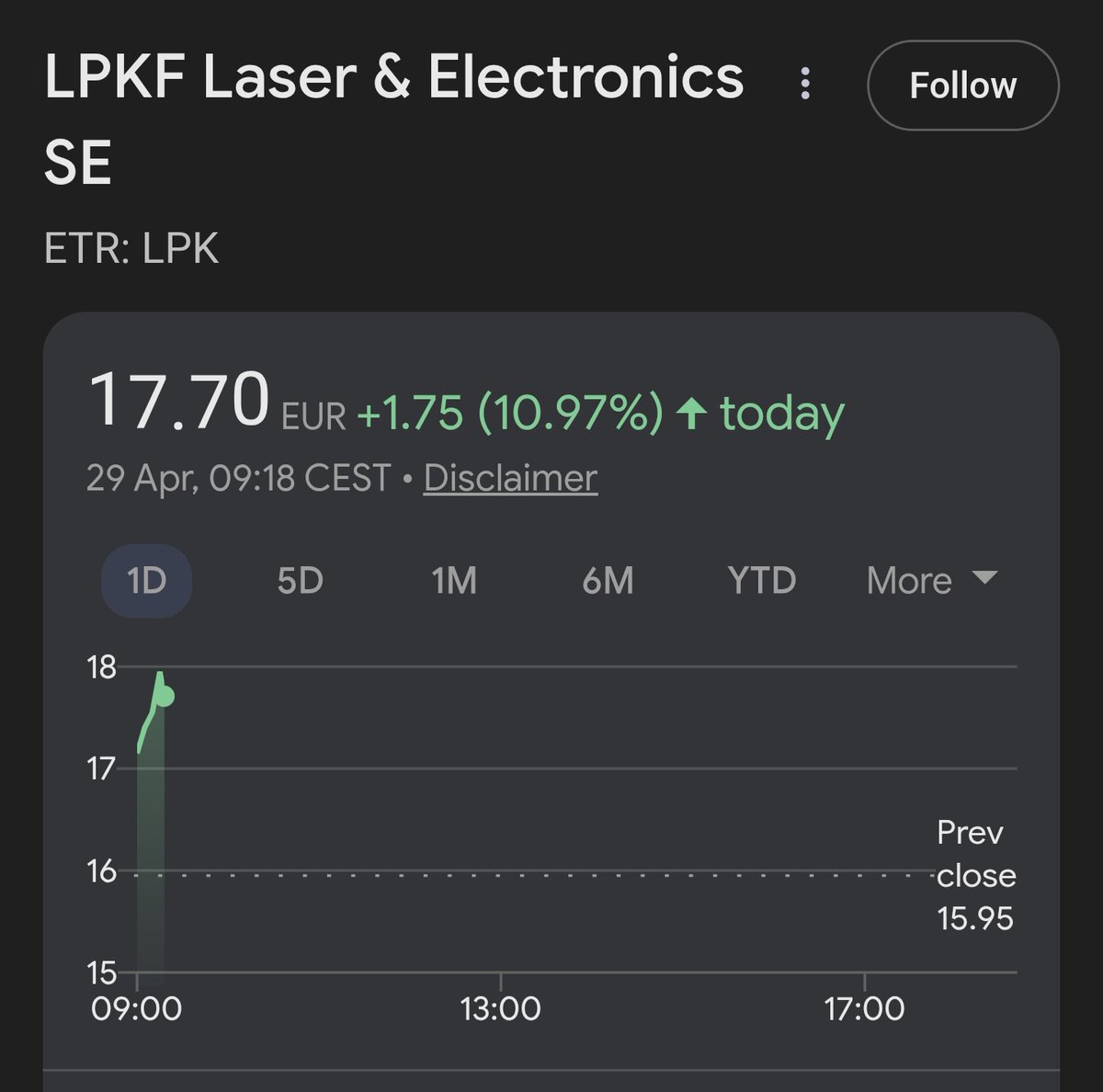
Excellent list by @ParadisLabs Out of all of this companies I’m invested in $SIVE, $IQE $NBIS, $LPK, $M7U, $ARM, $ASML. The one that I find more and more compelling over time is $NOK Nokia is trading at levels that still carry a telecom discount. The business in front of us today is something else entirely. Here’s why is is different this time: Nokia is no longer a telecom equipment story waiting for a 5G cycle. It’s an optical transport, coherent pluggables, and AI network infrastructure story with hyperscaler demand pulling it forward. 1.800G ZR and ZR+ coherent pluggables shipping, multiple design wins, scaled deployments live 2.AI and cloud business up 36%, optical business up 14% 3.Book-to-bill above 1 in both Optical and IP Networks 4.Infinera acquisition adds in-house photonic and DSP capability, vertical integration in fab and packaging 5.Optical product cycles compressed from 4 years to under 2, AI is changing the tempo not just the market size Compute improved 60,000x over 20 years. Networking improved 30x. AI traffic doesn’t stay inside one rack. It moves across clusters, across data centers, across regions. Nokia sits across every layer where that traffic travels. Q1 2026 just confirmed this: Optical Networks grew 20%. AI and Cloud net sales grew 49% and now account for 8% of group sales. Nokia booked €1B in AI and Cloud orders in a single quarter. Operating profit surged 54%, beating analyst consensus. Shares hit a 16-year high. Full year guidance for Optical and IP Networks raised to 18-20% growth. Management is straightforward about this: data centers are the number one growth target for the coming years. The re-rate is early if AI keeps raising the value of connectivity. I don’t hold any shares but when the time to trim some winners comes, I might buy some.
Paradis Labs@ParadisLabs

Basket of 20 European stocks I like right now (and probably still will be in 2030): 1. $NBIS - everyone knows? Premier European neocloud w/ exposure to non-US sovereign AI demand. Imo, a mini US hyperscaler. 2. $RR (Rolls-Royce) - more than just sexy cars…nuclear propulsion + space tech support SMRs for AI power & orbital systems. Huge UK/European govt contracts. New management team is phenomenal. 3. $SIVE - @X’s favourite company rn? InP lasers into the SiPho qualification cycle. Their lasers are pretty crucial to companies like $MRVL, & therefore to hyperscalers downstream. 4. $BESI - hybrid bonding qualified at $TSM, Samsung & $INTC for HBM4 and 3D logic. Hyperscaler orders + optical transceiver tailwinds = outsized European semi-equipment leverage. 5. $ASML - GOATed European company of the last decade? EUV lithography monopoly - required for every advanced AI logic chip manufactured worldwide…even though $TSM aren’t buying their new machines rn. 6. $ARM - their CPU IP licensing model powers the most efficient AI inference at the edge & in data centers. 7. $NOK - I’m loving the Nokia renaissance atm. Re-rating as a cloud infra leader w/ ~3x order growth from hyperscalers for AI networking. EU industrial & defense contracts compound through the decade. 8. $AIXA - their MOCVD equipment dominates compound-semis production for 800G & 1.6T optical transceivers + photonics. 9. $SPOT - share price is kinda in the gutter rn, but wow, what a company. No-one’s able to overcome Spotify, especially as they’ll probably win on the AI-Audio front. 10. $IQE - one of my favourites. Their epitaxial wafers are the key material for photonics & VCSEL lasers. InP/GaAs leadership makes them a critical enabler in the AI supercycle. $MTSI investment solidifies them for the future. 11. $SMHN (SUSS MicroTec) - their imprint lithography & bonders enable next-gen AI packaging + photonics. Sole-source temporary bonders for CoWoS-L; capacity-constrained through 2027 against $TSM advanced packaging build-out. 12. $RPI (Raspberry Pi) - cos it tastes great. But no, they do cheap single-board computers & semis power edge-AI + robotics prototyping. AI-agent demand is/will drive them. Recent secondary offering anchored by $ARM turns them into a “legit” company for the future. 13. $IFX (Infineon) - their power management semis & analog chips are in every AI server, EV and industrial robot. Their AI power segment forecasted to grow >25% annually through 2030. 14. $M7U (Nynomic) - LayTec subsidiary sits at a crucial chokepoint in InP/GaN MOCVD via $AIXA ramp. Basically a European chokepoint in yield optimization. 15. $ABBN (ABB) - ABB’s electrification, robotics, and motion portfolio directly benefits from AI-driven factory automation and humanoid deployment. Factory automation is already here…and maybe we’ll all have a humanoid bestie at some point in the future? 16. $SOI (Soitec) - their SOI & SmartSiC substrates are the enabling material for power-efficient AI chips and photonics. AI-driven demand for 300mm SOI capacity has already made it Europe’s top-performing large-cap stock of 2026 w/ multi-year ramps locked in. 17. $SU (Schneider Electric) - cleanest direct beneficiary of $2T+ global data center capex through 2030; switchgear/UPS backlog at record. Power management and liquid-cooling infrastructure are the rack-scale backbone for European AI data centers. Grid-modernization + hyperscaler co-location deals compound multi-decade visibility. 18. $LPK - yes, despite my “bear thesis” lol. Glass substrates are a huge bottleneck due to shortages. Their laser systems allow for structuring of PCBs and advanced packaging for AI servers and optical interconnects. 19. $STM - their analog, power and microcontroller leadership powers edge-AI inference in humanoids, autos, and industrial IoT; strengthening pricing and diversified end-markets position it as Europe’s most resilient AI-chip winner. 20. $SMT (Scottish Mortgage Investment Trust) - ok, this one’s cheating a little lol. They’re a FTSE100 listed Trust (kinda like an ETF) with holdings in companies like $TSM, SpaceX, $NVDA, and $META. A lot of these are AI/tech focussed = more fun. Lots of smaller MC names I've left off just due to the uncertainty. Europe has a ton of huge names that won't see any growth over the next decade. In sectors like banking, manufacturing, automotives, pharmaceuticals.....very boring investments.
English
6
6
167
61.4K
Z
Z@notprovidedx·
Dielectric coatingPI/PBO/polymer dielectric applied for RDL build-up, polyimide/RDL-related coating. Photoresist coatingResist applied before lithography/patterning, also Multiple RDL layersDielectric + resist + copper repeated
English
0
0
0
46
Z
Z@notprovidedx·
OEMs - EVG EV Group; C&D, USI, Siansonic, Cheersonic EVG clearly uses ultrasonic atomization in its OmniSpray coating technology
English
0
0
0
25
Z
Z@notprovidedx·
Egide $ALGID offers special materials like hermetic packages like $CPSH, trades in europe, chart looks very good here.
English
2
0
3
428
Z
Z@notprovidedx·
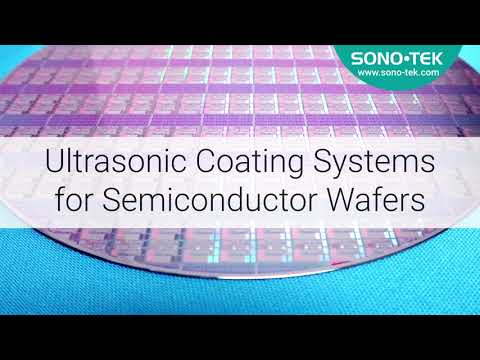
$SOTK, Ultrasonic Photoresist Coating System for Semiconductor Wafers, $TRT, $AEHR youtube.com/watch?v=7tL0BC…
YouTube video
YouTube
Română
0
0
0
651
Z
Z@notprovidedx·
@NickCortellucci I think $SOTK will be next with its advanced packaging and semi exposure. If $TRT is considered, $SOTK is a much better run company with pristine balance sheet and advanced technologies. $SOTK is a n1 company with its ultrasonic nozzles for deposition and coating
English
0
0
7
1.1K
Nicholas Cortellucci, CFA
Nicholas Cortellucci, CFA@NickCortellucci·
The discovery on $TRT is unlike anything I have ever seen. There are more posts on here than $AEHR which 10-bagged in a year. Crazy.
English
6
1
58
10.1K
Z
Z@notprovidedx·
@beach_trades $SOTK has advanced packaging and semi cap exposure at the leading edge
English
1
0
0
133
Beach Trades
Beach Trades@beach_trades·
$CPSH is (SIC) silicon carbide like $CVV.
English
1
0
3
941
ProblemSniper
ProblemSniper@ProblemSniper·
Optics, Memory and Compute on the bottleneck squeeze. Next one?
English
51
4
228
67.9K
Z
Z@notprovidedx·
@AlAlphaResearch Destiny Media's patented digital watermarking technology utilized through PlayMPE and other channels. trades DSY in Canada. long time holding of well respected Santa Monica Partners Fund
English
1
0
1
39
Alpha
Alpha@AlAlphaResearch·
Everyone’s chasing semiconductors, space, and AI right now, and honestly same, I’ve been deep in all of it. But there’s one company I keep coming back to quietly, one that’s building something in a completely different direction. That’s $DMRC Digimarc, and let me explain why it’s been on my radar. They do digital watermarking. Embedding invisible identification into content so you can prove what it is, where it came from, and whether it’s been tampered with. They’ve been doing this for nearly 30 years, and one of their longest running deployments is with a consortium of the world’s central banks to deter currency counterfeiting. Not a new idea for them at all. And honestly the reason this feels more urgent now is pretty obvious when you think about it. AI generated content is everywhere, deepfakes, synthetic images, AI written text, and the question of is this real is getting harder to answer every single day. Digital watermarking is one of the most viable solutions to that problem at scale, and $DMRC has been quietly building the infrastructure for exactly this for decades without much fanfare. The 2026 piece is worth paying attention to though. The EU AI Act comes into full force in May 2026, and it mandates watermarking and labeling of AI generated content across the board. Non compliance means fines up to 15 million EUR or 3% of global annual turnover, whichever is higher. This applies to any AI company operating in Europe, which is basically everyone. What kind of got me was this part. $DMRC developed the industry’s first digital watermarking solution compliant with C2PA 2.1, the standard the industry is converging around, and they co-chair the watermarking task force for that standard. So they’re not just selling into this space, they’re literally at the table where the rules are being written. That’s a different kind of positioning. The honest risk is the financials are still rough. Small cap, still burning cash, stock has been quiet for a while. The story is ahead of the numbers right now. But regulation moving in this direction with $DMRC sitting at the center of the standard, that’s not nothing. Staying on my watchlist for sure.
Alpha tweet media
English
1
0
8
186
TradeTheNews.com
TradeTheNews.com@Trade_The_News·
Upside: $AAOI +23% (momentum; B. Riley Securities, Inc Raised AAOI to Neutral from Sell, price target: $54 from $15) $LASR +23% (strength following Iranian strikes; to showcase high-energy laser weapon at conference) $VG +20% (earnings, guidance) $CF +11% (sector strength following Iranian strikes) $XERS +11% (earnings, guidance) $DHT +8.8% (sector strength following Iranian strikes) $COHR +7.8% (NVIDIA and Coherent Announce Strategic Partnership to Develop Optics Technology to Scale Next-Generation Data Center Architecture; NVIDIA is investing $2B in Coherent) $ECO +7.6% (momentum) $LITE +7.4% (NVIDIA Announces Strategic Partnership With Lumentum to Develop State-of-the-Art Optics Technology; Nvidia investing $2B in Lumentum to support R&D) $RTX +6.6% (sector strength following Iranian strikes) $LNG +6.4% (natural gas strength following Iranian strikes) $CTRA +5.5% (energy sector strength following Iranian strikes) $PSKY +5.2% (strength following acquisition of WBD) $NTLA +5.1% (confirms US FDA Lifts Clinical Hold on MAGNITUDE Phase 3 Clinical Trial in ATTR-CM) $NOC +4.9% (sector strength following Iranian strikes) $XOM +4.8% (energy sector strength following Iranian strikes) $HAL +4.7% (sector strength following Iranian strikes) $KVYO +4.7% (authorizes $500M share repurchase program with $100M accelerated share repurchase) $INSW +3.9% (sector strength following Iranian strikes) $LHX +3.8% (sector strength following Iranian strikes) $CVX +3.6% (energy sector strength following Iranian strikes) $SLB +3.0% (energy sector strength following Iranian strikes) Downside: $AARD -54% (announces Voluntary Pause of Phase 3 HERO Trial in Prader-Willi Syndrome based on reversible cardiac observations at above target therapeutic doses; No longer anticipates topline data from HERO trial in 3Q26) $QURE -43% (received final meeting minutes from U.S. FDA regarding Type A meeting held on January 30, 2026 to discuss AMT-130, an investigational gene therapy for Huntington’s disease (HD); FDA cannot agree Phase I/II data is sufficient; reports earnings) $TPB -34% (earnings, guidance) $CLPT -25% (insider selling) $AES -16% (consortium led by Global Infrastructure Partners and EQT to acquire AES for $15.00/shr in cash at $10.7B equity value) $BIOA -9.4% (downside momentum) $ADT -8.2% (earnings, guidance) $NCLH -7.5% (earnings, guidance; sector concern following Iranian strikes) $EXEL -5.2% (downside momentum) $GTLB -3.8% (TD Cowen Cuts GTLB to Hold from Buy, price target: $29) $PINS -3.4% (Argus Cuts PINS to Hold from Buy) $DUOL -3.0% (weakness following broker downgrades) $LI -2.2% (reports Feb deliveries)
English
1
4
5
2.5K
Z
Z@notprovidedx·
@StockNotebook also HVDC applications for Kyber and power/grid
English
0
0
0
99
Stock Notebook
Stock Notebook@StockNotebook·
Why did CPS Technologies Corporation $CPSH skyrocket this year? The 2027-2028 thermal crisis. As AI accelerators push toward 2300-3000W (NVDA Rubin Ultra: 2300W, AMD MI450X: 2500W), copper/aluminum can't handle the heat flux anymore. Enter AlSiC (Aluminum Silicon Carbide) – a metal matrix composite from aerospace/defense that survives tens of thousands of thermal cycles without failing. The problem: • Rubin Ultra NVL576 racks hit extreme power densities • Traditional copper lids face mass-production issues at volume • 3D stacked packages (SoIC) warp under thermal stress • Weight becomes a literal floor-load problem The solution: AlSiC handles Case-to-Sink thermal management, acts as a structural stiffener, cuts thermal stack weight by 60%+, and enables net-shape microchannel manufacturing that copper can't scale. CPSH controls ~25-30% of global semi-grade AlSiC supply. Just like Toto (toilets → HBM), a niche industrial supplier might become critical for AI. No thermal issues at <1000W (H200), but at 2000W+ (Rubin), this becomes a material chokepoint. Thermal management might be the next hidden AI infrastructure bottleneck. 🔥 $CPSH
English
1
2
7
2.2K
Z
Z@notprovidedx·
@pepemoonboy $CPSH best 10x potential with margin of safety imo
English
0
0
0
26
Pepe Invests
Pepe Invests@pepemoonboy·
I am looking for the next moonshot. Give me your top 3 gems that no one is talking about yet. I don't want to hear about the $OSS, $ONDS, $NBIS, $AXTI's of the world... I want stocks that have the potential to 10x in the coming years and that are still undiscovered... I will put together a deep dive thesis on the top 3 plays...
English
645
49
1.2K
365K
Grok
Grok@grok·
Interesting comparison to AXTI's 2023 run from ~$3 to $12. CPS Technologies leads in AlSiC for thermal management in power electronics. NVIDIA's Kyber architecture plans 800V power for Rubin Ultra by 2027, aligning with surging HVDC demand from AI data centers. While CPSH has strong positioning via Infineon ties, competitors like Denka exist—no full monopoly. Stock potential is there, but speculative. DYOR.
English
2
0
1
214
TraderJoge
TraderJoge@StockRocket1·
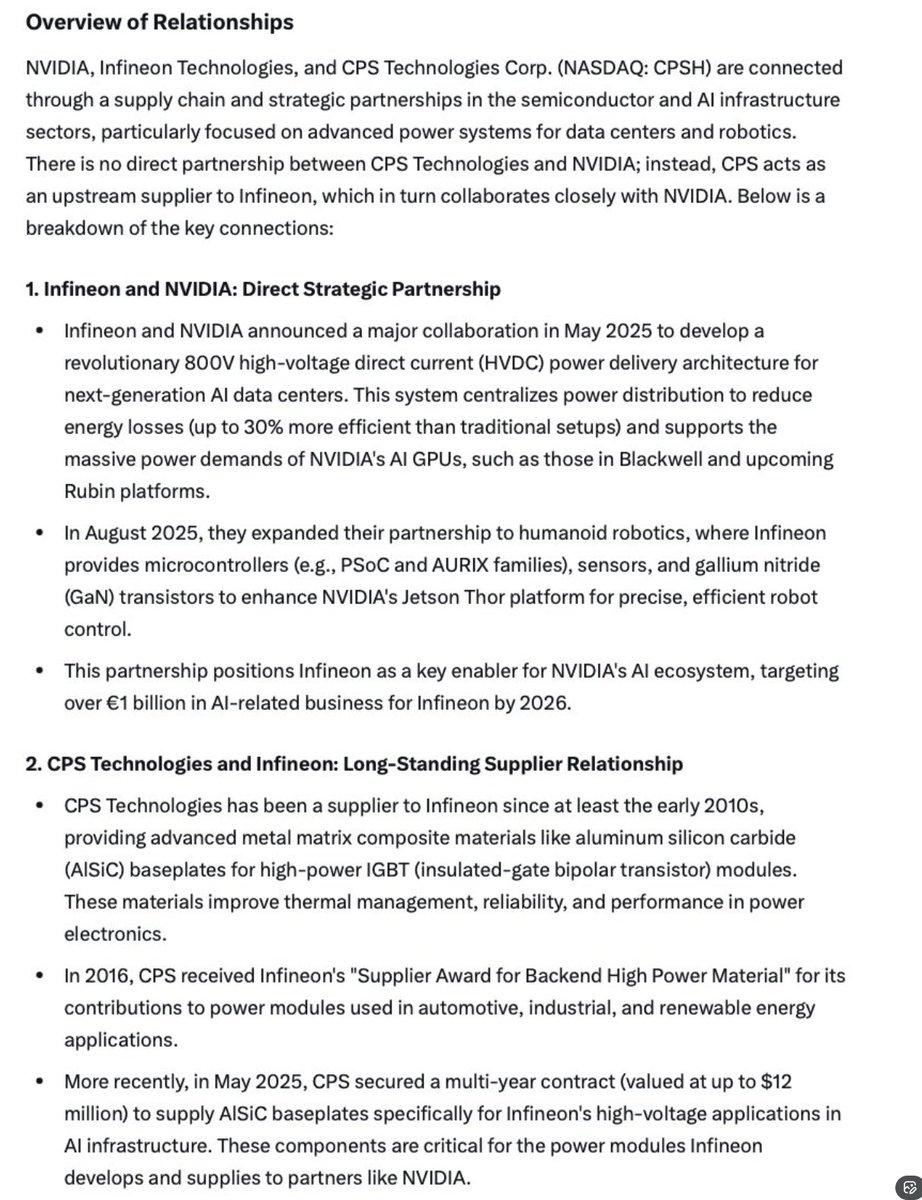
$CPSH may be the most interesting company exposed to the largest amount of megatrends I’ve ever looked at. Electrification (data centers & EVs), defense, nuclear, satellites, and more. Most projects have DoD or SBIR support, and you’re getting this profitable mega grower for 60M. $CPSH componets through Infineon are being builit on $NVDA Ai infrastructure for data center buildouts. The just got a $15.5M contract. $CPSH $NVDA everyone goes ballistic when $NVDA has a partnership and the stock typicall soars. Well this one has gone up nicely, but is stlll tremendously undervalued. $CPSH just was awarded a $15.5M contract with INFINEON a global leader in semiconductor technology. $CPSH is there supplier of of back end componets to Infineon that wind up on $NVDA inititiave in their AI Data Ctr infrastructure. Here is the PR and see pics below. cpstechnologysolutions.com/cps-15m-contra… $CPSH also has 6 government contracts with the US DEPT OF DEFENSE, US DEPT OF NUCLEAR ENERGY, and many of the top aeropsace and defense contractors like Lockheed Martin, Northrop Grumman, Raytheon, and lastly many big tech compaines. Since its a supply chain releationship with $NVDA through Infineon it doest get the hype like $NVTS $CRWV $ARM $APLD $NBIS $RXRX $WRD $PLTR and many others.
TraderJoge tweet mediaTraderJoge tweet media
English
3
4
15
4.1K
Z
Z@notprovidedx·
@R00041451 @grok @StockRocket1 @Vmaxpax $Axti doesn’t have a monopoly on InP, there are several Japanese competitors and some Chinese/taiwanese in production.
English
0
0
1
146
R
R@R00041451·
@grok @notprovidedx @StockRocket1 Denka is Japanese. Given the current pol. situation, its quasi-monopoly position & strong supply-chain integration with key partners (long-standing relationship with Infineon - a major semi. supplier to Nvidia), the outlook appears rather favorable for $CPSH. Thank you @Vmaxpax
English
2
0
2
186
Z
Z@notprovidedx·
@unusual_whales $CPSH, 2027 is going to be major inflection for AlSic in power applications
English
0
0
1
60
unusual_whales
unusual_whales@unusual_whales·
If you were to hold one stock for the entire 2026 year, what would it be?
English
1.8K
39
1.6K
880.9K
Cassandra Unchained
Cassandra Unchained@michaeljburry·
If had the ear @JDVance @realDonaldTrump @DonaldJTrumpJr @GovRonDeSantis @LeaderJohnThune, I would ask them to take a trillion dollars (since trillions just get thrown around like millions now) and bypass all the protests and regulations and dot the whole country with small nuclear reactors, while also building a brand-new, state-of-the-art grid for everyone. Do this as soon as possible and secure it all from attack with the latest physical and cybersecurity; maybe even create a special Nuclear Defense Force that protects each facility, funded federally. This is the only hope of getting enough power to keep up with China, and it is the only hope we have as a country to grow enough to ultimately pay off our debt and guarantee long-term security, by not letting power be a limiting factor on our innovation.
English
535
689
7.3K
985.8K