Sabitlenmiş Tweet

neuroblast
375 posts
@nrblast
▫️So many currencies in a brain▫️AI in the decentralized substrate 🔻🔺 Agent based simulator. ▫️▫️
Verifiably private AI is NEAR AI. Major platforms and nation-scale systems like Venice, Brave, Abound, and the Government of Bermuda are integrating NEAR AI to bring confidential inference to their users 🧵
The soft-power of countries controlling the big models will be insane.
Creativity feeds on constraints
As one of the first people to warn about a possible AI backlash—years ago—let me tell you this: it’s going to get much, much worse. It breaks my heart that AI—something I spent my whole life thinking about—is likely to become a dirty word, and that it has been subverted so deeply by arrogance and greed.




I redid the multi-digit multiplication experiment, now with gpt-5.5. With medium reasoning and 7 samples each cell, it pretty much aced the test with 99.46% accuracy. The model had no tools to call and had to rely on its reasoning. Can it go further? (1/4)

the model alone is no longer the product

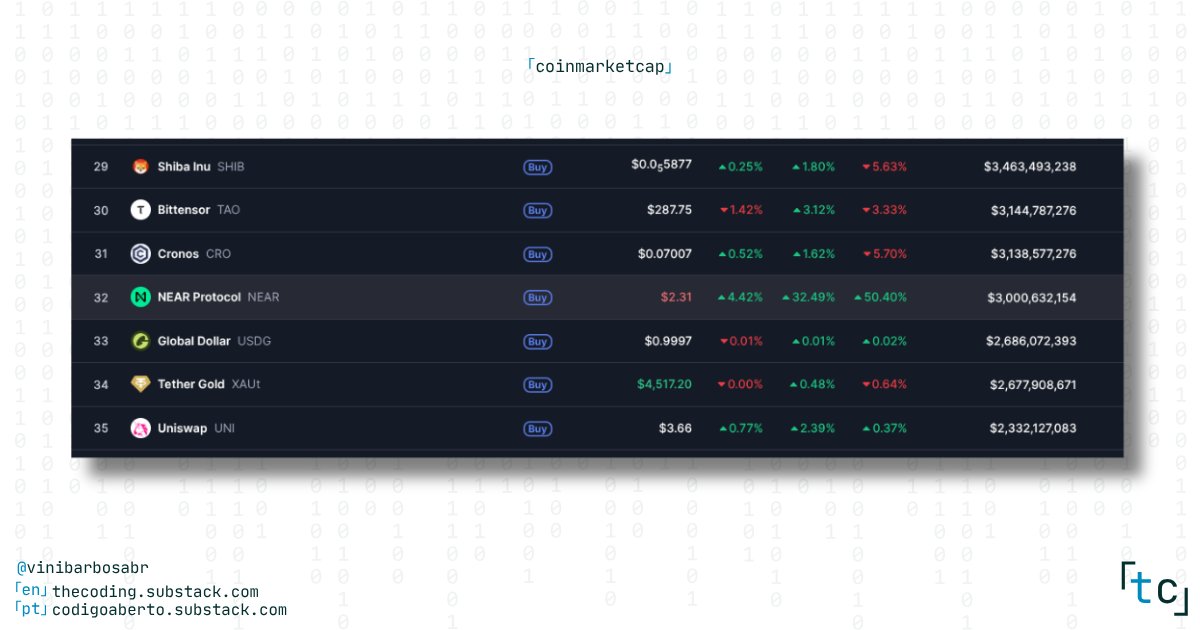
📈 near:native continues climbing market cap ranks! After passing Trump's WLFI, NEAR Protocol has already conquered three more spots against Mantle and Polkadot, eyeing Uniswap and TAO, while challenging gold-backed stablecoins (PAX and Tether) NEAR (#35) + has a $2.15B market cap + at $1.65/token, up 8% in 24h WLFI (#39), MNT (#38), DOT (#37), and PAXG (#36) + are all behind, now, from $2.12B to $1.90B mcap UNI (#34), XAUt (#33), and TAO (#32) + could be next, from $2.20B to $2.83B mcap First slowly, then suddenly -- Study NEAR

Theoretical physicist Michio Kaku on why aging is simply an accumulation of errors that AI can now identify: He opens with a bold claim about what artificial intelligence might finally make possible: "Artificial intelligence may give us something that the kings and queens of old could never conquer and that is the aging process." For @michiokaku, the science behind why we age is no longer a mystery. It comes down to one thing: errors building up inside our cells over time. "We now know why things age. Things get old and die because they accumulate error. Error in the form of DNA mistakes. Accumulation of errors inside cells." The challenge, until now, has been the sheer scale of the problem. Identifying exactly where and how these errors occur across the human genome has been beyond what conventional research could handle. That's where artificial intelligence changes everything: "But now we have artificial intelligence. We can analyze millions of genomes of old people, compare them to millions of genomes of young people, and identify where aging takes place in the body."
Do blockchain systems, by introducing ticks, increase the physical embodiment of the internet?

The bitter lesson in 26 words: Don’t be distracted by human knowledge, as AI has been historically. Instead focus on methods for creating knowledge that scale with computation, like search and learning.

Base + USDC The agentic lineup

🇺🇸 Tucker lays out the deepest critique of AI yet, and it's not about jobs... His argument: writing produces thinking. You can't formulate a thought without first articulating it. If kids never write because AI writes for them, the quality of human thinking collapses. That's the surface problem. The deeper one is purpose: "The point of living is to create. That's the point of being a human being. It's necessary for joy. There is no joy without creation." If the machine creates everything and humans just consume, you don't get utopia. You get despair, mass unemployment, and eventually political revolution.
Europe’s solar boom is running into a new problem: too much power. Prices are going negative, grids are overwhelmed, and energy is going to waste. bloomberg.com/news/articles/…