
Sabitlenmiş Tweet
OJ Ochanda
35.3K posts

OJ Ochanda
@ochandaj
When you win, take a shower and go again.
Kenya Katılım Kasım 2011
2.2K Takip Edilen695 Takipçiler
OJ Ochanda retweetledi

My students often have a laptop in front of them when I lecture and many seem to type away at it. This despite the fact lectures are recorded, transcript generated, and slides integrated. I prefer handwriting and everything I write, barring most X posts, starts on paper—sometimes prose, often mind maps, or just doodles. I’ve always felt my students are missing something. We’re not allowed to ban laptops and anyway they’re adults making their own choices. I think the best method is no notes at all. Just listen. Interrupt politely when something doesn’t fit once in a while. Stare out the window when bored. Afterward, just quickly write up your reflections taking account of readings, discussions, what you heard the smart kid grousing about, whatever. Maybe draw some pictures. Then put it all away. I rarely studied for exams from my notes because it was all just there, if this theory is correct, because it was coded in the brain in multiple ways. Usually when studying I’d just go systematically through the outline asking the obvious questions. Good professors rarely hide their signals of what’s important. If I felt good about a section I just moved to whichever one didn’t feel good. Then I’d go to a movie or hang out with my girlfriend. I suspect an advantage of dyslexia is developing the habit of listening very closely. It also helps to understand that the unconscious brain is way more efficient and industrious than the conscious brain.
Ihtesham Ali@ihtesham2005
A Norwegian neuroscientist spent 20 years proving that the act of writing by hand changes the human brain in ways typing physically cannot, and almost nobody outside her field has read the paper. Her name is Audrey van der Meer. She runs a brain research lab in Trondheim, and the paper that closed the argument was published in 2024 in a journal called Frontiers in Psychology. The finding is brutal enough that it should have changed every classroom on Earth. The experiment was simple. She recruited 36 university students and put each one in a cap with 256 sensors pressed against their scalp to record brain activity. Words flashed on a screen one at a time. Sometimes the students wrote the word by hand on a touchscreen using a digital pen, and sometimes they typed the same word on a keyboard. Every neural response was recorded for the full five seconds the word stayed on screen. Then her team looked at the part of the data most researchers had ignored for years, which is how different parts of the brain were communicating with each other during the task. When the students wrote by hand, the brain lit up everywhere at once. The regions responsible for memory, sensory integration, and the encoding of new information were all firing together in a coordinated pattern that spread across the entire cortex. The whole network was awake and connected. When the same students typed the same word, that pattern collapsed almost completely. Most of the brain went quiet, and the connections between regions that had been alive seconds earlier were nowhere to be found on the EEG. Same word, same brain, same person, and two completely different neurological events. The reason turned out to be something nobody had really paid attention to before her work. Writing by hand is not one motion but a sequence of thousands of tiny micro-movements coordinated with your eyes in real time, where each letter is a different shape that requires the brain to solve a slightly different spatial problem. Your fingers, wrist, vision, and the parts of your brain that track position in space are all working together to produce one letter, then the next, then the next. Typing throws all of that away. Every key on a keyboard requires the exact same finger motion regardless of which letter you are pressing, which means the brain has almost nothing to integrate and almost no problem to solve. Van der Meer said it plainly in her interviews. Pressing the same key with the same finger over and over does not stimulate the brain in any meaningful way, and she pointed out something that should scare every parent who handed their kid an iPad. Children who learn to read and write on tablets often cannot tell letters like b and d apart, because they have never physically felt with their bodies what it takes to actually produce those letters on a page. A decade before her, two researchers at Princeton ran the same fight using a completely different method and ended up at the same answer. Pam Mueller and Daniel Oppenheimer tested 327 students across three experiments, where half took notes on laptops with the internet disabled and half took notes by hand, before testing everyone on what they actually understood from the lectures they had watched. The handwriting group won by a wide margin on every question that required real understanding rather than surface recall. The reason was hiding in the transcripts of what the two groups had actually written down. The laptop students typed almost word for word, capturing more total content but processing almost none of it as they went, while the handwriting students physically could not write fast enough to transcribe a lecture in real time, which forced them to listen carefully, decide what actually mattered, and put it in their own words on the page. That single act of choosing what to keep was the learning itself, and the keyboard had quietly skipped the choosing and skipped the learning along with it. Two studies. Two countries. Same answer. Handwriting makes the brain work. Typing lets it coast. Every note you have ever typed instead of written went into your brain through a thinner pipe. Every meeting, every book highlight, every idea you captured on your phone instead of on paper was processed at half depth. You did not forget those things because your memory is bad. You forgot them because typing never woke the part of the brain that would have made them stick. The fix is the thing your grandmother already knew. Pick up a pen. Write the thing down. The slower road is the faster one.
English
OJ Ochanda retweetledi

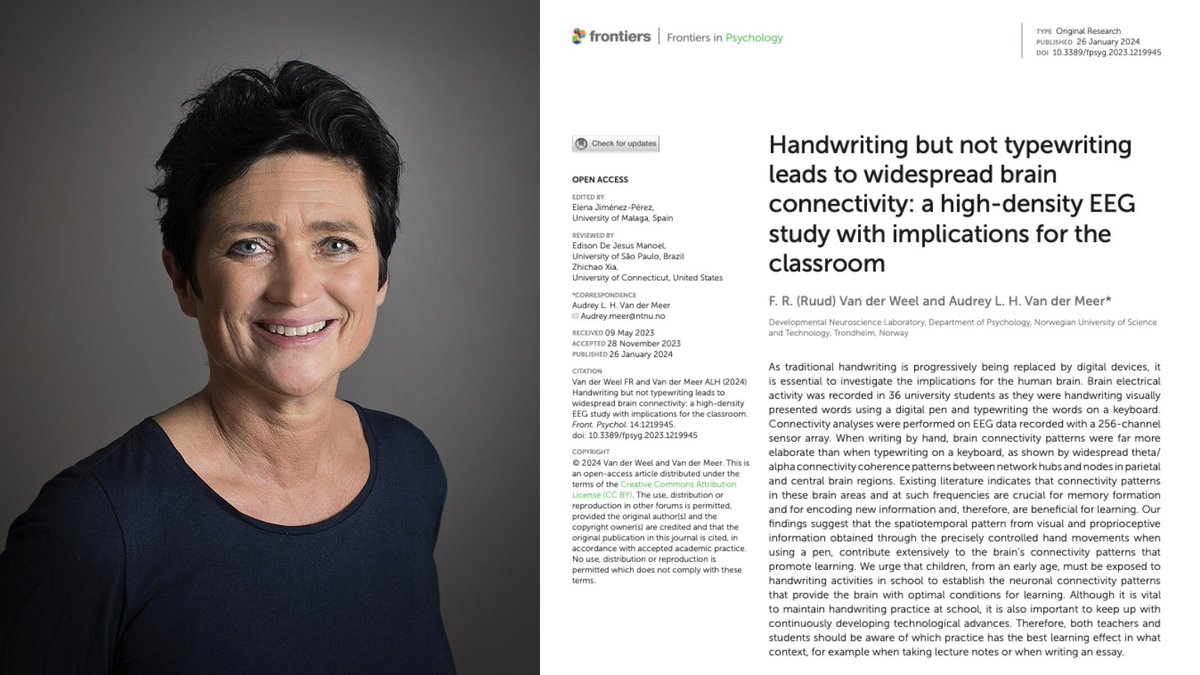
A Norwegian neuroscientist spent 20 years proving that the act of writing by hand changes the human brain in ways typing physically cannot, and almost nobody outside her field has read the paper.
Her name is Audrey van der Meer.
She runs a brain research lab in Trondheim, and the paper that closed the argument was published in 2024 in a journal called Frontiers in Psychology. The finding is brutal enough that it should have changed every classroom on Earth.
The experiment was simple. She recruited 36 university students and put each one in a cap with 256 sensors pressed against their scalp to record brain activity. Words flashed on a screen one at a time.
Sometimes the students wrote the word by hand on a touchscreen using a digital pen, and sometimes they typed the same word on a keyboard. Every neural response was recorded for the full five seconds the word stayed on screen.
Then her team looked at the part of the data most researchers had ignored for years, which is how different parts of the brain were communicating with each other during the task.
When the students wrote by hand, the brain lit up everywhere at once.
The regions responsible for memory, sensory integration, and the encoding of new information were all firing together in a coordinated pattern that spread across the entire cortex. The whole network was awake and connected.
When the same students typed the same word, that pattern collapsed almost completely.
Most of the brain went quiet, and the connections between regions that had been alive seconds earlier were nowhere to be found on the EEG.
Same word, same brain, same person, and two completely different neurological events.
The reason turned out to be something nobody had really paid attention to before her work. Writing by hand is not one motion but a sequence of thousands of tiny micro-movements coordinated with your eyes in real time, where each letter is a different shape that requires the brain to solve a slightly different spatial problem.
Your fingers, wrist, vision, and the parts of your brain that track position in space are all working together to produce one letter, then the next, then the next.
Typing throws all of that away. Every key on a keyboard requires the exact same finger motion regardless of which letter you are pressing, which means the brain has almost nothing to integrate and almost no problem to solve.
Van der Meer said it plainly in her interviews.
Pressing the same key with the same finger over and over does not stimulate the brain in any meaningful way, and she pointed out something that should scare every parent who handed their kid an iPad.
Children who learn to read and write on tablets often cannot tell letters like b and d apart, because they have never physically felt with their bodies what it takes to actually produce those letters on a page.
A decade before her, two researchers at Princeton ran the same fight using a completely different method and ended up at the same answer. Pam Mueller and Daniel Oppenheimer tested 327 students across three experiments, where half took notes on laptops with the internet disabled and half took notes by hand, before testing everyone on what they actually understood from the lectures they had watched.
The handwriting group won by a wide margin on every question that required real understanding rather than surface recall.
The reason was hiding in the transcripts of what the two groups had actually written down.
The laptop students typed almost word for word, capturing more total content but processing almost none of it as they went, while the handwriting students physically could not write fast enough to transcribe a lecture in real time, which forced them to listen carefully, decide what actually mattered, and put it in their own words on the page.
That single act of choosing what to keep was the learning itself, and the keyboard had quietly skipped the choosing and skipped the learning along with it.
Two studies. Two countries. Same answer.
Handwriting makes the brain work. Typing lets it coast.
Every note you have ever typed instead of written went into your brain through a thinner pipe. Every meeting, every book highlight, every idea you captured on your phone instead of on paper was processed at half depth.
You did not forget those things because your memory is bad. You forgot them because typing never woke the part of the brain that would have made them stick.
The fix is the thing your grandmother already knew.
Pick up a pen. Write the thing down. The slower road is the faster one.
English
OJ Ochanda retweetledi

@Tijaniheyzed Also watch The Redeem Team, Court of Gold and Together: Treble winners about Man City,
English
OJ Ochanda retweetledi

@Harri_obi Walahi I can relate.
Athletes are the highest level of obsession and mastery you can see. There was a time I used to binge documentaries of boxers on YouTube: Sonny Liston, Ali, Foreman, Tyson, Marvin Hagler, Rocky Marciano....
Those guys work ethic is insane 🥵
English
OJ Ochanda retweetledi
OJ Ochanda retweetledi


OJ Ochanda retweetledi

Dangote has done three things in the last 72 hours that the Nigerian government could not do in 60 years.
He cut aviation fuel to N1,650 per litre, slashed diesel and aviation fuel prices at ex-depot level, and filed a lawsuit to stop NNPC and private marketers from importing fuel that his refinery is already producing in surplus.
Now the oil marketers are crying monopoly.
Let us be honest about what monopoly means in this context. For 60 years, a cartel of fuel importers held Nigeria hostage, collecting $10 billion annually in subsidy, keeping state refineries deliberately broken, and charging Nigerians premium prices for refined crude they sent abroad themselves.
Nobody called that a monopoly. Nobody filed a lawsuit about market stability when ordinary Nigerians queued for fuel in an oil producing country for decades.
One private refinery starts cutting prices, increasing supply, and going to court to enforce a law that already says imports are only permitted when local supply is insufficient, and suddenly the marketers have discovered the language of competition and consumer protection.
The law is clear. The Petroleum Industry Act only permits fuel imports when domestic supply cannot meet demand. Dangote’s refinery is supplying over 90% of Nigeria’s daily petrol consumption. The legal basis for those import licences does not exist. He is not asking for a favour. He is asking for the law to be applied.
The marketers built their business model on Nigeria’s inability to refine its own oil. That inability has been solved by one man with private capital. Their business model is obsolete and their objection is not about market stability. It is about market access to a rent they no longer deserve.

English
OJ Ochanda retweetledi
OJ Ochanda retweetledi

There are few African countries with three cities that @KenyaAirways serves directly.
Zambia is one of them, with direct flights to Ndola, Lusaka, and Livingstone.
And thankfully so, because Kenya 🇰🇪 and Zambia 🇿🇲 are two countries that should have been neighbors.
I highly recommend the people of both countries to engage more and as much as possible. They are brothers.

English
OJ Ochanda retweetledi

Some people are asking what securitization of fuel is and I want to explain using a simple analogy using a cow
A short thread :
English
OJ Ochanda retweetledi

Kitutu Masaba MP Clive Gisairo is alleging that the refinery being fronted by President William Ruto and Nigerian businessman Aliko Dangote will end up as a family business.
The lawmaker claims the refinery will be owned by Gulf Energy, a company linked to President Ruto’s family.
English
OJ Ochanda retweetledi

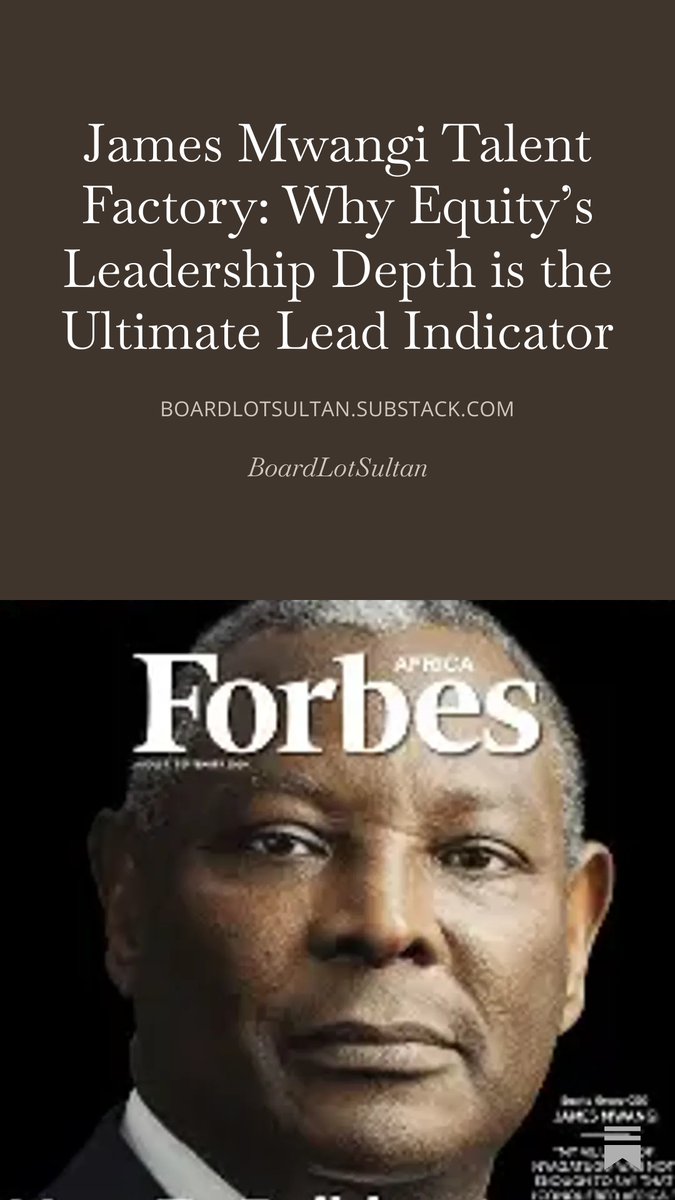
Investors often mistake @KeEquityBank for a one-man show. They are wrong.
If you look closely at the 20-YR evolution of this bank, Mwangi’s most enduring legacy isn't the DRC acquisition or the M-Pesa rivalries—it is the deliberate cultivation of talent.
open.substack.com/pub/boardlotsu…
English
OJ Ochanda retweetledi

OJ Ochanda retweetledi

The higher you climb the corporate ladder, the more relationships matter.
At entry level, your output is visible. You do the work, it shows up. It gets seen and you get a raise and promotion.
At director and above, almost none of your work is visible. You're not doing the hands on dirty work, or at least in large amounts. You're making decisions in a room with a few people and the results show up 6 months later. Nobody can trace them back to you.
So how do they decide who belongs in those rooms?
They pick people they already know.
Not "know of." Know.
People they worked with and have seen operate under pressure. That person gets the call more times than not over the stranger with the better resume.
The stakes are higher, so the trust threshold is higher. A bad hire at $70K is annoying. A bad hire at $300K who controls a $50M budget is catastrophic.
And yeah, it's political. Not in the "office politics is a game" way. In the "if you make a mistake at this level, it doesn't just hit you, it hits your boss, your boss's boss, and so forth.
So people protect themselves by surrounding themselves with people whose body of work they've seen firsthand.
This is why "networking" advice misses the point. The goal isn't to collect contacts.
The goal is to do good work with good people so that when a seat opens at their next company, your name is the first one they think of.
English
OJ Ochanda retweetledi

OJ Ochanda retweetledi

China has achieved extraordinary things in recent decades.
But it’s still nowhere near the USSR’s arc from 1920 to 1957.
A backwards autocracy, with remnants of feudalism, descends into civil war & almost fragments. 37 years later it launches humankind’s first satellite.
WW2 The Eastern Front@ShoahUkraine
Joseph Stalin inherited a country where vast parts of the population still lived in wooden huts and extreme poverty, and in less than 30 years transformed it into an industrial superpower armed with nuclear weapons. He accumulated no personal fortune and died a poor man. When he passed away, his possessions reportedly amounted to little more than his tobacco pipe, some clothing, and his personal library.
English
OJ Ochanda retweetledi
African leaders proclaim unity at summits.
Then negotiate bilaterally in ways that undermine it.
The most important obstacle to Africa's progress, says @LopesInsights, is lack of institutional agency — the inability to negotiate from a position of collective strength.
54 countries. One voice.
Realistic or romantic?
Read the post & comments here
➜ linkedin.com/posts/its-time…

English
OJ Ochanda retweetledi

Excise duty is an indirect tax originally intended to deter consumption of harmful goods.
Why was it imposed on fuel?
These are the questions Uhuru and his Ministers would have been fielding in a Commission of Inquiry on our finances under him.
Kenyan Wall Street@kenyanwalstreet
Full Fuel Costs Breakdown May/June Prices
English
OJ Ochanda retweetledi

OJ Ochanda retweetledi
Even if it has to be pumped here from the Indian Ocean for refining then back to us, it is safer than huko kwa Mama.
Cathy Wabomba@Cathiewabomba
Hoima (location of Uganda Refinery) sits within 180 km of the DRC, 280 km of Tanzania, 350 km of South Sudan, and 450 km of Rwanda. It is not at the edge of anything. It is at the centre of EVERYTHING. One piece, yes, but a load-bearing one in East Africa’s energy security puzzle. So, again, if I was Al Haji Aliko Dangote… (in Uganda we say, “I dono nakudono”)
English