GeorgL0ngGamma

4.2K posts

GeorgL0ngGamma banner
GeorgL0ngGamma

GeorgL0ngGamma

@options_g

trading, science, sports

Katılım Şubat 2021
203 Takip Edilen297 Takipçiler
Sabitlenmiş Tweet
GeorgL0ngGamma
GeorgL0ngGamma@options_g·
one group of #traders is operating on a purely quantitative basis, often with solid background in science/engineering another is only using qualitative heuristics about price action, market mechanics, forced buyer/sellers can the 2nd group survive? @mikeharrisny @Stefano_Peron
English
2
1
13
4.9K
GeorgL0ngGamma retweetledi
Brett Caughran
Brett Caughran@FundamentEdge·
A big pivot from Ken Griffin on AI: “Number one is, in the last few months, there has been a step change in the productivity of the AI toolkit. It is profoundly more powerful than it was just nine months ago. And for us at Citadel, that has allowed us to unleash a much broader array of use cases for AI. And it has been really interesting to watch, to be blunt, work that we would usually do with people with masters and PhDs in finance over the course of weeks or months being done by AI agents over the course of hours or days. These are not these are not mid-tier white collar jobs. These are like extraordinarily high skilled jobs being, I'm going to pick a word, automated by agentic AI. And I gotta tell you, I went home one Friday actually fairly depressed by this because you could just see how this was going to have such a dramatic impact on society. When you witness it in your own four walls, when you see work that used to be man years of work being done in days or weeks, it's like, wow, like that's the first time I've seen real impact in our four walls.” This echoes my own experience with agents and the conversations I am having with students, friends & clients. The toolkit has dramatically transformed and it feels like in finance, for the first time, AI is real.
English
238
698
4.8K
1.7M
GeorgL0ngGamma retweetledi
Martin Shkreli
Martin Shkreli@MartinShkreli·
prediction markets are sportsbooks wrapped in law firms
Matt Kalish@mattkalish

@KeatonInglis What a job you have! Legal must have changed your messaging up on you 13 times this year and somehow you almost kept up. What’s the current official marketing message you’re told to use by legal? Which version was your favorite?

English
39
47
781
169K
GeorgL0ngGamma retweetledi
Yet another commodity guy
Good reminder. People, and bank analysts are no exception, are myopic to fat tails / exponential distributions. The remaining waiting time at the bus station is on average the time you already waited for. The distance to the other shore across an unknown lake is on average the distance you already sailed. Food for thoughts ...
Tom Loughrey@TomLoughrey_LFE

"When will then be now? Soon" Here's a look at consensus drift on Straight of Hormuz reopening. Public GS data. We all know it will be open soon, but what possibilities become the future? 1/3 Chart 1 looks at the expected disruption on the day of publication. 74 days so far, and the estimates keep drifting higher.

English
3
3
63
7.9K
GeorgL0ngGamma retweetledi
Milk Road AI
Milk Road AI@MilkRoadAI·
This is WILD! MIT just solved one of the hardest unsolved problems in robotics (Save this). For decades, the fundamental problem with soft robots and wearable exoskeletons has not been compute or AI, it has been actuation. The moment you try to give a soft robot meaningful strength, you run into the same wall every engineer has hit since the field began, fluid-driven systems require external pumps, hydraulic reservoirs, and heavy infrastructure that makes the entire thing impractical to wear or embed into fabric. MIT's new Electrofluidic Fiber Muscles solve that problem by eliminating external infrastructure entirely. The key insight is electrohydrodynamic pumping using electric fields to generate pressure directly from electricity, with no moving parts, no motors, and no external fluid reservoir. The fibers are less than 2 millimeters thick, can be woven into fabric like ordinary textile, and operate in complete silence because nothing physically moves inside them, it is just ions propelling fluid through a closed circuit. The performance numbers published in Science Robotics are not conceptual, they are empirical results from actual hardware. These fibers achieve a power density of 50 watts per kilogram, matching skeletal muscle, with a contraction strain of 20% and a response time of 0.3 seconds. A single bundled configuration lifted 4 kilograms, 200 times its own weight while a separate configuration drove a robotic arm through a 40-degree bend compliant enough to safely complete a human handshake. Another configuration launched objects in under 100 milliseconds, which is faster than a human flinch reflex. The design mirrors biological muscle architecture in a way that prior artificial muscle approaches never achieved. The fibers are organized into antagonistic pairs, one contracts while the other extends, exactly like biceps and triceps and because the system runs in a closed loop, the relaxing fiber serves as the fluid reservoir for the contracting one, which is what allows the whole system to operate untethered with no external tank. The applications are not hypothetical but rather are the exact use cases the industry has been waiting years for the hardware to catch up to. Exoskeletons for physical labor, prosthetic limbs that move with the natural compliance of biological tissue, assistive garments for patients with motor disorders, and soft robots capable of safe physical contact with humans are all immediately unlocked by a muscle technology that is silent, lightweight, and weavable into clothing. The deeper significance is what this technology does when it meets the AI robotics wave that is already underway. Every major humanoid robot program, Figure, 1X, Boston Dynamics, Tesla Optimus is currently bottlenecked by the same hardware limitations these fibers address, actuators that are too rigid, too loud, too heavy, or too dependent on infrastructure to operate naturally alongside humans. Electrofluidic fiber muscles do not just solve a materials science problem but rather they remove one of the last physical barriers between robots that live in labs and robots that live in the world.
English
137
1K
5.1K
1.2M
GeorgL0ngGamma retweetledi
Alexander Stahel 🌻
Alexander Stahel 🌻@BurggrabenH·
As explained below. Turning SoH into an economic WMD was always a strategic mistake as it changes l-term behaviour just as the Arab Oil Embargo in 1973 let to behavioural changes -- oil was removed from grid; discovery of new oil provinces such as North Sea. But regimes by definition couldn't care less about tomorrow. They care about enriching themselves in the here & now. All of them
Alexander Stahel 🌻 tweet media
Alexander Stahel 🌻@BurggrabenH

The Atlantic piece by Robert Kagan is interesting not because it proves “America lost” or “Iran won”, but because it reveals how seriously parts of the US foreign policy establishment now view the Hormuz problem. Some of the article’s strongest points are actually correct IMHO: First, Hormuz does not need to be fully “closed” to create a strategic and economic crisis. A Strait that is selectively dangerous, politically conditioned or commercially unreliable already changes the entire equilibrium. As I explained in a Substack, it’s remarkably simple to stop vessel traffic. A threat is enough. Second, the key issue is not military maps but commercial confidence. Oil molecules do not teleport through Hormuz because politicians announce a ceasefire. Shipping is a human business run by fleet managers, insurers, charter desks and exhausted seafarers trying to avoid getting trapped in a warzone. That’s why I keep repeating: what matters is not some outbound Iranian or Indian tanker during a ceasefire window. That’s only a sign of people trying to escape the Persian trap. It’s noise. The signal is whether ballast vessels voluntarily go BACK INTO the Persian trap to restore normal tanker schedules. That is a much higher hurdle. I would certainly not send my vessel in there, not for any kind of premium. The article is also right that the current restraint by the US and regional actors reflects the enormous escalation risks tied to Gulf energy infrastructure. Markets still underestimate how vulnerable refining, LNG and export systems really are. But the article overreaches massively. “Checkmate”, “American surrender”, “Iran controls the global energy system”, “nobody can reopen Hormuz” etc. is rhetorical excess masquerading as inevitability. The current reality is not “can’t”, but “won’t yet”. The US, Israel, Japan/Korea, China, France/Britain (in other EU NATO combo), India or the Gulf states all ultimately possess plenty of latent military capability to destroy a (weak) Iranian military/resistance if political will emerges. The issue is that nobody wants to pay the political price of full escalation for now, which is entirely rational. A few weeks back this useless & under-resourced conflict wasn’t even on the radar. Why rush into a full blown war now? With what political support while diesel & jet fuel remains available? It’s early. Likewise, markets have a way to adapt. Painfully, slowly and with enormous friction, but they adapt. By H2 2027 we will see: - workarounds/bypass infrastructure; convoy systems, new insurance structures; - bilateral arrangements; altered trade flows; smuggling; new alliances etc; - and permanently higher geopolitical risk premia for the region (Asians in particular will be fat up with all this the Middle Eastern groundhog day bullshit, rightly so); Between now and then? A messy muddle-through phase attached to recessionary pressure, with significant pain in Asia & Africa and lesser pain in Europe and the US, huge inventory draws and massive SPR releases, inflation scares and periodic political panic. Meanwhile, forecasting neat “deal” outcomes is useless. Nobody knows: - how stable the Iranian regime really is, - how its populations react after a prolonged ceasefire and hyperinflation; - how long Western political tolerance for this nonsense lasts; - whether Israel escalates further; - how Saudi/UAE/TUR positioning evolves; - what China or India tolerate; - or when commercial shipping confidence returns (my biggest concern by far). There are simply too many moving parts and stakeholders, including global consumers which so far remained remarkably calm. That doesn’t have to stay that way. At some point they may demand to “bomb” it open. This is fog of war/peace territory. The most likely outcome for now is not a clean victory for anyone, but an ugly global shitty muddle-through regime with a proper recession by Q3, higher inflation & a structurally nervous energy market well into 2027.


English
6
6
105
18.8K
AlgoFlows
AlgoFlows@algoflows·
Me: I'm not going to chase $CBRS at $300 The buy button:
English
4
2
38
18.5K
GeorgL0ngGamma retweetledi
International Cyber Digest
International Cyber Digest@IntCyberDigest·
‼️🚨 This is wild. OpenAI just confirmed it got hit in the TanStack npm supply chain attack, and the attackers were close to being able to ship malicious code inside official OpenAI software, signed and trusted, if their incident response had not caught it in time. The campaign is the work of TeamPCP, the same crew running the Mini Shai-Hulud wave. Two employee devices in OpenAI's corporate environment were compromised through the malicious TanStack packages. The attackers used that foothold to reach a limited subset of internal source code repositories. OpenAI says only "limited credential material" was successfully exfiltrated, with no customer data, production systems, intellectual property or deployed software impacted. Here is the part that should grab your attention. OpenAI is rotating its code-signing certificates and forcing every macOS user to update their OpenAI apps. You do not rotate signing certs for "limited credential material." You rotate signing certs when the attacker was close enough to signing malicious binaries as OpenAI. The "we contained it in time" framing is doing serious heavy lifting here. For wider context, the same TeamPCP wave also hit Mistral AI, UiPath, Guardrails AI, OpenSearch and SAP npm packages. The TanStack compromise is tracked as CVE-2026-45321 at CVSS 9.6, and Mistral AI source code is already being advertised for sale by the group.
International Cyber Digest tweet mediaInternational Cyber Digest tweet media
English
80
331
2.1K
292.4K
GeorgL0ngGamma retweetledi
illiquidity providooooor
unpopular opinion - HL did not lead price discovery on $CBRS Theo auc prices on Nasdaq moved -> HL IPOPs moved Note the first auc tick at 00:10 that sparked the move, and the theo price collapse from $410->$370 Similar (overshoot) effect to weekend HL oil leading CL/Brent open
illiquidity providooooor tweet media
English
11
6
121
15.3K
GeorgL0ngGamma retweetledi
Ethan Kho
Ethan Kho@ethanrkho·
"I haven't seen a real new idea in trading in at least 15 years." Tom Costello (@tcoste110) ran money at Tudor, Moore Capital, and Caxton. Built one of the first NLP-driven equity systems in 2003. 20 years managing capital, never had a down year. "Comparing what a retail trader does to what a quantitative hedge fund does is like comparing driving a bus on the New Jersey Turnpike to winning a Formula One race." We cover: - His hot take: no genuinely new trading idea in 15 years — only better people doing the same things faster - Why everyone in quant finance is a genius — and why that makes you ordinary, not special - Crypto is "super smart guys cosplaying at finance" — built for retail, which is exactly why it's the easiest money in finance right now - Why AGI won't beat the hedge fund industry — all the readily-capturable alpha is already captured - The status trap: why the path that made Paul Tudor Jones a billionaire won't work for the kid trying to copy it in 2026 - His friend the investment banker who'd quit it all to run a 10-employee ambulance supply company worth $150M - Why excitement is "wildly overbid" in finance — and why wanting an exciting trading job is itself a disqualifier - The most honest end of the financial industry — and why the media has it exactly backwards Thanks so much to Tom for coming on Odds on Open! Highlights: 00:00 Intro 01:18 Building institutional credibility for early-stage managers 03:01 The Pareto distribution of hedge fund returns 04:25 Applying the Unified Field Theory of Finance to fair value 08:14 Trading against human incentives in a deterministic market 13:54 Why allocators don’t steal alpha from prospective PMs 25:16 Evaluating career edge in quantitative finance for 2026 30:48 Paul Tudor Jones and the art of game selection 33:42 Analyzing the economic viability of starting a new fund 35:16 Identifying common retail pitfalls: Mean reversion and arbitrage 38:55 Why there hasn't been a new trading idea in 15 years 50:33 Managing tail risk: Physics vs. deterministic financial distributions 59:10 Career pathing for PMs after a fund blow-up 1:07:53 SBF and FTX: Credibility vs. the "Founder-Genius" archetype 1:13:44 Establishing proof-of-concept through audited multi-year returns
English
34
129
1.2K
1.1M
Brian Roemmele
Brian Roemmele@BrianRoemmele·
Fast Fourier Analysis.
English
165
1.9K
16.3K
1.3M
GeorgL0ngGamma retweetledi
Kris
Kris@KrisAbdelmessih·
This dynamic can occur in options markets as well if there is an entrant trying to gain market share (more looks) but I've also seen banks put up customers at very generous prices for a customer because they view the relationship holistically...which is to say they are making money on the client in some other way. It sucks to be a market maker competing with that when the bank treats your entire way of life as a loss leader for a better adjacent business! Understanding the micro predator/prey games in markets is a good idea to deduce where there is edge (ie where is a price subsidized by a larger dynamic than just the pricing of the risk at hand)
Plus EV Analytics@PlusEVAnalytics

A common problem in insurance pricing in a highly competitive market: you have a bunch of independent estimates of the EV of a risk that's complex and difficult to price. Each estimate = true (unknown) mean + random model error which can be big or small, positive or negative. You could be the most accurate modeler and win very few bids because there will always be some idiot who undercuts you, at (unknowingly to them) a loss. Result is that the whole market loses money. Economists call this "the winner's curse". My question is - how big of a problem is this in the world of RFQ same game parlays on prediction markets? Seems like it would be similarly vulnerable.

English
7
7
62
13.3K
GeorgL0ngGamma retweetledi
Bloomberg
Bloomberg@business·
CME, the largest US derivatives exchange, and Silicon Data are teaming up to create a futures market for computing power, a key factor needed to help power the AI boom bloomberg.com/news/articles/…
English
20
31
138
87.1K
GeorgL0ngGamma retweetledi
Thalex
Thalex@ThalexGlobal·
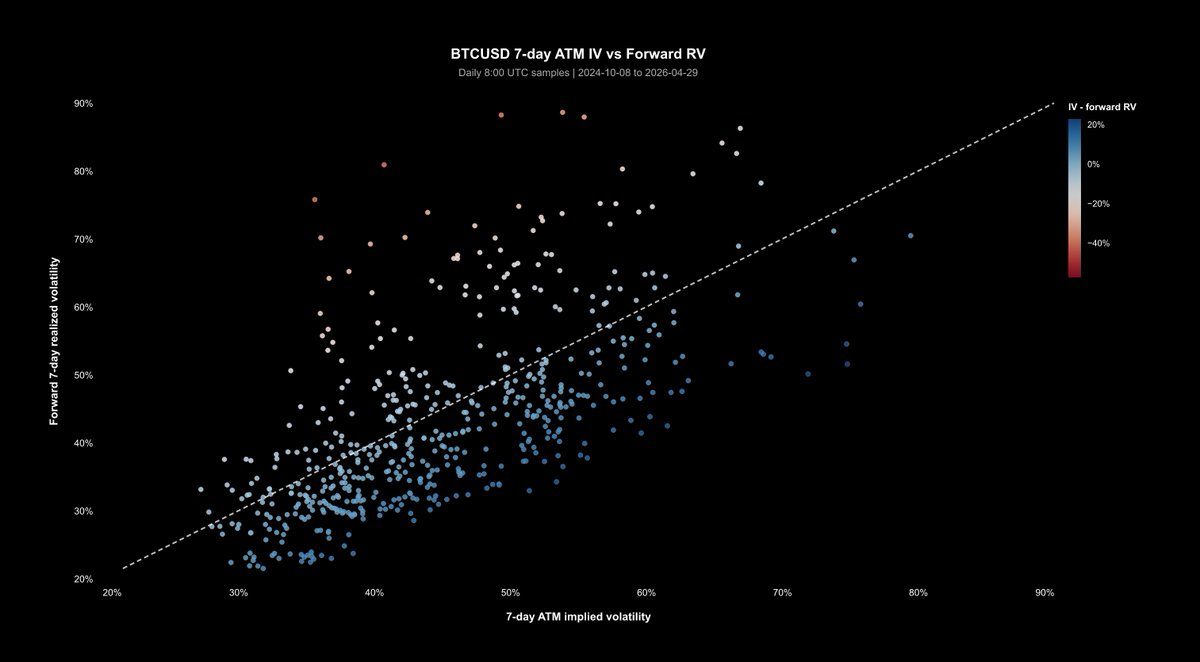
This chart shows 7-day BTC ATM IV plotted against 7-day look-ahead RV, sampled daily at 8:00 utc, with data going back to Oct'24. What do we see? Usually, IV > RV. The dotted line separates positive from negative volatility risk premium (VRP). 66% of observations fall below the line. This is the basic short-vol edge: most of the time, implied volatility overstates future realized. But IV - RV is left-skewed. While positive VRP observations are more frequent, negative VRP observations have larger outliers. That is the long-gamma payoff profile: lose small repeatedly, then get paid when realized volatility jumps. IV forecasts RV, but low IV is not the same as cheap vol. Higher IV generally lines up with higher forward RV, so IV contains information about future RV. That doesn't mean that low IV is good value. There are plenty of positive VRP observations while IV ranks low. Low IV does not mean RV is likely to outperform. In this sample, IV readings below 35% did not coincide with a higher likelihood of RV outperformance. If anything, the opposite. This doesn't mean selling low IV is a good idea either. We cannot observe what didn't happen. Logically, low IV means taking relatively more gamma risk so even if this paid off in-sample, it might not have been enough for the potential risk. Final note: This chart compares volatilities, but variance is more relevant. Vol was a bit easier on the eyes. However, the P&L of a (delta-hedged) straddle actually scales with the variance risk premium: IV^2 - RV^2. On that basis, the same volatility difference can have a different impact. A 30 IV versus 50 RV miss is `900 vs 2,500`, a variance gap of `1,600`; a 60 IV versus 80 RV miss is `3,600 vs 6,400`, a variance gap of `2,800`. Both are 20-vol misses, but the second is larger in variance terms.
Thalex tweet media
English
2
4
39
1.8K
GeorgL0ngGamma retweetledi
Stefano Peron
Stefano Peron@Stefano_Peron·
LLMs didn’t kill mysticism. They killed human narcissism. They showed that language, reasoning-like behavior and social fluency can be generated without an inner witness…. But that makes consciousness more mysterious, nott less: it separates performance from presence🥩🥩🍾.@mikeharrisNY
Big Brain AI@realBigBrainAI

Stephen Wolfram, founder of Wolfram Research, explains how LLMs are quietly dismantling our deepest assumptions about consciousness: He argues that large language models have done something philosophy and neuroscience couldn't: "In terms of consciousness, I have to say, the idea that there's sort of something magic that goes beyond physics that leads to sort of conscious behavior, I kind of think that LLMs kind of put the final nail in that coffin." His reasoning is that LLMs keep doing things people assumed they couldn't: "There were all these things where it's like, oh, maybe it can't do this, but actually it does. And it's just an artificial neural net." Wolfram then challenges a core assumption about conscious experience: the feeling that we are a single, continuous self moving through time. "I think our notion of consciousness is a lot related to the fact that we believe in the single thread of experience that we have. It's not obvious that we should have a persistent thread of experience." He points out that physics doesn't actually support this intuition: "In our models of physics, we're made of different atoms of space at every successive moment of time. So the fact that we have this belief that we are somehow persistent, we have this thread of experience that extends through time, is not obvious." Then Wolfram offers a striking origin story for consciousness itself. @stephen_wolfram suggests it traces back to a simple evolutionary pressure: the moment animals first needed to move. "I kind of realized that probably when animals first existed in the history of life on Earth, that's when we started needing brains. If you're a thing that doesn't have to move around, the different parts of you can be doing different kinds of things. If you're an animal, then one thing you have to do is decide, are you going to go left or are you going to go right?" That single binary choice, he argues, may be the seed of everything we now call awareness: "I kind of think it's a little disappointing to feel that this whole wanted thing that ends up being what we think of as consciousness might have originated in just that very simple need to decide if you are an animal that can move. You have to take all that sensory input and you have to make a definitive decision about do you go this way or that way." The takeaway is unsettling but clarifying. If LLMs can produce complex behavior from simple rules, then consciousness may not be a mystical add-on to physics. It may just be what happens when a layered enough system has to make a decision.

English
2
4
10
1.3K
GeorgL0ngGamma retweetledi