
Pablo Bardom retweetledi
Pablo Bardom
9.3K posts


Pablo Bardom
@pablobardom
Head of Machine Learning @ Finanzguru. Physicist and Mathematician. Millennial. Value investor and sport addict. My tweets are my own views.
Barcelona Katılım Mayıs 2012
753 Takip Edilen1.1K Takipçiler

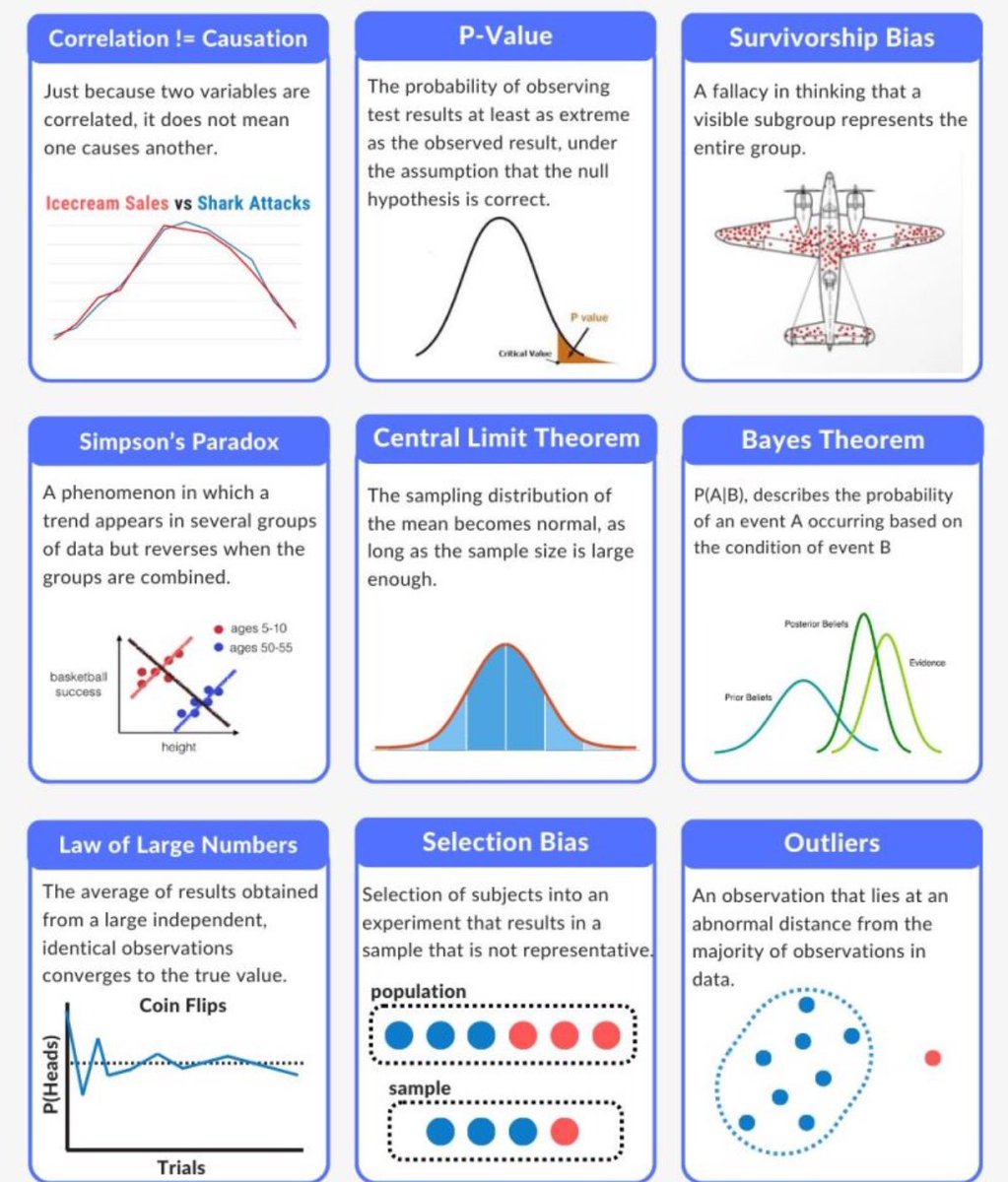
Selfsteem is the ability to recognize one’s flaws and limitations while maintaining a strong self
English
Pablo Bardom retweetledi

Did you notice this? ✨
@AIatMeta's LLama Agentic System uses @FastAPI 🤖
Nice to see all the cool stuff that some of the smartest AI people are building with FastAPI 😎
What do you use FastAPI for?
github.com/meta-llama/lla…
English
Pablo Bardom retweetledi


Pablo Bardom retweetledi

To start with Machine Learning, take these 2 free courses:
• Introduction to Python Programming (Udacity)
• Machine Learning Crash Course (Google)
If you need a bit more time before diving deeper, finish the following Kaggle tutorials:
• Intro to Machine Learning
• Intermediate Machine Learning
At this point, you are ready to finish your first project: The Titanic Challenge on Kaggle.
It's a simple project but a small step to get you going.
If math is not your strong suit, don't worry. I recommend not spending too much time learning math before writing code.
Instead, learn anything you need as you stumble upon new concepts.
From here, take the Machine Learning specialization in Coursera. This course is more advanced, and it will stretch you out a bit.
The top universities worldwide have published their Machine Learning and Deep Learning classes online. Here are some of them:
• MIT 6.S191 Introduction to Deep Learning
• DS-GA 1008 Deep Learning
• UC Berkeley Full Stack Deep Learning
• UC Berkeley CS 182 Deep Learning
• Cornell Tech CS 5787 Applied Machine Learning
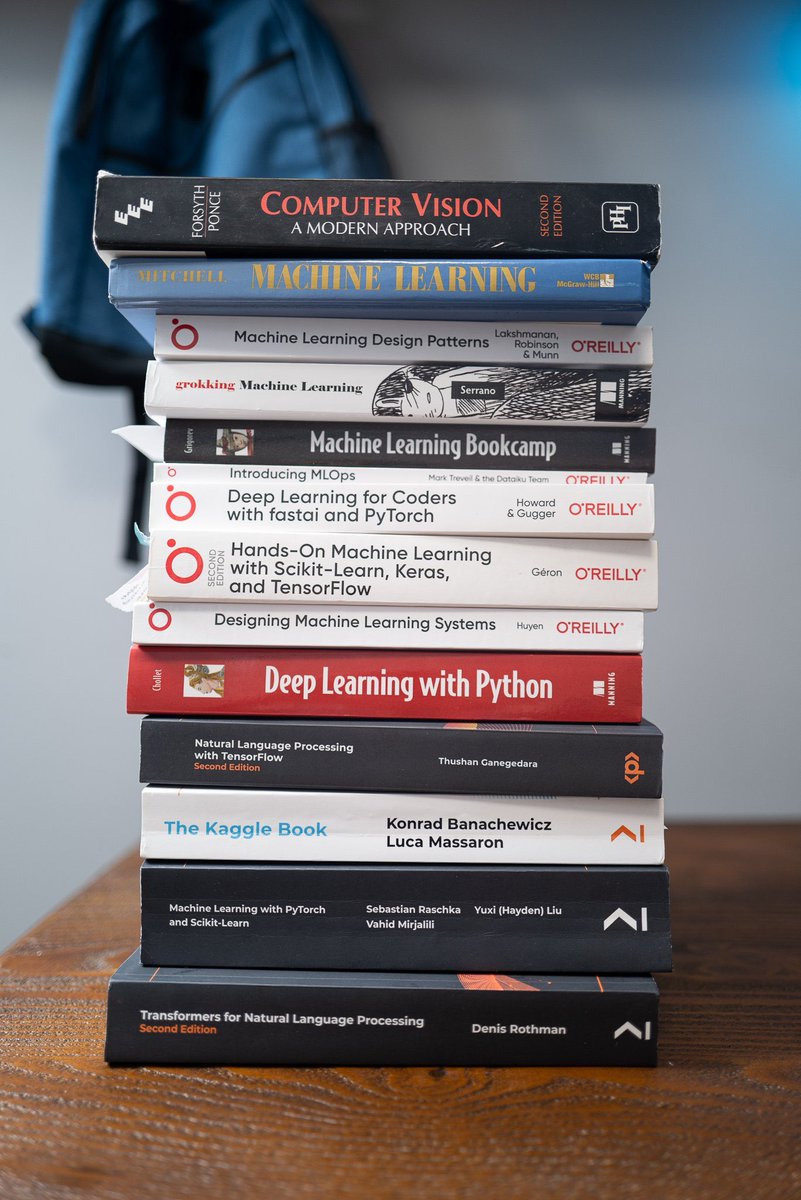
Many different books will help you. The attached image will give you an idea of some of my favorite ones.
Finally, keep these three ideas in mind:
1. Start by working on popular problems that another 100,000 people have solved before. This will ensure that you can find help whenever you get stuck.
2. Find opportunities to share what you learn. Whenever you try, you'll realize how little you know.
3. You'll never be done. There's no finish line. Learning is a lifelong pursuit. I started when I was 14, and I'm now 43 and still know very little. The good news is that you only need a tiny bit to build a fantastic career in this field.
Focus on making progress one day at a time and WRITE. MORE. CODE.
That's how you win.
English
Pablo Bardom retweetledi

Pablo Bardom retweetledi

this is the coolest thing ľ've ever
freaking seen in my life for real
English
Pablo Bardom retweetledi

so i saved $27000/year by removing 10 lines of code this morning
they were print() statements
English
Pablo Bardom retweetledi

Much has been said about many companies’ desire for more compute (as well as data) to train larger foundation models. I think it’s under-appreciated that we have nowhere near enough compute available for inference on foundation models as well.
Years ago, when I was leading teams at Google, Baidu, and Stanford that focused on scaling up deep learning algorithms, many semiconductor manufacturers, data center operators, and academic researchers asked me whether I felt that AI technology would continue to make good use of more compute if they kept on delivering it. For many normal desktop processing workloads, like running a web browser or a text editor, having a faster CPU doesn’t help that much beyond a certain point. So do we really need faster and faster AI processors to train larger and larger models? Each time, I confidently replied “yes!” and encouraged them to keep scaling up compute. (Sometimes, I added half-jokingly that I had never met a machine learning engineer who felt like they had enough compute. 😀)
Fortunately, this prediction has been right so far. However, beyond training, I believe we are also far from exhausting the benefits of faster and higher volumes of inference.
Today, a lot of LLM output is primarily for human consumption. A human might read around 250 words per minute, which is around 6 tokens per second (250 words/min / (0.75 words/token) / (60 secs/min)). So it might initially seem like there’s little value to generating tokens much faster than this.
But in an agentic workflow, an LLM might be prompted repeatedly to reflect on and improve its output, use tools, plan and execute sequences of steps, or implement multiple agents that collaborate with each other. In such settings, we might easily generate hundreds of thousands of tokens or more before showing any output to a user. This makes fast token generation very desirable and makes slower generation a bottleneck to taking better advantage of existing foundation models.
That’s why I’m excited about the work of companies like @GroqInc, which can generate hundreds of tokens per second. Recently, @SambaNovaAI also published an impressive demo that hit hundreds of tokens per second.
Incidentally, faster, cheaper token generation will also help make running evaluations (evals), a step that can be slow and expensive today since it typically involves iterating over many examples, more palatable. Having better evals will help many developers with the process of tuning models to improve their performance.
Fortunately, it appears that both training and inference are rapidly becoming cheaper. I recently spoke with @CathieDWood and @CCRobertsARK of the investment firm ARK, which is famous for its bullish predictions on tech. They estimate that AI training costs are falling at 75% a year. If they are right, a foundation model that costs $100M to train this year might cost only $25M to train next year. Further, they report that for “enterprise scale use cases, inference costs seem to be falling at an annual rate of ~86%, even faster than training costs.”
I don’t know how accurate these specific predictions will turn out to be, but with improvements in both semiconductors and algorithms, I do see training and inference costs falling rapidly. This will be good for application builders and help AI agentic workflows lift off.
[Original text: deeplearning.ai/the-batch/issu… ]
English
Really happy to see how FC Barcelona competed today. Just a single but big mistake prevented us to be in semifinals. We are so back 💙❤️
English
Pablo Bardom retweetledi

My post about Software Developer salaries around the world went viral.
A common take was that US companies should simply outsource all work to Pakistan.
It's not that simple, though. As a Fractional CTO I've seen US Founders go wrong with outsourcing in many ways:

English
Pablo Bardom retweetledi
LLMs can take gigabytes of memory to store, which limits what can be run on consumer hardware. But quantization can dramatically compress models, making a wider selection of models available to developers. You can often reduce model size by 4x or more while maintaining reasonable performance. In our new short course Quantization Fundamentals taught by @huggingface's @younesbelkada and @_marcsun, you'll:
- Learn how to quantize nearly any open source model
- Use int8 and bfloat16 (Brain float 16) data types to load and run LLMs using PyTorch and the Hugging Face Transformers library
- Dive into the technical details of linear quantization to map 32-bit floats to 8-bit integers
As models get bigger and bigger, quantization becomes more important for making models practical and accessible. Please check out the course here: deeplearning.ai/short-courses/…
English
Pablo Bardom retweetledi

Pablo Bardom retweetledi

NEWS: Elon Musk announced tonight that the first human implanted with @Neuralink’s brain chip has made a full recovery.
The patient is able to control a mouse using only their thoughts. Incredible achievement!
English
Pablo Bardom retweetledi

🚨 BREAKING: OpenAI just announced their new Text-To-Video model called Sora.
Look at these 10 insane examples:
1. Space movie trailer featuring a man wearing a red wool knitted motorcycle helmet
English
Pablo Bardom retweetledi

⚠ #ÚltimaHora Dijous es decreta l'emergència per sequera per a 6 milions d'habitants: consulta els municipis ccma.cat/324/dijous-es-…

Català
Pablo Bardom retweetledi

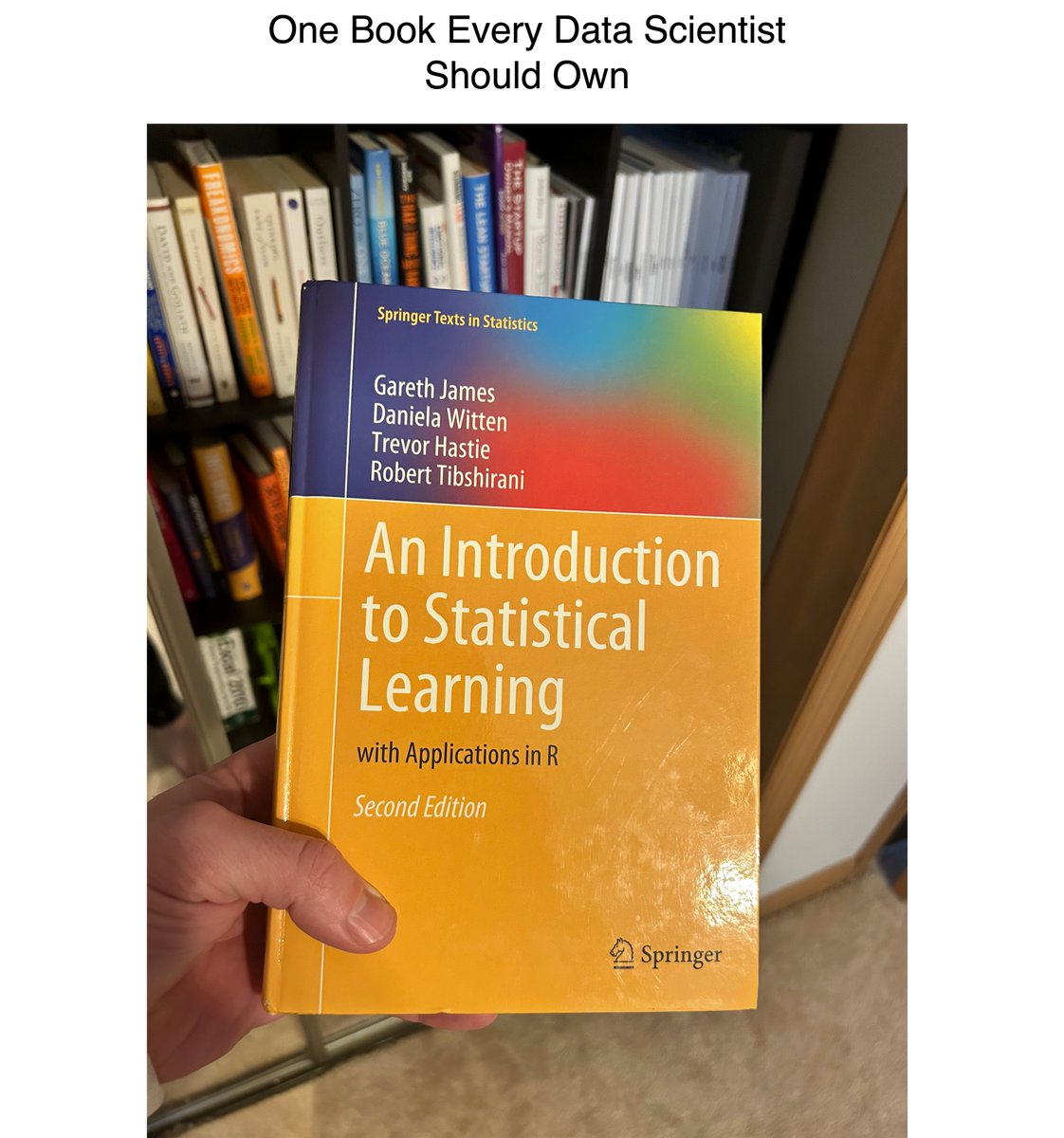
Intro to statistical learning... It's over a decade old. And it's still the Number 1 book for learning statistics and data science. This is why.
1. Free: First and foremost is accessibility. I own a hard copy (because I'm old school). But you can get an online copy for zero dollars. statlearning.com
2. Available in R and Python: The authors are gluttons for punishment. They have Intro to Statistical Learning in R and in Python.
#R version here: hastie.su.domains/ISLR2/ISLRv2_c…
#Python version here: hastie.su.domains/ISLP/ISLP_webs…
3. Second Edition Adds:
- Deep learning
- Survival analysis
- Multiple testing
- Naive Bayes and generalized linear models
- Bayesian additive regression trees
- Matrix completion
4. How ISLR helped me: In 2015, I read Intro to Statistical Learning with R (ISLR). It was the first book that made complex machine learning and statistical concepts approachable. It was a key tool that helped me apply concepts like PCA, K-Means Clustering, and Penalized Regression to my $15,000,000 lead scoring model.
Takeaways:
- It's a free resource.
- It's surprisingly easy to digest (for non-math experts).
- I was shocked at how much it improved my modeling.
- Heck, my company wouldn't have saved $15,000,000 without it.
===
There’s a lot more to learning Data Science for Business. I’d like to help.
I put together a free on-demand workshop that covers the 10 skills that helped me make the transition to Data Scientist: learn.business-science.io/free-rtrack-ma…
And if you'd like to speed it up, I have a live workshop where I'll share how to use ChatGPT for Data Science: learn.business-science.io/registration-c…
If you like this post, please reshare ♻️ it so others can get value.
English
Pablo Bardom retweetledi
Pablo Bardom retweetledi

🤖 GitHub Copilot just keeps getting smarter and smarter!
In case you missed them, here are 4 of the newest features that you're going to love 🧵
English
Pablo Bardom retweetledi

Introducing FunSearch in @Nature: a method using large language models to search for new solutions in mathematics & computer science. 🔍
It pairs the creativity of an LLM with an automated evaluator to guard against hallucinations and incorrect ideas. 🧵 dpmd.ai/x-funsearch
GIF
English