Pablo Orozco

1.1K posts

Pablo Orozco banner
Pablo Orozco

Pablo Orozco

@pablopvsky

El mundo no es tan teso.

Medellín, Colombia Katılım Aralık 2017
670 Takip Edilen70 Takipçiler
Pablo Orozco retweetledi
Miguel Ángel Durán
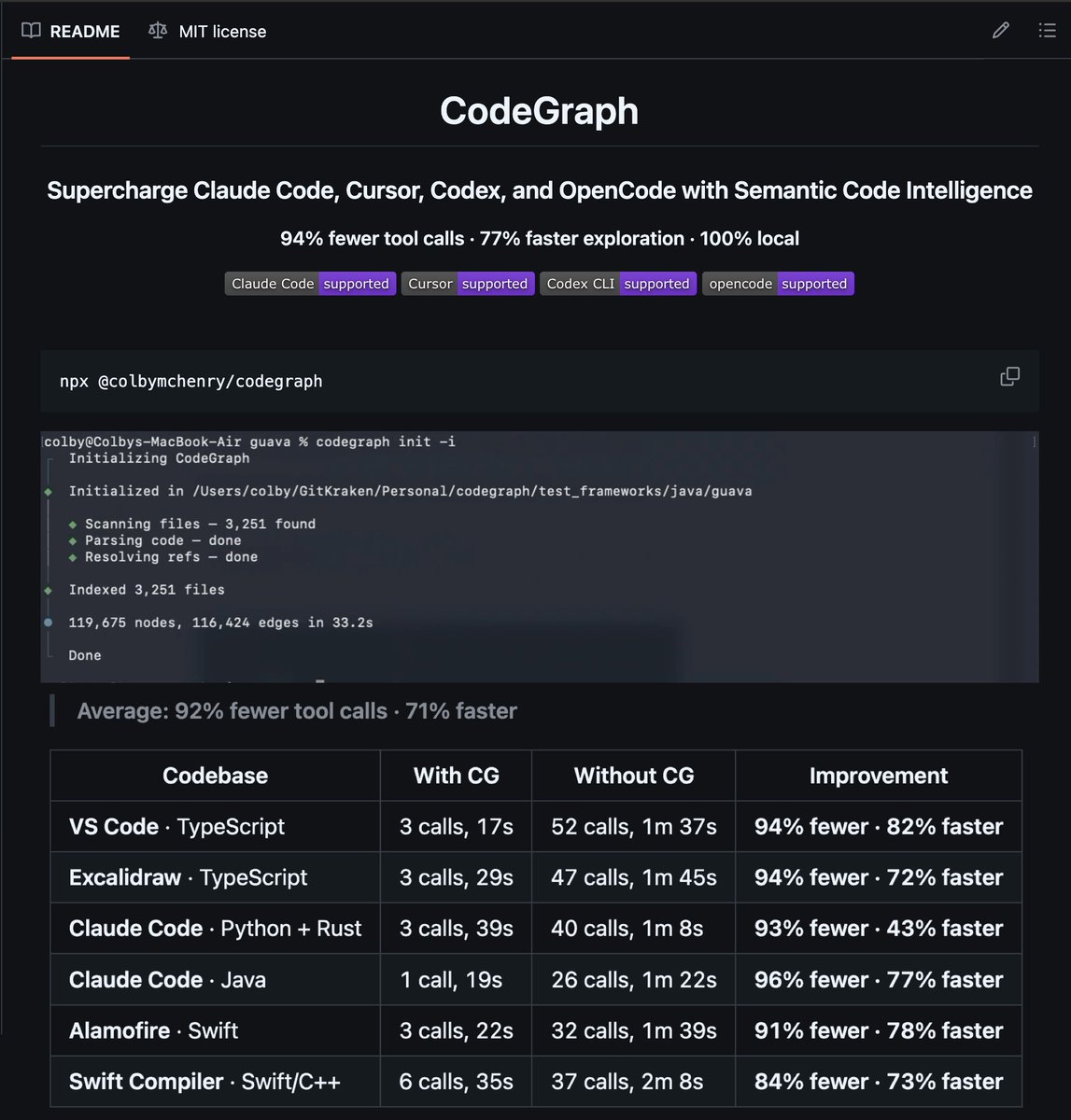
¡No quemes tokens con tu IA explorando tu proyecto! Crea un grafo semántico local de tu código con esto ✓ -92% tool calls ✓ 71% más rápido explorando código ✓ Claude Code, Cursor, Codex y OpenCode Local y de código abierto: → github.com/colbymchenry/c…
Miguel Ángel Durán tweet media
Español
43
316
2.6K
103.9K
Pablo Orozco retweetledi
Wes Winder
Wes Winder@weswinder·
this mac app is insanely good for databases > free > open source > beautiful > super fast handy for viewing local codex threads in sqlite too
Wes Winder tweet media
English
53
82
1.7K
161.6K
Pablo Orozco retweetledi
Manu Arora
Manu Arora@mannupaaji·
You can pin a chat scroller to the bottom with CSS 𝚘𝚟𝚎𝚛𝚏𝚕𝚘𝚠-𝚊𝚗𝚌𝚑𝚘𝚛, without having to use MutationObserver or 𝚜𝚌𝚛𝚘𝚕𝚕𝚃𝚘() functions <𝚍𝚒𝚟 𝚒𝚍="𝚜𝚌𝚛𝚘𝚕𝚕𝚎𝚛"> ... ... <𝚍𝚒𝚟 𝚒𝚍="𝚊𝚗𝚌𝚑𝚘𝚛"> #𝚜𝚌𝚛𝚘𝚕𝚕𝚎𝚛 * { 𝚘𝚟𝚎𝚛𝚏𝚕𝚘𝚠-𝚊𝚗𝚌𝚑𝚘𝚛: 𝚗𝚘𝚗𝚎; } #𝚊𝚗𝚌𝚑𝚘𝚛 { 𝚘𝚟𝚎𝚛𝚏𝚕𝚘𝚠-𝚊𝚗𝚌𝚑𝚘𝚛: 𝚊𝚞𝚝𝚘; 𝚑𝚎𝚒𝚐𝚑𝚝: 𝟷𝚙𝚡; } Browsers run scroll anchoring by default to prevent layout shifts Disable it on children, re-enable it on a 1px anchor at the end and the scroll follows new content down on its own
English
11
88
1.5K
64.5K
Pablo Orozco retweetledi
Notion Playground
Notion Playground@NotionPlay·
Any Notion page can become a presentation. Even one packed with images, text, and embedded content. Just add dividers between sections and hit present.
English
3
4
64
4.9K
Pablo Orozco retweetledi
Notion
Notion@NotionHQ·
Tip: You can set a default meetings database so every meeting lands in one place. Keeps things tidy, so you’ll never have to hunt things down.
Notion tweet media
English
6
17
182
17.4K
Pablo Orozco retweetledi
Guillermo Rauch
Guillermo Rauch@rauchg·
𝚗𝚙𝚡 𝚍𝚎𝚎𝚙𝚜𝚎𝚌 We're introducing an open-source agent orchestrator for deep security reviews. We built it for internal use, and after running it against some major OSS projects, we gained conviction to share it with the world. Coding agents can now find critical vulnerabilities in minutes that would take teams of people months (if they can spot them at all). Since 𝚍𝚎𝚎𝚙𝚜𝚎𝚌 is optimized to work with Vercel Sandbox, you can effectively harness the power of thousands of agents scrutinizing your codebase in parallel. I encourage you to try this on your repositories. BTW: If you run an OSS project and want us to sponsor a run, my DMs are open.
Vercel Developers@vercel_dev

Introducing deepsec, an open source coding security harness. • CLI-first • Sandbox-based scaling • Pluggable coding agents • Designed for large-scale repos • Use AI Gateway or your own subscription After months of successful internal use, we put it to the test on some of the largest open source codebases. vercel.com/blog/introduci…

English
89
133
1.8K
297.9K
Samay
Samay@Samaytwt·
Bro disappeared like he never existed.
Samay tweet media
English
260
52
2.9K
327.9K
Pablo Orozco retweetledi
池田 泰延
池田 泰延@clockmaker·
░▒▓█ ↑ こんな文字列、コンピューターの世界で誰が使うのか、何のために存在するのかと思いきや、テキストのスクランブルな演出に役立てていて、センス良すぎと思いました。>Anime.js
日本語
19
688
7.4K
747.1K
Pablo Orozco retweetledi
jhey ʕ•ᴥ•ʔ
jhey ʕ•ᴥ•ʔ@jh3yy·
<shimmer-details> configurable css text reveal 💫
English
17
53
797
41.8K
Selene
Selene@vaaselene·
is anyone using Gemini?
English
882
13
1.1K
149K
Pablo Orozco retweetledi
Disha Shah
Disha Shah@dishashah66·
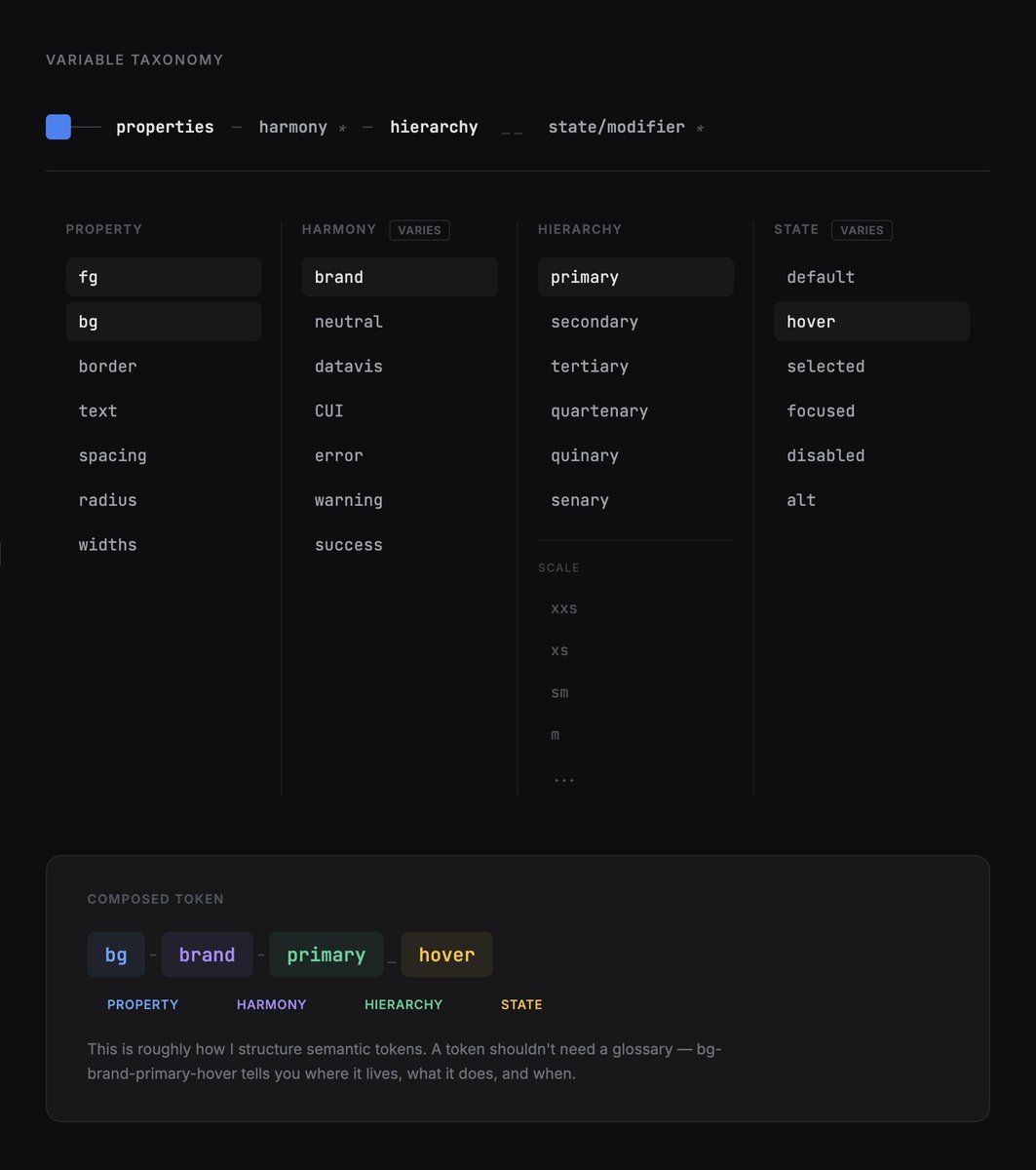
When I build design systems, I don't start with components. I start with structure. Primitive variables come first — colour, spacing, radius. These are the raw values. They stay stable because everything else references them. From there, I build a naming layer that encodes intent. Every variable is constructed from four dimensions: → Property — what the variable controls. Foreground, background, border, text, spacing, radius. → Harmony — the colour role. Brand, neutral, data visualisation, error, warning, success. This dimension doesn't appear in the token name — the values themselves are the identifier. → Hierarchy — the visual weight. Primary, secondary, tertiary, and down. → State — how the element behaves. Default, hover, selected, focused, disabled. So a token isn't just a value. It's a sentence: bg-brand-primary-hover tells you exactly where it lives, what it does, and when. Harmony is the concept. The values carry it. That structure flows into alias variables — where "black" becomes "text-primary" and a hex value becomes a decision. Then into component-level variables, where the system starts adapting to real product needs. And always a utility layer for what doesn't fit neatly elsewhere. None of this is rigid. It shifts with the product, the domain, the scale. But the primitives hold. They're the foundation. Everything else is built to serve context.
Disha Shah tweet media
Disha Shah@dishashah66

One question I get on almost every discovery call when someone's trying to build a custom design system to suit their evolving product needs: "Should we use semantic naming for component tokens?" My answer is almost always no. But let me explain what's actually being asked first. Design system variables work in layers. → Primitives are your raw values — no meaning attached. For color, this looks like a full grey scale: grey-25, grey-100, grey-200, grey-400, grey-800. Every shade and tone your system will ever use, named after what it literally is. Nothing more. → Alias variables are where meaning enters. You take grey-800 and call it text-primary. grey-400 becomes text-placeholder. white becomes bg-primary. Now your primitives have context — and when your brand color shifts, you update one value, not fifty components. These two layers do the heavy lifting. This is where most systems should stop. → Component variables go one level further — input-field-label, input-field-border, input-field-bg-default. Scoped entirely to one component. And this is where teams over-engineer. Your alias layer already handles semantic meaning. Component variables duplicate that work without adding clarity — and they multiply maintenance. Every new state, every new component, every new variant is now a naming decision at three levels instead of two. The coming of AI tools like @claudeai code, codex, and VSCode is making the design of design systems easier. This argument doesn't change that. More variable tokens means more surface area for drift and inconsistency — for your team and for the model. Primitives → named after value. Alias → named after context. Components → consume alias variables. Don't create new ones. Two layers of meaning. That's what scales.

English
6
19
315
29.7K
Pablo Orozco retweetledi
りゅう@Obsidianガチ勢
りゅう@Obsidianガチ勢@obsidianstudio9·
【速報】 Obsidian公式がAIエージェント用スキルを正式リリース😳 CEOのkepano自らが作ったobsidian-skillsが公開された。 Claude CodeにObsidianの使い方を教えるスキル集👇 ・Markdown構文の正しい扱い方 ・Bases(データベース機能)の操作 ・JSON Canvasの生成と編集 ・CLIでのvault操作 ・Webコンテンツの取り込み 5つのスキルが1セットになってる。 つまりObsidian公式が「AIエージェントにvaultを任せる」前提で設計し始めた。 この流れは確実に加速する🔥 github.com/kepano/obsidia…
日本語
12
216
1.7K
102.2K
Pablo Orozco retweetledi
Paul Bakaus
Paul Bakaus@pbakaus·
Impeccable 3 natively supports crafting new design with diffusion (e.g. GPT Image 2) in harnesses that support it (e.g. Codex, Gemini w/ nano banana plugin). Impeccable now uses the best mode of operation for net-new vs iterative design: 1) completely new design: diffusion-first, then build w/ best practices for brand or product design (new in 3.0) 2) iterative design (additions/changes): design-system first, discovers your components, reads DESIGN/PRODUCT.md, goes to work. new live mode (new in 3.0) makes it extra convenient. Here's a tutorial documenting the whole workflow (incl. how I made the demo site in the video): impeccable.style/designing/
English
32
36
629
35.7K
Aman 🧋
Aman 🧋@CodeWithAmann·
Be honest — what would you do right now?
Aman 🧋 tweet media
English
417
6
298
31K
TablePlus
TablePlus@TablePlus·
TablePlus Update (Coming Soon) We've added the ability to drag columns from the left sidebar to the SQL Query Editor.
English
43
16
877
618.8K