_______

1.3K posts

_______ banner
_______

_______

@paull_______

Manchester, England Katılım Eylül 2010
814 Takip Edilen222 Takipçiler
Sabitlenmiş Tweet
_______
_______@paull_______·
starting my first @buildinpublic project with only low-code experience may vibe be the guide 🙏🏻
English
1
0
1
80
Bryan Johnson
Bryan Johnson@bryan_johnson·
I think peptides are popular because they give people a feeling of power and control. One feels helpless when they can't sleep, stop scrolling, eat well or exercise consistently. A few injections wrestles back a feeling of control. Evidence shows that injections amplify perceived agency (the ritual potency of administration). This creates a dangerous situation where powerful compounds are being used less for biomarker improvement and more for psychological wellbeing. This is what you want: closed loop. > intervention (peptide) > biological change > measured biomarker > adjustment How most people are using peptides: open-loop. > intervention (peptide) > subjective feeling > more intervention The open-loop compounds over time. Without biomarker feedback, dose escalation is driven by subjective feelings which creates increased risk of doses with no clinical precedent. I am pro peptide and pro experimentation. Some peptides such as GLP-1s and similar are among the most effective in the world. Peptides (without clinical data) are among the most promising therapies available. They also need more clinical work so that we can characterize their effects, both good and bad. Nothing is free in biology.
English
162
79
2K
367.2K
Satya Nadella
Satya Nadella@satyanadella·
New in M365 Copilot: Council. You can run multiple models on the same prompt at the same time, so you can see where they align and diverge, and understand what each adds.
English
313
313
2.6K
439.4K
AI at Meta
AI at Meta@AIatMeta·
Today we're introducing TRIBE v2 (Trimodal Brain Encoder), a foundation model trained to predict how the human brain responds to almost any sight or sound. Building on our Algonauts 2025 award-winning architecture, TRIBE v2 draws on 500+ hours of fMRI recordings from 700+ people to create a digital twin of neural activity and enable zero-shot predictions for new subjects, languages, and tasks. Try the demo and learn more here: go.meta.me/tribe2
English
723
2.5K
16K
6.7M
_______ retweetledi
David Senra
David Senra@davidsenra·
My conversation with @EricJorgenson, author of The Book of Elon (@elonmusk). 0:00 Book Reveal 0:39 Build Useful Things 2:19 Engineering Talent Edge 4:26 Wired for War 6:47 Tip of the Spear 8:47 Burn the Boats 13:13 Facing Fear 15:16 Origin Story Myths 18:19 Know Business A to Z 22:17 Simplify and Fail Fast 25:35 Reality and Physics 28:18 The Algorithm Begins 30:34 Delete and Simplify 34:25 Starlink War Room 36:52 Repetition as OS 38:18 Step Three Simplify Optimize 38:43 Question Every Requirement 39:13 Tesla Battery Pack Delete 40:43 Repetition Installs Ideas 42:02 Step Four Accelerate 43:26 Design Org for Speed 46:06 Step Five Automate 46:29 Control and Clean Sheet 48:54 Vertical Integration and Costs 50:47 SpaceX Incentives and Mars 57:11 Frontier Unlocks Starlink 1:00:26 Time as True Currency 1:03:58 Speed Triage and Bottlenecks 1:10:11 Internalized Responsibility 1:12:56 Avoid Serialized Dependencies 1:14:31 Aligning the Team 1:15:07 Time Is the Constraint 1:16:00 One Metric Focus 1:18:03 Directional Predictions 1:19:06 We Must Make Stuff 1:25:39 Manufacturing as Moat 1:26:23 Speed and Direct to Customer 1:28:41 SpaceX Feasibility Study 1:33:07 Edge of Sanity Leadership 1:37:10 Bottlenecks and Integration 1:40:01 Design and Simplify 1:45:15 Catch the Rocket 1:48:14 Capitalism and Closing Includes paid partnerships.
English
98
398
2.3K
3.3M
Groundhog day
Groundhog day@truedat999·
The field has crossed into human testing in 2026 (huge milestone!), but only for targeted eye diseases—not the "50-year-old skin acting 20 again" application from the post. Life Biosciences (building on David Sinclair's work) received FDA IND clearance on January 28, 2026, for ER-100, the first-ever partial epigenetic reprogramming therapy to enter humans (NCT07290244 on ClinicalTrials.gov). The Phase 1 trial is now recruiting: it involves a single injection of an AAV-delivered OSK gene therapy (Oct4, Sox2, Klf4—Yamanaka factors minus c-Myc) into one eye of patients with open-angle glaucoma (OAG) or non-arteritic anterior ischemic optic neuropathy (NAION). It's inducible (via doxycycline) for controlled, transient expression to minimize risks. The primary focus is safety, tolerability, and immune responses, with secondary checks on visual function (e.g., acuity, OCT scans). Dosing started sequentially (one patient, 28-day wait, then next), with enrollment ramping up after site activation in early 2026. First safety data could emerge late 2026 or early 2027; the study runs through ~2032 for long-term follow-up. The Babraham Institute's 2022 skin fibroblast work (13-day transient reprogramming resetting ~30 years on epigenetic clock, boosting collagen and wound closure in dishes) remains preclinical—no human trials yet as of March 2026. Recent efforts (e.g., 2025 partnership with Axol Bioscience) aim to refine efficiency and reduce Yamanaka factor reliance, but no direct clinical push for skin applications is announced. No other partial reprogramming trials are active in humans for skin, cosmetics, broad anti-aging, or other tissues right now. Turn Biotechnologies (mRNA-based transient expression for skin) and others are prepping or in preclinical stages—no registered human studies yet. Some companies (e.g., Rejuvenate Bio) have shown lifespan extension in mice with OSK, but human translation lags. For the skin-specific "rejuvenated fibroblasts" to become a real clinic treatment (e.g., injections/topicals for collagen boost, elasticity, wound healing like younger skin): - Best-case (3–8 years, ~2029–2034): Eye trial success on safety (and any efficacy hints) would de-risk the platform massively, speeding funding, regs, and follow-on trials in accessible tissues like skin (chronic wounds, dermatology, fibrosis). Localized delivery could accelerate skin/derm paths. - More realistic (10–20+ years, 2035+): Broad, approved, Botox-level options require large Phase 2/3 trials proving durable benefits/safety (e.g., no cancer risk from factors), acceptance of aging as a treatable indication (not standard yet), non-viral/scalable delivery (creams, injections), and affordability. It's genuine, accelerating progress—not vaporware—but this is literally the starting line for human data on partial reprogramming. Don't expect anti-aging skin treatments soon; patience remains essential. Exciting times ahead, though!
English
6
16
98
14K
Massimo
Massimo@Rainmaker1973·
Scientists just made 50-year-old skin cells behave like they’re 20 again. Researchers at the Babraham Institute in Cambridge have developed a groundbreaking method to reverse the biological aging of human skin cells by approximately 30 years, all while keeping them as fully functional adult skin cells. The team used a carefully controlled, short-term version of the Nobel Prize-winning Yamanaka reprogramming technique. By exposing adult skin fibroblasts to a specific set of reprogramming factors (the Yamanaka factors) for just 13 days—and then stopping the process early—they successfully “reset” many molecular markers of aging without pushing the cells all the way back to a stem cell state. After this brief treatment, the rejuvenated cells displayed a dramatically younger profile: their epigenetic clock (a measure of chemical tags on DNA that tracks biological age) and their gene expression patterns (the transcriptome) closely resembled those of cells from much younger individuals. Even more impressively, the cells behaved younger too. The treated fibroblasts produced significantly higher levels of collagen—the protein essential for skin firmness, elasticity, and wound healing—and they migrated faster to close an artificial “wound” in laboratory dishes compared to untreated older cells. The researchers also observed reversal of age-related changes in genes associated with diseases such as Alzheimer’s and cataracts, suggesting the technique could have broader therapeutic implications. While this work is still in its early stages and the precise mechanisms remain under investigation, the findings open exciting possibilities: one day, scientists may be able to selectively rejuvenate aging cells in the body to enhance tissue repair, improve healing, and potentially slow or mitigate some effects of age-related diseases—without the risks associated with fully reprogramming cells into stem cells. [Gill, D., Parry, A., Santos, F., Okkenhaug, H., Seale, M., Dobbs, L. J., Reik, W., & Ocampo, A. (2022). Multi-omic rejuvenation of human cells by maturation phase transient reprogramming. eLife, 11, e71624. DOI: 10.7554/eLife.71624]
Massimo tweet media
English
182
1.5K
6.1K
504.6K
_______
_______@paull_______·
@OpenAIDevs Great move. Mini manual side chats outside of the main context for specific qs would be great in all products
English
0
0
0
122
OpenAI Developers
OpenAI Developers@OpenAIDevs·
Subagents are now available in Codex. You can accelerate your workflow by spinning up specialized agents to: • Keep your main context window clean • Tackle different parts of a task in parallel • Steer individual agents as work unfolds
English
444
769
8K
1.6M
Indra
Indra@IndraVahan·
bryan johnson’s been real quite since this came out
Indra tweet media
English
148
357
13.2K
1.9M
Layah Heilpern
Layah Heilpern@LayahHeilpern·
Right now I think we’re overestimating AI. I’ve spent the last few weeks building an AI crypto bot which is almost ready to launch. But I realised the AI is only as good as the human training it. While building my bot I realised AI cannot think critically to problem solve. It can fix bugs, but I, the human, need to activity problem solve and instruct the AI on that basis.
English
201
22
323
40K
_______
_______@paull_______·
@beffjezos The others are controversial, furthest from what Apple means
English
0
0
0
29
Matteo Franceschetti
Matteo Franceschetti@m_franceschetti·
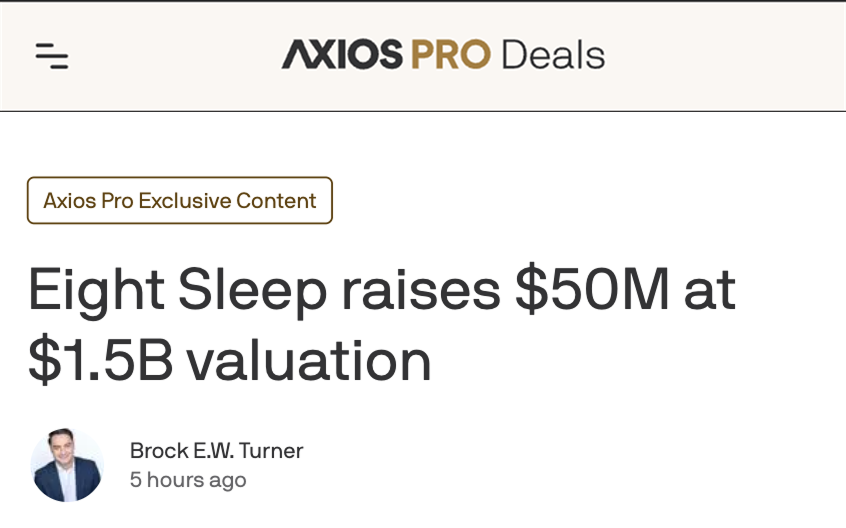
Today we're announcing a new round of funding that values @eightsleep at $1.5 billion, led by @tether Investments. Ten years ago I started Eight Sleep with one conviction: the night is the most underutilized lever in human health. Almost nobody was engineering their sleep. Last year, we hit free cash flow positivity, launched 3 new products, expanded to 34 countries, and published peer-reviewed studies showing the Pod reduces menopausal hot flashes by 56% and restores the body's natural circadian temperature rhythm during sleep, lowering core body temperature and improving cardiovascular recovery. A product you sleep on is producing clinical outcomes that rival pharmaceutical interventions. We're now building a predictive AI agent trained on 1B+ hours of sleep data. It anticipates your night before it happens. And we're advancing FDA filings for sleep apnea detection. Passive. Every night. No wires, no clinic visits. The night is just the beginning.
Matteo Franceschetti tweet media
English
161
73
1.3K
572.5K
_______
_______@paull_______·
@aakashgupta It might even make it’s own MCP server for the site and use far fewer tokens
English
0
0
0
872
Aakash Gupta
Aakash Gupta@aakashgupta·
Anthropic buried the real announcement in a demo. A small business owner typing "go to my web store and make delivery free for orders over $25 this holiday weekend" and the model just... does it. Finds the store, reads the pricing logic, updates it, confirms. No code. No developer. No instructions beyond what you'd text a coworker. That's the entire SMB automation market getting disrupted in a 10-second clip. The math makes it alarming. Sonnet runs at roughly $3 per million tokens. A full agentic task, navigate to a site, read the page state, make decisions, execute changes, burns maybe 50K-100K tokens. That's under $0.30 per autonomous business operation. The question for every small business owner stops being "can I afford AI" and starts being "why am I still doing this manually." The 1M token context window in beta is the second unlock. Long-context was the wall keeping Sonnet out of serious agentic deployments. You need the model to hold an entire store's product catalog, pricing history, and current task in working memory simultaneously. That wall just moved. Everyone will screenshot the benchmark improvements. The real trade sits one layer below: autonomous business operations just got cheap enough for a sole proprietor running a Shopify store. 33 million small businesses in the US alone. All of them have tasks exactly like this one.
Claude@claudeai

This is Claude Sonnet 4.6: our most capable Sonnet model yet. It’s a full upgrade across coding, computer use, long-context reasoning, agent planning, knowledge work, and design. It also features a 1M token context window in beta.

English
121
238
3.7K
754.5K
Emre Elbeyoglu
Emre Elbeyoglu@elbeyoglu·
I built markdown.new Put markdown.new before any URL → get clean Markdown back. Cloudflare's Markdown for Agents is great, but only works for enabled sites. markdown.new works for ANY website on the internet. 80% fewer tokens. Also converts PDFs, images, audio. Free. No signup. markdown.new
Cloudflare@Cloudflare

Time to consider not just human visitors, but to treat agents as first-class citizens. Cloudflare’s network now supports real-time content conversion to Markdown at the source using content negotiation headers. cfl.re/4ksZQ1S
English
196
316
4.3K
1.1M
_______
_______@paull_______·
@BoringBiz_ Obvious if you work in transofmration for more than thirty seconds
English
0
0
0
32
Boring_Business
Boring_Business@BoringBiz_·
Thought this was the most interesting part of Dario's conversation with Dwarkesh The two fundamentally disagree on the concept of diffusion, which is the rate at which AI propagates through the economy From Dwarkesh's perspective, diffusion is "cope" and is a way for model providers to signal that the reason their amazing technology has not been adopted yet is due to slow movers Dario disagrees and says that diffusion is very real. Even if AI is easier to adopt today than teaching a new human, it takes time for enterprises and organizations to catch up Worth a listen
English
21
11
324
59.7K
_______
_______@paull_______·
@levelsio @DevWithHassan Google’s distribution could bear hug them into ruin.. it’s so easy to let your workflow become: open chrome tab > type/speak > tab > enter > answer to 10x your productivity
English
0
0
0
40
@levelsio
@levelsio@levelsio·
@DevWithHassan That's not why Google is winning though, they own everything
English
16
0
88
15.3K
@levelsio
@levelsio@levelsio·
Why is Microsoft not competing in the model wars? Like why don't the top LLM benchmarks have Microsoft models in them? Because they already own % in OpenAI? Seems like they should start training their own LLMs no?
English
335
16
1K
185.2K
Ben Gold
Ben Gold@bengold·
Seriously this is the dumbest fucking things I’ve ever read.
Nikita Bier@nikitabier

@DCinvestor @X We don't have the capacity to support more than two colors right now. But feedback noted: we are looking into lightening the black on web.

English
65
66
2.5K
609.9K
_______
_______@paull_______·
@aakashgupta “Hey Claude 9.2, make me Claude 9.3. Infact, make me an Anthropic to pump and dump” ..”you’re absolutely right!”
English
0
0
0
16
Aakash Gupta
Aakash Gupta@aakashgupta·
$4.1 billion to $380 billion in 32 months. That’s a 93x increase in valuation for a company that didn’t exist five years ago. The revenue trajectory explains why investors tripled the round from $10B to $30B mid-raise. Anthropic went from $0 to $100M to $1B to $14B in run-rate revenue across three consecutive Januaries. 10x growth compounding annually for three straight years. No software company in history has done that. But the number that should terrify every SaaS CEO on Earth is buried in the fine print: Claude Code is running at $2.5B in annualized revenue less than a year after launch, and 4% of all GitHub commits now come from it. That single product would be a $2.5B standalone company. Anthropic built it as a feature. The math on the valuation tells you where investors think this is going. $380B on $14B revenue is a 27x multiple. OpenAI trades at roughly the same. But Anthropic is growing faster, has 80% enterprise revenue mix versus OpenAI’s consumer-heavy model, and enterprise customers churn at a fraction of the rate. 79% of OpenAI’s business customers also pay for Anthropic. A second operating system is being installed alongside the first. The software sector has lost ~$2T in market cap since Claude Code and Cowork started shipping. The market is repricing everyone around Anthropic.
Anthropic@AnthropicAI

We’ve raised $30B in funding at a $380B post-money valuation. This investment will help us deepen our research, continue to innovate in products, and ensure we have the resources to power our infrastructure expansion as we make Claude available everywhere our customers are.
English
21
84
851
154.1K
_______
_______@paull_______·
@JoelSercel @elonmusk @paulg You could get 1G on Mars / the Moon / anywhere sub 1G just as you would with a Dyson sphere, wouldn’t you?
English
0
0
0
526
Joel C. Sercel, PhD
Joel C. Sercel, PhD@JoelSercel·
@elonmusk @paulg On this Elon, I think you are 100% wrong. You need to move the same amount of mass to make a Mars habitat and you can't get 1 g on Mars, which may be needed for multigenerational human life.
English
55
1
47
372.1K
Paul Graham
Paul Graham@paulg·
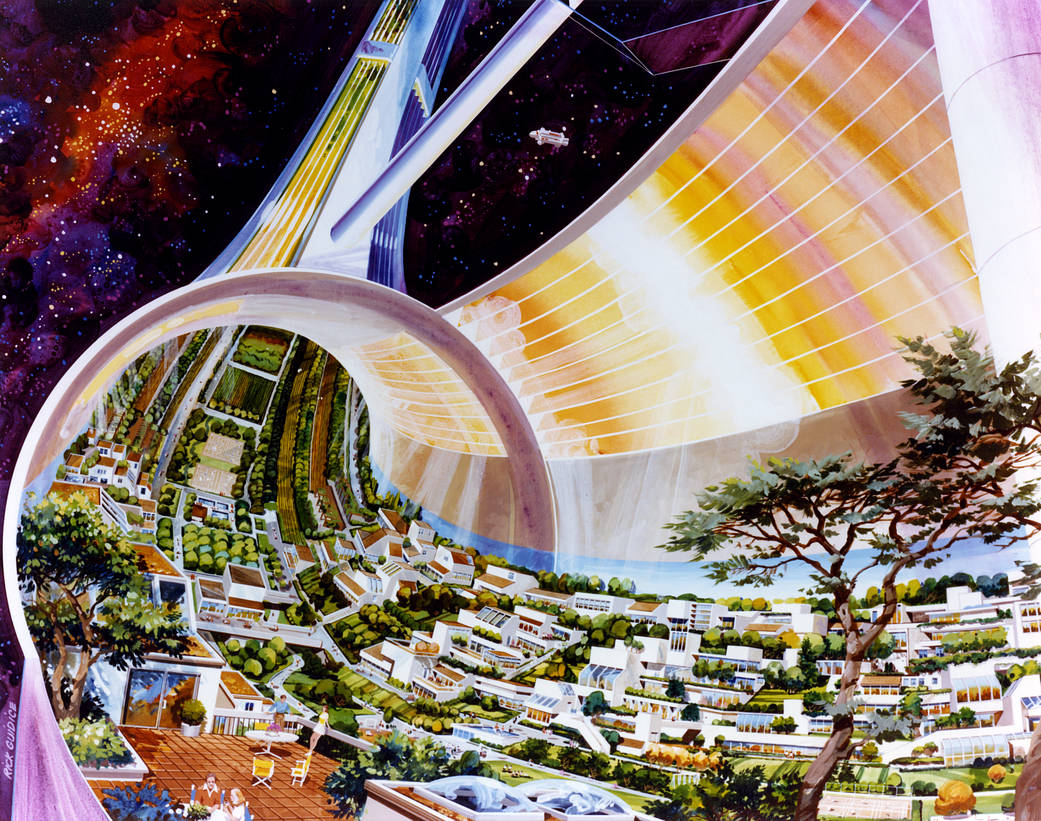
When I was a kid, I genuinely believed this was where we'd all be living by now. Do kids today have some sci-fi vision of the future, or was that just my generation?
Paul Graham tweet media
English
1.7K
839
14.2K
4.7M
_______
_______@paull_______·
@levelsio @TobiasTrades Vendors are incentivised to do physical receipts.. harder to keep track of a scrap of paper than search email
English
0
0
0
66
@levelsio
@levelsio@levelsio·
@TobiasTrades Receipts should just be auto saved to every payment via bank
English
3
0
40
4.1K
@levelsio
@levelsio@levelsio·
Things in your house slowly poisoning you, and what to change them to: Plastic salt/pepper grinders → ceramic Polyester/nylon clothes → cotton & linen Plastic cutting boards → wood or ceramic Plastic food containers → glass Plastic pyramid tea bags → steel strainer Receipt paper (BPA) → don't touch them Plastic cups → glass Plastic kettle → stainless steel Polyester bedding → cotton or wool Polyester towels → cotton Teflon pans → cast iron or ceramic Tap water → reverse osmosis filter
English
238
137
2.6K
240.1K
_______
_______@paull_______·
@KobeissiLetter I mean it happens every four years like clockwork…
English
0
0
0
157
The Kobeissi Letter
The Kobeissi Letter@KobeissiLetter·
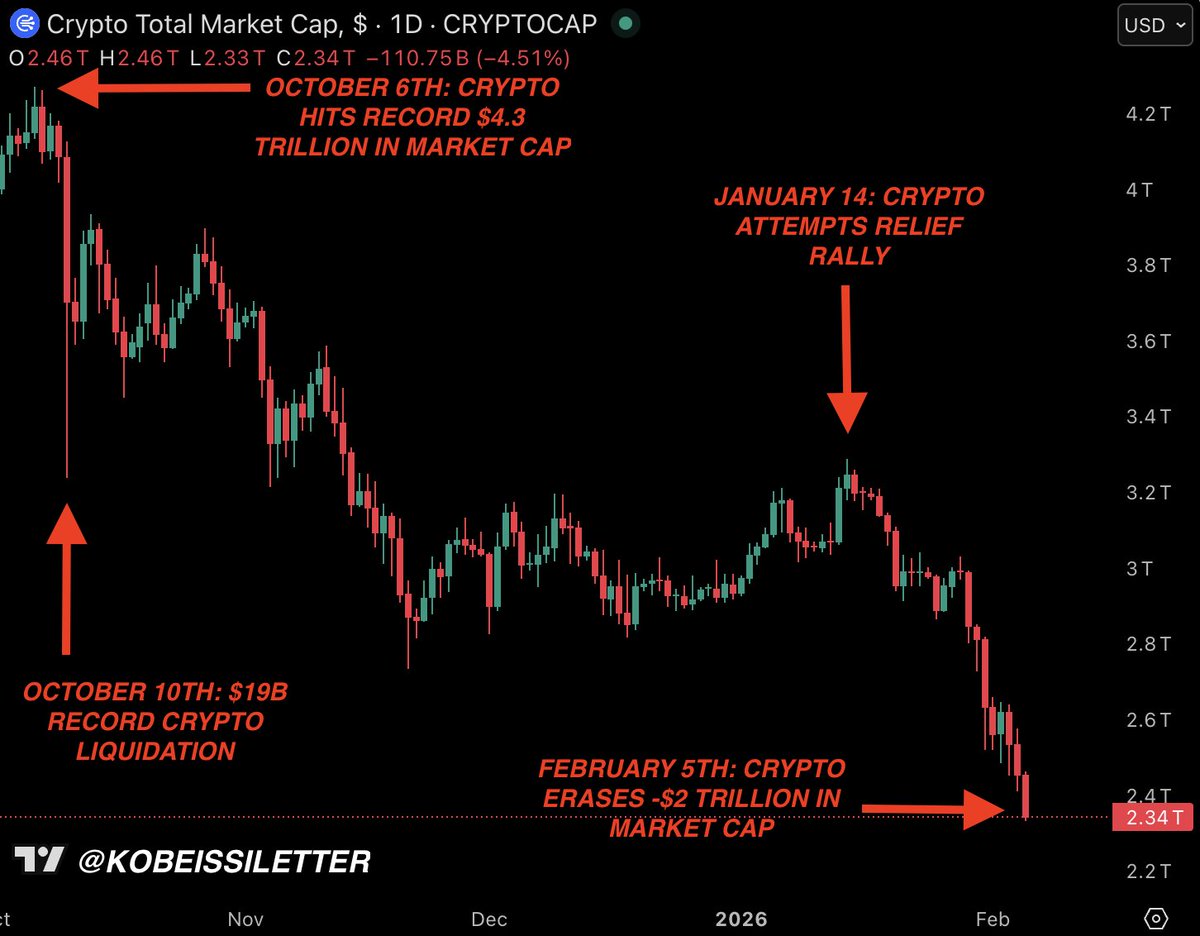
This is absolutely insane: On October 6th, crypto markets hit a record high market cap of $4.3 trillion. Today, the crypto market is worth just $2.3 trillion, losing -$2 TRILLION worth of market cap in 4 months. In other words, ~46% of crypto's entire value has been wiped out since October 6th. Bear markets arrive when markets least expect it.
The Kobeissi Letter tweet media
The Kobeissi Letter@KobeissiLetter

BREAKING: Crypto markets have now erased -$1 TRILLION in market cap since January 14th. That's -$1 trillion in market cap in 22 days, or -$45 billion per day. There has never been more noise in capital markets than now. Eliminate the noise.

English
453
1.1K
6.3K
896K