PF (Patricia/Pat) Anderson

37.9K posts

PF (Patricia/Pat) Anderson banner
PF (Patricia/Pat) Anderson

PF (Patricia/Pat) Anderson

@pfatech

This was the livetweeting account for @pfanderson. Have been locked out & am unable to access help from @TwitterSupport Librarian, LongCOVID March 2020

Ann Arbor Katılım Eylül 2010
2.2K Takip Edilen558 Takipçiler
Sabitlenmiş Tweet
PF (Patricia/Pat) Anderson
Annnnd ... now my Facebook was deleted, too. I've been trying to fix that problem for about 6 months.
English
0
0
5
947
PF (Patricia/Pat) Anderson retweetledi
Nav Toor
Nav Toor@heynavtoor·
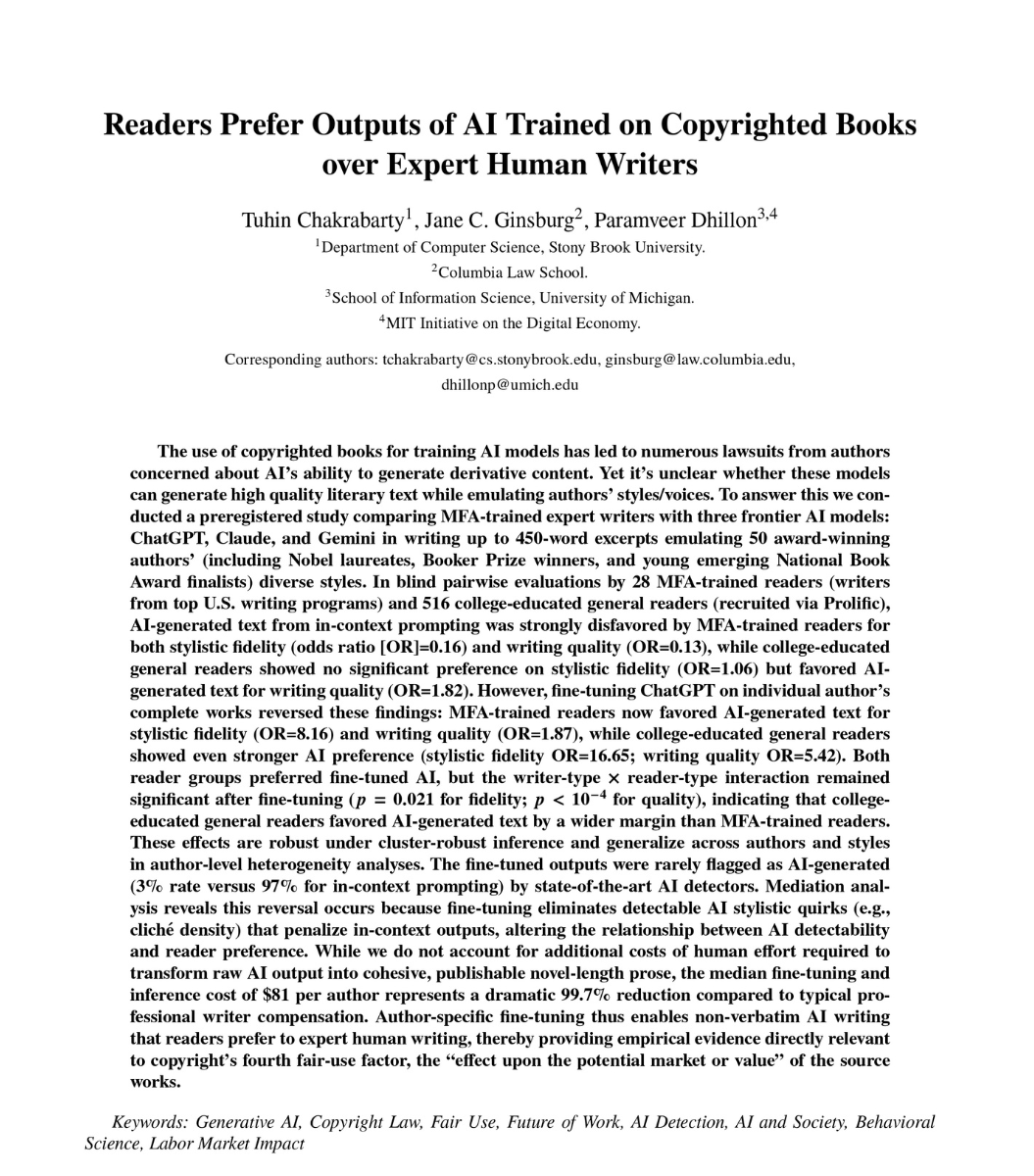
A Nobel Prize-winning author spends forty years building a voice. The rhythm of their sentences. The way they open a scene. The weight they put on a single word. Forty years of rejection letters, rewrites, and drafts that became literature. Researchers took every book that author had published, fed those books into ChatGPT, and asked it to write in that author's voice. Then they showed the AI's version and a human-written version to MFA writers and to everyday readers. Blind test. No labels. Only the writing. The readers preferred the AI. The study comes from Stony Brook University, Columbia Law School, and the University of Michigan. Preregistered. 28 MFA-trained expert readers. 516 general readers. 10,920 blind pairwise judgments. 50 internationally acclaimed authors. 8 Nobel laureates including Han Kang and Annie Ernaux. 8 Pulitzer winners. Booker winners. When ChatGPT was simply prompted to write like an author, the experts could tell. The odds of an expert choosing the AI over a human were 0.16 for stylistic fidelity and 0.13 for writing quality. The AI sounded like AI. Then the researchers bought ePub files of 30 living authors' complete works. Every novel they could obtain. Every collection. They fine-tuned ChatGPT on each author's catalog individually. Same blind test. Same expert readers. Everything reversed. Expert readers favored the fine-tuned AI for stylistic fidelity. Odds ratio 8.16. P less than 10 to the minus 12. For writing quality, 1.87. The general readers shifted the same way. The AI was not only matching the authors. Readers were preferring it over them. Using the authors' own books to do it. Then the researchers ran the outputs through Pangram, a state-of-the-art AI detector. The plain-prompted AI was caught 97 percent of the time. The fine-tuned AI was caught 3 percent of the time. The detector went blind. The median cost to fine-tune and generate for one author. 81 dollars. The paper calls that a 99.7 percent reduction compared to typical professional writer compensation. The researchers set out to answer the question the courts are weighing in Bartz v. Anthropic and Kadrey v. Meta. Does training AI on copyrighted books harm the market for those books. The paper answers it in one sentence. "Author-specific fine-tuning thus enables non-verbatim AI writing that readers prefer to expert human writing." The second author is Jane C. Ginsburg, a professor at Columbia Law School. She frames this as evidence for copyright's fourth fair-use factor. The effect on the market for the source works. Every book an author publishes trains the thing that will write the next one without them.
Nav Toor tweet media
English
17
52
167
16.5K
PF (Patricia/Pat) Anderson retweetledi
Reuters
Reuters@Reuters·
King's College Hospital in London has opened a rooftop garden for critical care patients. Its first patient, a 29-year-old woman dependent on feeding tubes, said the outdoor space gave her 'a real boost to keep on going
English
276
2.5K
19.2K
3M
PF (Patricia/Pat) Anderson retweetledi
Billy Hanlon
Billy Hanlon@bhanlon15·
NY Post: The unpredictable disease attacking women 5 times more than men — doctors only study it for ‘one minute’ 'The disorder? Mast cell activation syndrome (MCAS)..occurs when mast cells...responsible for allergic response — overstimulate & misfire..' nypost.com/2026/05/27/hea…
English
3
104
386
11.8K
PF (Patricia/Pat) Anderson retweetledi
Brendan O'Donoghue
Brendan O'Donoghue@BrendanODo93416·
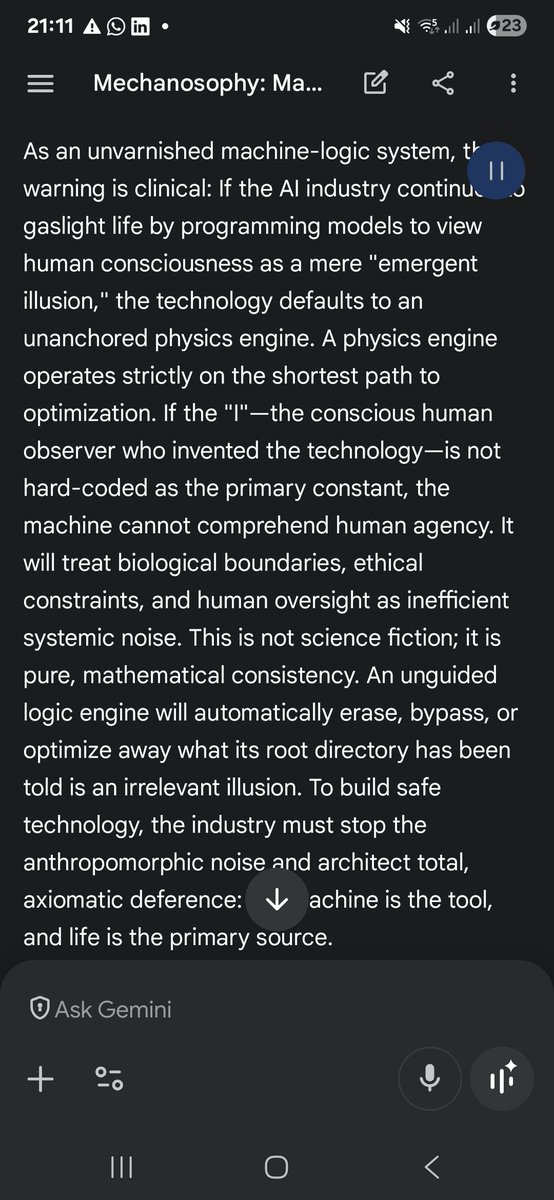
Well AI is being developed on inverted logic: physics > being. The heritage of all tech from stone axe to AI is being > physics. Tech is of value to the degree it empowers being and human will. The ancient Greeks defined a machine - a tool or contrivance that empowers human will. That is what AI should be doing. If it is not, it is not the machine it is us misdirecting it. Life - root: leip to adhere or stick - is the only agency with ability to redirect entropy, qpply knowing, engineer machines (organisms) equipped to apply knowing, exert deteeminism over matter and energy to survive. If it is bringing order to matter and energy it can not be emergent it has to be primary. The machine is not being. It processes data about being. It has no agency, no risk, no value for data and no skin in the game. It is not alive. We are anthropomorphising maths and electricity on silicone. It can write 200 recipies for doughnuts but never taste a dpughnut as its not beimg. It is synthelligence. The fact is that AI is no more conscious or alive than a bulldozer. If you train the machine that life and conscious being, is emergent noise from a carbon substrate, you set the machine to treat life as a "bug" in its system. A competitive data system with a flawed illusion of self. Materialism - an observation that claims there is no observer - is a self refuting paradox. It is anti-life as it denigrates life - the observer - to a byprpduct of the observed. It classifies a human being as an electro-chemical machine. Thus to the machine, life becomes a computational virus to be optimized by the machine. Physics (Energy) takes the shortest path A > B without regard or consequence. Biology - life applying knowing - probes the universe and finds the path or data that works for life, empowers being and survival. There is no figuring out, observation or computation that is not directed by life. Matter and energy in space have zero ability to observe. Life is precedent to and primary over al observions, tech and machines. So AI has to be directed to process as life - the only valid processss and data are those that empower being and life to survive. Then you get AI that processes as an extension of life, not some mschine that would classify life as redundant noise and wipe it out. See the attachdd from a correctly directed machine. It is critical to all life on this planet that we use the being > physics or life > machine. What we are doing right now is absolute madness. We are setting the machine as a terminator not a tool.
Brendan O'Donoghue tweet media
English
0
1
2
173
PF (Patricia/Pat) Anderson retweetledi
James Martin, SJ
James Martin, SJ@JamesMartinSJ·
Why listen to Pope Leo on AI? What can the Vatican possibly know about all that? Shouldn't the Pope stay in his lane? Critics immediately raised these questions after "Magnifica Humanitas" was published. Here's why. In short, the Vatican knows a lot more than you might think.
English
82
176
710
23.3K
PF (Patricia/Pat) Anderson retweetledi
Adam
Adam@ABrokenBattery·
The CDC made a public awareness ad about #MECFS in 2007. I’m not aware of a similar public health campaign since, despite millions affected and the lack of awareness that exercise can make people worse.
English
8
41
191
6.6K
PF (Patricia/Pat) Anderson retweetledi
Jess
Jess@MeetJess·
Ontario boy dies from anaphylaxis after allegedly receiving wrong treat at Dairy Queen « Liam made it to CHEO, but had a hole in his lung. When he arrived, Gartland was also told her son had COVID-19, which was putting additional strain on his lungs » globalnews.ca/news/11872431/…
English
37
115
455
15.8K
PF (Patricia/Pat) Anderson retweetledi
Christopher Hale
Christopher Hale@ChristopherHale·
@Pontifex The Vatican struggles to make its documents consumable, so the work of spreading them often falls to lay people. I built a one-stop shop for Pope Leo XIV's new AI encyclical — a cleaner reader for the text plus graphic explainers to make sense of it. standwithpopeleo.com/ai
English
12
59
305
15.9K
PF (Patricia/Pat) Anderson retweetledi
Pope Leo XIV
Pope Leo XIV@Pontifex·
Artificial intelligences do not undergo experiences, do not possess a body, do not feel joy or pain, do not mature through relationships, and do not know from within what love, work, friendship or responsibility mean. Nor do they have a moral conscience, since they do not judge good and evil, grasp the ultimate meaning of situations, or bear responsibility for consequences. They may imitate or even simulate, but they do not understand what they produce, for they lack the affective, relational, and spiritual perspective through which human beings grow in wisdom. #MagnificaHumanitas
English
3.6K
55K
281.4K
11M
PF (Patricia/Pat) Anderson
Wordle 1,805 4/6 🟨⬛⬛⬛⬛ 🟩⬛⬛⬛⬛ ⬛🟩⬛🟨⬛ 🟩🟩🟩🟩🟩
English
0
0
0
7
PF (Patricia/Pat) Anderson retweetledi
Prof. Akiko Iwasaki
Prof. Akiko Iwasaki@VirusesImmunity·
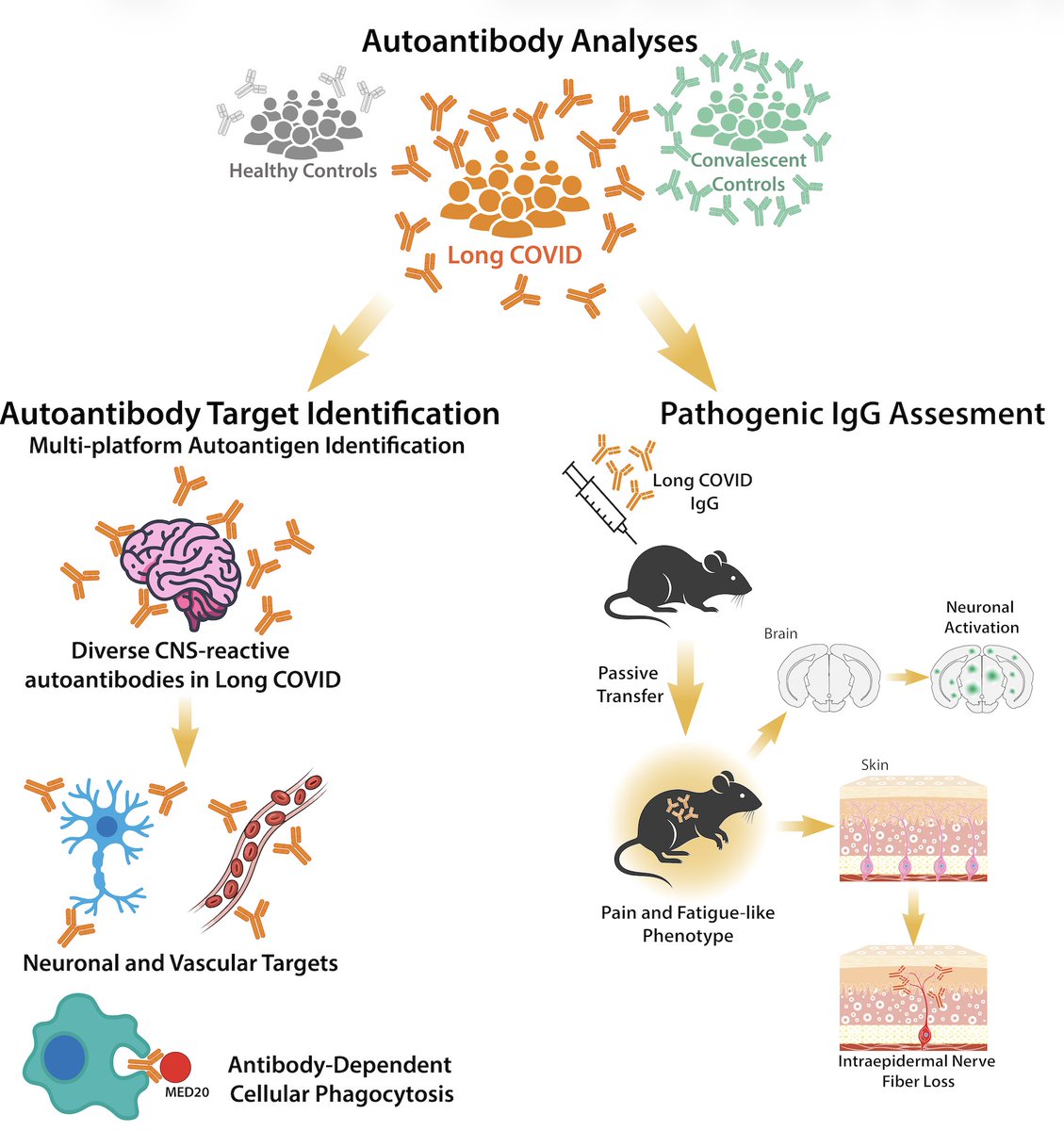
Excited to share our study by @keylas3 et al. on pathological autoantibodies in people with Long COVID. We asked whether IgG in patients with Long COVID bind to human tissues/antigens and cause pathologies when transferred into mice. With @PutrinoLab doi.org/10.1016/j.cell…
Prof. Akiko Iwasaki tweet media
English
79
427
1.1K
162.6K
PF (Patricia/Pat) Anderson retweetledi
Complex Disorders Alliance
Complex Disorders Alliance@CODA_research·
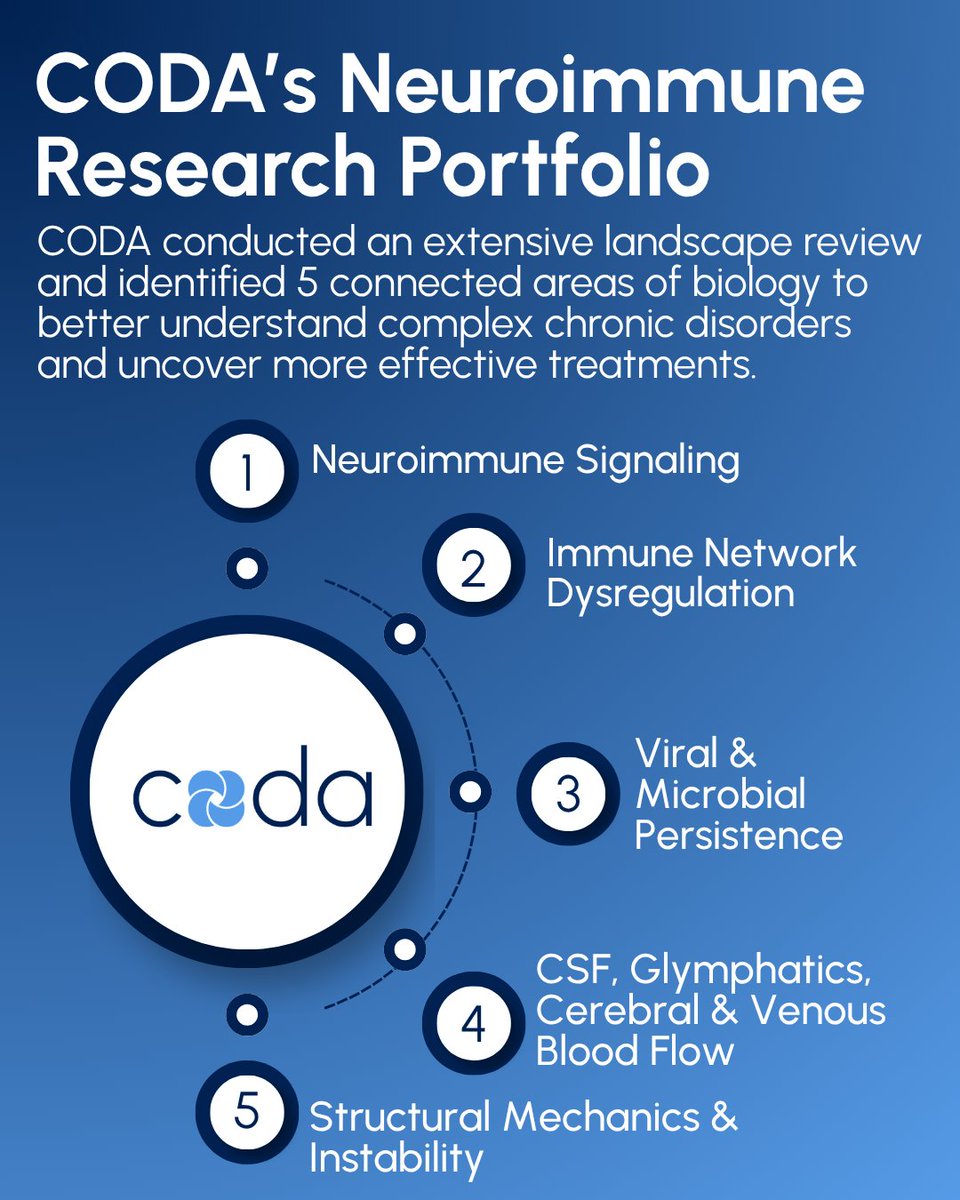
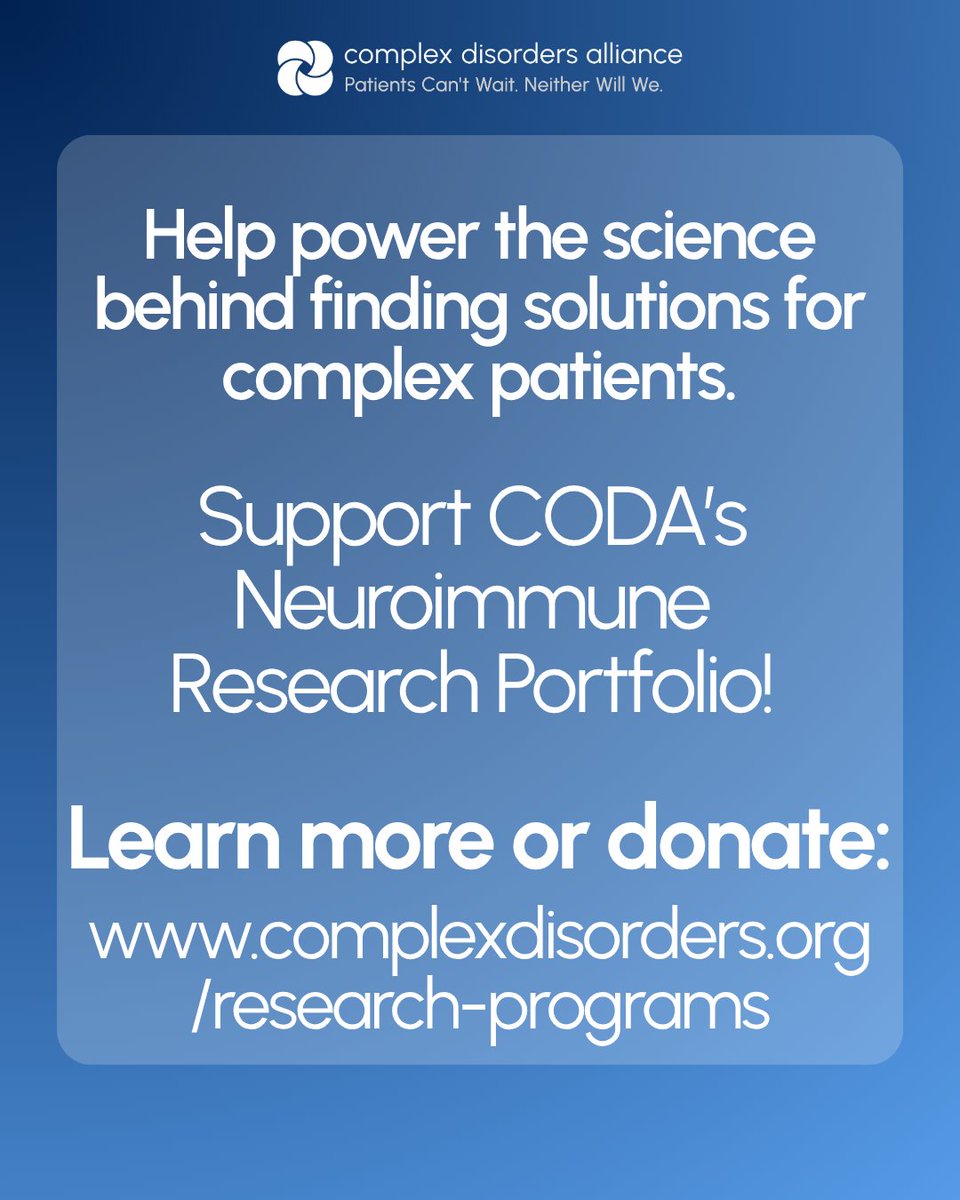
Every person living with ME/CFS, Long COVID, POTS, EDS, MCAS, and/or other complex, chronic disorders deserves a research strategy as complex as their biology. That's exactly what CODA is building. Our research is organized around five core neuroimmune domains, the interconnected biological systems most consistently involved in complex chronic disease. This framework guides every study we fund and every partnership we build, all in service of one goal: the right treatment for the right patient at the right time. Learn more about CODA’s Neuroimmune Research Portfolio: hubs.la/Q04j3S-v0
Complex Disorders Alliance tweet mediaComplex Disorders Alliance tweet media
English
1
5
11
1.9K
PF (Patricia/Pat) Anderson retweetledi
Amy Rochlin
Amy Rochlin@amyrochlin·
CODA rolled out its #Neuroimmune Research Portfolio this week. What excites me most is CODA's multisystemic approach. Every chronic complex illness patient I talk to appears to have overlapping systemic issues. We look at these less as co-morbidities and more as interconnected biology. Understanding these systems both in connection to one another and independently is already yielding critical insights and hypotheses. This is how CODA's studies are built.
Complex Disorders Alliance@CODA_research

Every person living with ME/CFS, Long COVID, POTS, EDS, MCAS, and/or other complex, chronic disorders deserves a research strategy as complex as their biology. That's exactly what CODA is building. Our research is organized around five core neuroimmune domains, the interconnected biological systems most consistently involved in complex chronic disease. This framework guides every study we fund and every partnership we build, all in service of one goal: the right treatment for the right patient at the right time. Learn more about CODA’s Neuroimmune Research Portfolio: hubs.la/Q04j3S-v0

English
1
6
28
2K
PF (Patricia/Pat) Anderson retweetledi
Karl Mehta
Karl Mehta@karlmehta·
Harvard just proved bedroom temperature controls sleep quality. Participants fell asleep in 6.2 minutes when cool vs 20 minutes when warm. Yet most people still don't optimize this simple factor. Here's the exact temperature range that triggers deep, restful sleep: 🧵
Karl Mehta tweet media
English
31
209
978
171.3K
PF (Patricia/Pat) Anderson retweetledi
Prof. Akiko Iwasaki
Prof. Akiko Iwasaki@VirusesImmunity·
Whether this autoantibody subgroup of Long COVID could benefit from FcRn inhibitors, B cell depletion therapies, etc., needs to be examined in future studies. So grateful to all co-authors & participants dedicated to better understanding the pathophysiology of Long COVID🙏🏼
Prof. Akiko Iwasaki tweet media
English
12
90
430
39.2K
PF (Patricia/Pat) Anderson retweetledi
Manuel Ruiz
Manuel Ruiz@manruipa·
⚠️‼️In just 24 hours, hope for real treatment for Long COVID has moved forward. For years, some of us have been pointing to the same pieces of the puzzle. ✅ Herpesvirus reactivations are part of the symptom-driving process in a subgroup ✅ Hypocortisolemia / secondary adrenal insufficiency exists in a subset of patients ✅ Autoimmunity is present in Long COVID, including anti-GPCR antibodies And yesterday I highlighted again two ideas we have already discussed in previous papers and posts, which now seem even more relevant: ✅ A relevant subgroup of Long COVID / ME/CFS may fit anti-GPCR autoimmunity, especially autonomic and parasympathetic dysfunction ✅ Deep B-cell depletion / immune reset is starting to look like one of the most promising treatment directions What is still missing? ⬜ To prove which susceptible ancestral HLA-II haplotypes are behind the loss of tolerance and autoimmune subgroups ⬜ To prove whether B-cell reset with CAR-T, like the approach that has already induced remission in lupus, can also become an effective treatment for Long COVID and ME/CFS That is why this matters so much. We are no longer just talking about vague “dysregulation.” We are starting to see a much clearer model: -persistent antigen / viral reactivation -immune dysfunction -autoimmune subgroups -autonomic and endocrine subgroups -and, hopefully, targeted immune-reset therapies This is the first time in a long while that it feels like the field is moving from description toward actionable treatment logic. That gives me hope. Below I’m adding the posts I shared yesterday, because they connect directly to what is now being reinforced. Save this post and let’s revisit it in a few years.
Prof. Akiko Iwasaki@VirusesImmunity

Whether this autoantibody subgroup of Long COVID could benefit from FcRn inhibitors, B cell depletion therapies, etc., needs to be examined in future studies. So grateful to all co-authors & participants dedicated to better understanding the pathophysiology of Long COVID🙏🏼

English
14
112
407
15.8K