Raghav

396 posts

Raghav

Raghav

@raghav50k

St. Stephen’s College | Harvard | Macro, economics history, politics, energy policy

New Delhi, India Katılım Aralık 2012
386 Takip Edilen100 Takipçiler
Raghav
Raghav@raghav50k·
@econ_robinson @erhanBLC @mean_field_zane Does anyone in MMT have an argument for how you can avoid currency devaluations (and thereby currency induced inflation) if you follow sustained YCC?
English
0
0
2
22
Raghav
Raghav@raghav50k·
@econ_robinson @erhanBLC @mean_field_zane Plenty - yet to find any solution on how to avoid currency-devaluation induced inflation that would result from widespread YCC….outside of Nathan Tankus’ outright ban on foreigner sales of FX and general autarky
English
1
0
1
31
Raghav
Raghav@raghav50k·
@econ_robinson @erhanBLC @mean_field_zane Would that change the fact that fiscal spending is still constrained by inflation, which MMT has no credible ability to respond to, since it has no meaningful model of how currencies would respond to YCC?
English
1
0
1
51
E-40 and Econometrics
E-40 and Econometrics@econ_robinson·
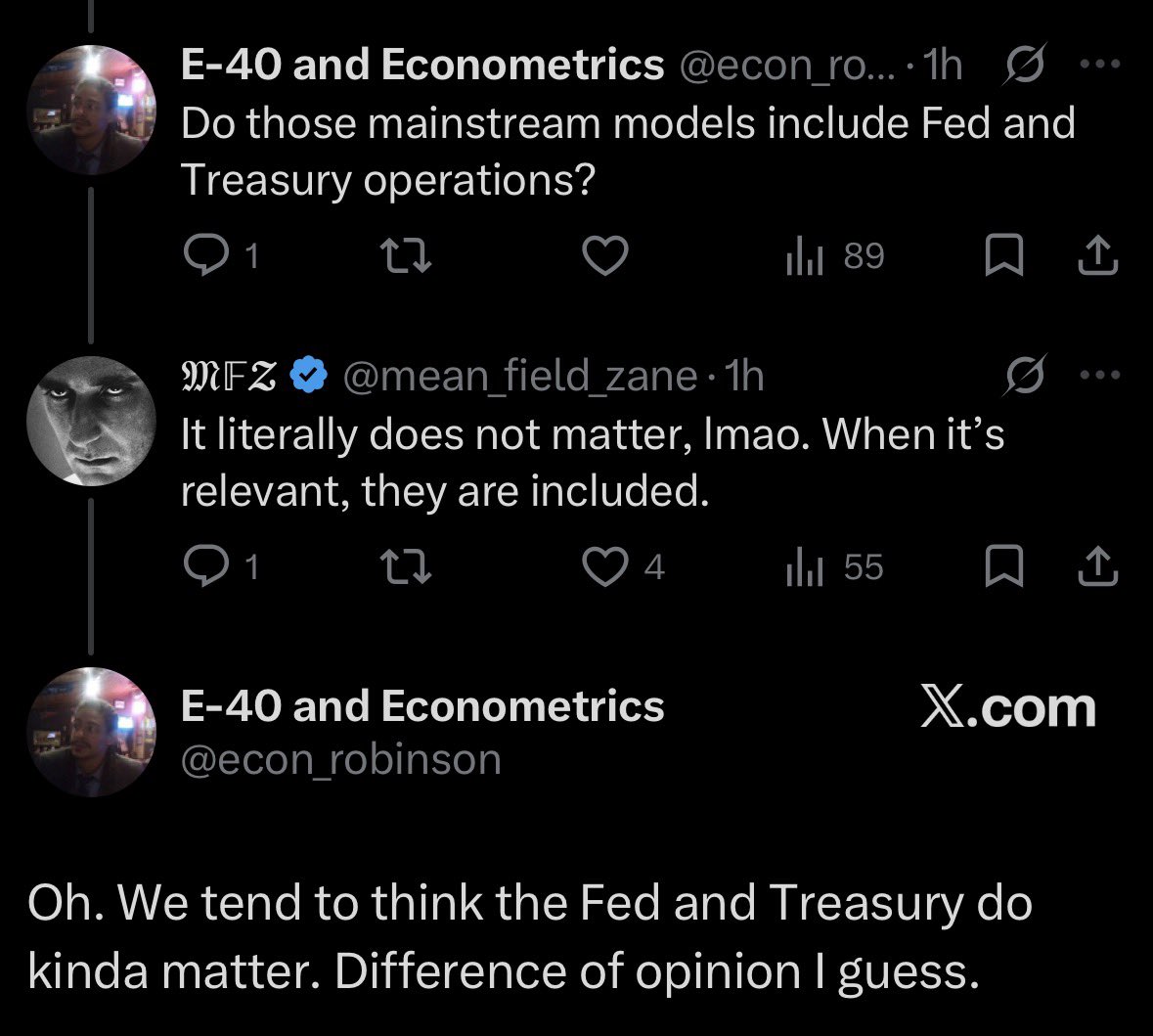
@erhanBLC @mean_field_zane Fed and Tsy are important to the US and global economy. Beyond just academic interest, if econs are interested in improving economic outcomes, they should know how things actually work.
English
1
0
0
82
Raghav
Raghav@raghav50k·
@talmonsmith @ArmandDoma It went viral entirely over its $140K = poverty line assertion. That’s the only reason it came on your timeline instead of more thoughtful benefits cliff analysis. Giving it oxygen because it aligns with your priors really diminishes the credibility of NYT econ reporting, frankly
English
0
0
2
31
talmon joseph smith
talmon joseph smith@talmonsmith·
@ArmandDoma the honest issue isn't with the precise numbers. somebody from EPI or the MIT project could've cleaned up his assertions in edits. and if it went viral the same centreright/left folks would've been mad. the real beef is over fears of undue doomerism becoming even more popular
English
3
0
0
241
talmon joseph smith
talmon joseph smith@talmonsmith·
great story from WaPo. "poverty" line nitpicks aside, Mike has started a great debate thats triggered so much of the center-left & center-right officialdom - which has stuck with "no no things are better than ever you masses are too dull & IG Jealous to realize" even after Nov24
Michael Green@profplum99

Unfortunately, the first draft of this misquotes me as suggesting we need a new bureaucracy to distribute cash to households. I specifically said, “We do NOT need a new bureaucracy” But otherwise a fairly balanced article. Amazing how hard American Enterprise Institute (AEI) is trying to suppress the discussion. washingtonpost.com/business/2025/…

English
17
14
125
280.6K
Hal Singer
Hal Singer@HalSinger·
For Matt’s thesis (price caps on beer put upward pressure on ticket prices) to work, you must assume (aside from the demand correlation point) that the entity setting beer prices is the same as the one setting ticket prices. Else there is no guarantee that the vendor will choose the jointly profit maximization price for beer. I acknowledge that the stadium owner could establish price floors for all vendors (to prevent competition), and capture the inflated beer prices via a tax, but that might draw the attention of regulators.
English
2
0
16
314
Tim Wu
Tim Wu@superwuster·
I take back "dumb" and replace it with "simplistic, overly stylized, and dated." The three questions you raise actually have more bearing on the policy question, as opposed to the simplistic assumption that a seller in one market can raise prices at will to make up for regulated prices by another seller in an adjacent market.
Jason Furman@jasonfurman

Three questions for @superwuster: 1. Is there a positive or negative externality to alcohol consumption at sporting events? 2. Does the price of alcohol at sporting affect the demand for tickets? 3. What happens to prices when demand changes and supply is inelastic?


English
9
2
98
59.5K
Raghav
Raghav@raghav50k·
@varma_ashwin97 @Afinetheorem @binarybits @superwuster The other is that even if these are separate monopolies, access to consumers is gated by the stadium, and so the pricing power would pass thru to the stadium rather than consumers. Given how dynamic stadium pricing tends to be, no reason to assume ticket prices will remain sticky
English
0
0
1
36
Ashwin Varma, MD
Ashwin Varma, MD@varma_ashwin97·
@Afinetheorem @binarybits @superwuster Reading through, the only contention he makes imo that isn't captured by this quite simple logic is the idea that the ticket selling stadium is not the same business entity as the vendors, while this analysis assumes they are pricing jointly.
English
3
0
5
288
Tim Wu
Tim Wu@superwuster·
This is just dumb and shows a failure to understand buyers. Assuming fans have a fixed total budget is a fallacy. If the stadium could charge more for tickets it would.
English
41
12
349
1.1M
Raghav
Raghav@raghav50k·
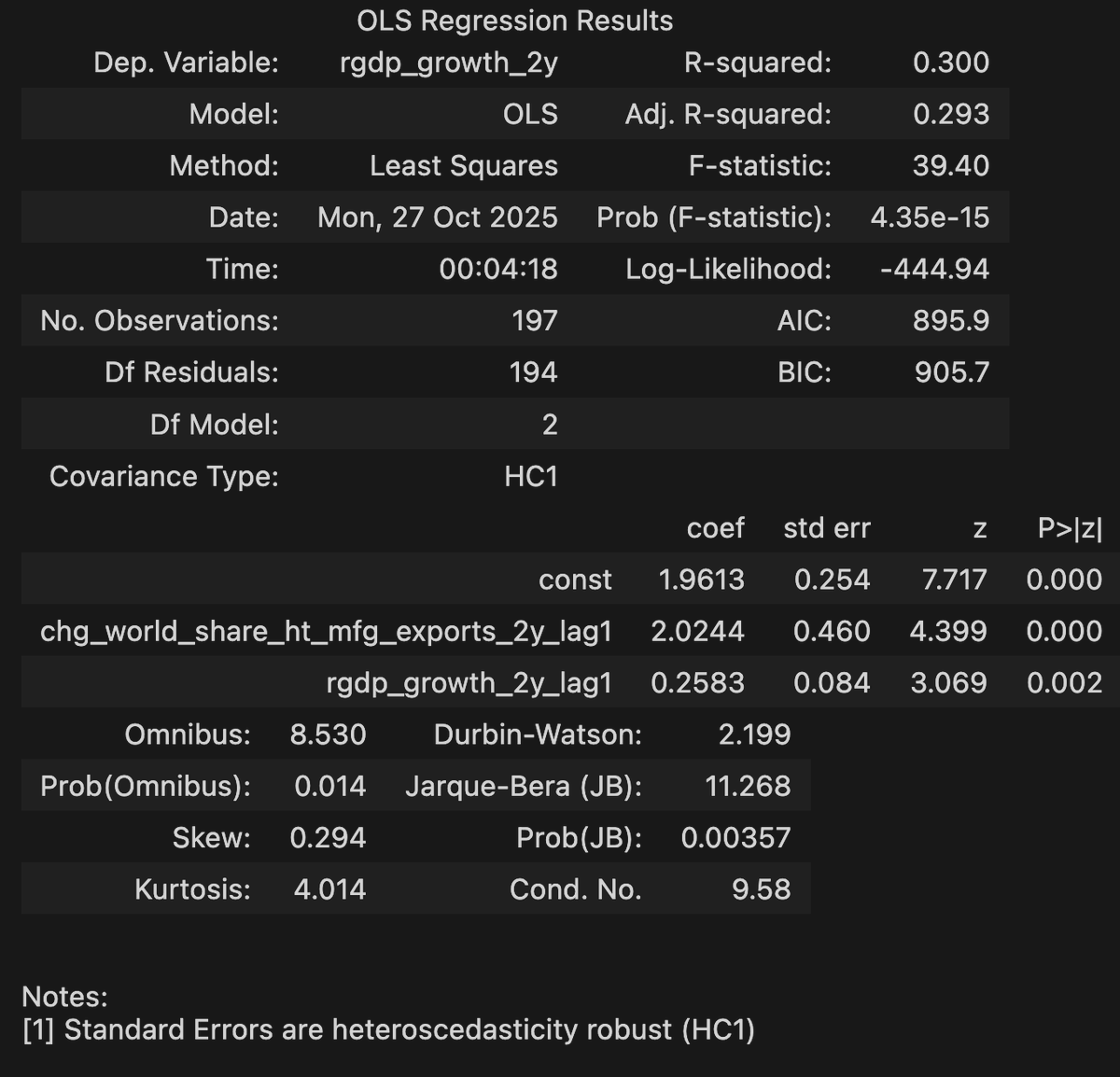
@policytensor 200 datapoints seems quite small though - how many independent country-time-period cells have you included here? (I.e: non-overlapping years per country)
English
1
0
1
23
Policy Tensor
Policy Tensor@policytensor·
With DW is close to 2, I feel more comfortable about my predictive estimate of 2pp faster growth per 1pp of change in world share on average per annum over the previous 2yr period: export success sensu stricto.
Policy Tensor tweet media
English
1
0
1
587
Alex Armlovich
Alex Armlovich@aarmlovi·
I want to steelman @MattBruenig's viral-dunked "risk" quote. He intended something interesting: Every generation gets the same ex ante risk advice: "put your 401k in S&P500" But morally arbitrary timing of a few years in the same index will enrich or bankrupt your retirement
Alex Armlovich@aarmlovi

Some say Gen Z is nihilistic bc of the randomness by which people get rich nowadays But market based retirements have always been insane Even doing it right—save up, follow a version of the 4%SWR rule—you could easily die bankrupt or with >$6M depending on the year you retired

English
30
12
253
47.9K
Raghav
Raghav@raghav50k·
@AliceFromQueens @PortmanToes Two people who give up the same number of units of consumption deserve the same expected return because their sacrifice helps fulfil an equivalent amount of demand for immediate consumption/investment in society
English
0
0
0
25
Alice
Alice@AliceFromQueens·
@PortmanToes the only argument here is about what ppl deserve. no one fails to understand what a market is or a price is
English
4
0
5
185
Alice
Alice@AliceFromQueens·
This is the proprietary method I use to select among S&P 500 ETFs. It's a very difficult job and I deserve to be well compensated for all the value I bring society with my ingenious allocations
Alice tweet media
English
19
3
84
11.4K
Raghav
Raghav@raghav50k·
@MattBruenig @a19grey @jaxgriot @AlexGodofsky What they *do* is fulfil the needs of those who seek to invest/consume now rather than later. As that person’s needs are no more fulfilled by consumption that is foregone as a greater sacrifice, sacrifice isn’t the scale used to judge desert
English
0
0
0
31
Alex Godofsky
Alex Godofsky@AlexGodofsky·
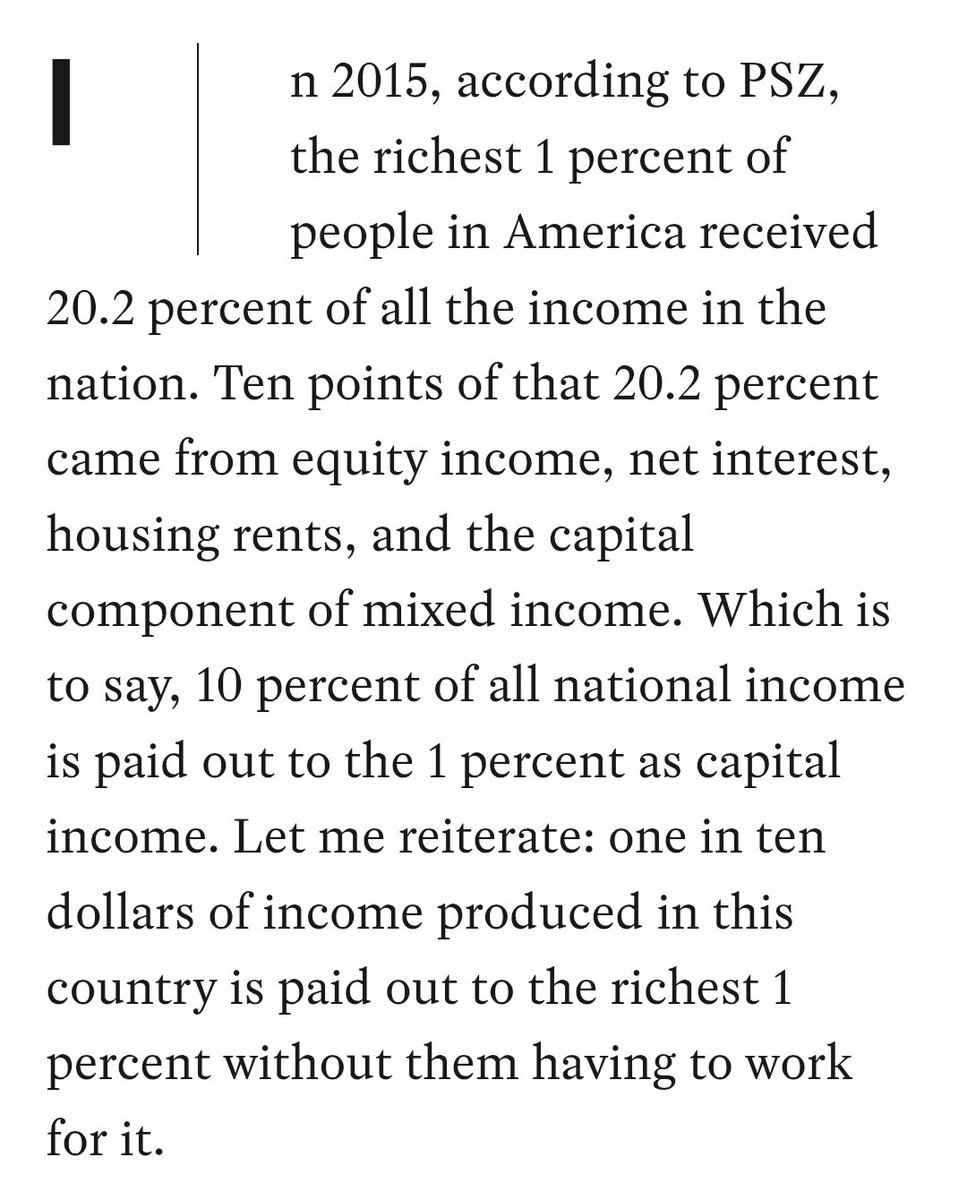
Bruenig is treated like a serious econ policy commentator in left-of-center circles, but one of his longest-held principles, which inspires much of his positioning on issues, is rejection of the time value of money.
Alex Godofsky tweet mediaAlex Godofsky tweet media
English
52
95
1.3K
201.5K
Raghav
Raghav@raghav50k·
@arpitrage It’s path dependence: each default/credit episode exacerbates conditions for the next. Credit episode -> risk premia rise -> fiscal space is squeezed -> you have political incentives to try unorthodox debt management -> creditors fear getting squeezed -> rinse /repeat
English
0
0
0
50
Arpit Gupta
Arpit Gupta@arpitrage·
Seems weird we have all these countries in the world but ~only Argentina is a somewhat developed country which struggles with fiscal/monetary/currency issues this badly. I’m a bit aware of the details, but don’t really have a framework for why just them
English
17
2
89
23.2K
Raghav
Raghav@raghav50k·
@ritwik_priya @Akshay_VAK @Blankname1982 @swarajk_ Seems like the need for monetary and fiscal easing is clear, IMO the question is whether cash transfers have the highest fiscal multiplier (esp with the political economy risks of creating new programs that become hard to scale back in the future ala fertiliser subsidies)
English
1
0
0
46
Ritwik Priya
Ritwik Priya@ritwik_priya·
So a variety of reasons - some structural e.g. government bodies/ military procuring a larger number of replacement items at historical prices, or some purely technical like path dependence (100-175-200 leads to a different chain weighting of index vs 100-125-200) or simply the evolution of consumption baskets during a period for change, may lead to a deflator that is not representative of the underlying price trend of the private economy. If you are stabilising aggregate demand, you should have a lower variance NGDP series than RGDP series, because nominal spending is your closest thing to 'hard directly measured reality' in national income stats. (This is what Swaraj is saying wrt nominal is real. You can aggregate 100 rs of jeans with 100 rs of eggs into 200rs of consumption. Inferring eggs and jeans from 200 and a price index has more errors) This does not mean it should hit a point estimate or that higher is always better (the Pak/ Turkey or UPA-2 examples). But if you have: 1. multiple successive sub 10% readings for an economy that used to do 12-13% regularly, and should be doing 11-12% given our 'realistic ambitions', and 2. we also know that credit growth, real wage growth, rural consumption etc were weak (before the ladlis took off), and 3. we know that govt has policy space given CAD, FX reserves and Russia oil windfall Then....the Swaraj conclusion follows.
English
4
0
1
321
Raghav
Raghav@raghav50k·
@swarajk_ This is true of all interventions - all to say 0.1 SD impacts for an ECD program aren’t necessarily ground-breaking.
English
1
0
2
252
Raghav
Raghav@raghav50k·
@swarajk_ Implementation isn’t the only thing that changes when things get scaled up - impacts may be transitory and fade a few years down the line, there may be socioeconomic variation that blocks impact channels, you can also have localized GE effects that an RCT can’t measure etc etc
English
1
0
2
251
Raghav
Raghav@raghav50k·
@arpitrage @paulnovosad Their version of shock therapy was better implemented because (a) Poland had a private sector thru the 80s, so the shift to a price system wasn’t as much of a shock and (b) they were lucky in that they got to see (and avoid) the worst of shock therapy before they privatised SOEs
English
0
0
1
52
Arpit Gupta
Arpit Gupta@arpitrage·
@paulnovosad Why do you think this happened to Poland more so than other former Communist areas like East Germany or Ukraine?
English
4
0
12
1.6K
Paul Novosad
Paul Novosad@paulnovosad·
Polish growth was more about removal of stupid communist policies than about any special policy. They had the human capital, social institutions, all the right inputs — when 50 years of repression stopped, they could go back to the predicted income level given their inputs.
Wojtek Kopczuk 🇵🇱🇺🇦 and 🇺🇲@wwwojtekk

Among countless other things that make me happy about it, Poland did it without an "industrial policy". Just stable policy, modest but consistent growth, the craziness of our politicians restrained by the EU, and a broad-based economy - you can't point to one sector driving it

English
16
47
480
46K
Raghav
Raghav@raghav50k·
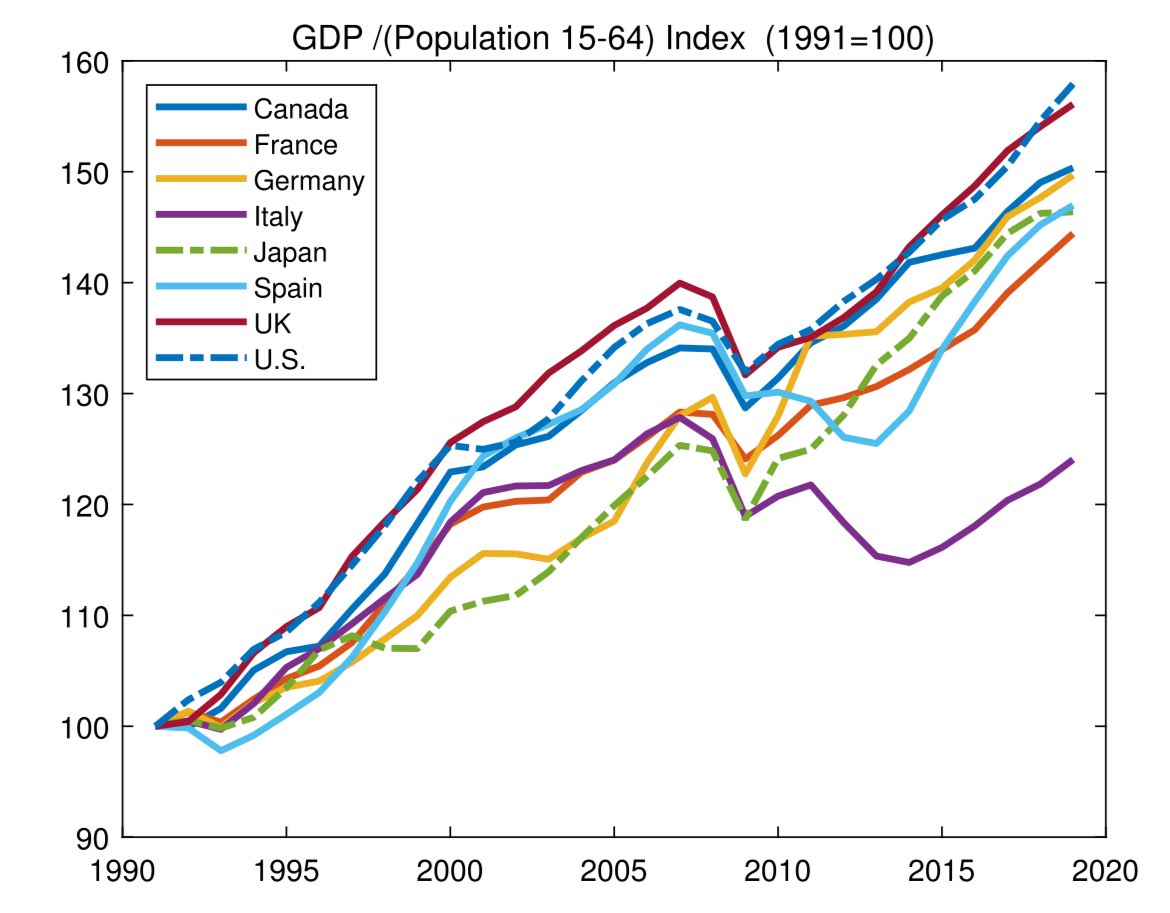
@pseudoerasmus The demographics are not quite the explanation in till 2008 no? Japanese GDP per working age adult lagged most of the G7 through most of the 90s-00s
Raghav tweet media
English
0
0
2
70
Raghav
Raghav@raghav50k·
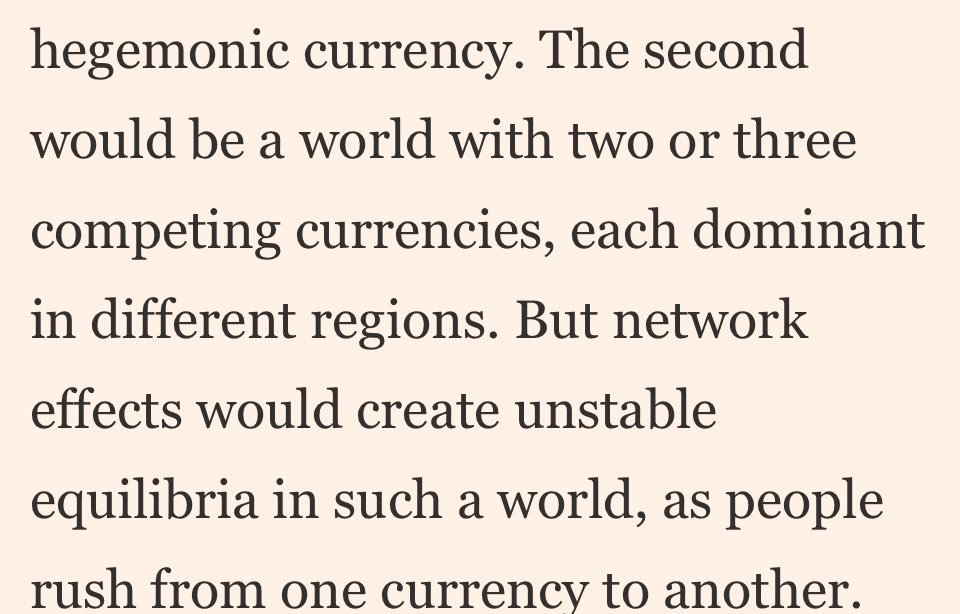
@RajaKorman Farhi and Maggiori had a paper on this a few years ago, arguing that safe asset providers may be less willing to roll the dice with Triffin Dilemma sunspots if they did not have a monopoly over convenience yields - leading to safe asset scarcity and forced deleveraging
English
2
0
0
34