Robert 🐀
4.1K posts


Robert 🐀
@rkieru
I do things with the Internets and the Prints and stuff.
Katılım Nisan 2009
36 Takip Edilen61 Takipçiler
@randomrecruiter A terrible but revealing answer. We're told to use AI, told to trust AI over years of experience. AI is going to 10x us, no, 100x us, no, another exponent! You don't need skill; just AI.
Move fast, don't think, trust AI. That's the plan.
English

If you respond to your manager with "Well Claude thinks" you're next on the chopping block

English


@sama Can it fix the massive disconnect between the goals of AI companies and the world economy? Close the inequality gap between the world’s richest and the rest of us? Cure cancer? Crack cold fusion? Solve colonizing the galaxy?
No? Just code and silly images? That’s… nice.
English

what problem do you most hope AI will solve in the future?
maybe we can help!
English
@intraalpha @wallstengine They could have invested in training, find new revenue streams and opportunities. By all accounts they had the time, money, and talent to take that route.
Instead they treated people like a liability, while people like you cheer them on singing ‘burn baby burn’
English

No financial need? So… you mean be wasteful on purpose?
Overcharge the customers to maintain the inferior solution?
It never works this way. The argument never holds.
They can and should find the shortest/best path. That’s what we want from capitalism.
Widespread benefits, narrow focused costs. The system improves on the whole for all.
But from time to time a group is holding the inferior solution and they lose the ground they had during this optimization.
Yep. Good.
Do it again.
Do it to me and my job, it’s correct. I’ll adapt as quickly as I possibly can. Complaining - and god forbid regulating - is counterproductive to your own goals.
And it has a 100 percent failure rate. And always will.
So… what is the point of even discussing what this company “should” or “shouldn’t” do. The moral judgement on what is fair is not desired nor helpful to any party in the system - including those who were terminated.
Solved.
English

Cloudflare CEO Prince on how AI changes who gets laid off first:
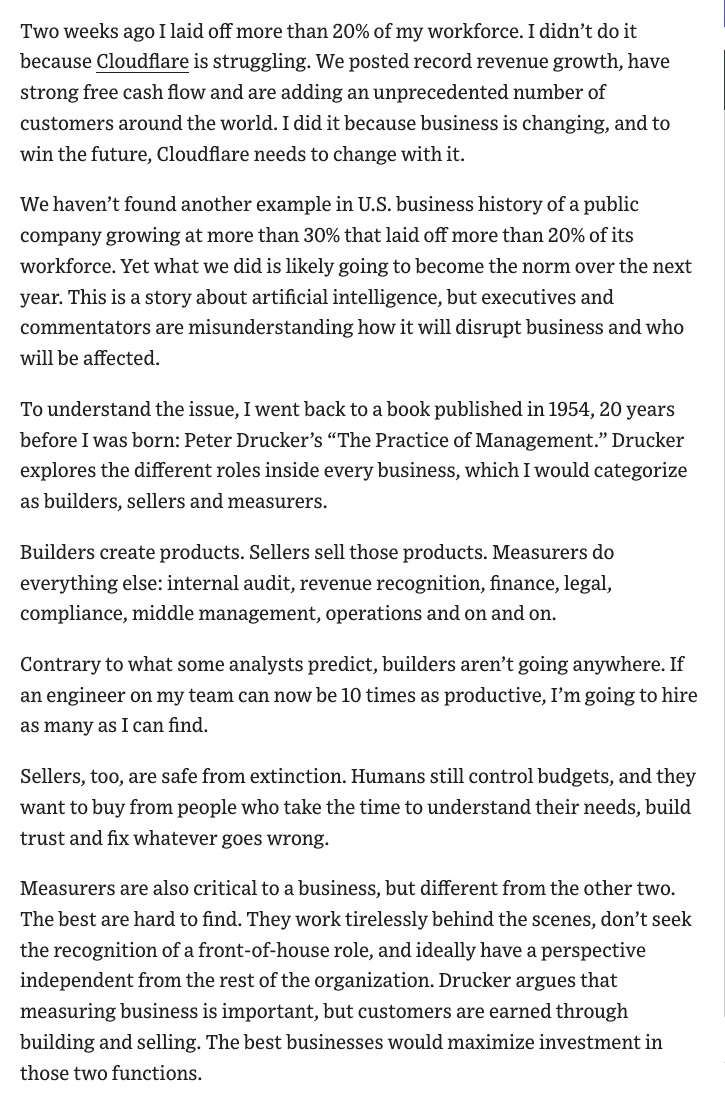
Two weeks ago I laid off more than 20% of my workforce. I didn’t do it because Cloudflare is struggling. We posted record revenue growth, have strong free cash flow and are adding an unprecedented number of customers around the world. I did it because business is changing, and to win the future, Cloudflare needs to change with it.
We haven’t found another example in U.S. business history of a public company growing at more than 30% that laid off more than 20% of its workforce. Yet what we did is likely going to become the norm over the next year. This is a story about artificial intelligence, but executives and commentators are misunderstanding how it will disrupt business and who will be affected.
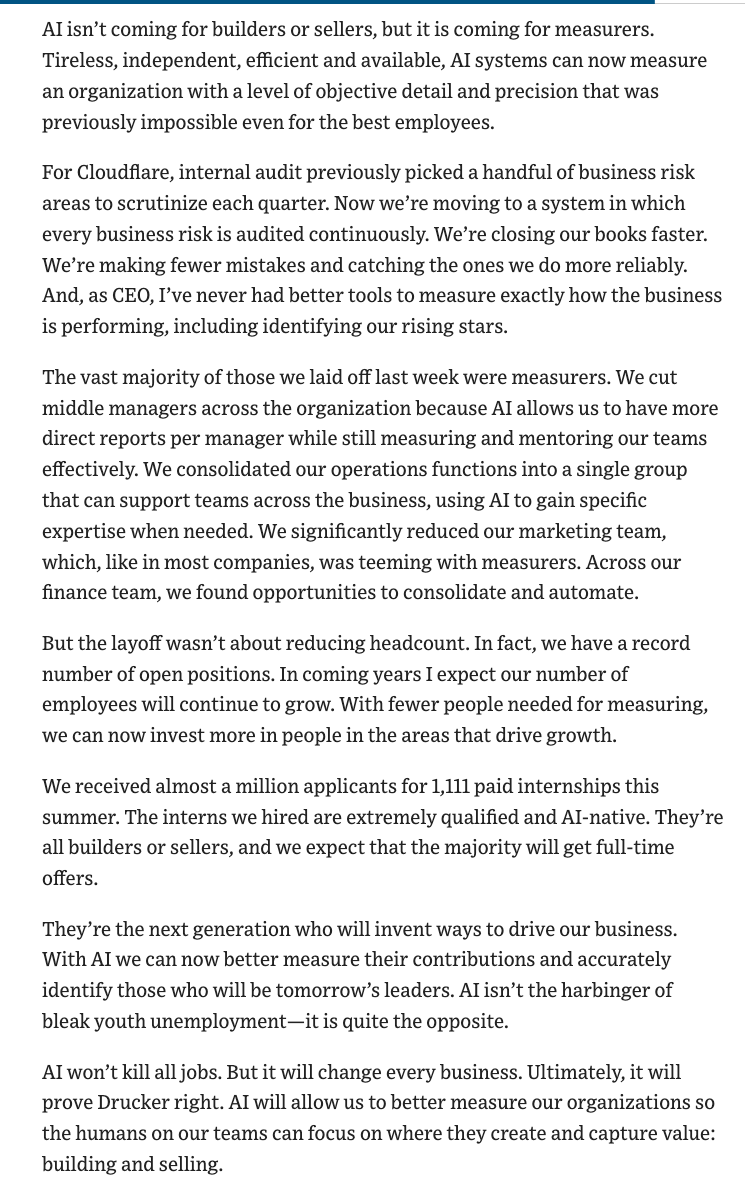
AI isn’t coming for builders or sellers, but it is coming for measurers. Tireless, independent, efficient and available, AI systems can now measure an organization with a level of objective detail and precision that was previously impossible even for the best employees.
For Cloudflare, internal audit previously picked a handful of business risk areas to scrutinize each quarter. Now we’re moving to a system in which every business risk is audited continuously. We’re closing our books faster. We’re making fewer mistakes and catching the ones we do more reliably. And, as CEO, I’ve never had better tools to measure exactly how the business is performing, including identifying our rising stars.
The vast majority of those we laid off last week were measurers. We cut middle managers across the organization because AI allows us to have more direct reports per manager while still measuring and mentoring our teams effectively.
We consolidated our operations functions into a single group that can support teams across the business, using AI to gain specific expertise when needed. We significantly reduced our marketing team, which, like in most companies, was teeming with measurers. Across our finance team, we found opportunities to consolidate and automate.
We received almost a million applicants for 1,111 paid internships this summer. The interns we hired are extremely qualified and AI-native. They’re all builders or sellers, and we expect that the majority will get full-time offers.
English
@DJ_CURFEW I wonder if you gave any thought to investing in improving the 22%. You want AI innovators? Grow them! What you’ve essentially done here is weaponize productivity. Beat your coworker for $$$. Come in last place and expect to be fired.
English

Today we reduced headcount by 22%. The business is the strongest it's ever been. So I think it's important to be direct about what I'm seeing and why.
First, I made this decision and I own it. I did it because the way to operate at the highest level of productivity is changing, and to win the future, ClickUp needs to change with it.
Second, this wasn't about cutting costs. Most savings from this change will flow directly back into the people who stay. We'll be introducing million-dollar salary bands. If you create outsized impact using AI, you'll be paid outside of traditional bands.
Most importantly, I have the deepest gratitude for those affected. We're doing this from a position of strength specifically so we can take care of people properly. Everyone affected receives a package aimed at honoring their contributions and easing the transition.
I only see two options: wait for this to play out gradually in the market or be honest about what I'm seeing and act proactively.
THE 100X ORGANIZATION
The primary change is that we're restructuring around what I call 100x org. The goal is 100x output. The roles required to build at the highest level are fundamentally different than they were a year ago.
Incremental improvements to existing systems won't get us there. We need new ones. That means creating enough disruption to rebuild rather than iterate on what's already broken.
The common narrative is that AI makes everyone more productive. It doesn't. Many of the workflows of today, if left unchanged, create bottlenecks in AI systems.
These roles will evolve. But waiting for that to happen naturally means falling behind now.
The 100x org is actually heavily dependent on people - infinitely more than today. This is only possible with 10x people that have embraced and adopted new ways of working.
THE BUILDERS, AGENT MANAGERS, AND FRONT-LINERS
— THE BUILDERS: 10X ENGINEERS
I don't think most companies have internalized what's actually happening with AI in engineering. The common narrative is that AI makes all engineers more productive. That may be true in isolation, but at an organization level - that is the farthest thing from reality.
Here's what we've validated recently at ClickUp: the great engineers, the ones who can orchestrate, architect, and review, are becoming 100x engineers. They're not writing code. They're directing agents that write code. The skill is judgment.
AI makes the best engineers wildly more productive, and everyone else using AI slows these engineers down.
Think about it - the bottlenecks are (1) orchestration - telling AI what to do, and (2) reviewing - what AI did. Everything is leapfrogged and no longer needed.
So who do you want orchestrating and reviewing code?
And how do you want your best engineers to spend their time?
If your best engineers are spending time reviewing other people's code, then this is inherently an inefficient bottleneck. These engineers can review their agent's code much faster than reviewing human code.
The new world is about enabling your 10x engineers to become 100x.
The wrong strategy is to push every engineer to use infinite tokens. Companies doing this are celebrating 500% more pull requests. But customer outcomes don't match the volume of code being generated.
I call this the great reckoning of AI coding, and every company will face this soon if not already.
More code is just another bottleneck to the best engineers, and ultimately to your company's impact as well.
— THE BUILDERS: 10X PRODUCT MANAGERS
Product management and design roles are merging.
Designers that have customer focus, become more like product managers.
And product managers that have intuition for UX become more like designers.
The bottleneck of user research is gone. It takes us just one mention of an agent to kickoff research and analyze results.
The bottleneck of product <> design iteration is also gone. The product builder iterates on their own, along with agents and skills that ensure alignment with quality and strategy.
Also controversial today - I believe that the wrong strategy is to have your PMs shipping code - that just introduces another bottleneck that the best engineers will waste their time on.
To be clear, PMs should be coding but they should do this in a playground to iterate, validate, and scope. That code should not go to production.
Everything outside of managing systems, orchestrating AI, and reviewing output becomes a bottleneck.
That's why the other roles that are critical along with these are the systems managers (to reduce bottlenecks) along with a bottleneck you can't replace - customer meeting time.
— THE SYSTEM MANAGERS
Ironically, the people that automate their jobs with AI will always have a job. They become owners of the AI systems - agent managers. We have many examples of these people at ClickUp.
The underlying systems in which we operate are absolutely critical to get right. I think most companies are delusional to think they can iterate on existing systems and compete in this new world.
You must create enough disruption so that old systems are deprecated entirely. If there's any definition for 'AI native' that's what it is.
— THE FRONT-LINERS
In a world that will become saturated with AI communication, the human touch will matter more than anything to customers.
This is a bottleneck that you shouldn't replace - even when agents are high enough quality to do video meetings.
One-on-one meeting time with customers is something that shouldn't be automated. The systems around the meetings should be - so that front-liners spend nearly 100% of their time with customers.
REWARDING 100X IMPACT
In a world where companies are able to do so much more with less, where does that excess money go?
In our case, much of the savings in this new operating model will flow directly back to those that enabled it.
We must reward people that create productivity accordingly. This aligns incentives on both sides. Plus, in a world where your best people create 100x impact, you can't afford to lose them.
You should aim to retain these employees for decades. The context they have and their ability to efficiently orchestrate and review will be nearly impossible to replace.
Compensation bands of today should be thrown out the door. We're introducing $1 million cash/year salary bands with a path available to nearly everyone in the company if they produce 100x impact by creating or managing AI systems.
THE FUTURE
Nearly every company will make changes like these. The ones that do it proactively will define what comes next.
The future is not fewer people. It's different work, new roles, and better rewards for those who embrace it. We're already seeing entirely new roles emerge, like Agent Managers, that didn't exist a year ago.
ClickUp is positioning to lead this shift, not just internally, but for our customers too. I've never been more certain about where we're headed.
English
@Enelemtal @wallstengine What was improved? Is their business BETTER without those people? Based on their stocks it would seem that they HURT their business with this decision.
English

@rkieru @wallstengine “Because they could” is a gross oversimplification.
You should only improve your business if you’re struggling? That’s a recipe for not lasting very long as a business
English
@intraalpha @wallstengine Coinbase had no financial need to fire them. They could have upskilled the staff, figured out how the staff could leverage AI to do more. If your AI strategy is to just replace humans with binary you're showing a lack of imagination. Use AI to help humans do MORE.
English
@rkieru @wallstengine This explanation of "the new tech is better and more efficient" has occurred 1000x in history and it was the correct choice all 1000 times.
Each of those times people complained about progress. All 1000 of those times those people were wrong.
This time its different?
English
@Cold_horizons @crypt0lake AI is quickly becoming more expensive than humans, not less. That will eventually change but right now I think OP is right. Shedding quality for quantity.
English

@crypt0lake AI is even cheaper honestly. I think a ton of back office roles that used to be offshored are just going to be agentic workflows soon. India especially is going to take a huge hit.
English

all of these US tech layoffs are a ruse btw, they are all aggressively hiring in EU and India with half the salary for the same roles, US talent just became too expensive
English
@chelo_xl @hypeddev @reactjs I don’t understand? Am I missing something on MDN that identifies custom select as a web standard, or are you assuming that something existing on MDN makes it a web standard? Because MDN is a great resource, but not an authority on what is and is not a web standard.
English


The @reactjs team don’t care about web standards
github.com/facebook/react…
English

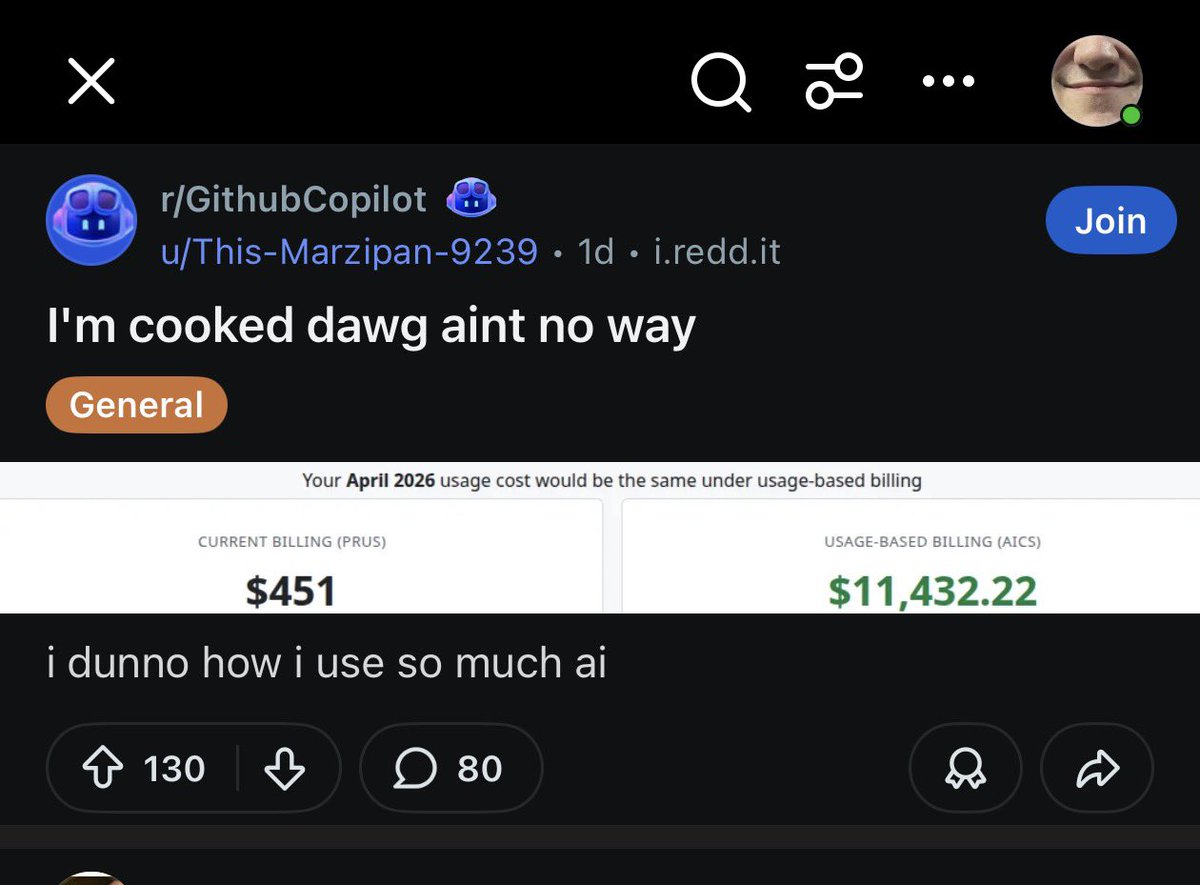
Turns out Microsoft’s GitHub copilot strategy was to let give people $25 of tokens for $1, or put another way, $11,432 of tokens for $451
Ed Zitron@edzitron
GitHub Copilot moves to token based billing on June 1, and its users got a calculator showing their actual monthly token burn - some $39-a-month users have spent $1500 to $5800 in tokens a month. I believe it's indicative of every AI startup. wheresyoured.at/premium-what-i…
English
@jamesperkins The reasons are fabricated. It’s never been about AI making human roles redundant, nor is it about some brave new world. It’s about money. AI costs are only going up, so they are hedging their bets that reallocating all those salaries will give them more flexibility. Sad.
English

if i read one more layoff announcement with “the way we work has fundamentally changed” this week.
i’m going to write a hate post about how much of a cope bullshit excuse this is
English
@mariorod1 While I appreciate the impact AI has had on your service, we heard this same promise last month. I suspect we will hear it again next month. To me, the core issue is that GitHub needs its own leadership structure that is separate from CoreAI.
English

Being the foundation for millions of developers means our bar must be higher for availability, reliability, and security. I’m sorry it’s been a rocky stretch at GitHub. We know we need to do better.
Today we published an update on two recent incidents: one on April 23 involving merge queue behavior, and one on April 27 affecting pull requests, issues, projects, and search-backed experiences.
We’re taking this seriously. We’re listening, and you have my commitment that we’ll communicate more frequently about the work underway to improve reliability and scale GitHub for what comes next.
github.blog/news-insights/…
English
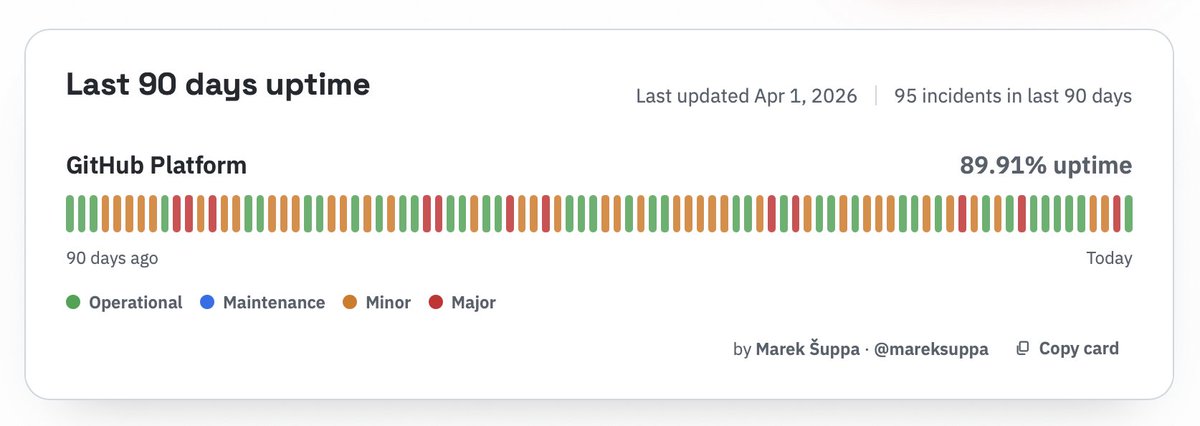
@RhysSullivan The only reason that page exists is because GitHub chose to remove aggregate numbers from their own status page, leaving us a corporate-speak blog post addressing reliability issues, promising to do better, and failing to deliver on that promise.
English

The GitHub status page everyone is posting about mostly seems disingenuous
They definitely have a lot of issues but saying it’s 89.91% uptime is just not really true
From a brief scroll:
- it marks an increase of latency in one region as downtime for the whole product
- marks things like a MS Teams notifications as a major outage
While I’ve obviously been critical on GitHub in the past, feels like it’s important to represent them fairly otherwise it’s just going to push them to under reporting incidents
It seems like a lot of the current discourse around it is in a desire to see them fail and misrepresenting it just creates a bad culture
English