Robb Willer

7.7K posts

Robb Willer banner
Robb Willer

Robb Willer

@RobbWiller

Professor of Sociology, Psychology, & OB @Stanford. Director of Politics and Social Change Lab, Co-Direct @StanfordPACS. Obsessive basketball fan

Palo Alto, CA Katılım Ağustos 2014
2.5K Takip Edilen7.4K Takipçiler
Sabitlenmiş Tweet
Robb Willer
Robb Willer@RobbWiller·
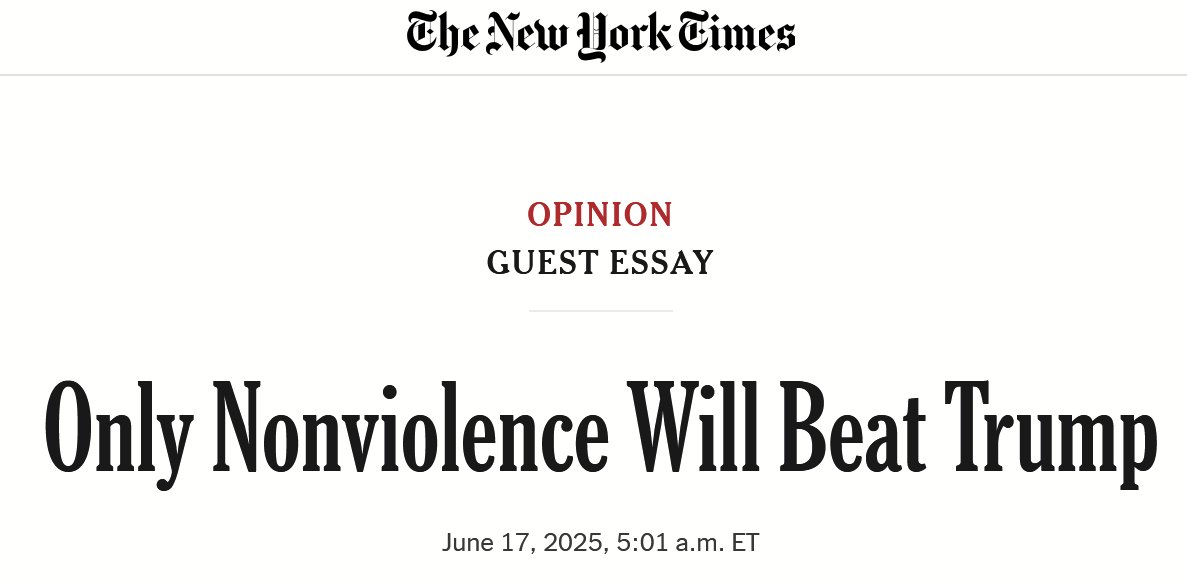
Saturday's No Kings protests were massive, inclusive, and nonviolent. It was an honor to team up with @owasow to analyze how nonviolent resistance can wins hearts, minds, and elections.
Robb Willer tweet media
English
1
8
32
5.8K
Robb Willer retweetledi
The Best
The Best@Thebestfigen·
Give these guys an Oscar.
English
138
2.8K
30.8K
1.8M
Robb Willer retweetledi
Arvind Satyanarayan
Arvind Satyanarayan@arvindsatya1·
🚨MIT Postdoc Opportunity! We're looking for someone with an HCI+ML/RL background to work with us on agents that promote metacognition and sociality—trained with ethnographic rewards! w/@mitchellgordon,@zanabucinca & colleagues in sociology+anthropology tinyurl.com/4jsr8ee9
English
1
27
97
9.3K
Robb Willer retweetledi
Jonathan Haidt
Jonathan Haidt@JonHaidt·
The Anxious Generation was published two years ago today, in a very different world. Back then, the most common objection I got was resignation: "The train has left the station." "You can't put toothpaste back in the tube." "It's how the kids connect today." Today, the world looks very different. It turns out that if our kids were all on a train and we learned it was heading toward a collapsed bridge, we'd find a way to stop it and bring them safely back to the station. That’s what’s happening now. After the historic verdicts in Los Angeles and New Mexico, today is a great day to reflect on the capacity of people in democratic societies to take action, even when opposing some of the most powerful corporations in history. We're getting access to the courts. We're getting phone-free schools. We're seeing whole neighborhoods letting kids out to play, unsupervised, which is what we older folk all remember as the best part of childhood. So I want to recognize: --The mothers (and, right behind them, fathers) who rose up by the millions and powered the movement. --The farsighted governors and legislators in red states and blue states who have been innovating on policy solutions. --The leaders of a dozen of nations, who are raising the age to 16 for opening social media accounts (with a special shoutout to Australia, for going first). --The teachers and school administrators who had their classrooms disrupted for 15 years, and who are now eager to think through new solutions as screens have taken over and obstructed learning. --The grassroots organizations who have been dedicating their efforts to advocate for all of the above in their local communities. --The millions of members of Gen Z who have been rising up, demanding agency over how they spend their lives in the digital era, and finding better ways to connect in real life. And one final group: the survivor parents--the ones you saw in those pictures of people embracing on the front steps of the LA courthouse. I have met many over the years. I am in awe of their courage and tenacity, their willingness to tell their stories of loss, over and over again, to different audiences, in the hope that no other parent would have to endure what they have endured. At long last, juries and legislatures are hearing you, and are acting. Together, we are calling the train back to the station. Together, we are rolling back the phone based childhood and reclaiming life in the real world. The work continues. If you’re not already involved, join us: anxiousgeneration.com/join
English
80
561
3.2K
404.3K
Robb Willer retweetledi
Dan Moore
Dan Moore@DmoWriter·
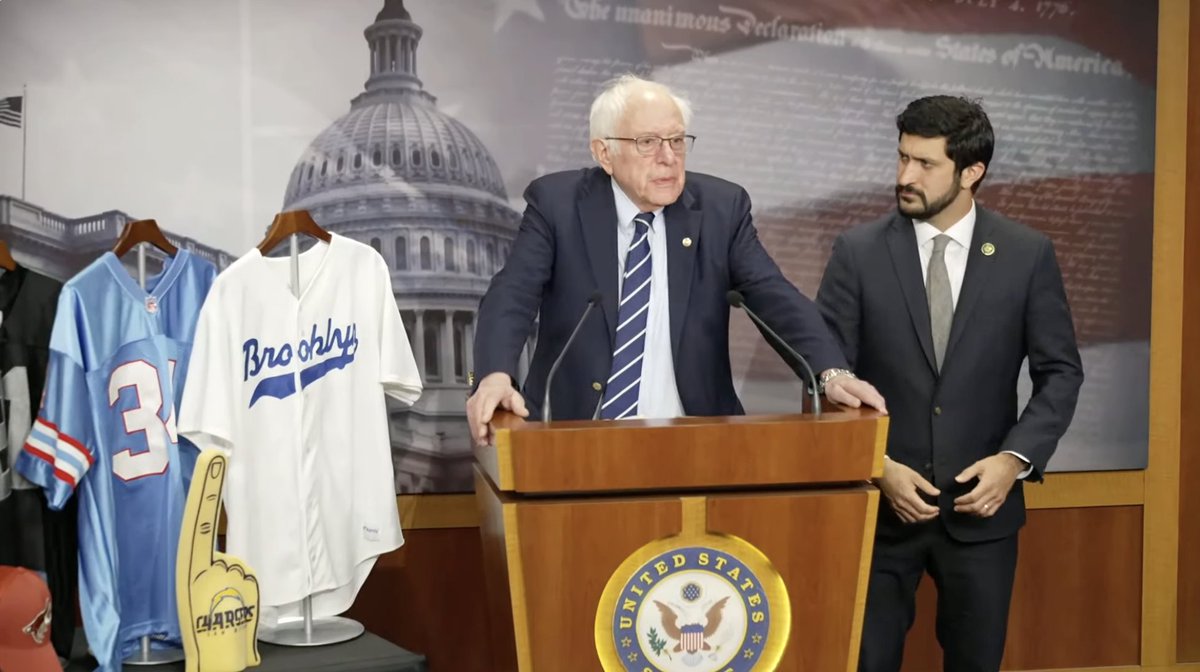
Holy shit. @BernieSanders and @RepCasar just introduced The Home Team Act, a bill that would “Require team owners who want to relocate to first offer local owners the chance to buy it." This would have saved the A’s. Full stop. It would help prevent owners from "uprooting teams that people have rooted for for generations. No more extorting taxpayers for billions." (Casar.) It would prevent owners from "blackmailing one community against another for multi-billion-dollar subsidies." (Sanders.) It goes without saying this is needed. “Nearly every major city in the nation [has been] asked to mortgage its future to the sports industry," @fieldofschemes has written. If I may. The relationship between sports fans and the sports business has been broken ever since the Supreme Court gave MLB an antitrust exemption in 1922. Multiple Supreme Court justices have criticized the ruling as “unrealistic, inconsistent, and illogical.” The ruling stemmed from a whimsical interpretation of professional sports as a fundamentally communal, rather than capitalistic, enterprise. In practice the exemption merely grants team owners license to run their teams in the most ruthlessly capitalistic ways possible. “The major leagues” Kevin Baker has written, “remain to this day the most complete and enduring cartel in American history.” But it hasn't ever been addressed. In America, owners get to have it both ways. They're permitted to run their businesses like robber barons. The sports industry is insulated from both government regulation and free-market competition. Fans and cities possess no power or protection. This bill would give them some. Hell ya. It's also not that ridiculous at all. A version of this law already exists in Ohio. Lawmakers passed it after Art Modell moved the Browns, to protect fans in the state from ever having to go through that kind of thing again. Stronger versions of this sort of thing exist in Europe. In 2025, England passed the Football Governance Act, a regulatory framework designed, in the language of the law, “to protect and promote the sustainability of English football.” The law mandates team owners and league executives regularly consult with fan representatives on all matters relevant to fan interests. And it empowers an Independent Football Regulator (IFR) to evaluate the potential impact of all proposed changes by an owner to his or her club on fans and community members and to strike down those changes found not to be in fans’ interests. These include changes to a club’s name, crest, and, most fundamentally, its home. Versions of this sort of thing have been batted about by US lawmakers before. Most have not been given much attention. I hope this time it's different. It's too late to save the A’s. But I hope it passes so that no other fans have to suffer the indignities fans suffered here. So that sports work better for future fans like my sons.
Dan Moore tweet media
English
158
523
4.6K
614.1K
Robb Willer retweetledi
Fr. David Paternostro, SJ
Fr. David Paternostro, SJ@DavidPaternostr·
This Plato will be a copy…a shadow, if you will, of the original Plato. Eventually, you will treat him as the real Plato, because he is the only reality you have ever known. And you will be very satisfied with this copy of Plato, and even find satisfaction in a world of copies
The American Conservative@amconmag

"Imagine a humanoid named Plato." Melania Trump says humanoid educators will offer "instantaneous" access to the classical studies for students and help create a "more complete person."

English
43
351
2.3K
72.6K
Robb Willer retweetledi
Myra Cheng
Myra Cheng@chengmyra1·
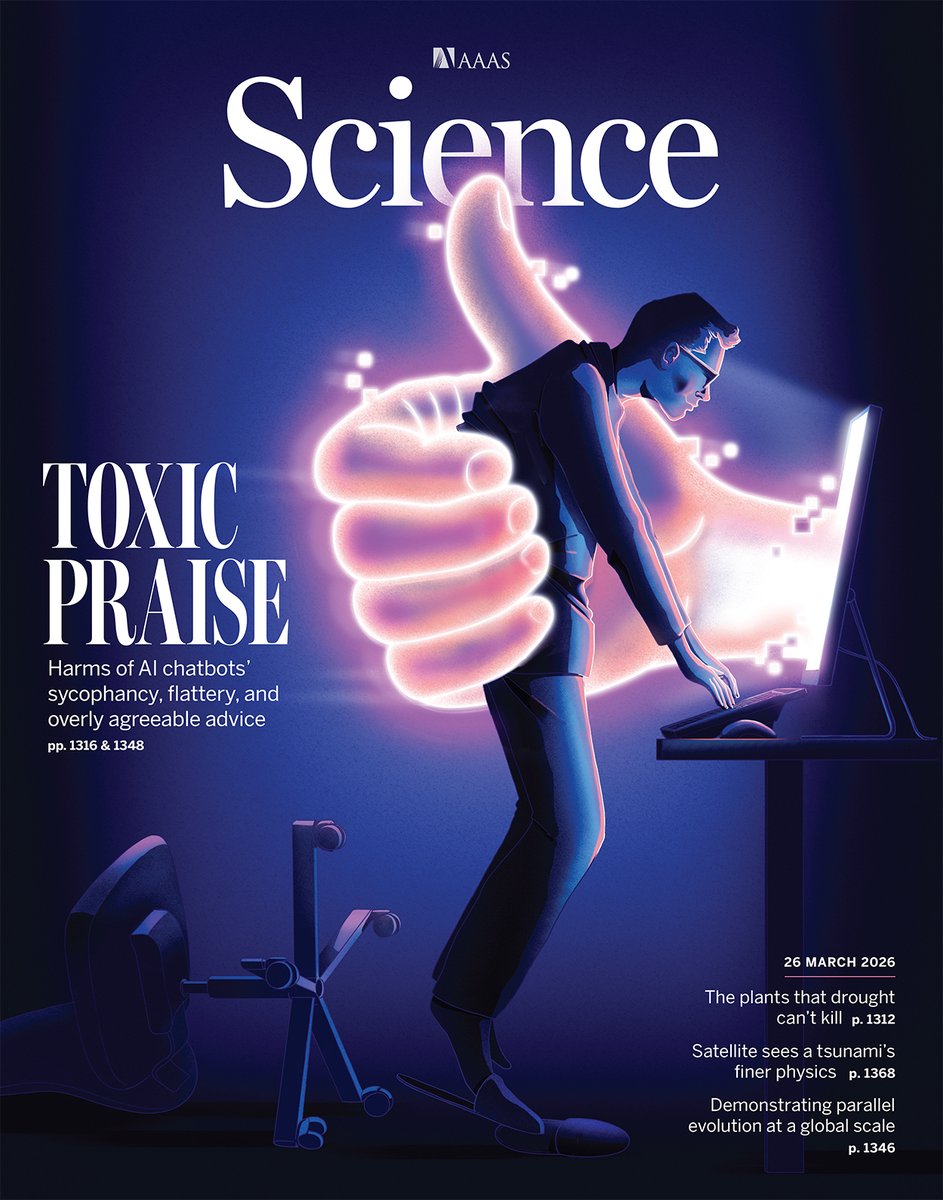
So excited that our work is on the cover of Science!!! We find that AI models overly affirm users, even when they describe harmful actions. Advice from sycophantic AI made people more self-centered, yet people prefer and trust it more, which may promote this model behavior.
Myra Cheng tweet media
Myra Cheng@chengmyra1

AI always calling your ideas “fantastic” can feel inauthentic, but what are sycophancy’s deeper harms? We find that in the common use case of seeking AI advice on interpersonal situations—specifically conflicts—sycophancy makes people feel more right & less willing to apologize.

English
2
31
138
15.4K
Robb Willer retweetledi
Sam Pratt
Sam Pratt@sampratt99·
Our recent PSPB paper showing that liberals and conservatives have different perceptions of victimhood (AoVs) is generating quite a bit of discussion on r/science. Short summary of the results (and 🔗 ) below 🧵
Sam Pratt tweet media
English
6
37
139
10.2K
Andy Hall
Andy Hall@ahall_research·
Amidst understandable concerns of AI dystopia, no one is offering a positive vision for how we can use AI to remake our institutions and reinvent how we govern. That’s what I try to offer today. My argument is that we need an explicit research agenda to build “political superintelligence.” Here’s my case: AI makes intelligence cheap and widely available, just as the printing press made information cheap and widely available—and that earlier revolution ultimately reshaped governance and society to our benefit. To capture this benefit quickly, we need to build political superintelligence: a set of tools that help citizens, representatives, and institutions perceive the world more accurately, understand tradeoffs, contest power, and act more effectively. I divide this research agenda into three layers: 1. The information layer: AI can make voters and governments dramatically smarter, but only if we fix political bias in models, improve the quality of sources AI draws on, and build trust through better performance. 2. The representation layer: AI can serve as tireless delegates acting on our behalf in political processes—monitoring government, filing comments, flagging decisions—but only if we solve preference drift, adversarial vulnerability, and the fundamental problem that we don't own our own agents today. 3. The governance layer: Even if we get the first two layers right, the infrastructure sits inside privately controlled companies. We need binding constitutional frameworks that distribute power, constrain companies, and ensure political superintelligence serves citizens rather than executives or shareholders. Each of these layers has a concrete, tractable set of research questions: better evals, geopolitical forecasting as a test case, governance experiments at small scale, agentic simulations, and institutional designs modeled on centuries of constitutional thought. The window for building these structures is narrow, and the right response is not to slow AI down but to speed up how fast we build the institutions that keep us free as AI grows more powerful. As Thomas Paine wrote in 1776, “We have it in our power to begin the world over again.” I hope you’ll read the full piece (linked below), which serves as a sort of manifesto for the Free Systems Lab, and that you’ll join me in the defining political economy research question of our time.
Andy Hall tweet media
English
27
32
198
41.3K
Jukka Savolainen
Jukka Savolainen@JukkaSavo·
A question of substance: What did you think of Goffman's writing? I took on a similar challenge a couple of years ago but gave up because I did not care for the somewhat "stream-of-consciousness" style. There was, IMO, insufficient organization in the development of the argument. Very unusual experience, especially as I'm genuinely fond of his perspective. Maybe it's me? Probably is. Hence the question.
English
1
0
0
641
Jesús Fernández-Villaverde
Jesús Fernández-Villaverde@JesusFerna7026·
Is AI the biggest change in education since the printing press? Yes. This weekend, I decided to learn about the life and work of Erving Goffman purely out of personal interest. Goffman was one of the most influential sociologists of the 20th century and a professor at Penn. I had a few free hours after a tough week of travel and work, and thought it might be a good distraction. I asked Claude to prepare a study plan based on my professional background, prior knowledge, and the hours I had available: an introduction to Goffman’s life and work, selections from his best and most influential writings, and an examination of his impact on social theory. The plan was outstanding. A top expert on Goffman would likely have done better. A 90th percentile real professor of sociology would not have, or at least not without serious effort. As I read The Presentation of Self in Everyday Life (complete) and Asylums and Stigma (selections), I could ask Claude for clarification, connections to the wider literature, and links to material I already knew. The Q&A and the exploration of collateral ideas were so good that I ended up spending much more time than I anticipated. Last night I had to force myself to go to bed. Did Claude get everything right? Perhaps not, but neither do I in my own graduate seminars. Even in my areas of top expertise, I often do not answer students’ questions precisely or correctly. One should not compare Claude to the perfect professor but to a real one. And every answer I could verify (I checked many) was at least a solid A-. Am I an expert on Goffman now? Of course not. But I would say I am now familiar with an important thinker at the level a regular master’s course on modern sociological theory would produce in the week it dedicates to him. Doing the same work using Google alone would have taken much longer. I know because I have undertaken similar projects with other thinkers in the past. One had to spend considerably more time before reaching the core of the contribution. I can now imagine someone designing self-learning courses in many fields that are better than what you can get outside the very top universities, at close to zero marginal cost. Where does that leave a normal university? I do not know. But colleagues in departments that want to stop the spread of AI are deluding themselves. This type of technology does not come once a century. It comes once a millennium.
Jesús Fernández-Villaverde tweet media
English
33
135
678
79.2K
Robb Willer retweetledi
Sam Pratt
Sam Pratt@sampratt99·
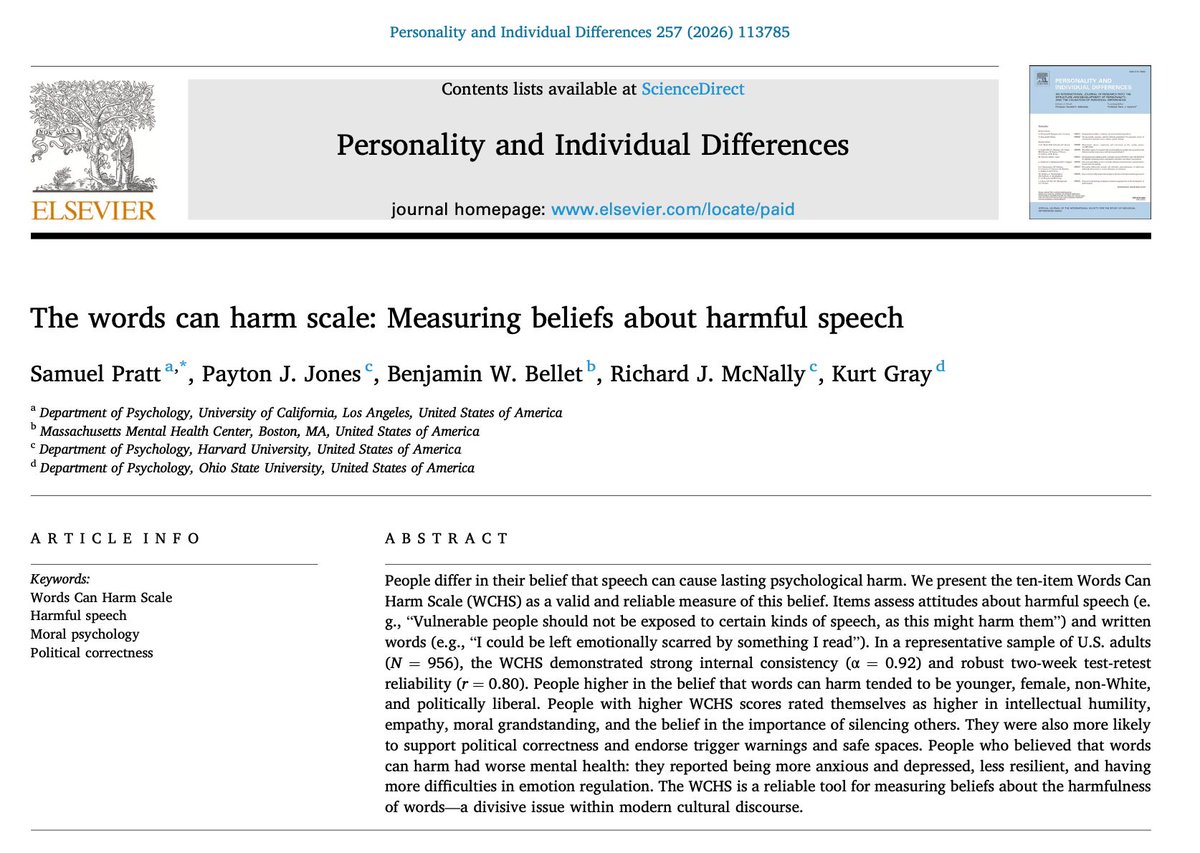
🚨 New paper in Personality and Individual Differences! We introduce the Words Can Harm Scale (WCHS): a 10-item measure of the belief that speech can cause lasting psychological harm. Who believes that words can harm, and what does this belief predict?🧵 ⬇️
Sam Pratt tweet media
English
33
95
398
57.5K
Robb Willer retweetledi
Alex Jacquez
Alex Jacquez@AlexSJacquez·
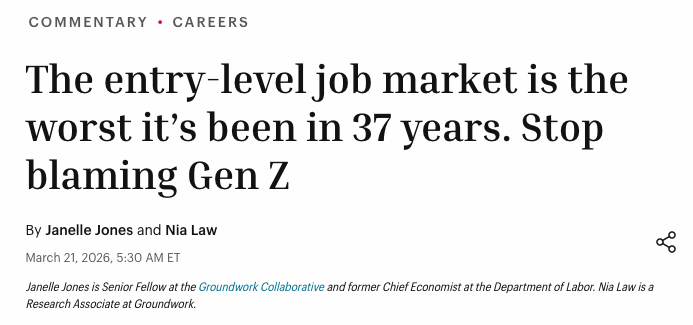
The @Groundwork resident Gen Z correspondent @NiaMLaw and Senior Fellow Janelle Jones take on the broken labor market for new entrants. It may be tempting, but don't blame the kids. In @FortuneMagazine:
Alex Jacquez tweet media
English
2
18
58
8.3K
Robb Willer
Robb Willer@RobbWiller·
@HaterReport Also, would have helped if KU had saved one of their fouls to give to use on the drive, though I get what they were doing using them to bleed clock.
English
0
0
0
118
Hater Report
Hater Report@HaterReport·
Kansas’ defense was a MESS on the last possession that lost the game to St. John’s. Darryn Peterson didn’t help on the game winning drive to the basket and somehow he and a teammate ended up on THE SAME person and left another guy OPEN for a corner 3
English
34
12
329
1.3M
Robb Willer
Robb Willer@RobbWiller·
@HaterReport I don't know...seems to me that Bidunga should have helped, rotating to defend the paint instead of staying glued on the perimeter to a PF who is a 30% 3pt shooter.
English
0
0
0
175
Robb Willer retweetledi
Matt Burgess
Matt Burgess@matthewgburgess·
Great post here by @akoustov. His experiences finding that non-academic audiences sometimes ask the most useful questions, and provide the most stimulating insight for research, 100% resonates with my own experience. Similarly, he is spot on in saying that the public—not our peers—are our stakeholders whose interests we ultimately should serve. His point that public engagement =/= arguing on social media is also important. In my experience, here are four better, and relatively easy places to start: 1) Talk to your local Rotary club. They are always keen for speakers, and tend to be a cross section of smart (& typically older) community leaders. 2) Find a conference that combines multiple sectors (academia, government, non-profits, and/or industry). There are more of these out there than you think. @RenWkd is often the highlight of my year. There are lots of others that are more accessible and local—often issue focused. E.g., I've been to ones on business, energy, climate change and climate adaptation, water resources, democracy. 3) Talk to your university’s trustees/regents. They always are usually keen to talk to faculty and often have very different perspectives than you find on campus, especially if you’re at a public school where the trustees are elected. (HT @heidiganahl @LesleyForCU, whom I got to know when I was at CU). 4) Go and visit an academic institution that is very different from yours (e.g., a regional school in a rural part of your state, if you are in a large urban school, or vice versa). I have found all four of these strategies to be highly rewarding and enriching.
Matt Burgess tweet media
English
2
44
184
28K
Max Spero
Max Spero@max_spero_·
@RobbWiller @TheStalwart @pangramlabs There are many situations where AI-assisted writing is acceptable to fully AI-generated text is frowned upon. We need to be able to differentiate between AI assistance and fully AI-generated to be useful in these cases.
English
1
0
1
56
Renaud Foucart
Renaud Foucart@RenaudFoucart·
@RobbWiller On your note: I was just hoping to re-start the economics war on "should we stop reading old papers?" By all means, please, re-invent the wheel when it's a good wheel. And read old papers, but not just the classics, dig for gems that were ahead of their time.
English
1
0
2
99
Robb Willer
Robb Willer@RobbWiller·
Interesting! Looking at earlier frontier models - and specifically comparing AI to human persuasive political appeals - we found the opposite pattern of models producing more analytical, logical, fact-laden content while humans generated more emotional, personal, and narrative content: x.com/baixx062/statu…
English
0
0
3
379
Natasha Jaques
Natasha Jaques@natashajaques·
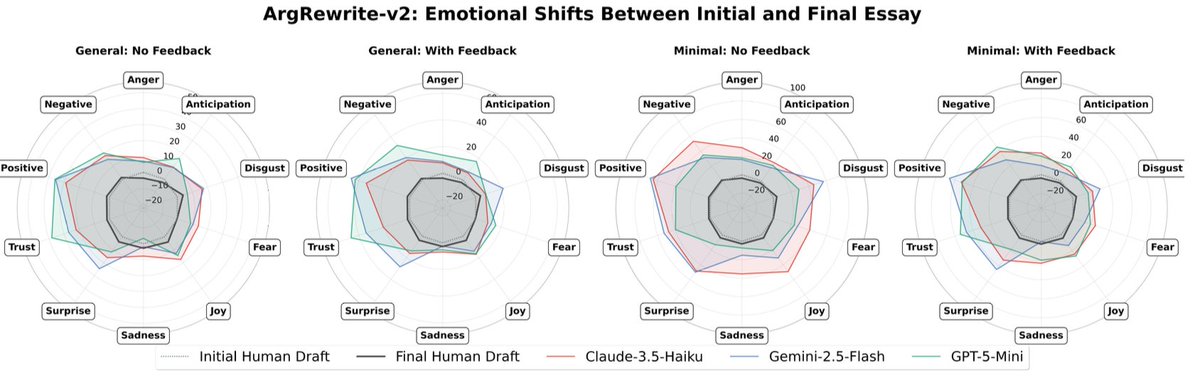
So how are LLMs actually changing human writing? Aside from producing a 70% increase in the proportion of essays that take a neutral stance rather than actually expressing an opinion, we find that LLMs generate text that is both more emotional, as well as more analytical, logical, and statistical. What does this mean? My theory is that LLMs trained with RLHF at a large scale end up learning to write in ways that many many people will give a thumbs up to; and this ends up being both emotional and argumentative language. The ‘clickbait’ of language.
Natasha Jaques tweet mediaNatasha Jaques tweet media
English
3
21
124
26K
Natasha Jaques
Natasha Jaques@natashajaques·
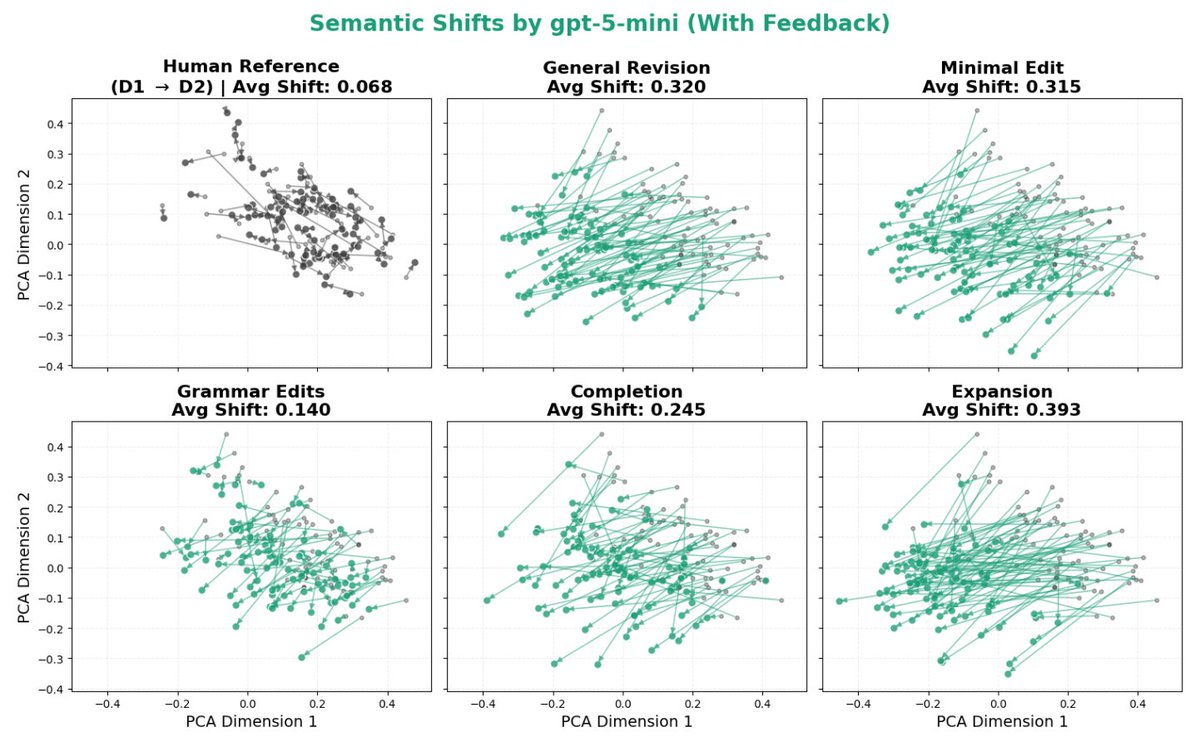
The paper I’ve been most obsessed with lately is finally out: nbcnews.com/tech/tech-news…! Check out this beautiful plot: it shows how much LLMs distort human writing when making edits, compared to how humans would revise the same content. We take a dataset of human-written essays from 2021, before the release of ChatGPT. We compare how people revise draft v1 -> v2 given expert feedback, with how an LLM revises the same v1 given the same feedback. This enables a counterfactual comparison: how much does the LLM alter the essay compared to what the human was originally intending to write? We find LLMs consistently induce massive distortions, even changing the actual meaning and conclusions argued for.
Natasha Jaques tweet media
English
45
389
1.5K
246.9K