
Sabitlenmiş Tweet
rob
1.5K posts


rob
@robcrt
investment & research @ambergroup_io
opinions my own Katılım Mayıs 2022
1.8K Takip Edilen2.4K Takipçiler


major demo24.xyz is out! the project is finally reaching completion... that means only 1-2 more updates until full release!
Notable changes:
- basic animgraph2 player and viewmodel animations
- added "classic" viewmodel
- bullet tracers !!!
- smoke grenades now obfuscate player models
- adjusted utility trails to better mimic real game client
- improved loading times
- various improvements to sound
GLHF
English

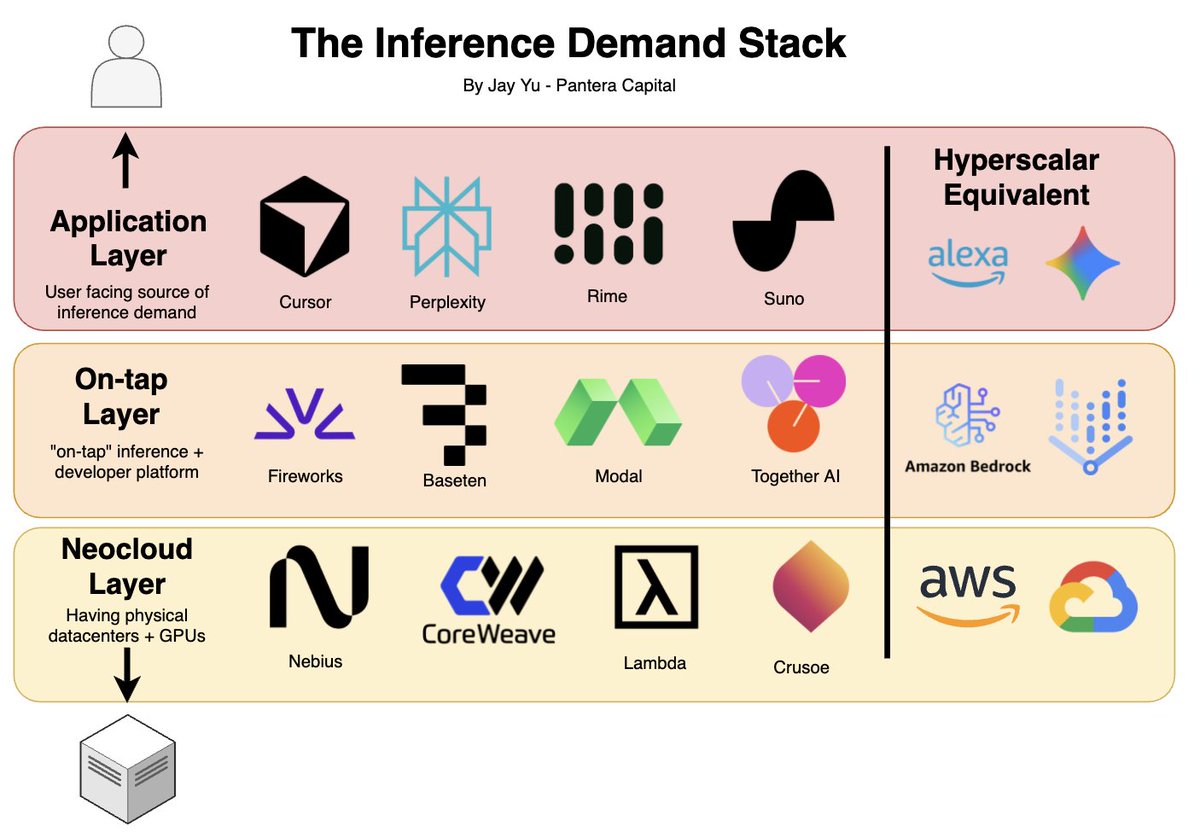
Good primer on the need for hedging on compute markets. But as the post mentions, a lot of times hedges will actually come from those that need the underlying (eg. airlines on jet fuel). So a few nuances to this pic:
- You need to first understand what the inference demand stack looks like. As shown, there's generally three layers. From bottom to top:
(1) neoclouds like Coreweave/Nebius
(2) "on-tap" inference dev platforms like Fireworks/Baseten
(3) application layer like Cursor/Perplexity/Rime
- Layer (1) forms the sell-side of compute marketplace. Coreweave is afraid that GPU prices will tank in next 6 mo. Layers (2) and (3) form the buy-side. Both Fireworks and Cursor are afraid that GPU prices go up too much in next 6mo, and are unlikely to run many many datacenters themselves.
- Hyperscalars (eg. Google, Amazon) are kind of another separate category here, just because they cross the entire stack - they have different teams at each layer of the stack
- These are all the fundamental principals that need to hedge, rather than many of the financial institution boxes in Brett's diagram. But the question is - do you think Fireworks or Cursor will run an in-house trading team? Probably not.
- And so what happens is bilateral agreements with various OTC desks for reservation capacity, which is where the current market is. These OTC platforms in turn can run trades on indexes + have their own trading desks and begin to build up the financialized/generalized version of compute. These guys will take on the basis risk of specific SKU reservations and a generalist index
- So if I were to pay attention to this market, I would want to see how these OTC desks are actually built up - both how they deal with spot demand from the principals, as well as how they run trades/financial strategies against the general index
Brett Harrison@BrettHarrison
US Compute Futures As Hedges Compute futures face the argument that if a future doesn’t track the exact costs hedgers incur, it will carry too much basis risk to form a viable market. This fundamentally misrepresents how hedges actually function in many major US markets. A hedge does not need to be perfect in order to be useful, let alone transformative, to its underlying commodity market. To be viable as a multi-billion dollar market, a hedging instrument needs to remove enough risk at scale to be worth its initial cost. If the correlation between a hedging instrument and the portfolio is ρ and the optimal hedge ratio is used, the fraction of variance eliminated by the hedge is ρ². A correlation of only 0.7 cuts variance in half. Cross-hedges built on loose relationships predominate in the real US economy. Airlines hedge jet fuel with crude. Bond desks hedge rate risk in credit with treasuries. Long-short equity portfolios hedge market beta with S&P 500 futures. At my former firms Jane Street and Citadel Securities, every trading desk was required to hedge portfolio factors with related instruments intraday and overnight to isolate alpha. Commodity markets are typically heterogeneous. Compute is not a unique underlying in this respect. An “H100 hour” could represent many different goods: SXM or PCIe, spot or reserved, hyperscaler or neocloud, US or Asia. Weigh this “problem” against the “solution” that compute buyers and sellers have today: nothing. Asset-backed loans on GPUs carry 40-50% haircuts because lenders can’t transfer the associated risks. The institutions financing the >$1T datacenter-linked debt sector regularly transact in other heterogeneous commodity markets. The success of US compute futures/options markets primarily depends on CFTC-regulated exchanges’ agility and competency at collaborating with index providers native to chip configurations, neocloud procurement, and timeseries interpolation on a continuous basis. Designing a futures contract that minimizes basis risk and maximizes liquidity formation is an antecedent requirement. Fulfilling the US government mandate to “accelerate the maturation of a healthy financial market for compute” is the main goal.
English

Super excited to announce that I've joined @PanteraCapital on the investment team!
panteracapital.com/blog-joining-p…
English

Coming soon: $NOCK
@nockchain is a hard money protocol powered by useful Compute Networks. Mining the network verifies useful compute instead of wasting energy.
Trading starts June 23
Get ready → kraken.com/sign-up

English


There’s an Indian VC (based there, invests there) who I won’t name. Every term sheet he writes — even $1M checks — includes this: founders must return 5x, he keeps full anti-dilution AND his equity on top, and if they don’t hit it in 3 years, he gets to fire them. 😂😭
I told him, “dude, I can’t invest into this structure, it’s insane.” His response: “JJ! No no, you don’t understand — this is totally normal in India, man! We want you to invest!!”
LESSON: Any founder in India who’s been handed this — email me. I’ll personally make sure you get introduced to VCs who aren’t actively trying to fuck you over.
English

Decentralised/permission-less AI is one of the most important use cases but so is proof systems. Eventually everything will have to be verified, a bit similar to Blade runner.
News outlets will be forced to use software where users can authenticate the video material to make sure its real and many more. We already cant distinguish AI vs non AI videos.
Same as i want to be certain my humanoid is not teleoperated, i want to be able to verify these actions are powered by the model its running on.
I think there will be a lot of demand for something like ZKP's once its economical viable.
English


Nockchain’s AI Compute Network will initially be compatible with merge-mining Pearl to bootstrap compute.
Yes, we’re vampire attacking Pearl.
nockmilio@nockmilio
alpha
English
@internetvin @_kelindi if you have the orange one maybe the orange arc could look cool but i’m in same boat idk what case to use
English

I want to get a new case or something for my iPhone 17 Pro. I want a case that doesn't feel like I'm using a case at all.
What should I grab?
English
@internetvin @_kelindi they became ugly for 17 pro and air models. 16 was fine. looks okayish on base 17
English
Would love to see a chain that is like $nock or $prl to secure the chain and at same time use the compute to train big OS models
probably one of the only ways to compete with the likes of anthropic/openAI, although it would have a lot of technical challenges
Algod@AlgodTrading
So bitcoin fundamentals: -wastes energy for nothing -not quantum proof -impossible to transact -a ponzi that holds 5% that will collapse at some point Why not bet on a chain: -secures chain with economical productive activity -quantum proof -easier to scale Imagine we can use all the energy of bitcoin, turn it into compute and eventually train OS models with SOTA like performance Rather have society reach consensus something is digital gold for something like this than old tech that just wastes resources
English

How to make >101% on $40k on world markets in 2 minutes and 52 seconds
English


quietly noting that $nock now appears on @DCGco’s official portfolio page.
first investment listed as 2025.
dcg.co/portfolio
nock nock


English