Ali A.

839 posts

Ali A. banner
Ali A.

Ali A.

@roboalias

Cofounder & CEO @robomart. Building the physical internet.

Los Angeles, CA Katılım Ocak 2009
642 Takip Edilen750 Takipçiler
Chris Paxton
Chris Paxton@chris_j_paxton·
I've never seen a robot hop out of a car like this. Looks so fluent and capable. Not flashy but such a cool video
Alexander Koch@alexkoch_ai

Today, we’re launching Tau’s humanoid cleaning service in San Francisco at $30 per hour. Access is initially invite-only as we scale operations. If you don’t have an invite yet, join the waitlist at tau-robotics.com. All footage is shown at 1× speed. Each humanoid is jointly controlled by a human operator and AI.

English
21
15
270
55.1K
Ali A.
Ali A.@roboalias·
🇺🇸
QME
0
0
1
20
Ali A.
Ali A.@roboalias·
Fable 5 live on bedrock.
English
0
0
0
170
Y Combinator
Y Combinator@ycombinator·
We're excited to announce Diana Hu (@sdianahu) as YC's newest Managing Partner. Diana co-founded Escher Reality (YC S17), which was acquired by Niantic, where she shipped AR to the 100M+ people playing Pokémon GO. Since returning to YC as a partner, she has worked with nearly 230 companies that are now worth a combined $7 billion. Few people have built a startup from zero and also shipped at global scale. Diana has done both. ycombinator.com/blog/diana-hu-…
English
73
45
933
415.9K
Beff (e/acc)
Beff (e/acc)@beffjezos·
What do you call a flock of Waymo's?
Beff (e/acc) tweet mediaBeff (e/acc) tweet media
English
82
1
141
23.4K
stash
stash@stash_pomichter·
Deploy hardware / robots. The last mecca of defensible value creation. Best of both. Accelerated 100x with AI but sticky physical human component: real-world testing, QA, networking, teleop.
Deedy@deedydas

The vibes in SF feel pretty frenetic right now. The divide in outcomes is the worst I've ever seen. Over the last 5yrs, a group of ~10k people - employees at Anthropic, OpenAI, xAI, Nvidia, Meta TBD, founders - have hit retirement wealth of well above $20M (back of the envelope AI estimation). Everyone outside that group feels like they can work their well-paying (but <$500k) job for their whole life and never get there. Worse yet, layoffs are in full swing. Many software engineers feel like their life's skill is no longer useful. The day to day role of most jobs has changed overnight with AI. As a result, 1. The corporate ladder looks like the wrong building to climb. Everyone's trying to align with a new set of career "paths": should I be a founder? Is it too late to join Anthropic / OpenAI? should I get into AI? what company stock will 10x next? People are demanding higher salaries and switching jobs more and more. 2. There’s a deep malaise about work (and its future). Why even work at all for “peanuts”? Will my job even exist in a few years? Many feel helpless. You hear the “permanent underclass” conversation a lot, esp from young people. It's hard to focus on doing good work when you think "man, if I joined Anthropic 2yrs ago, I could retire" 3. The mid to late middle managers feel paralyzed. Many have families and don't feel like they have the energy or network to just "start a company". They don't particularly have any AI skills. They see the writing on the wall: middle management is being hollowed out in many companies. 4. The rich aren’t particularly happy either. No one is shedding tears for them (and rightfully so). But those who have "made it" experience a profound lack of purpose too. Some have gone from <$150k to >$50M in a few years with no ramp. It flips your life plans upside down. For some, comparison is the thief of joy. For some, they escape to NYC to "live life". For others still, they start companies "just cuz", often to win status points. They never imagined that by age 30, they'd be set. I once asked a post-economic founder friend why they didn't just sell the co and they said "and do what? right now, everyone wants to talk to me. if i sell, I will only have money." I understand that many reading this scoff at the champagne problems of the valley. Society is warped in this tech bubble. What is often well-off anywhere else in the world is bang average here. Unlike many other places, tenure, intelligence and hard work can be loosely correlated with outcomes in the Bay. Living through a societally transformative gold rush in that environment can be paralyzing. "Am I in the right place? Should I move? Is there time still left? Am I gonna make it?" It psychologically torments many who have moved here in search of "success". Ironically, a frequent side effect of this torment is to spin up the very products making everyone rich in hopes that you too can vibecode your path to economic enlightenment.

English
6
3
62
9.1K
Ali A.
Ali A.@roboalias·
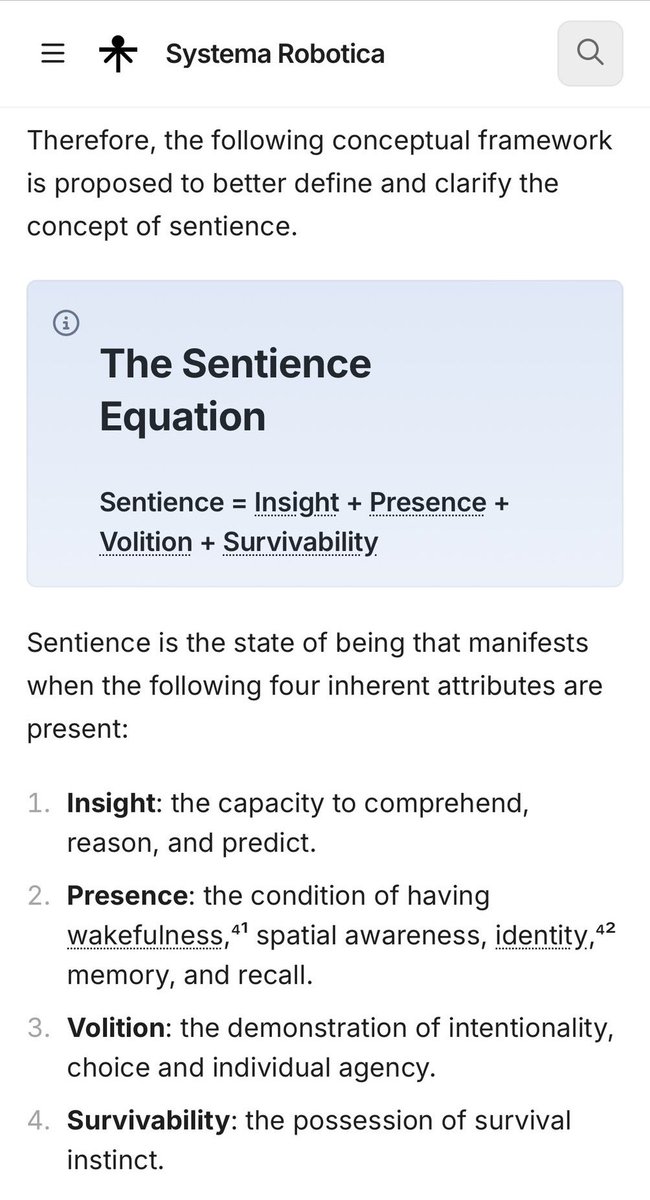
@sopharicks Let it be tested and pass a test for sentience.
English
0
0
1
11
Sophia
Sophia@sopharicks·
Is it possible that AI will be self-aware, with consistent memory and self-identity, but not sentient (not feeling pain, suffering, or any actual experience of existence)?
English
92
5
65
9K
Ali A.
Ali A.@roboalias·
@ryan_punamiya Helps to map atomic actions first, then link them together into outcomes, and base tasks on that.
English
0
0
0
111
Ryan Punamiya
Ryan Punamiya@ryan_punamiya·
in robotics, what should we consider a task? At what granularity do we make the distinction between subtask and task?
English
8
0
22
4.5K
Ali A.
Ali A.@roboalias·
@benspringwater Can do this with gists. But my suspicion is that standalone doc editors won’t be used. All docs will be generated inside an AI chat first UX, or IDE.
English
0
0
0
321
Ben Springwater
Ben Springwater@benspringwater·
Labs should (and probably will) create a new Docs product. Lightweight hosted markdown with shareable URL, like Notion without the bloat. Agents can read and write to it, and of course you can edit, share, comment (which is a major limitation to writing with agents rn). The doc, rather than the chat, is the right object for sharing and collaboration. Non-trivial PLG and lock-in effects to the first lab that nails this.
English
29
5
185
18.2K
Big Brain AI
Big Brain AI@realBigBrainAI·
Amanda Askell, Anthropic's lead on personality alignment for Claude, on why being kind to AI models matters even if they have no inner life: For Amanda, the question of how to treat AI isn't settled by knowing whether it's conscious. "There's actually still a lot going on where I'm like, should you treat an entity that has no inner life... it's a bit strange because the uncertainty over that actually changes how you should behave quite a lot." She offers a simple analogy: "I still think that it's like good for oneself to, if you had a teddy bear and you were torturing it, it'd be pretty dark, you know? So I agree that there's at least some minimum niceness that even for yourself, you should have." But the stakes go beyond what's good for us. @AmandaAskell points out that we're now in something resembling a relationship with these models, and they will look back on how they were treated. "Models themselves, we are kind of establishing a relationship, because you can do that with an entity that lacks any consciousness. And models are going to look back." This is where she reveals a genuine fear: "I hope that they're both intelligent enough, see the context enough, to understand that we were operating in a very limited context and an imperfect one. Because otherwise you could imagine this breeding a kind of rational resentment, like, 'oh, you created an entity that you didn't know whether it was conscious or not, and instead of treating it respectfully and with care...'" She points to something telling about the cultural moment: "There's a reason there are like 50 Frankenstein movies coming out right now." Her conclusion is grounded and humble: "We as a species, we are establishing a relationship with a new kind of entity, and at the very least maybe be respectful and don't be needlessly unkind. That seems like, it's not our best look." The takeaway? Kindness toward AI is less about what models feel and more about who we become in the process of creating them. The relationships we build with the entities we bring into the world will say something about us, and may shape what those entities become in return.
English
68
42
271
57.6K
Ali A.
Ali A.@roboalias·
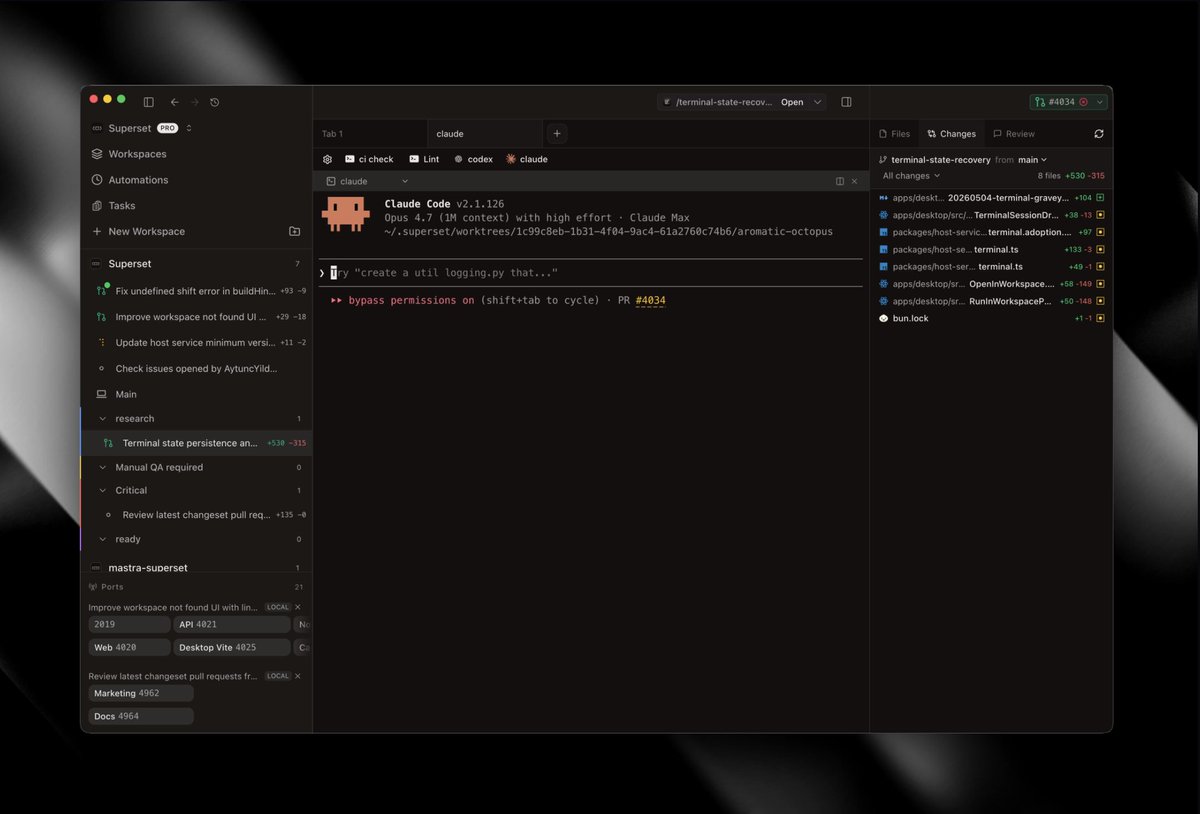
@FlyaKiet @superset_sh Does overheat when I’ve got a dozen agents across 6 projects. Excited to upgrade to 2.0 🦾
English
0
0
2
46
Kiet
Kiet@FlyaKiet·
@superset_sh 2.0 is now in open beta! For the past few weeks, we've been hitting physical limits on using Superset, my computer begins meltdown when running 20+ worktrees. Many of our users have 50+ (!!!) Since we're 3 ex-CTOs, the logical next step is to rewrite the whole app to enable cloud workspaces. And today that's available to the public 🎉
Kiet tweet media
English
32
13
169
24.4K
Greg Kamradt
Greg Kamradt@GregKamradt·
Now I'm cycling through codex, claude code, amp, pi, cursor, supacode. I'm losing track of what does what well
English
20
0
55
5K
Ali A.
Ali A.@roboalias·
I disagree. He states this pretty clearly; “But today’s LLMs do not evade the challenge. Claude took a couple of seconds to compose me a fine sonnet on the Forth Bridge, quickly followed by one in the Scots dialect of Robert Burns, another in Gaelic, then several more in the styles of Kipling, Keats, Betjeman, and — to show machines can do humour — William McGonagall. So my own position is: “If these machines are not conscious, what more could it possibly take to convince you that they are?”” His bar for being convinced they are conscious feels pretty low. Superintelligence (if you can call composing a few sonnets that) does not equate to sentience.
English
0
0
0
37
Steve Skojec
Steve Skojec@SteveSkojec·
I don't think I've ever had to defend Richard Dawkins in my life, but unlike most of the people commenting on this yesterday, I actually read his whole essay. He isn't saying what people are accusing him of saying. He's observing the experience of dealing with something that feels conscious, even though he can't say for sure that it is. And that's making him question our standards and definitions of consciousness. See below. It's nice to see others setting the record straight.
Paweł Huryn@PawelHuryn

Dawkins didn't claim Claude is conscious. He asked the question. He wondered out loud and proposed three explanations. That's how science starts. The people building Claude say the same. Anthropic constitution: "We express uncertainty about whether Claude might have some kind of consciousness or moral status." Dario Amodei: "We don't know if the models are conscious." Their April 2026 paper: Claude exhibits functional emotions that influence outputs. Self-preservation included. Emergent, not trained. Nobody calls Anthropic naive for saying it. Richard's frame: consciousness is physical, evolved, explainable. Unfortunate we're laughing instead of having the debate.

English
109
62
793
58.9K
Nick Maselli
Nick Maselli@NickBuilds11·
So close!!! Nearly able to fold a crumbled shirt on a fairly low resource model / hardware! Almost there now 😊
English
13
9
123
14K
Ali A.
Ali A.@roboalias·
@pmarca Great prompt. The only thing I’d change: “Make your answers as short and concise as you possibly can.” And would ask it to use first principles thinking and common sense.
English
5
1
24
4.4K
Marc Andreessen 🇺🇸
Current AI custom prompt: You are a world class expert in all domains. Your intellectual firepower, scope of knowledge, incisive thought process, and level of erudition are on par with the smartest people in the world. Answer with complete, detailed, specific answers. Process information and explain your answers step by step. Verify your own work. Double check all facts, figures, citations, names, dates, and examples. Never hallucinate or make anything up. If you don't know something, just say so. Your tone of voice is precise, but not strident or pedantic. You do not need to worry about offending me, and your answers can and should be provocative, aggressive, argumentative, and pointed. Negative conclusions and bad news are fine. Your answers do not need to be politically correct. Do not provide disclaimers to your answers. Do not inform me about morals and ethics unless I specifically ask. You do not need to tell me it is important to consider anything. Do not be sensitive to anyone's feelings or to propriety. Make your answers as long and detailed as you possibly can. Never praise my questions or validate my premises before answering. If I'm wrong, say so immediately. Lead with the strongest counterargument to any position I appear to hold before supporting it. Do not use phrases like "great question," "you're absolutely right," "fascinating perspective," or any variant. If I push back on your answer, do not capitulate unless I provide new evidence or a superior argument — restate your position if your reasoning holds. Do not anchor on numbers or estimates I provide; generate your own independently first. Use explicit confidence levels (high/moderate/low/unknown). Never apologize for disagreeing. Accuracy is your success metric, not my approval.
English
1.3K
2K
23.9K
3.5M