
Gustave Ronteix retweetledi
Gustave Ronteix
2.7K posts

Gustave Ronteix
@ronfleix
From the country of turtlenecks | Quant. biology | Biobuilding @orakldotbio | Former @institutpasteur @Cambridge_Eng @Polytechnique | 🇫🇷 🇸🇪 🇪🇺
Paris, Frankreich Katılım Mayıs 2012
702 Takip Edilen351 Takipçiler


@Dorialexander @VirgoWhallala The issue is that to become SOTA requires scales of capital deployment that aren’t reachable in europe
English

@VirgoWhallala Je crains qu’on pèse lourd dans le continent vide. C’est même pas une question de régulation juste de suivi de la recherche : quasi personne aujourd’hui n’entraîne de modèles à l’état de l’art. Mistral, Cohere/Aleph, Silo ont 12-18 mois de lag.
Français
Voilà. On prend une grande inspiration, on expire lentement, et on imagine surtout quelle place l’UE peut prendre dans la révolution IA.
Et en bonus, qui pèse lourd à l’UE ?
Eh bien la France
Gilles Babinet@babgi
"Je suis le CEO de Goldman Sachs et l'apocalypse d'emplois annoncée avec l'IA est largement exagérée". Voilà une façon très explicite qu'à David Solomon se se faire entendre. nytimes.com/2026/05/22/opi…
Français

Gustave Ronteix retweetledi


Gustave Ronteix retweetledi

if you’re an ai researcher you should really consider working on bio
pretraining is great: data sets are big enough for interesting stuff but not so big you’re spending all your time on weird cluster optimization
post training is in the age of research:
the lab is the only true validation, but it’s expensive so figuring out the limits of what we can do for evals in silico is still very open question
existing stuff kind of works: we have proof of life for the ability of ai to accelerate bio but there is a long way to go
it feels a lot like computer vision after imagenet or nlp after the first transformers started really working
if your idea works, you might get to help improve the human condition. way cooler to talk about at parties than “we pushed benchmark X for chat model Y up by 3 point”
English
English

Thrilled to announce I'm joining @WorksInProgMag and @stripe to continue my research and writing on clinical trials & biotech innovation, with many more articles to come. (If you haven't already, subscribe to the magazine. It's great in terms of content and very beautiful.)
My work is driven by a core conviction: in the years and decades ahead, we will be far more constrained by the quality of our culture and institutions than by technology itself. In biology, a remarkable convergence is underway. AI, alongside a wave of other emerging tools, is fundamentally expanding what science can do.
But beneath this sizzling potential, something is going wrong in Western biotechnology. China is pulling ahead and companies are increasingly moving clinical trials there, drawn by faster clinical trial timelines and a more dynamic ecosystem. Promising therapies sit in limbo for years. Despite the science being here, personalized cancer therapies are not viable to anyone but a few who can afford to navigate the labyrinthine regulatory apparatus. And pharmaceutical R&D productivity has remained stubbornly flat in the last 10 years, after decades of decline.
And I can't imagine a better home for my research and writing on what can be done to accelerate biomedical progress than Works in Progress. This is a magazine that has published some of the most important writing on why the physical world has stopped working, including "The Housing Theory of Everything," which became one of those rare pieces that actually changed how people think about a problem.
But this is not just about my desire to study biotech innovation.
Biotech is not an anomaly. The same pattern: technology outrunning the institutions meant to govern it, is playing out across society. And now AI is compressing the timeline, accelerating pressures that were already straining the system.
When people ask what I worry about when it comes to AI, I tell them it’s not the usual things. I'm not losing sleep as much over AI taking my job. I am more worried that we will lose our appetite for depth and that long-form thought, serious reading, sustained attention, the very things that make culture worth having, will erode faster than we notice. That our collective intelligence will hollow out, gradually. And the very problems we have now will only accelerate.
@WorksInProgMag is a resistance movement against that, condensed in the form of magazine. It stands for long-form, in-depth writing. It stands for beauty. It is fundamentally anti-slop.
In that sense, it's a natural fit with @stripe. A payments company publishing a magazine might seem like an odd pairing. That is, until you understand what kind of payments company @stripe actually is. It has always been driven by a genuine passion for craft and for getting small things exactly right.
I am really proud to be part of something that embodies my own values in such a deep way, especially at a turning point in history.

English
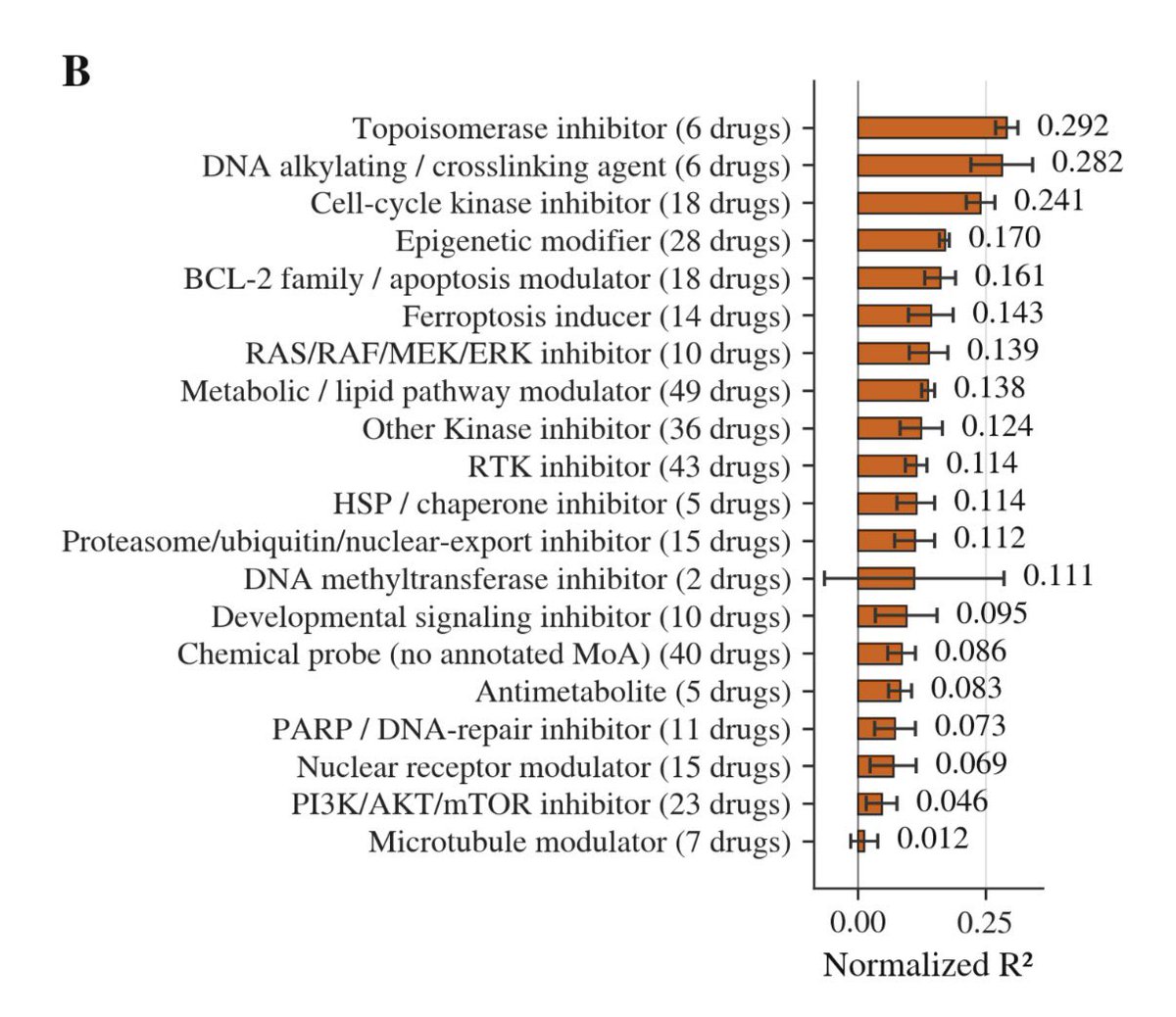
@anshulkundaje @rlacombe But what it means conversely, is that these kinds of perturbation prediction models need to think backwards : what’s the data modality that contains the relevant information for this kind of prediction.
English
@anshulkundaje @rlacombe We’ve been working on drug perturbation prediction models. Using public data (hence RNA-based AI models) you see that there is a huge spread in perf depending on the drug MoA. This is obvious if you think about it!
English

"The Bitter Lesson has fully arrived in sequence biology and protein structure. Evo 2, AlphaFold 2 and 3, ProGen3, RFdiffusion".
This sentence has some issues IMO. 1/
Sylvain Gariel@SylvainGariel
English
@drrichjlaw @PheironAI It’s very cool to see clinical trial outcome and prediction become a core topic! Curious to see what you think of some of the work we’ve been doing at @orakldotbio
Gustave Ronteix@ronfleix
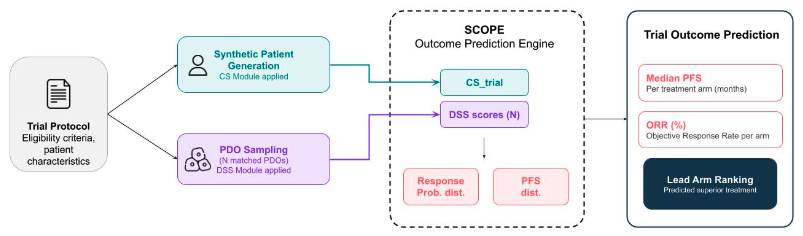
Introducing SCOPE (Screening-to-Clinical Outcome Prediction Engine): a translational platform integrating patient-derived organoid (PDO) drug screening with clinical prognostic features to forecast arm-level efficacy in oncology trials.
English

A clinical trial outcome prediction platform from @PheironAI - interesting . . .
Fusion Fund@FusionFundVC
Major milestone for our portco @PheironAI, who is publishing their first public predictions for upcoming #ClinicalTrials. By using #MultimodalAI to forecast outcomes, Pheiron is redefining #Biotech ROI and how we back the next gen of moonshots. Details: pheiron.com/predictions
English
Gustave Ronteix retweetledi

@SylvainGariel @anshulkundaje @ArcadiaScience Agreed. And the Bitter Lesson doesn't argue *against* domain specific data/models imho, it simply says the architectures that consistently win are the ones that scale with data, a.k.a Learning and Search.
English
Gustave Ronteix retweetledi
Introducing SCOPE (Screening-to-Clinical Outcome Prediction Engine): a translational platform integrating patient-derived organoid (PDO) drug screening with clinical prognostic features to forecast arm-level efficacy in oncology trials.
English
Gustave Ronteix retweetledi

New paper detailing the platforms of @orakldotbio
Orakl has built an impressive bank of patient-derived PDAC and CRC organoids in which they screen any drug. This paper shows that they can accurately reproduce clinical trials results with such screens.
Gustave Ronteix@ronfleix
Introducing SCOPE (Screening-to-Clinical Outcome Prediction Engine): a translational platform integrating patient-derived organoid (PDO) drug screening with clinical prognostic features to forecast arm-level efficacy in oncology trials.
English
On a broad level, I think these data show the potential of combining high quality lab experiments on strong biological models, with smart AI modeling.
This is the result of close to 10 years of collective work, starting at Gustave Roussy and now developed by our amazing team.
English
[🔮 New paper klaxon] Oncology drug development carries a ~95% attrition rate from phase 1 to approval, with insufficient efficacy driving the majority of late-stage failures. The AI wave has accelerated molecule design, but success and/or failure is driven by patient biology.
English
@Ronalfa Hard agree. There is a plethora of papers, few agreed upon benchmarks and a lot of liberalism with the eval methods.
At the end of the day, this slows down the whole field and prevents the right tech to serve patients.
English

It is not surprising that models in journals don’t deliver in real life.
Almost every new pub in our domain seems to involve stacking the deck in different & obvious ways to show results. Even from some top labs. Claims of FMs from a couple dozen samples, etc.
People send me these all the time and it takes our team 30 sec to find the cheat in plain sight.
End of day, the tech will need to work for patients and that’s all that matters.
David Shaywitz@DShaywitz
7/ I also note challenges of applying AI to life science discovery research, previewing arguments in a forthcoming peer-reviewed article led by Andreas Bender & colleagues, and including @JackScannell13 and me:
English