Isaac

2.9K posts

Isaac banner
Isaac

Isaac

@roundrobin42

sports bettor writing about sports betting. research + policy fellow @aibm_org, views expressed are my own. sporadic tennis bets (not financial advice)

Katılım Ocak 2019
1.3K Takip Edilen4.4K Takipçiler
Sabitlenmiş Tweet
Isaac
Isaac@roundrobin42·
I am ofc biased, but strongly believe this is the best and most thorough framework out there, useful for anyone interested in understanding how policy can feasibly mitigate the harms of sports betting without being overly draconian
Richard V. Reeves@RichardvReeves

Sports betting is now integrated into how young men experience sports. @aibm_org researchers, @oso, @jonathandcohen1 and @roundrobin42 published “Sensible Sports Betting: A Policy Framework”—nine approaches to reduce harm without prohibition. Give it a read: aibm.org/policy/how-spo…

English
1
0
20
18.4K
Isaac
Isaac@roundrobin42·
@RobDFS_ On sixers, thinking of betting Pritchard 30+ as a hedge
English
1
0
2
497
Peanut
Peanut@peanut_bettor·
Here is my OFFICIAL tier list of how fast everyone from Circles Back is. If you disagree, you don't know ball.
Peanut tweet media
English
11
0
35
13K
Isaac retweetledi
Derek 🦅 (Go Birds)
Derek 🦅 (Go Birds)@TheRealDRoc28·
Wait… the odds for a Philly sports trifecta today are +1776?
Derek 🦅 (Go Birds) tweet media
English
140
347
10.3K
1.3M
Isaac retweetledi
Joe Weisenthal
Joe Weisenthal@TheStalwart·
Great post from someone who knows what they’re talking about
John Arnold@johnarnold

Curious how Jane Street made $40 billion last year with few negative days? Here’s one example: - Between 1990-2000, there was only one exchange-listed product to trade natural gas: the NYMEX (now CME) physically-settled futures contract - In 2000, ICE realized there was demand for a financially settled (swap) futures contract and introduced it - CME countered and listed their own swap future At this point, the products were primarily for institutional and sophisticated individuals with a commodities account. But as commodities boomed in the 2000s, exchanges created new contracts to increase access and appeal to retail traders. - the NYSE introduced an ETF (UNG) that followed natural gas prices in 2007 - More ETFs followed that offered ability to bet on a price decline and to get 2x or 3x leverage - CME introduced a mini contract that was 1/4th the size of the original The next evolution was to appeal to the pure speculator by expanding the market to less regulated exchanges, widening access globally, increasing leverage, and creating daily bets. - ICE introduced mini same day settlement contracts - CME introduced the micro contract that is 1/10th the size of the original - CME and ICE introduced contracts that expire each trading day - Hyperliquid and Binance offer unregulated, on-chain, high leverage, perpetual nat gas contracts for non-US uses - Kalshi offers same day binary contracts. Other prediction markets are moving forward as well. Now add other iterations on settlement days for the contracts and options on everything listed above. Note that all of these contracts settle (perps notwithstanding) against the original CME physical futures contract. But instead of one way to trade the product, there are dozens. This creates an opportunity to make markets across all of these surfaces and arbitrage among them. And that's what Jane Street and other similar HFT shops do (among many, many other things). Nat gas for delivery at Henry Hub, Louisiana is just one product. Take all the ways to trade equities, currencies, commodities, crypto, interest rates, etc across all the different exchanges in all the jurisdictions and the opportunity of making $50 here and $1000 there adds up to an enormous, low-risk money making machine. This opportunity originates from the large variety of ways people desire to trade random financial instruments and the various products designed for them. This creates a hugely profitable opportunity for the HFTs. They provide a valuable service of creating liquidity for those seeking to trade. Whether that trading is smart and profitable for the average punter on the other side is a different story.

English
0
4
63
17.8K
Drew Dinsick
Drew Dinsick@whale_capper·
🐎🐎🐎 Oaks goes off at 8:40 tonight on NBC… fast and firm today players, best of luck!
English
11
3
115
16.2K
Isaac
Isaac@roundrobin42·
@storm_pig @KirkEvans0 Believe it was Abraham Lincoln who said "It is difficult to get a man to understand underlying exchange dynamics when his his P&L depends on being fed fish."
English
0
0
6
262
storm
storm@storm_pig·
@KirkEvans0 There is no point in engaging with bad faith arguments
English
2
0
14
1.4K
Kirk Evans
Kirk Evans@KirkEvans0·
Domer gets a lot wrong here but the thing he's most wrong about is right at the start: "And from that business necessity of some type of fee, the conclusion reached is that Kalshi is churning through losers in order to feed the fee machine, much the same way a casino needs to maximize traffic into their establishment. And that, therefore, these two business are "fundamentally" the same." The point is not that Kalshi takes fees, and because of those fees people slowly lose over time. The point is that the reason the markets exist, the reason there are market makers willing to put up liquidity, the reason Domer has been able to win millions, is because everyone involved knows their are people who are going to hold the bag and lose a lot. If those people did not exist, none of it would. I agree with Domer that its a far more ethical business model than sportsbooks, and I am a large fan of prediction markets. But Domer calling Isaac and idiot for a take that everyone knows is a simple truth is laughable.
Domer❤️‍🔥@Domahhhh

Isaac acknowledges that prediction markets are different from sportsbooks right off the bat: "Sportsbooks really do limit and ban winners. Casinos really are extractive by design. Kalshi really does operate as an exchange rather than a bookmaker, profiting through transaction fees instead of directly from user losses." But then eventually warps it into something predatory, specifically this quote: "Kalshi pitches itself as morally superior to casinos because it isn’t on the other side of users’ trades, so it has no stake in whether they lose. That is a lie. Kalshi does not need to beat users directly. But it does need enough regular users to keep losing to sharper ones, while charging a fee on every trade." And my rewording of his original tweet: "Kalshi's incentives are fundamentally the same as a casino's incentives." One immutable fact here is that, because the markets are player vs player -- one person wins all and another person loses all -- and because markets are not operating as charities, then there will be some extraction of funds in terms of fees (and Kalshi is def on the more aggressive end of charging fees at the moment). Overall, across the universe of users and funds, people will lose a tiny percentage of money, and that money will be sent to the exchange. And from that business necessity of some type of fee, the conclusion reached is that Kalshi is churning through losers in order to feed the fee machine, much the same way a casino needs to maximize traffic into their establishment. And that, therefore, these two business are "fundamentally" the same. It is a seductive argument, but I'm going to (try to) explain why this is totally batshit slop/misleading propaganda. -- Let's start with me. I am not some super genius (If you've been following me on here you probably have come to realize this! And if you know me better than that, you realize this even more! Lol.) Yet I've made millions doing this. It didn't start that way. My first $100 on poker was gone in a few hours. My first bet on something other than a card game was a $2 loser on a Knicks game. I was/still am a regular person. I'll come back to this later. I was just at a couple of prediction market conferences over the past few weeks, and during both of them I was on a panel with other traders. I bring that up for two reasons: The first is that all of the people who were up there with me were/are also just normal people who found a niche. At the Kalshi event, the person who was sat next to me is an Ariana Grande superfan making a small fortune predicting music charts. He is a school teacher. The second reason I bring that up is because I was asked, "Are prediction markets more of an art of a science?" and my answer was, among other things, "Neither one, they're hard work." A regular person can make money on prediction markets if they find a niche, do actual work, and stay disciplined. There will be some degree of unpredictability in any endeavour that you pursue, but as someone who has bet on crypto, stocks, cards, sports...the one that I've found most rewards hard work, above all else, is prediction markets. Yes, even more so than active stock trading, where markets can react arbitrarily. Yes, even more than poker, which involves luck in the short term. My career is a testament to the fact that you can simply show up to a market, do the work, out-compete your counterparties, and win money. I may be an outlier because of the length/time devoted to doing this, but there are thousands of people churning out big/medium/small wins. One of my real-life friends deposited $100 a few months and has grown it to $1000 (then withdrew the initial $100 back out so his wife wouldn't be worried about it lol). -- The distinction between casinos/sportsbooks and a prediction market is a large one. The incentives that drive each business are fundamentally different. The relationship between a sportsbook/casino is predatory. And given that it is predatory, then the users/customers are literally the prey. And these companies have optimized to take as little risk as possible these days; in other words, they want easy prey. Easy prey does as much gambling as possible, and as little work as possible (the extent to which these companies try to maximize users gambling can be, in a word, disgusting). Someone who is smart and hard working and finding a niche is totally anathema to them. It's like sunlight to a vampire. They will shriek at an ear-curdling pitch if they find you are a profitable bettor, and ban your ass. The relationship between a prediction market operator and a customer, meanwhile, is bordering on collaborative. An exchange wants to put up interesting markets. They want to put up fair markets. They want users matching offers with each other as much as possible. The goal is a seamless, easy-to-use exchange for predicting topics that people care about. The areas where you are their 'adversary' are much fewer (and, principally, really just the fees). -- Now, let me synthesize both of these thoughts (1) my usage/observed usages of others with (2) the stark difference between a casino/sportsbook and an exchange: On prediction markets, a user, like me, has far, far, far more CONTROL. The user can deposit what they want, deposit when they want, bet on what they want, bet when they want, bet the amount they want, choose the price they want to buy at, choose to be a maker or a taker, choose when and where to sell. And, if you are a user, and you spend hours looking at every single market and can't find anything interesting, you can literally ask them for a new market on something you DO want. Most importantly, on a prediction market, you control the why. Bets are accepted from anyone along the continuum of "I have a PhD in this topic and I've created a model to crush my opponents" all the way down to "Well I'm bored and I'm rooting for this to happen and I guess we'll see how it goes??" The leap from playing against adversarial companies to playing against other users on a fair, agnostic prediction market is power and control. I...me alone, as a person in the world...am able to use hard work to make money against other people in the second lane, but not really the first. And the INVERSE of the user having the power is that Kalshi's control over a user's trading on the site is minimized. They have very little control over all of the variables above. Just as Robinhood has very little control over someone buying risky stock options. Or a DEX has very little control over someone betting on a crypto token. Or Schwab has very little control over someone day trading. Criticizing companies for users using that control to lose money is a silly, slippery slope argument. The reason it is is a slippery slope is that you can already make legal and socially-acceptable bets in far more reckless and far more idiotic venues (look at the Wall Street Bets subreddit). [Tbc, if you want to criticize prediction markets for their marketing, then I will probably be on board with those criticisms.] But, anyway, from that unlock of user control, all sorts of things will arise. We get good things (better pricing on the future, cool stories of big wins on smart bets) and bad things (navigating insiders, rule fights, and hearing stories of people losing money being stupid). Simply by virtue of the fact that you have people losing money does not equate with a prediction market's incentives being "fundamentally equivalent" to a casino's incentives. A prediction market, much like a stock exchange -- or any of the other millions of service companies in the US -- gives you a cost to use it. We can debate what that fee should be, but it's going to be above zero. -- To summarize: Prediction markets give the user control, whereas sportsbooks and casinos offer up the illusion of control. Lumping these two very different businesses into the same category is not only objectively wrong, but it does a disservice to outside observers and regulators. And, finally Isaac et al.: I'm sorry to break the news to you, but a free market where users have control is absolutely morally superior to an adversarial company that preys on its customers. We can argue the absolute morality of doing ANY of the above, but the differential in morality between the two types of business is not close.

English
9
0
48
12.5K
Isaac
Isaac@roundrobin42·
@Domahhhh @mrpredict69 Agree that the framing of how people first hear about prediction markets is super important. Although I'm a bit more worried about all the people (many underage) whose introduction looks like this
Isaac tweet media
English
1
0
4
251
Domer❤️‍🔥
Domer❤️‍🔥@Domahhhh·
Well setting aside whether anyone's minds will change, a lot of people are hearing of & learning about prediction markets for the first time, and I think the framing of how they hear about it is important. I think it's very valid to be against prediction markets for whatever reasons. There's also plenty of things to criticize about how they do business, where they can improve, etc. But a take of "prediction markets are like basically just casinos" is very bad and very dumb. It muddies the waters, and tries to taint the concept from the jump.
English
2
1
28
1.1K
Domer❤️‍🔥
Domer❤️‍🔥@Domahhhh·
I've noticed sports bettors are a bit obsessed with classifying PMs as gambling, or at least in the same breath as casinos. It's stupid. A tweet yday on Kalshi (but applies to Poly, BF, etc.) made this point & it drove me nuts. Responding in 2nd tweet. howgamblingworks.substack.com/p/kalshis-favo…
Isaac@roundrobin42

Wrote about how prediction markets depend on user losses, and why Kalshi’s claim that their incentives are fundamentally different from casinos is a lie

English
23
5
103
53.5K
Isaac
Isaac@roundrobin42·
I understand the difference, and say in the piece that prediction markets are more transparent and fair in important ways. But my question is about the 90+% of users who aren't placing limit orders, and just want to gamble. For them, the "control" you're talking about is almost entirely theoretical. They're still taking the price in front of them, paying the fee, and funding the winners and the platform. Obviously Kalshi is better for skilled traders. But skilled traders are a tiny minority, so when we think about the societal implications of these products, we should think about how most people actually use them. Especially when it comes to marketing, which is clearly aimed at the vast majority of users who will never win.
English
2
0
18
601
Domer❤️‍🔥
Domer❤️‍🔥@Domahhhh·
I did, Isaac. I talked about how users have more control on how they choose to interact with the platform. If you want to argue that: "X% of prediction market users are really just stupid gamblers using a PM instead of a sportsbook." My answer would be: okay. I'm sure it's a pretty significant percentage. But these people are making the CHOICE to be a "stupid" gambler on a prediction market, for whatever reason. Maybe they don't have the time to save $1.50 by being a maker, and the game is about to start. Or they're too lazy to research the platform. Whatever it is, their action is purposeful. On Draftkings, you're not allowed to be anything BUT stupid. One is a sandbox, and the other is a a hamster wheel. Do you not understand the fundamental difference here....?
English
9
0
22
1.9K
Isaac
Isaac@roundrobin42·
@egzee25 You're right I can't read
English
0
0
0
409
Egzee
Egzee@egzee25·
@roundrobin42 I think here they don’t want all mention markets banned, only words associated with negative events like a player getting concussed
English
2
0
8
863
Isaac
Isaac@roundrobin42·
@dan_bernstein_ lol outing yourself by not knowing Bonk. major player in the space
English
0
0
2
311
Dan Bernstein
Dan Bernstein@dan_bernstein_·
"Bonk Inc." says in a new SEC filing that it's planning a major push prediction markets. Sure.
English
3
0
5
2K
Isaac
Isaac@roundrobin42·
Other NBA asks include: Blocking Prohibited Traders, Cooperation with League lntegrity-Related lnvestigations, Reporting of Prohibited Trades and Potentially Suspicious Trading, Data Sharing, Official League Data, and Limits on Approved Markets. comments.cftc.gov/PublicComments…
English
1
0
3
1.5K
Isaac
Isaac@roundrobin42·
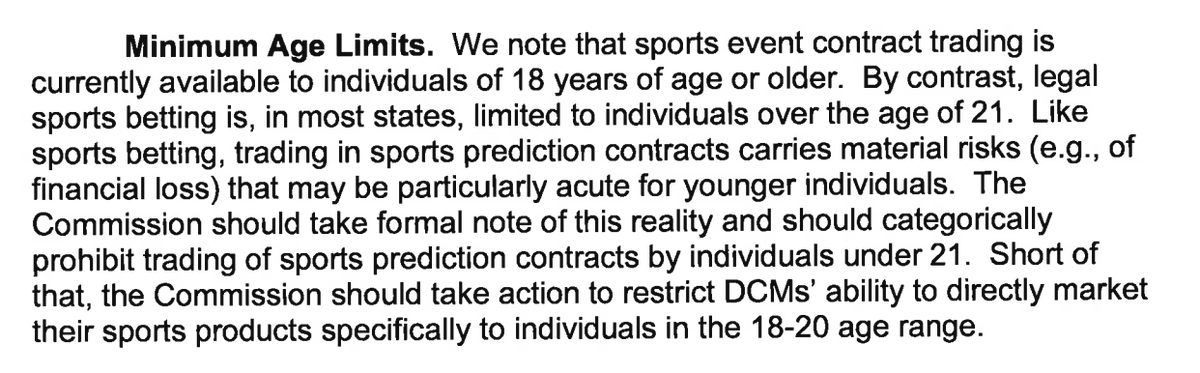
NBA asking for a ban on 18-20yo trading for sports event contracts
Isaac tweet media
English
11
25
107
46.1K